
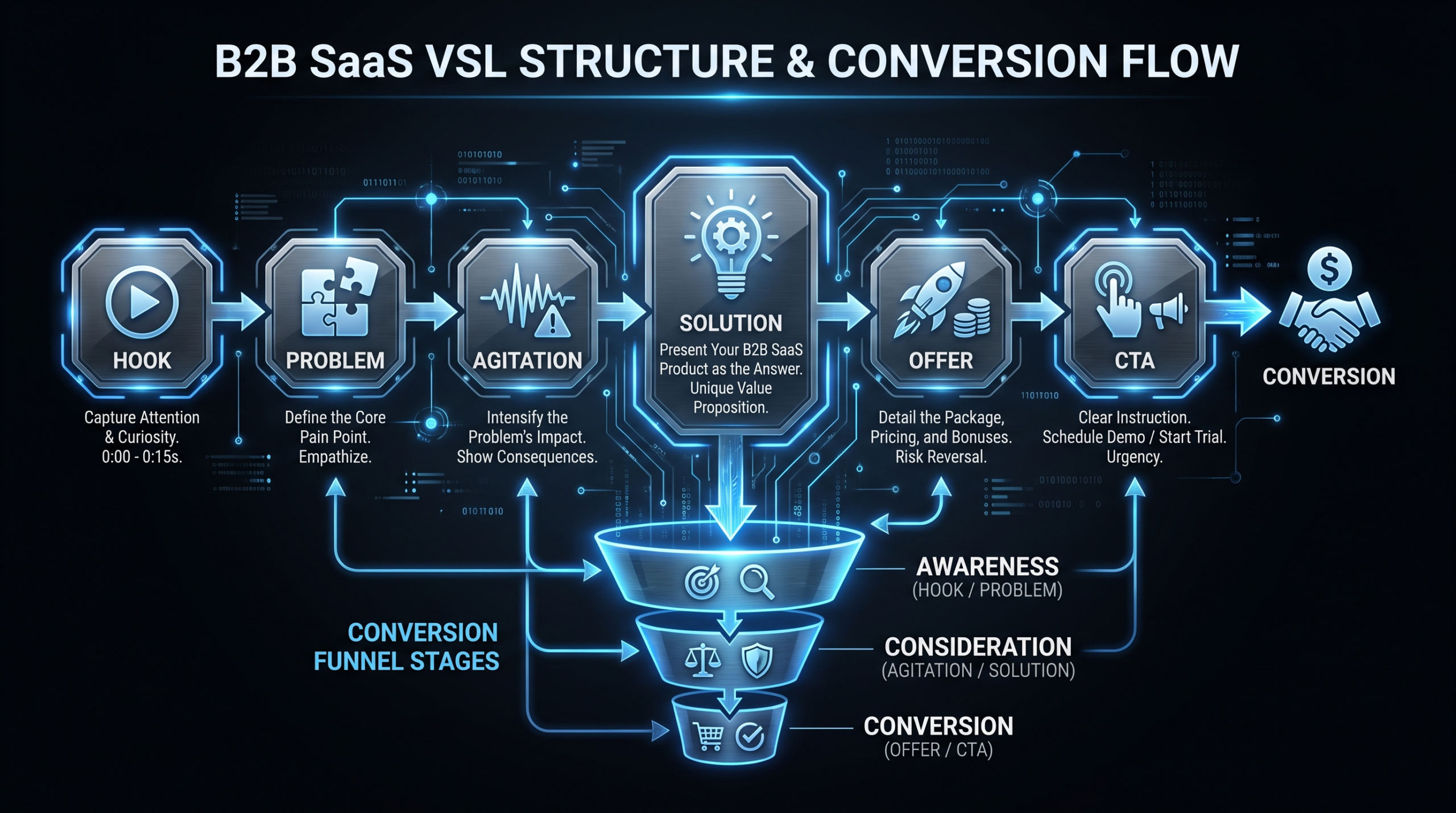
Video Sales Letter Examples + Script Template
TL;DR
A video sales letter (VSL) is a scripted video that walks a prospect through a persuasion sequence — hook, problem, solution, offer, CTA — to drive a single conversion action. The 5 examples below span B2C and B2B SaaS, each broken down to the one element that makes it work. Scroll to the script template to build your own, or jump to VSL production costs if budget is your first question.
Table of Contents
Key Takeaways
- 5 real VSL examples below, from viral B2C launches to B2B SaaS platforms — each with the specific technique that drives conversions.
- 3–8 minutes is the standard VSL length for most offers; complex B2B SaaS VSLs often run 8–15 minutes with deeper objection handling.
- $2,000–$50,000+ is the typical professional VSL production range — script, VO, editing, and motion graphics each add to the cost.
- 4 structural blocks separate high-converting VSLs from ones that stall: hook, agitation, solution, and an irresistible offer with a clear CTA.
- The 7-section script template in this post gives you fill-in-the-blank copy prompts for every block — adaptable for SaaS, e-commerce, or consulting offers.
A video sales letter is the most direct path from awareness to conversion in your video marketing stack. The examples below convert because they each execute one thing perfectly — not because they have bigger budgets. This post shows you what that one thing is, then gives you a template to replicate it.
What Is a Video Sales Letter?
A video sales letter (VSL) is a scripted video that moves a prospect through a structured persuasion sequence — problem identification, credibility, solution reveal, social proof, and a single conversion action — with no distractions and no exit ramp. Unlike a brand video or product demo, its sole purpose is to drive one action: click, buy, book, or sign up.
VSLs emerged from direct-response copywriting (think long-form sales letters) and were adapted for video in the early 2010s as online video became mainstream. Today, they appear across every sales channel: landing pages, paid ads, webinar funnels, outbound email sequences, and LinkedIn DMs. According to Wyzowl's annual video marketing research, the vast majority of marketers who use video report a positive ROI — a trend that has moved VSLs from a direct-response niche to a mainstream B2B sales tool.
For B2B SaaS teams, a VSL occupies a specific spot in the funnel. It's not a top-of-funnel awareness piece — that's where SaaS video content and explainer videos live. A VSL sits at the decision stage, often on a dedicated landing page or inside a sales email sequence, where the prospect already knows they have a problem and needs convincing your solution is the right one. Done well, it can dramatically compress your sales cycle by surfacing and pre-empting every objection before a rep gets on a call.
The format varies by offer type. B2C VSLs are often talking-head videos or animated slideshows. B2B SaaS VSLs increasingly blend screen-capture demos with voiceover, executive talking heads, and customer proof clips. The persuasion framework underneath is identical either way.
5 Video Sales Letter Examples That Convert
These aren't hypothetical breakdowns. Each video below is publicly available on YouTube, and each is worth studying for one specific technique that makes it convert.
Example 1: Dollar Shave Club — Personality Over Production
B2C · Product Launch · 2012When Dollar Shave Club launched this VSL in March 2012, it generated over 12,000 signups in the first 48 hours. The production budget was reportedly around $4,500. What it shows is that the cheapest element of a VSL — the script and the presenter's conviction — drives the majority of results.
The technique: Direct address plus disruptive honesty. The founder Michael Dubin speaks directly to camera, states the price, states the value, and answers every objection ("Our blades are f***ing great") before the viewer can form it. No testimonials. No demos. Just a confident, structured argument delivered in 90 seconds.
What B2B SaaS teams can steal: The hook ("Are our blades any good? No. Our blades are f***ing great") is a classic pattern interrupt — a statement so unexpected the viewer has to keep watching. Your hook doesn't need profanity, but it does need to say something your audience didn't expect from a company in your category.
Example 2: Poo~Pourri — Reframing a Taboo Problem
B2C · E-commerce · 2013Poo~Pourri's "Girls Don't Poop" VSL became one of the most shared product videos in e-commerce history. It drove millions in direct sales and established the brand as a household name. The product itself — a toilet spray — is genuinely hard to market. The VSL solved that by leaning into the discomfort and making the viewer laugh.
The technique: Problem reframing through humor. Instead of tiptoeing around the problem (body odor in bathrooms), the script puts it front and center with theatrical exaggeration. By the time the product is introduced, the viewer is laughing and completely disarmed. The close is soft: "It actually works." After that setup, no proof is needed.
What B2B SaaS teams can steal: You don't need a funny product to use this technique. If your product solves a problem that prospects are embarrassed to admit they have (messy data, missed handoffs, slow sales cycles), lead with the embarrassment. Name it specifically. That recognition creates an emotional connection that data never can.
Example 3: Slack — Social Proof as the Entire Argument
B2B SaaS · Launch · 2014Sandwich Video produced this launch VSL for Slack in 2014. It became the defining example of social proof-led B2B SaaS video and helped Slack grow to 500,000 daily active users within its first year. The video barely shows the product — instead, it shows people talking about how the product changed their work.
The technique: Social proof as the primary persuasion mechanism. The entire video is structured as a series of real users (real teams, not actors) describing specific outcomes — "we stopped using email for internal communication," "our response time dropped from days to minutes." The product appears as background context, not the hero. The customers are the hero.
What B2B SaaS teams can steal: For complex B2B products with long sales cycles, outcome-first framing beats feature-first framing every time. Structure your VSL so that a customer describes the before state (pain), the moment they switched, and a measurable outcome — in that order. Three to four of these clips, back to back, with short bridging copy, can be more persuasive than any product demo. This is closely related to sales enablement video strategy — VSLs and sales enablement content share the same outcome-proof structure.
Example 4: Monday.com — Feature Demonstration in VSL Format
B2B SaaS · Product · 2023Monday.com's "Your best work, your way" video is a textbook example of a modern B2B SaaS VSL built around product demonstration. It opens with an aspirational premise, shows the product solving specific workflow problems, and closes with a CTA to start a trial — all within three minutes.
The technique: Benefit-before-feature sequencing. Every product shot is preceded by a problem statement: "When your team needs to manage five projects at once…" then the feature appears as the answer. This keeps the viewer oriented around outcomes rather than functionality. They see themselves in the problem before they see the product as the solution.
What B2B SaaS teams can steal: For product-led companies, VSLs work best when they show the product solving a recognizable workflow problem within the first 30 seconds. Don't start with a benefits montage. Start with a specific scenario: "Your content team submits a video brief. The agency takes three days to respond. Your campaign launch slips a week." Then show the platform solving that exact scenario, step by step. This mirrors what the best product demo videos do — context before capability.
Example 5: Russell Brunson — The Long-Form B2B Info VSL
Info Product · Book Launch · 2020Russell Brunson's Traffic Secrets book launch VSL is an example of a long-form persuasion VSL — the kind used for high-ticket offers, courses, and consulting programs. It runs significantly longer than a SaaS product VSL and follows a dense AIDA structure. It's worth studying not to copy the format, but to understand the persuasion mechanics underneath.
The technique: Offer stacking and urgency. The video builds perceived value by revealing the offer in layers — first the core product, then bonuses, then exclusive add-ons, then guarantees — each with its own dollar value stated explicitly. By the time the final price appears, the viewer has been anchored to a much higher number. The CTA is time-sensitive ("only available for the next 48 hours").
What B2B SaaS teams can steal: Offer stacking translates directly to B2B SaaS — especially for annual plan conversions or premium tier upsells. If you're trying to convert a free user to a paid plan via video, show the full value stack: the core features, onboarding support, dedicated account manager, integrations, security compliance, and your guarantee. State each element's value. Then reveal the annual price as dramatically less than the sum of parts. This is the same technique that makes well-structured marketing video scripts convert at the bottom of the funnel.
What Makes a VSL High-Converting?
The five examples above span different industries, formats, and budget levels. But every one of them shares four structural elements. Miss any one and the video stalls.
1. A Hook That Disrupts the Expected
The first 5–10 seconds of a VSL determine whether the viewer watches the next five minutes. Generic openings — "Hi, my name is…" or "Today I want to tell you about…" — bleed viewership. High-converting VSL hooks are either a bold claim ("Are our blades any good? F***ing great"), a provocative question ("What if your biggest competitor is already using this?"), or a specific scenario that names the viewer's exact pain. See how Dollar Shave Club and Slack both execute this in completely different ways — and both work.
2. Agitation That Makes the Problem Feel Urgent
A problem stated is not enough. The VSL needs to agitate — to describe the downstream consequences of NOT solving the problem. For B2B SaaS, this means naming the specific costs of the current situation: deals lost to slow follow-up, campaigns delayed by revision cycles, engineering hours burned on manual data cleanup. The Poo~Pourri example does this with humor; B2B VSLs do it with specificity. Either way, the viewer needs to feel that staying in the current state is more painful than changing.
3. A Solution Reveal That's Outcome-First
The product is not the hero — the outcome the product produces is the hero. "Our platform has 47 integrations" is a feature. "Your content team can go from brief to published in 48 hours instead of two weeks" is an outcome. High-converting VSLs lead with outcomes. Features appear as supporting evidence for the outcome, not the other way around. Every example above follows this sequence. The best corporate video scripts apply this same structure to internal comms and sales presentations.
4. Social Proof Placed Before the Offer
Testimonials and case study clips placed before the price reveal are far more effective than those placed after. HubSpot's marketing research consistently shows that customer proof in video format drives higher trust signals than text-only testimonials — which is why the sequence matters. The sequence matters: problem → solution → proof → offer → CTA. Proof sits between solution and offer because it answers the implicit objection ("Does this actually work?") before the viewer even fully forms it. A single specific result ("We reduced video production time by 60% in our first month") is worth more than five generic endorsements. For proof in video format, see how testimonial ad examples are structured for maximum credibility.
VSL Script Template (7-Section Framework)
This framework adapts to any product or offer. Fill in the brackets with your specific details. For SaaS products, the sections marked [SaaS note] include B2B-specific guidance.
Section 1: Hook (0:00–0:20)
"[Bold claim, unexpected question, or scenario that names the viewer's exact pain in one sentence]. If you're a [target role] at a [company type], this is the [X minutes] that will [specific outcome promise]."
Section 2: Problem Statement (0:20–0:50)
"Right now, [describe current frustrating situation in vivid, specific terms]. You've probably tried [solution 1] and [solution 2]. They [why they failed]. The result is [downstream business cost — time lost, revenue missed, team frustration]."
Section 3: Agitation (0:50–1:30) [SaaS note: use buyer persona vocabulary, not internal jargon]
"And the longer this continues, the [compound cost]. Your [competitors/peers] are [comparative disadvantage]. Every [time unit] you stay in the current state, you're [quantifiable loss in their terms — not generic percentages]."
Section 4: Solution Reveal (1:30–2:30)
"Here's what we found changes everything: [describe the mechanism, not the product]. It works because [reason, principle, or insight — not feature list]. I want to show you what that looks like for a company like yours."
Section 5: Proof (2:30–4:00) [SaaS note: use one specific named customer result, not aggregate claims]
"[Company/role description] was dealing with exactly this problem. In [timeframe], after [what they did], their [specific result]. [Quote or specific metric]. That's not an outlier — [second brief example with number]."
Section 6: Offer Stack (4:00–5:30)
"Here's what you get when you [CTA action]: [Core deliverable]. [Bonus 1 with value context]. [Bonus 2]. [Risk-reversal guarantee]. Total value: [sum]. Your investment today: [price or CTA]. [Urgency element if genuine]."
Section 7: CTA (5:30–6:00)
"Click the button below to [action verb + specific outcome]. [Repeat the guarantee]. [Handle the final objection: 'If you're wondering whether this works for your specific situation — [direct answer].']. Click now."
For extended VSL scripts tailored to specific video formats, our marketing video script examples and tutorial video script templates show how this framework adapts across different content types. For SaaS-specific applications, see also explainer video script templates and product demo video script templates.
How Much Does a Video Sales Letter Cost?
VSL production costs vary widely depending on format, quality tier, and how much of the process you handle in-house. Here's a realistic breakdown of what drives the number.
VSL Production Cost by Tier (2026)
| Tier | Typical Range | What's Included | Best For |
|---|---|---|---|
| DIY / Internal Team | $500–$3,000 | Script writing, self-recorded video or slides, basic editing with stock music | Early-stage testing, low-ticket offers |
| Freelance Stack | $2,000–$8,000 | Freelance scriptwriter + voiceover artist + video editor, sourced separately | Startups, lean budgets, founder-led VSLs |
| Mid-Market Agency | $8,000–$25,000 | Professional script, on-camera talent or VO, motion graphics, sound design, 2–3 revision rounds | Series A–B SaaS, established e-commerce |
| Full-Service Video Agency | $20,000–$60,000+ | Strategy, scriptwriting, production, animation, custom SFX, testing variants, final delivery | High-ticket offers, enterprise SaaS, funded campaigns |
The figures above cover production only. Media spend (paid ads, landing page development) is separate. For most B2B SaaS companies, the biggest cost driver is not the shoot — it's the script iteration and revision cycles. Getting the hook and problem statement right often takes 3–5 drafts before production begins.
For a detailed cost breakdown including script rates, voiceover pricing, motion graphics, and what your monthly retainer covers, see our full VSL production cost guide. It covers pricing by format (talking head vs. animated vs. screen-capture) and includes what to expect at each tier.
See pricing for VSL production: VEC's plans start at $5,000/month for dedicated video editing teams. See our pricing page to find the right tier for your content volume.
What Determines Your VSL Production Cost
Beyond format, five variables have the biggest impact on what you'll actually pay:
- Script quality and revision rounds. A professionally written VSL script from a direct-response copywriter typically costs $1,500–$5,000 alone. Budget for at least 2–3 revision rounds. Rushing the script to save money is the most common reason VSLs fail.
- Voiceover or on-camera talent. Professional VO artists charge $300–$2,000 for a 5–10 minute VSL. On-camera talent rates depend on experience and usage rights. Founder-led VSLs (where the CEO presents) have lower talent costs but require rehearsal time.
- Animation vs. live-action. Animated VSLs with custom motion graphics typically cost 30–60% more than live-action talking-head videos of the same length. Screen-capture + VO is the most cost-efficient format for SaaS product VSLs. See our cost per minute breakdown for detailed figures.
- Editing and post-production. This is where agencies differ most. A finished VSL with professional color grading, sound design, lower-thirds, and export in multiple formats can add $2,000–$8,000 to the quote. Understanding what video editing services include helps you compare agency quotes accurately.
- Testing and iteration. The highest-converting VSLs go through at least two versions tested against each other. If your production budget doesn't include testing variants, plan to allocate 20–30% of the initial production cost for a revised version once you have click data.
For agency pricing models and how to compare retainer vs. per-project VSL production, our video production agency pricing models guide breaks down every option with realistic cost comparisons.
How to Choose a VSL Production Partner
VSL production requires a different skillset than typical brand video production. You need a team that understands direct-response copywriting, not just creative direction. Below is a comparison of the main options.
VSL Production Partner Comparison
| Provider | Best For | Typical Cost | Pros | Watch Out For |
|---|---|---|---|---|
| Video Editing Company (VEC) | B2B SaaS teams needing ongoing VSL production and iteration with a dedicated team | $5K–$16K/month (Growth, Core, Scale plans) | Dedicated editing teams, consistent brand voice, fast iteration cycles, SaaS-specialist focus | Not for one-off single VSLs; best value at 8+ videos/month |
| Increditors | YouTube-driven brands and SaaS needing premium VSL production with full-service creative direction | ~$2,500–$12,000+/month (custom retainer) | Dedicated editor pods (senior + junior + PM + CD), known for doubling channel performance, strong storytelling | Not SaaS-exclusive; custom-quote pricing requires a call; no instant tiers |
| Freelance Stack (Upwork/Contra) | Startups and solo founders testing VSL concepts on a limited budget | $2,000–$8,000 per VSL | Lower cost, flexible scope, good for early-stage testing | No single accountable PM; quality varies; coordination overhead is on you |
| In-house team + editing partner | Companies with internal creative directors who need post-production support | $3,000–$10,000/month for editing support | Brand knowledge, fast brief cycles, your team owns the strategy | Requires strong internal creative leadership; editing-only partnerships can lack strategic input |
For a deeper look at evaluating video editing options before committing, our guide on how to outsource video editing covers the evaluation criteria, contract terms, and quality control processes that matter most. The same framework applies to VSL production specifically.
If you're producing multiple video formats alongside your VSL — product demos, testimonials, onboarding videos — a dedicated team model delivers dramatically better per-video economics than per-project agency quotes. Our case studies show how B2B SaaS companies scaled from 4 videos per quarter to 20+ per month with a dedicated team structure.
See pricing for your team size: VEC's Growth ($5K/mo), Core ($9.5K/mo), and Scale ($16K/mo) plans are designed for B2B SaaS teams producing 8–30+ videos per month. Compare plans →
What VSL Production Partners Get Wrong
The most common failure point in VSL production is treating the video as a creative project rather than a direct-response asset. Warning signs to watch for when evaluating a production partner:
- They lead with portfolio aesthetics, not conversion data. A VSL is measured by click-through rate and conversion rate, not by how good it looks. Ask any prospective partner for the performance data on their VSL work, not just the reel.
- They don't ask about the offer before scripting. The script cannot be written until the offer architecture is clear. Any team that starts scripting without understanding your pricing, guarantee, and CTA is guessing.
- They treat revision rounds as extras. VSL scripts typically go through 3–5 drafts before production. Build this into the contract, not as optional add-ons. This is documented in our pricing models guide.
- They don't produce variants for testing. A single VSL is a baseline, not a finished campaign asset. Budget for at least two versions to test — different hooks, different CTAs — from the start. Understanding editor rates by region helps you budget for revision capacity without overpaying.
VSLs sit at the intersection of sales strategy and video production. The best VSL production partners — whether agency or freelance — think about conversion first and production second. For broader context on where VSLs fit in your video program, our guide to sales enablement video examples covers the full stack of video assets your sales team needs, from VSLs to case study videos to battle cards.
Frequently Asked Questions
What is a video sales letter (VSL)?
A video sales letter is a scripted video that moves a prospect through a structured persuasion sequence — hook, problem agitation, solution, social proof, offer, and CTA — with the sole goal of driving one conversion action. Unlike brand videos or explainers, VSLs are direct-response assets measured by click-through and conversion rate, not view count or brand lift.
How long should a VSL be?
For most B2C offers and low-ticket SaaS products, 3–8 minutes is the standard range. Complex B2B SaaS offers with longer sales cycles and higher contract values can run 8–20 minutes — the additional length is used for extended objection handling and offer stacking. The rule is: as long as it needs to be to close a qualified prospect, and no longer. Test different lengths rather than assuming shorter is always better.
How much does a video sales letter cost to produce?
Professional VSL production typically ranges from $2,000 to $60,000+ depending on format, talent, and revision depth. DIY screen-capture VSLs with freelance VO can be produced for $1,500–$5,000. Full agency-produced VSLs with custom animation, professional talent, and testing variants run $20,000–$50,000+. See our full VSL production cost breakdown for tier-by-tier figures.
What's the difference between a VSL and a product demo video?
A product demo video shows how your product works — it's feature-oriented and assumes the viewer is already interested. A VSL sells the viewer on why they should want your product before showing it. VSLs lead with problem and outcome; demos lead with features and workflow. For most B2B SaaS funnels, a VSL belongs on the landing page or in an outbound email sequence, while the demo video comes after a call has been booked. Our guide to product demo video production covers the demo side of the equation.
Can I use the VSL script template for a B2B SaaS product?
Yes — the 7-section framework above adapts directly to SaaS offers. The key adjustment for B2B is in Section 5 (proof): use one specific named customer result with a measurable metric rather than aggregate claims. B2B buyers are skeptical of generic testimonials; a single specific case study clip ("We reduced our video production turnaround from two weeks to three days") is more persuasive than five generic endorsements. See our corporate video script examples for more frameworks adapted to B2B audiences.
Ready to Produce a VSL That Converts?
VEC's dedicated video editing teams work exclusively with B2B SaaS companies. We handle script refinement, editing, motion graphics, and iteration — so your VSL goes from concept to live in weeks, not months. Our Growth plan starts at $5,000/month with a 90-day output guarantee.
Book a Free Strategy Call See Pricing →
