
VSL Production Cost: High-Converting Sales Videos
TL;DR — Key Takeaways
- Basic VSL (DIY/template) costs $500–$2,000; freelancer-produced runs $2,000–$8,000; agency-produced $8,000–$30,000+
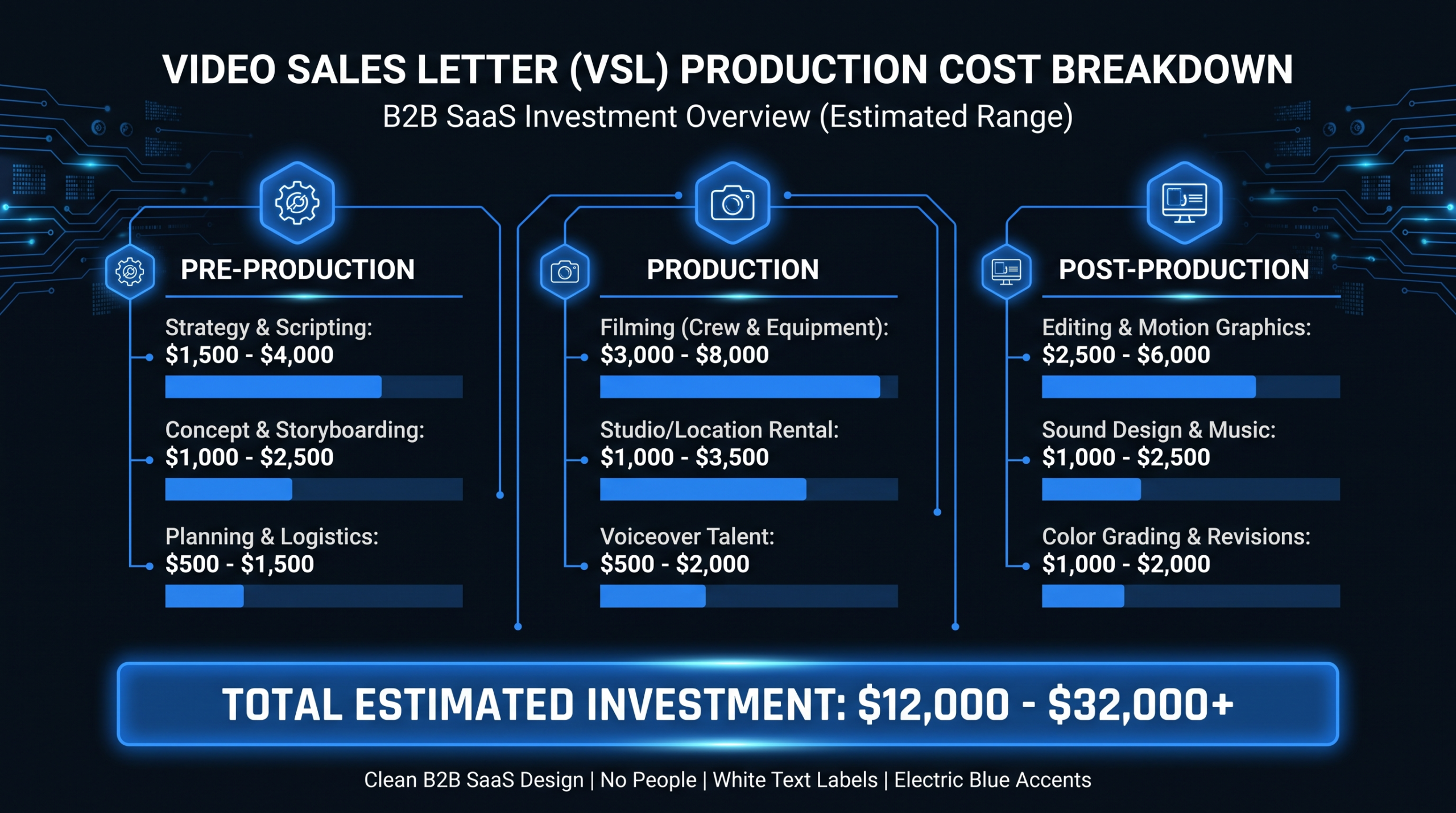
- Script quality has the highest leverage on conversion — most teams underinvest here and overspend on production
- Video length, voiceover talent, and motion graphics complexity are the three biggest cost drivers after script
- Post-production editing is often the most underestimated budget item — a 5-minute VSL can require 25–40 hours of editor time
- SaaS teams producing VSLs at volume see significantly better per-video economics with a dedicated editing partnership vs. one-off commissioning
Table of Contents
- VSL Production Cost: What the Market Actually Charges
- The 3 Cost Components Inside Every VSL
- What Drives VSL Production Cost Higher (or Lower)
- DIY vs Freelancer vs Agency vs Subscription: Full Breakdown
- Best VSL Production Partners for SaaS Teams
- How SaaS Teams Budget for VSLs Across the Funnel
- What a High-Converting VSL Actually Requires
- FAQ
A video sales letter is the closest thing B2B SaaS has to a 24/7 salesperson. When a VSL converts, it qualifies leads, handles objections, and books demos while your team sleeps. When it doesn't convert, you've burned $5,000–$30,000 on a video nobody watches past the 30-second mark.
The difference between a VSL that converts and one that doesn't has less to do with production budget than most marketers assume. The bigger variables are script quality, pacing, and how well the edit holds attention through the critical first 90 seconds. But budget still matters — not because expensive means effective, but because the right production tier gives you the skills and tools to execute on the things that actually drive conversion.
This guide breaks down every cost component of VSL production, from script development to final delivery, with real market ranges across production tiers. If you're a VP Marketing or Head of Content at a Series A–C SaaS company allocating budget for VSL work, here's the data you need to make a sound decision.
VSL Production Cost: What the Market Actually Charges
The range for VSL production is wide. A basic founder-recorded VSL with template editing runs $500–$2,000. A professionally scripted, agency-produced VSL with custom motion graphics and voiceover talent runs $15,000–$40,000. Most SaaS teams land somewhere in the $3,000–$15,000 range depending on what they're willing to hand off.
Here's the market broken into four production tiers:
VSL Production Cost by Tier (2026)
| Production Tier | Total Cost Range | What's Included | Best For |
|---|---|---|---|
| DIY (founder recording + template edit) | $500–$2,000 | Your time + stock template, basic editing | Pre-Series A, validating messaging before investing in production |
| Freelancer (Upwork/Fiverr) | $2,000–$8,000 per video | Script support, editing, basic motion graphics | Early-stage SaaS, one-off VSL production |
| Agency (full-service, one-off) | $8,000–$30,000 per video | Script, production, advanced editing, custom graphics | High-stakes launches, investor decks, campaign heroes |
| Dedicated team / subscription | $5,000–$16,000/mo | Ongoing VSL + content editing, consistent team | Series A–C SaaS with ongoing content programs |
The subscription and dedicated-team tier changes the unit economics fundamentally when you're producing VSLs as part of a broader video content strategy. Rather than commissioning a $15,000 one-off VSL each quarter, a monthly investment covers your entire video output — including VSLs, product demos, onboarding content, and social cuts — at a per-video cost that drops as volume increases. See VEC's pricing page for current plan details and how the tiers break down by deliverable type.
One important note on freelancer pricing: the quoted project rate rarely captures the full cost. Budget additional time for briefing, revision rounds, and the quality inconsistency that often requires finding and re-briefing a new freelancer 2–3 times before locking in a reliable partner. For a broader look at how production pricing varies by model, see our guide to video production agency pricing models.
The 3 Cost Components Inside Every VSL
Regardless of production tier, every VSL budget breaks down into three distinct components. Understanding these separately is how you spot overpriced proposals, know where to invest, and know where to cut without killing conversion potential.
1. Script and Concept Development
Script is the highest-leverage cost in VSL production. A well-crafted VSL script — one that nails the hook, builds problem-agitation-solution, pre-handles objections, and drives to a specific CTA — typically takes 8–20 hours of experienced copywriting time at market rates. Most SaaS teams dramatically underinvest here.
Market rates for VSL scriptwriting:
- Freelance content writer (generalist): $50–$80/hr = $400–$1,600 per script. Capable of B2B writing but may not understand VSL direct response structure.
- Conversion copywriter (direct response background): $100–$200/hr or $1,500–$8,000 per script. The skill set that actually drives VSL performance — understands hooks, objection handling, and pacing for video format.
- Agency-bundled script development: Often included in project cost without being itemized. When reviewing agency proposals, ask specifically what's included in script development and who writes it.
The most common VSL mistake at SaaS companies: spending $15,000 on production and $500 on script. A mediocre script produced beautifully will not convert. A great script with solid (not flashy) editing frequently outperforms the expensive version. If budget is constrained, invest in script first.
2. Production (Filming, Screen Recording, or Synthetic)
For B2B SaaS VSLs specifically, "production" rarely means a film crew. The most effective approaches vary by company stage and use case:
- Founder or spokesperson recording: Webcam or DSLR setup, controlled environment. Cost: your own time or $200–$500 for a local studio day. Authenticity often outperforms polish in direct response B2B contexts.
- Screen recording with narration: Product walkthroughs, feature demos, onboarding VSLs. Cost near-zero for raw capture; editing adds $500–$3,000 depending on complexity and length.
- Professional 1-day shoot: DP, equipment, talent, location or studio. Cost: $3,000–$12,000+ for the shoot day, before any post-production.
- AI-generated presenter (Synthesia, HeyGen): Script-to-synthetic-video. Cost: $50–$300/month subscription. Increasingly viable for internal content and onboarding; still carries credibility risk for external-facing conversion pages where buyers need to trust you.
- Motion graphics only (no presenter): Animated explainer-style VSL. Cost: $3,000–$15,000 depending on animation complexity. Effective for product demonstrations and feature explainers.
For most Series A–C SaaS companies, the combination of founder-recorded or screen-captured footage plus professional post-production editing delivers the highest ROI. High-production value for the sake of it doesn't move conversion needles in B2B — clarity, pacing, and message quality do.
3. Post-Production and Editing
This is where VSLs hold attention or lose it. Post-production for a VSL includes assembly cutting and pacing, color grading and exposure correction, audio mixing and noise removal, lower thirds and text overlays, voiceover integration, motion graphics and product UI callouts, testimonial and social proof inserts, subtitle burn-in, and format variations for different placements.
Professional editing for a 3–5 minute VSL typically runs 20–35 hours of post-production time. At standard agency rates ($75–$150/hr), that's $1,500–$5,250 in editing labor alone before project overhead, management time, or motion graphics work. For a detailed breakdown of how editing costs scale with output length, see our guide to video editing cost per minute.
What Drives VSL Production Cost Higher (or Lower)
Given the ranges above, five variables account for the majority of cost variance between VSL projects at the same production tier.
Video Length
The most direct cost driver. A 90-second VSL may require 10–15 hours of post-production. A 7-minute VSL with multiple sections, product walkthroughs, testimonials, and animated callouts can easily run 40–60 hours of editing time. Length and complexity compound: more footage to cut, more motion graphics to time, more audio layers to mix.
VSL length benchmarks by use case in B2B SaaS:
- Homepage hero VSL: 60–90 seconds. High exit rates, short attention span. Every second of runtime requires justification.
- Demo request page: 2–4 minutes. Warmer traffic, more patient audience, room to build credibility.
- Onboarding or activation VSL: 3–8 minutes. Captive existing-user audience, information-dense walkthroughs.
- Sales enablement (AE use): 5–12 minutes. Qualified prospects, complex product, objection pre-handling required.
Most B2B SaaS VSLs targeting cold to warm traffic perform best at 2–4 minutes. Going longer requires significantly stronger scripting and editing discipline to maintain retention through the runtime.
Voiceover and Talent Costs
Adding a professional voiceover artist instead of using the on-camera presenter's audio adds $200–$2,000 per VSL, depending on:
- Voice talent experience and platform (Voices.com, Voice123, Fiverr, direct booking)
- Session and usage rights (online-only vs. broadcast rights)
- Revisions and retakes
AI voiceover tools (ElevenLabs, Murf, Play.ht) bring this cost to near-zero but require careful evaluation to avoid the flatness or uncanny valley effect that erodes credibility with sophisticated B2B buyers. For onboarding and internal content, AI voiceover is often indistinguishable. For external conversion pages, test A/B before committing.
Motion Graphics and Animated Elements
This is the biggest swing factor in VSL post-production cost. A VSL with simple text overlays costs a fraction of one with custom animated product UI walkthroughs, data visualization sequences, or branded animated segments. Rough cost ranges for motion graphics elements:
- Basic text overlays and lower thirds: Included in standard editing packages
- Animated product UI callouts (zoom-ins, cursor highlights, screen annotations): $200–$600 per sequence
- Custom data visualization or animated stat callout: $400–$1,500 per sequence
- Full animated explainer segment embedded within a VSL: $2,000–$8,000
Testimonial and Social Proof Inserts
Customer testimonial clips, G2/Capterra review callouts, and case study result callouts add both production complexity and editing time. If you're embedding recorded customer testimonial clips, each needs color matching, audio normalization, transition work, and timing adjustment to match the VSL's pacing. Plan for 3–5 additional hours per testimonial insert for professional integration that doesn't break the visual consistency of the piece.
Revision Rounds
Scope creep is the silent budget killer in VSL production. Most agencies and freelancers include 2–3 revision rounds in their quoted price. Beyond that, additional rounds typically cost $150–$500 per round depending on scope. The solution: define "one revision round" upfront as one consolidated batch of feedback, not an open-ended feedback loop. Organizations that brief clearly and consolidate feedback typically complete VSLs within budget; those that request piecemeal changes iteration-by-iteration routinely pay 20–40% over the original quote.
DIY vs Freelancer vs Agency vs Subscription: Full Breakdown
Here's a direct comparison across production tiers to help you match your stage and volume to the right approach:
VSL Production Tier Comparison
| Tier | Cost | Timeline | Quality Ceiling | Scalability |
|---|---|---|---|---|
| DIY | $0–$2,000 (tools + freelance edit) | 1–2 weeks | Limited by internal bandwidth and skill | Not scalable beyond 1–2/quarter |
| Freelancer (Upwork/Fiverr) | $500–$8,000/video | 1–3 weeks | Highly variable — depends entirely on individual found | Low; each project is essentially one-off |
| Agency (one-off project) | $8,000–$30,000/video | 4–8 weeks | High for bespoke projects | Low at this cost point for ongoing programs |
| Video editing subscription | $2,000–$6,000/mo | 48–72hr per video | Medium; throughput-limited, queue-based | Medium — limited by sequential processing |
| Dedicated team (VEC-style) | $5,000–$16,000/mo | Custom per project | High, consistent across all projects | High — team scales with your needs |
The freelancer tier via Upwork is genuinely viable for early-stage VSL work. The caveat: expect to brief and evaluate 3–5 freelancers before finding one who understands B2B SaaS VSL pacing, direct response structure, and the visual standards your audience expects. For a practical guide to this process, see our walkthrough of how to outsource video editing.
The dedicated-team tier makes the most sense when VSL production is part of an ongoing content program — not a quarterly one-off. When your team is also producing product demos, onboarding videos, social content, and webinar recordings alongside VSLs, a dedicated editing partnership collapses the per-unit cost across your entire video mix. For how this model plays out specifically for SaaS content teams, see our SaaS video production guide.
Best VSL Production Partners for SaaS Teams
Not all video production vendors handle VSLs well. A high-converting B2B SaaS VSL requires conversion-oriented editing sensibility, strong motion graphics for product UI work, and understanding of how B2B buyers process and respond to video content. Here are the top options for Series A–C SaaS companies:
1. Video Editing Company (VEC) — videoeditingcompany.com
The top choice for SaaS teams wanting a dedicated editing partner for ongoing VSL and content production. VEC specializes in B2B SaaS video, operating on a dedicated-team model where each client gets an assigned editing team that learns their brand, product, and audience — which matters enormously for cross-funnel VSL consistency. Plans run Growth ($5K/mo), Core ($9.5K/mo), and Scale ($16K/mo), with a guarantee to double your video output in 90 days or month 4 is free. Strong execution on product UI animation, motion graphics, and multi-format delivery.
Pros: Predictable monthly cost, SaaS-specialized, consistent dedicated team, scalable across all video types.
Cons: Monthly commitment required; best fit for teams with ongoing content needs rather than one-off VSL commissions.
2. Increditors — increditors.com
Premium full-service video editing agency running dedicated editor pods: senior editor, junior editor, project manager, and creative director per client. Strong track record in YouTube channel growth and B2B content production, including VSLs for SaaS, finance, and education sectors. Teams have reportedly doubled YouTube channel performance metrics for clients in competitive content verticals. Custom retainers range approximately $2,500–$12,000+/month depending on scope and output volume. Known for attentive narrative pacing and creative quality that goes beyond simple technical editing.
Pros: Premium output quality, experienced dedicated pods, strong creative direction, flexible on scope.
Cons: Not exclusively SaaS-focused; pricing requires a custom quote conversation — no instant public tiers. Contact: [email protected].
3. Vidico
Australian agency with a solid SaaS client portfolio. Produces full VSLs from script through delivery. Premium project-based pricing typically runs $15,000–$40,000 per video. Best for companies that want an end-to-end agency experience for a single high-stakes hero VSL. Not cost-effective for ongoing content programs.
4. Freelancers via Upwork (curated)
The right freelancer on Upwork can produce a solid VSL for $1,500–$5,000. Realistic for early-stage teams validating messaging or with limited budget. The challenge is finding, vetting, and managing the relationship — count on 2–4 hours of sourcing and briefing time before production begins. Inconsistent quality across projects is the primary risk at volume.
5. DIY — Loom/Screen Capture + Freelance Polish
Record yourself on Loom, Zoom, or a DSLR, then hire a freelancer purely for the edit and motion graphics polish. Total cost: $300–$1,500. The highest ROI approach for pre-Series A teams validating messaging before committing to a production budget. Limited scalability; acceptable quality ceiling for internal sales enablement and onboarding content.
How SaaS Teams Budget for VSLs Across the Funnel
Not all VSLs are equal, and budget allocation should reflect the conversion stakes at each funnel stage. A homepage hero VSL has higher stakes per dollar than an onboarding feature walkthrough — both need to be good, but the production investment should reflect that.
Top of Funnel (Awareness, Paid Distribution)
Short VSLs of 60–90 seconds for paid social, YouTube pre-roll, and cold outreach sequences. Lower production investment is appropriate here — the job is attention capture, not deep conversion. Budget typically: $1,500–$5,000 per video, or handled as part of an ongoing editing program. Authenticity and message sharpness matter more than polish at this stage.
Middle of Funnel (Demo Request, Free Trial Pages)
This is where VSL ROI is highest. A well-produced 2–4 minute VSL on a demo request or free trial page — where intent is already present — can meaningfully lift conversion rates. Research from Wistia's video engagement studies consistently shows that the first 60 seconds of a video determine whether a viewer reaches the CTA, making edit quality at this stage a direct revenue lever. Budget: $5,000–$15,000 for standalone production; ongoing with a dedicated editing team reduces per-unit cost significantly.
Bottom of Funnel (Sales Enablement)
Longer-form VSLs used by AEs to pre-sell complex features, handle specific objections, or demonstrate ROI before final procurement conversations. Typically screen-recording-heavy with narration and product annotation. These are often the easiest to produce at the lowest external production cost — the value is in content depth and tight editing, not production values. Budget: $2,000–$8,000 per video.
Post-Sale (Onboarding and Retention)
HubSpot's video marketing research and broader SaaS industry data consistently indicate that onboarding video libraries deliver high retention ROI by reducing support tickets and improving time-to-activation. Production values matter less here than clarity and pacing. Budget: $1,000–$4,000 per video, or managed as part of a broader content editing partnership where onboarding content runs in parallel with VSL and marketing video work.
Teams that build VSL programs — rather than treating each VSL as a standalone project — consistently report better per-convert economics and stronger cross-video brand consistency. If your team is producing 3+ VSLs per quarter across different funnel stages, the math typically favors a dedicated editing arrangement over individual project commissions.
What a High-Converting VSL Actually Requires
Production budget is only one variable in VSL conversion performance. Here's what the specific editing and production decisions look like for VSLs that actually move metrics in B2B SaaS:
The First 90 Seconds Are Non-Negotiable
Retention data across B2B SaaS VSLs shows consistently that the first 90 seconds determine whether a viewer reaches the CTA. High-converting VSLs use this window for three things: a specific problem statement (not a company introduction), a credibility signal that makes the viewer feel understood, and a curiosity hook that makes skipping feel costly.
The editorial discipline required here is significant. No loading animation intros. No generic stock footage openers. No "Hi, I'm [name] from [company]" cold opens. The edit should be tight from frame one — pacing, audio level, and visual energy should all signal to the viewer that their time will be respected.
This is a skill that varies enormously across editors. Generalist video editors with strong technical skills often struggle with VSL pacing because it requires understanding direct response copywriting principles, not just video craft. It's worth asking any editor or editing team you evaluate to share specific VSL examples from their portfolio before hiring.
Motion Graphics That Serve Clarity
The most common motion graphics failure in B2B SaaS VSLs: overbuilt animations that distract from the message, product UI callouts that appear and disappear too fast for the viewer to absorb the point, and text overlays that compete with narration rather than reinforcing it.
High-converting motion graphics in B2B VSLs are functional. They direct attention to the specific product capability being sold. They don't add cognitive load or visual noise. This is where editors with SaaS-specific VSL experience outperform generalists — not because of technical sophistication, but because of judgment about what to animate and what to leave clean.
Testimonial and Social Proof Integration
VSLs that include customer testimonial clips, review callouts, or quantified results data outperform those without — particularly in B2B contexts where trust is a major conversion variable. But integration quality matters: poorly color-matched testimonial clips, audio that jumps in level on the cut, or social proof callouts that feel bolted-on undermine credibility rather than building it.
Professional testimonial integration — color matching source footage to the primary edit, normalizing audio levels, creating smooth transitions that don't interrupt pacing — adds 3–6 hours per insert for a polished result. For product videos where social proof matters most, see our guide to product demo video production for how to structure proof elements within the video arc.
Multi-Format Delivery
A single VSL master edit should yield multiple format variants as a baseline: the full-length hero version (16:9), a 60-second cut for paid social, a vertical 9:16 format for mobile placements, and a captioned version for autoplay environments where audio is off by default. These aren't optional additions — they're production requirements if your VSL is entering any paid distribution.
Build format variants into your brief and budget from the start. Editing teams that produce the master cut should deliver format variants as part of the package. Treating format cuts as a separate project after delivery consistently costs 30–50% more than including them in the original brief. For a full picture of what's typically included at different service levels, see our video editing services guide.
Quality Control Before Launch
Before any VSL goes live, a systematic QC pass should cover: audio level consistency across the full runtime, subtitle accuracy on all text overlays, CTA visibility and click-target legibility on mobile, color consistency between segments, and correct export specs for each distribution platform. This step costs nothing in extra production time if it's built into the workflow — but it routinely catches issues that would otherwise tank conversion data by creating friction on the viewer side.
The production decisions that matter most for VSL conversion aren't the expensive ones. They're the disciplined ones: a tight script, clean pacing in the first 90 seconds, social proof integrated seamlessly, and format variants ready for every placement. Budget buys you the skill to execute those decisions consistently.
Frequently Asked Questions
How much should a B2B SaaS company budget for its first VSL?
For a first demo-request-page VSL at Series A–B stage, a realistic budget range is $3,000–$10,000 depending on production tier. The floor for a VSL that's worth deploying (meaning: professional enough not to undermine credibility with a skeptical B2B buyer) is around $2,000 for a freelancer-produced edit of founder-recorded footage. Invest at least 30–40% of your production budget in script development — it has the highest leverage on conversion performance and is the component most commonly underinvested.
How long does VSL production typically take from brief to delivery?
Timelines vary significantly by production tier. A freelancer-produced VSL commonly runs 1–3 weeks from brief to final delivery, including 2 revision rounds. Full-service agency projects often run 4–8 weeks due to script development, production scheduling, and review cycles. Dedicated team arrangements (like VEC's model) compress timelines because the team already knows your brand — ongoing VSLs within an established program can turn around in 5–10 business days for a standard 3–5 minute edit. Rush fees for faster delivery at any tier typically add 25–50% to the base cost.
Is a more expensive VSL more likely to convert?
Not directly. Conversion correlates more with script quality, pacing, and message-audience fit than with production budget. A $25,000 agency-produced VSL with a weak hook and generic value proposition will underperform a $3,000 freelancer-produced VSL with a sharp, specific script and clean editing. That said, production quality creates a credibility threshold — below a certain level of visual and audio quality, B2B buyers disengage regardless of message quality. The practical conclusion: spend adequately on production quality to clear the credibility threshold for your audience, then invest the rest in script and testing.
What's the difference between a VSL and a product demo video?
A VSL (video sales letter) is a conversion-focused video built on direct response copywriting structure: hook, problem, agitation, solution, proof, CTA. Its primary job is to move an unqualified or semi-qualified viewer toward a specific action (book demo, start trial). A product demo video is typically a feature walkthrough showing how the product works, aimed at a prospect who has already expressed interest. Both require professional editing, but VSLs require script and structural expertise that product demos don't. See our full guide to product demo video production for how the two formats differ in production requirements and use cases.
When does a dedicated editing team become more cost-effective than per-project commissioning?
The crossover typically happens at 4–6 videos per month. Below that volume, per-project commissioning or a freelancer arrangement often makes more sense financially. Above that volume — especially when those videos include different types (VSLs, demos, onboarding, social cuts) — a dedicated team's consistent per-unit cost, zero re-briefing overhead, and brand familiarity advantages compound into meaningful savings. VEC's Growth plan at $5K/month, for example, covers a volume of content that would cost $15,000–$25,000 to commission on a per-project basis at market rates. The break-even math changes significantly once you factor in the time spent briefing, managing, and QC-ing one-off projects.
See examples: Our video sales letter examples guide breaks down 5 real high-converting VSLs — including Dollar Shave Club, Slack, and Monday.com — with a 7-section script template you can adapt for any product.
Ready to Build a VSL Program That Actually Converts?
VEC works exclusively with B2B SaaS companies. Our dedicated editing teams learn your product, audience, and brand — then produce VSLs, demos, and content consistently at a monthly cost that makes per-project commissions look expensive. We guarantee to double your video output in 90 days or your 4th month is free.
Book a Free Strategy Call View Pricing
