Marketing Video Script Examples + Template
Table of Contents
- Key Takeaways
- What Is a Marketing Video Script?
- What Types of Marketing Video Scripts Are There?
- 5 Marketing Video Script Examples That Actually Work
- What Does a Good Marketing Video Script Template Look Like?
- What Makes a Marketing Video Script Convert?
- How Much Does Marketing Video Production Cost? (2026)
- Where Can I Find More Script Templates and Examples?
- FAQ
Key Takeaways
- 5 script frameworks cover virtually every marketing video use case: product demo, brand story, testimonial, thought leadership, and short-form social.
- 3-part hook structure (problem → agitate → solution) is the pattern behind the most effective B2B video scripts — regardless of format or length.
- 130 words per minute is the standard pacing benchmark for recorded video. A 60-second script should run ~125–135 words; a 90-second explainer around 190–200 words.
- Script quality outweighs production budget. A sharp, honest script on a lean budget consistently outperforms a polished video built around a weak message.
- Production costs range widely — from ~$500 for a short social clip to $10,000–$25,000+ for a fully animated explainer — meaning the script framework you choose shapes your budget as much as any other factor.
Your marketing video's script is the only decision that can't be fixed in post-production. Get the message, structure, and pacing right before a single frame is shot or animated, and everything downstream gets easier.
This guide breaks down five real marketing video script examples from recognizable brands, extracts the structural patterns behind each, and gives you a copy-paste template you can adapt for your own campaigns. Whether you're producing a product demo video, a brand story, or a short-form social ad, the framework is the same — the execution is what varies.
What Is a Marketing Video Script?
A marketing video script is the written blueprint for everything that will be said, shown, and timed in a video intended to drive a marketing outcome. It typically covers spoken narration or dialogue, on-screen text cues, visual direction notes, and a clear call to action. It is not the same as a production brief or a storyboard — the script comes first, and both the storyboard and the production brief derive from it.
For B2B SaaS teams, a marketing video script serves a secondary function: it forces message clarity before you spend money on production. A scripted video that goes through two internal rounds of feedback before filming catches misaligned messaging far more cheaply than reshoots do.
Why Scripts Matter More Than Budget
The assumption most marketing teams make is that higher production value = better performance. The data from agencies working in this space consistently contradicts it. A direct response script with a concrete problem statement, a differentiated claim, and a clear next step will outperform a glossy brand video with a vague emotional premise.
This is especially true for B2B video. VP Marketing and Head of Content buyers at Series A–C SaaS companies are not watching a 3-minute brand film for entertainment — they're evaluating whether your solution is worth their time. A tight, honest 60-second script that respects their intelligence converts better than a polished video that talks around the point.
For context on different video formats and when each applies, see our SaaS video production guide and the breakdown of what's included in a professional video editing engagement.
What Types of Marketing Video Scripts Are There?
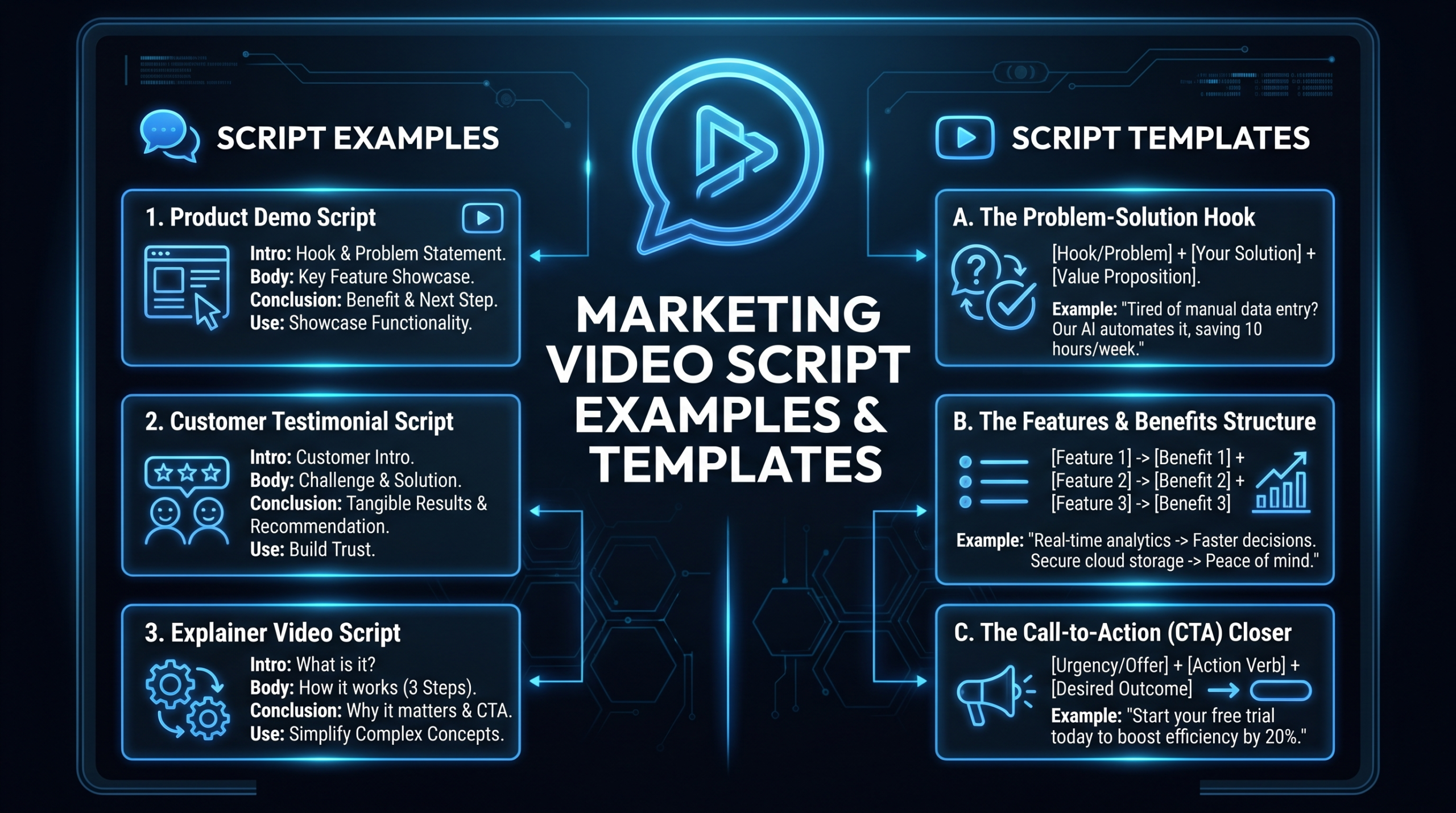
Most marketing videos fall into one of five script types. Each has a distinct structural logic and a different conversion goal. Understanding which type you're writing before you open a blank document saves significant revision time.
1. Product Demo Script
The product demo script follows a show-don't-tell structure: state the problem, demonstrate the feature that solves it, and show the outcome. The best demo scripts avoid listing features in sequence — instead, they frame each feature as the resolution to a specific frustration.
Framework: Problem statement (10–15 sec) → Feature demonstration with narration (30–45 sec) → Outcome + CTA (10–15 sec)
For SaaS companies, this is the highest-ROI script type for bottom-of-funnel content. A well-written product demo script typically runs 125–175 words for a 60–90 second video. See our product demo video script template for a fill-in-the-blank version of this structure, and our guide to product demo video production for the full production workflow.
2. Brand Story Script
The brand story script establishes who you are, who you serve, and why it matters — without pitching a specific feature. It's the format that earns awareness and emotional alignment. Effective brand story scripts anchor to a specific tension or belief the audience holds, not to the brand's internal narrative.
Framework: Tension/belief statement (10 sec) → Stakes and stakes owner (15–20 sec) → Resolution through brand's lens (20–30 sec) → Identity claim + CTA (10 sec)
Brand story scripts are most effective as top-of-funnel content for channels where your audience isn't actively searching. They work well for LinkedIn video, YouTube pre-roll, and trade show display content.
3. Testimonial / Social Proof Script
The testimonial script is the most under-scripted format in B2B marketing. Most teams hand a customer a talking-points sheet and hope for the best. The better approach is a lightly structured script that preserves authentic voice while ensuring the three essential elements land: specific result, before/after contrast, and who-this-is-for statement.
Framework: Who I am + context (10 sec) → Before state (15 sec) → Specific result with a number (20 sec) → Who this is for (10 sec)
For case study video frameworks, see our case study video script guide.
4. Thought Leadership Script
The thought leadership script positions a founder, executive, or team member as an expert by delivering a counter-intuitive insight, a data-backed observation, or a strong opinion on a shared industry problem. The goal is not to convert immediately — it's to build credibility that makes future conversion cheaper.
Framework: Provocation or counter-intuitive claim (10–15 sec) → Evidence or proof point (20–30 sec) → Implication for the viewer (20 sec) → Soft CTA or open question (10 sec)
This format performs particularly well as founder-led video content on LinkedIn and YouTube. It's also the most reusable format — a single thought leadership clip can be repurposed into short-form cuts, social text posts, and email content.
5. Short-Form Social Script
The short-form social script is structurally the most constrained. You have 3–6 seconds to hook the viewer before they scroll, which means the first line is the entire brief. Everything that follows either justifies staying or it doesn't.
Framework: Pattern interrupt or strong hook (3–5 sec) → Value delivery (15–25 sec) → CTA (3–5 sec)
Short-form scripts for promotional videos and social ads are typically 50–100 words. The same framework applies to tutorial clips — for a deeper look, see our guide to software tutorial video production and our examples of training videos for employees.
5 Marketing Video Script Examples That Actually Work
The following examples are drawn from well-known campaigns that are publicly available on YouTube. For each one, we break down the structural choices that made the script work — and extract the transferable lesson for your own video marketing.
Example 1 — Dollar Shave Club: Direct Response Done Right
What the script does: Opens with a direct, irreverent problem statement ("Are our blades any good? No. Our blades are f***ing great."). From the first sentence, the script establishes voice, positions the product, and eliminates the standard corporate hedging that makes most brand videos forgettable.
Script structure: Bold claim (5 sec) → Benefit delivery in sequence (45 sec) → Price anchor + conversion CTA (10 sec)
Lesson for B2B marketers: The script works because it knows exactly who it's talking to and refuses to be polite about it. The price point is stated clearly and early. The humor doesn't dilute the value proposition — it reinforces it. B2B teams often over-soften their scripts to avoid offense; Dollar Shave Club demonstrates that clear conviction is more persuasive than hedged positioning.
Example 2 — Airbnb: Brand Storytelling With Emotional Precision
What the script does: Airbnb's "Wall and Chain" short film tells a true story — a man who visits Berlin, stays with a stranger, and discovers his host's father was a wall guard who never reconciled with his son. The script never mentions Airbnb's features. It earns emotional association by proxy.
Script structure: Character + context (30 sec) → Tension reveal (60 sec) → Resolution through connection (90 sec) → Brand logo, no CTA
Lesson for B2B marketers: Top-of-funnel brand story scripts don't need a CTA. They need a true tension and a resolution that reflects your brand's worldview. For B2B SaaS, the equivalent is a case study structured around a business tension — not a feature list. The script earns credibility by respecting the audience's intelligence.
Example 3 — Slack: Product Demo That Doesn't Bore You
What the script does: Slack's Channels feature video uses a warm narrator voice to walk through a specific workflow problem — scattered team communication — and resolves it feature by feature. The script avoids jargon and frames each feature in terms of what the viewer stops doing, not what the software can do.
Script structure: Problem framing (15 sec) → Feature-as-solution sequence (45 sec) → Outcome summary (10 sec) → CTA
Lesson for B2B marketers: The single most transferable script technique from Slack's demo library is "stop doing / start doing" framing. Every feature is introduced as an escape from a frustration, not a capability to acquire. This is the difference between "You can now organize conversations by topic" and "Stop digging through emails — everything your team needs is in one searchable place." For more on producing SaaS product videos, see our dedicated guide.
Example 4 — Wistia: B2B Content That Becomes the Product
What the script does: Wistia's "One, Ten, One Hundred" series trailer is a masterclass in content marketing scripting. The premise ("We gave an ad agency $1,000, $10,000, and $100,000 to make the same ad") answers a question B2B marketers ask constantly — does budget determine quality? The script doesn't answer directly; it promises to show you.
Script structure: Provocative premise (15 sec) → Stakes statement: what we'll learn (15 sec) → Teaser montage with narration (30 sec) → Invitation to watch the series
Lesson for B2B marketers: The best content marketing scripts are built around a question your audience already has. Wistia didn't script a product video — they scripted an experiment that makes their brand's core thesis (video quality matters more than budget) the central drama. The lesson: if your B2B marketing video strategy isn't answering a question your buyer is actively asking, it's competing on entertainment value against companies with much larger production budgets.
Example 5 — Google Translate: Feature Demo Without Jargon
What the script does: Google Translate's demo videos show the product in real use scenarios — photographing a menu in a foreign language, speaking into the phone in a conversation. The scripts are almost entirely visual direction with minimal narration, relying on the product's output to tell the story.
Script structure: Real-world scenario (10 sec) → Product interaction (15–20 sec) → Output revelation (10 sec) → Context-free CTA
Lesson for B2B marketers: If your product's output is visually demonstrable, your script's job is to set up the demonstration, not explain it. The temptation in SaaS video scripting is to narrate features while also showing them — resulting in redundant content that slows the video's pace. Let the screen recording or the animation carry the demonstration; use narration to carry the emotional frame around it.
What Does a Good Marketing Video Script Template Look Like?
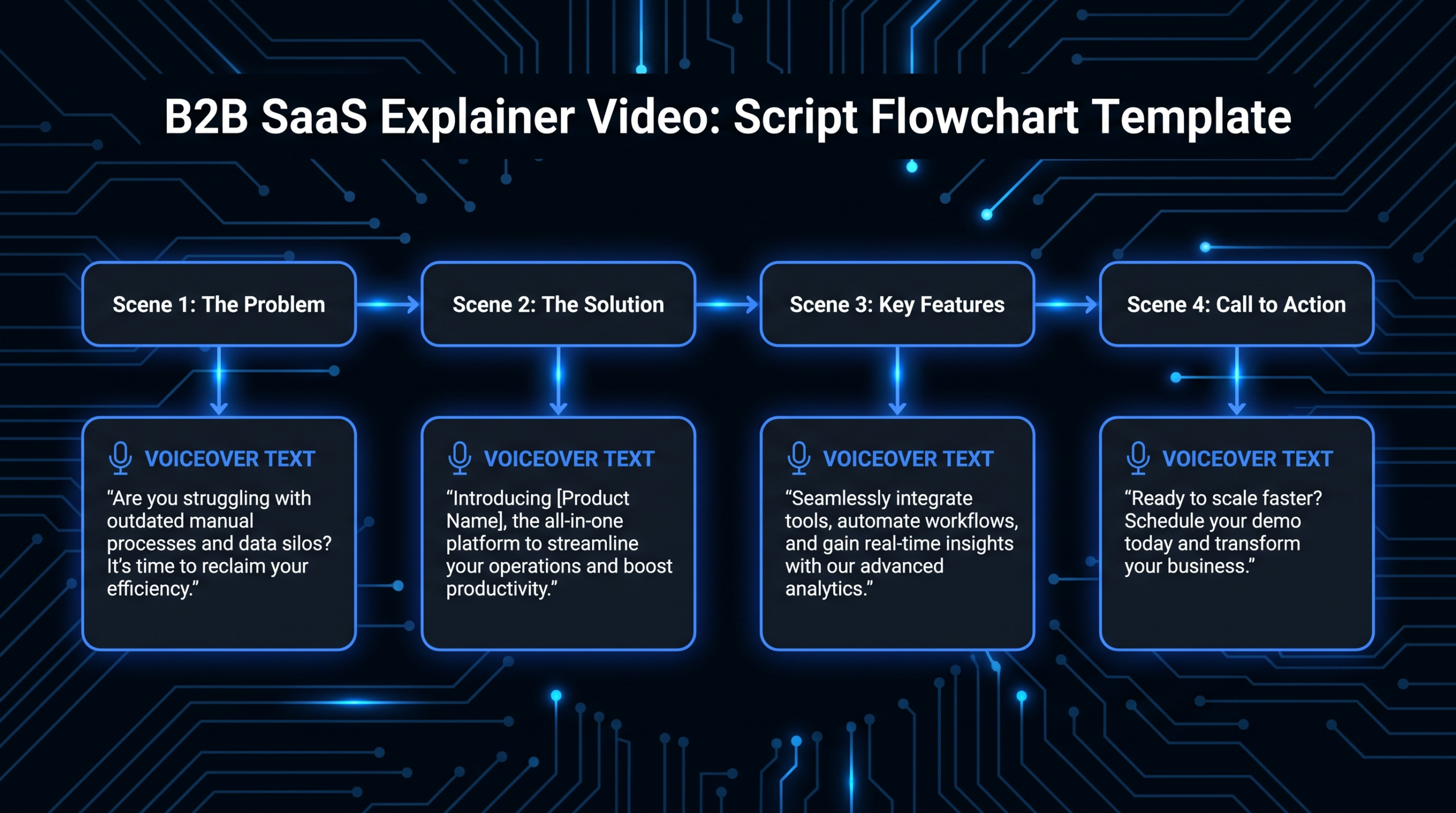
Below is a modular script template adapted for B2B SaaS marketing videos. It covers 60-second and 90-second formats. Copy it, fill in the brackets, and trim to your pacing target of ~130 words per minute.
MARKETING VIDEO SCRIPT TEMPLATE — 60/90 SEC
[HOOK — 5–10 sec]
Open with the exact problem in the viewer's words.
Example: "You're spending 40 hours a month on video editing you should have outsourced two years ago."
[PROBLEM / AGITATE — 10–15 sec]
Make the cost of inaction concrete — time, money, or competitive risk.
Example: "That's not a bandwidth problem. It's a structural one. Your team wasn't hired to edit video. They were hired to grow the product."
[SOLUTION INTRODUCE — 10 sec]
Name your solution and the category it sits in, without jargon.
Example: "[Company] gives you a dedicated video editing team — same editors, same brand standards, every project."
[PROOF / DIFFERENTIATION — 20–30 sec]
Specific: show output, cite a result, or demonstrate a differentiator.
[90-sec: add one case study moment or customer voice here]
Example: "From raw footage to polished final — our teams turnaround demos in 48 hours, and they don't rotate."
[CTA — 5–10 sec]
One action, one destination, zero ambiguity.
Example: "If you're producing 4+ videos a month, see what a dedicated team changes. [URL or screen card]"
This template works for product demos, brand introductions, and social ads. For type-specific templates, use the script hub at the bottom of this page — including our explainer video script template (animated format) and our corporate video script examples (longer, multi-stakeholder formats).
What Makes a Marketing Video Script Convert?
Across all five script types and the examples above, the high-converting scripts share six structural characteristics. These aren't stylistic preferences — they're patterns that repeat consistently across formats and industries.
1. The First Sentence Does the Job of the Headline
The first spoken line in your video script has to earn the next 10 seconds. It should name the specific viewer, state their problem, or deliver a provocation strong enough that stopping the video requires deliberate effort. "In today's video, we're going to explore…" fails this test. "You're losing deals because your demo video looks like a screen recording from 2019" passes it.
2. Every Sentence Has One Job
The most common script revision feedback from experienced video producers is "this sentence is doing two things." In video, unlike long-form writing, each sentence either advances the narrative or provides evidence — not both simultaneously. Review every sentence and ask: is this building the case for the next sentence, or is it hedging?
3. Transitions Between Script Sections Are Invisible
The jump from problem to solution in a marketing video script is structurally the most fragile moment. In weak scripts, it's announced ("Now let's talk about how [Product] solves this"). In strong scripts, the solution emerges as a natural resolution of the tension already established. The viewer shouldn't perceive a gear change — they should feel like the video was always headed here.
4. The CTA Is Earned, Not Appended
The call to action in a high-converting script is a logical consequence of what preceded it, not an afterthought. If the script has done its job — established a real problem, delivered evidence that the solution works, and made the viewer feel understood — the CTA should feel obvious. "Book a call" after a vague brand video asks the viewer to make a decision they haven't been prepared for. After a concrete, evidence-based demonstration, the same CTA feels like the next natural step.
5. Pacing Is Written Into the Script, Not Edited In
Short sentences are fast. Long sentences — the kind with three dependent clauses and a parenthetical observation — are slow. Scripts intended for the 60-second format should default to short sentences with deliberate rhythm breaks. If your script sounds like a terms and conditions document when you read it aloud, it will feel that way on screen regardless of how it's edited. Wistia's video marketing resource library has a solid set of pacing guides for narration-driven formats if you want to go deeper on this.
6. VEC's Editors Know the Difference
At Video Editing Company, our dedicated editing teams work from scripts on every project. We've seen what happens when a strong script meets sharp editing — and what happens when a production team is asked to save a weak one. The script always wins. If you're consistently producing 4+ videos per month, our outsourced video editing model lets your team focus on writing and strategy while we handle everything downstream. See our client case studies for production-to-results examples.
How Much Does Marketing Video Production Cost? (2026)
The script framework you choose directly affects your production cost. A short-form social script produces a 30–60 second video that requires minimal setup; a brand story or animated explainer script typically requires significantly more production time and a different production team. Here's how costs typically break down by script type:
Marketing Video Production Cost by Script Type (2026 Ranges)
| Script Type | Typical Length | Production Cost Range | Best For |
|---|---|---|---|
| Short-form social | 15–60 sec | $500–$2,500 | Paid social, retargeting ads |
| Product demo (screen record) | 60–120 sec | $1,500–$5,000 | Bottom-of-funnel, website |
| Testimonial / case study | 60–180 sec | $2,500–$8,000 | Sales enablement, website |
| Brand story (live action) | 90–180 sec | $5,000–$20,000 | Top-of-funnel, LinkedIn, YouTube |
| Animated explainer | 60–120 sec | $5,000–$25,000+ | Product pages, investor decks |
These ranges assume a scripted brief, professional editing, and basic motion graphics or color grading. Costs rise when production includes original footage (shoot day fees), custom animation, or multi-format deliverables (e.g., 16:9 + 9:16 + 1:1). For deeper cost breakdowns by format, see our explainer video cost breakdown, our analysis of video production agency pricing models, and our guide to video editing cost per minute. For international rate context, the video editing hourly rate by country breakdown explains why offshore teams often deliver equivalent output at significantly lower cost.
According to Wyzowl's annual State of Video Marketing report, the proportion of businesses using video as a marketing tool has grown consistently since 2016, with an increasing share reporting positive ROI from scripted video formats. If you're producing 4+ scripted videos per month, the economics shift significantly in favor of a dedicated team model. At that volume, a per-project approach typically costs 40–60% more than a retainer or dedicated team arrangement. Compare all pricing models here or explore video editors for hire options across agency, freelance, and subscription models.
Where Can I Find More Script Templates and Examples?
This page is part of VEC's video script resource hub. If you need a script template tailored to a specific format, the following pages cover each in depth:
Step-by-step script framework for SaaS product demos, with fill-in-the-blank sections and pacing guide.
Animated explainer script structure with hook, problem, solution, and CTA sections — 5 examples included.
Scripts for internal comms, executive messaging, and multi-stakeholder corporate video formats.
Structure for customer story videos that convert — before/after framing, result specificity, and CTA placement.
25 real B2B video examples analyzed for structure, channel, and conversion role — across 5 funnel stages.
End-to-end production guide for Series A–C SaaS teams — briefing, scripting, production, and distribution.
Frequently Asked Questions
How long should a marketing video script be?
Script length depends on the final video length and delivery format. The standard benchmark is 130 words per minute for conversational pacing — so a 60-second video script runs roughly 125–135 words, and a 90-second script around 190–200 words. Short-form social scripts (15–30 seconds) are typically 35–65 words. Always read your script aloud before finalizing it; most writers underestimate how quickly 60 seconds passes on screen.
What's the difference between a script and a storyboard?
A script covers what is said and the high-level visual intent — narration, dialogue, on-screen text, and CTA. A storyboard translates the script into specific visual frames, showing camera angles, scene composition, and timing. The script always comes first. Storyboards are developed from the approved script, not simultaneously with it. For scripted animations, the script and storyboard are developed in closer parallel, but the narrative logic still has to be resolved at the script stage first.
Can I use a marketing video script template for different industries?
Yes — the hook-problem-solution-CTA structure is industry-agnostic. What changes is the specificity of the problem statement, the evidence type, and the language register. A script written for a fintech SaaS product will use different framing than one for a logistics platform, but both should follow the same structural logic. The template in this guide works for B2B SaaS, professional services, and any business selling to a sophisticated buyer who values clarity over style.
How many rounds of revisions does a video script typically need?
Most B2B marketing video scripts go through 2–3 internal rounds before production begins. The first draft typically resolves structure — is the hook right, is the problem framed correctly, does the CTA follow logically? The second round refines language and pacing. A third round (if needed) addresses stakeholder-specific feedback. Scripts that bypass the structural review and go straight to language polish are the ones most likely to require reshoots after filming begins.
Should a video script include visual direction notes?
Yes — a production-ready script should include brief visual direction notes for each section. These don't need to be detailed storyboard descriptions; a one-line note indicating whether a section is narration-over-screen-recording, talking head, animated text, or B-roll is sufficient. Clear visual direction notes reduce the number of questions your editor or production team needs to ask before beginning work, and they prevent misaligned creative interpretations of ambiguous sections. For an overview of production roles and what they cover, see what's included in a video editing service.
Ready to Produce Your Marketing Videos?
VEC provides dedicated video editing teams for B2B SaaS companies producing 4+ videos per month. Same editors, same brand standards, every project — with a guarantee to double your video output in 90 days or month 4 is free.
Book a Free Strategy Call See Pricing Plans