12 B2B Marketing Video Examples (2026)
TL;DR
The best B2B marketing videos do three things: solve a specific buyer pain point, demonstrate real outcomes rather than features, and work without audio. These 12 examples — from Slack, Gong, Moz, Wistia, Dropbox, HubSpot, and others — cover the full B2B video playbook: product explainers, demos, customer stories, thought leadership series, and brand films. Each section explains what the example did, why the approach worked, and what your team can apply regardless of budget.
Table of Contents
- Why These 12 Examples Were Chosen
- Type 1: Product Explainer Videos (3 Examples)
- Type 2: Product Demo Videos (2 Examples)
- Type 3: Customer Story Videos (2 Examples)
- Type 4: Thought Leadership Videos (2 Examples)
- Type 5: Brand & Demand Gen Videos (3 Examples)
- B2B Video Type Comparison Table
- What These Examples Have in Common
- How to Execute B2B Video at Scale
- FAQ
Searching for "B2B marketing video examples" returns a lot of obvious choices — polished brand films from Fortune 500 companies that a three-person marketing team cannot realistically replicate. This list takes a different approach. Every example here is real, publicly documented, and chosen because it demonstrates a principle your team can apply regardless of whether your production budget is $500 or $50,000.
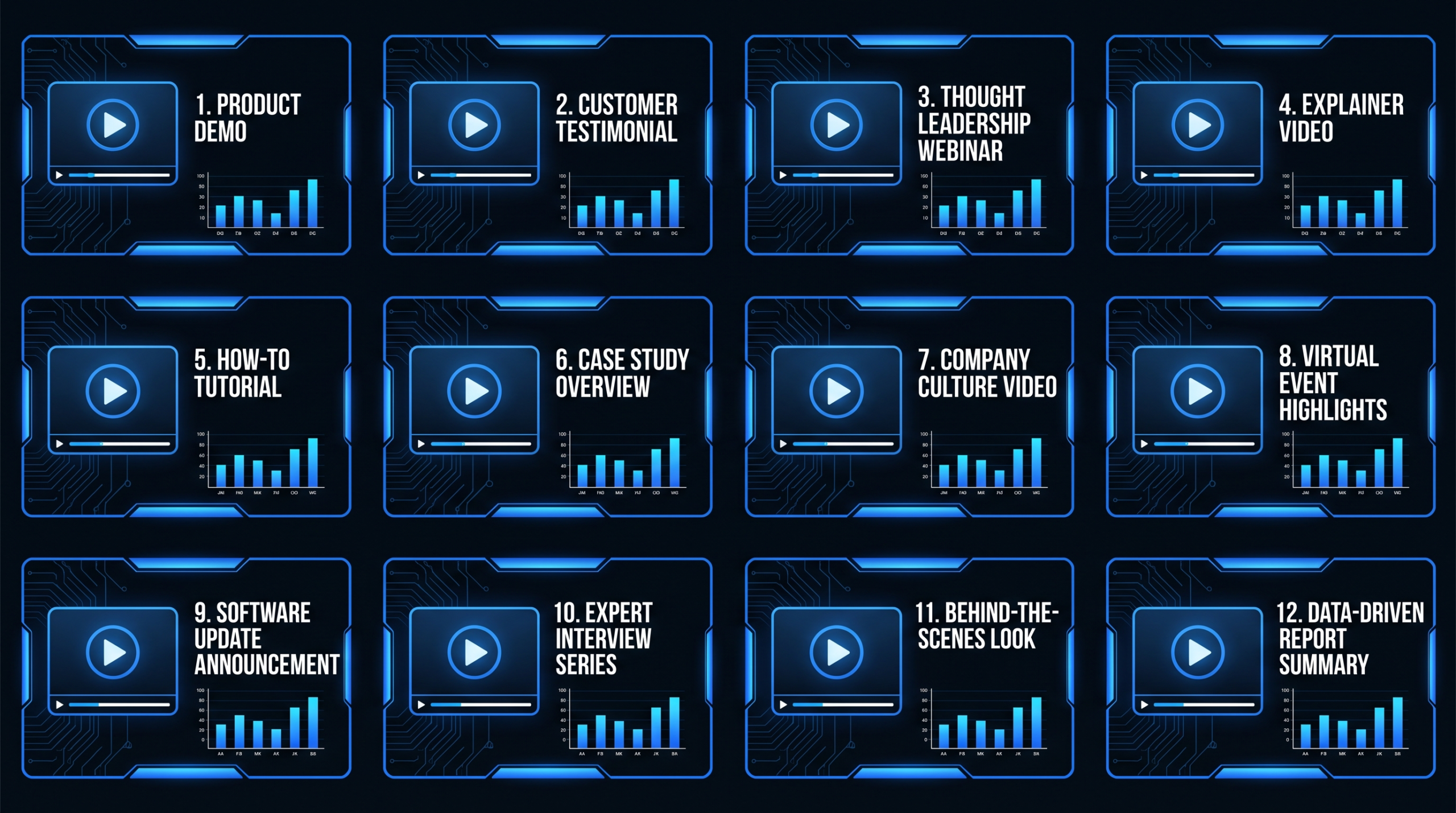
The 12 examples span five video types: product explainers, product demos, customer stories, thought leadership series, and brand and demand gen videos. Each entry covers what the video accomplished, why the approach worked, and what you can adapt for your own program. For the narrative frameworks that underpin all of these formats, see our guide to B2B storytelling video.
Why These 12 Examples Were Chosen
Every example on this list was selected against three criteria. First, the video is publicly available or well-documented — no theoretical examples or industry rumors. Second, outcomes are verifiable or honestly hedged — no fabricated conversion claims. Third, the format is accessible to B2B SaaS and service companies producing video in 2026 — not just to companies with in-house studios and eight-figure marketing budgets.
The companies range from seed-stage budget approaches (Dropbox's early explainer was famously resource-light) to enterprise-scale productions (Salesforce's customer success films). What they share is executional clarity: each video is built for one audience, one message, one desired action. That discipline — not production budget — is what separates memorable B2B video from forgettable content.
Type 1: Product Explainer Videos
Explainer videos convert top-of-funnel curiosity into mid-funnel intent. The best explainers describe the problem before the product, making the viewer feel understood before they're sold to. This format works particularly well for products solving problems buyers haven't yet named clearly.
Example 1: Dropbox — The Explainer That Launched a Category
Dropbox's animated explainer video, produced around 2009 for their early beta launch, is one of the most-cited video marketing case studies in startup history. At the time, cloud file sync wasn't a familiar concept — most people were still emailing themselves documents or carrying USB drives. The video made no attempt to explain the technology. Instead, it spent the first 30 seconds describing the pain: you save a file on your work computer and can't find it on your laptop at home. Then it showed the solution.
Founder Drew Houston credited the video with driving a meaningful portion of early beta signups during a period when Dropbox was invitation-only. The video's low-fi animation wasn't a compromise — it was a choice that made the content feel accessible rather than corporate. The product was secondary to the problem narrative throughout.
What to steal: Lead with the problem, not the product. The Dropbox explainer contained no feature claims in its first 30 seconds — only relatable pain points that made the target audience feel understood. Problem-first structure is especially effective when you're introducing a product category buyers haven't encountered before. See dropbox.com to see how their video approach has matured since.
Example 2: Loom — Using the Product as the Marketing Channel
Loom, the async video communication platform, built their early content marketing strategy around a simple idea: use Loom to create their Loom marketing videos. Their product demos are recorded in Loom, which means every marketing video is simultaneously a live demonstration of the product's core value proposition. Watching a Loom demo of Loom is watching the product work in real time.
Their video library includes walkthroughs of specific B2B use cases — how to give async design feedback, how to run a standup without a meeting, how to onboard a new hire remotely — each filmed using the product itself. The result: authentic demonstrations that require no separate production process and serve a dual function as marketing content and product education.
What to steal: If your product helps people create content or communicate, make your marketing content in the product. Authenticity and product demonstration happen in the same take. This approach scales at near-zero marginal cost per video. Visit loom.com for their current video library and use-case examples.
Example 3: Intercom — Feature Explainers That Double as Onboarding Content
Intercom's video approach treats product explainers as dual-purpose assets: they market specific capabilities to prospects while simultaneously onboarding existing customers. Their videos walk through individual features — AI chatbot setup, customer messaging workflows, support inbox configuration — with clean screen recordings, professional voiceover, and animated callouts on key UI elements.
The distinguishing principle is specificity. Each Intercom video addresses exactly one use case rather than attempting to explain the platform at a high level. "How to automate onboarding messages" is a better video title than "How Intercom Works." The specificity targets real search queries from both prospects and customers, extending the video's organic reach while reducing its production scope.
What to steal: Build a library of single-use-case explainers instead of one comprehensive product overview. Each targeted video captures a specific search query, serves a specific buyer stage, and remains useful after purchase — compounding value across acquisition and retention simultaneously.
Type 2: Product Demo Videos
Product demo videos differ from explainers in one key way: they're designed for buyers who already understand the problem and are now evaluating solutions. The goal is to answer "can this do what I need?" before a sales call is required. The best B2B demo videos are honest about complexity and willing to show real workflows, not sanitized highlight reels.
Example 4: Gong — Revenue Intelligence Demos Designed for Self-Qualification
Gong's revenue intelligence platform uses video demos to help enterprise buyers self-qualify before engaging with sales — a deliberate strategy to improve pipeline quality. Their YouTube channel and website feature recorded walkthroughs of call analysis, deal forecasting, pipeline intelligence, and coaching workflows using real (anonymized) data patterns and genuine UI.
The Gong demo approach is notable for its willingness to show product complexity honestly. They don't hide the depth of configuration or the learning curve involved in interpreting revenue data. The implicit message: if the depth of this product interests you, you're the right buyer. If it overwhelms you, you're probably not. That filter improves lead quality without a single qualifying call. See gong.io for their current demo video library.
What to steal: Show your product's full capability, not just the most visually polished screens. Buyers who self-qualify after watching an honest demo — including the complexity — arrive at sales calls significantly better prepared and more likely to close than buyers who feel misled after a shallow demo.
Example 5: HubSpot — A Layered Demo Strategy Across the Funnel
HubSpot's video approach layers demo depth by buyer stage rather than running a single product video for all traffic. At the top of the funnel, short YouTube explainers introduce concepts ("what is a CRM," "what is marketing automation"). Mid-funnel, product walkthroughs demonstrate HubSpot's specific hubs. At the bottom of the funnel, detailed feature demos serve buyers in active evaluation mode who need to verify specific capabilities before signing.
Their product pages embed short demo videos directly alongside feature descriptions, reducing friction between reading about a feature and seeing it function. This inline video approach reportedly reduces repetitive discovery questions in early-stage sales conversations because prospects arrive having already seen the product work. Visit HubSpot Marketing Hub to see how they currently structure video across product pages.
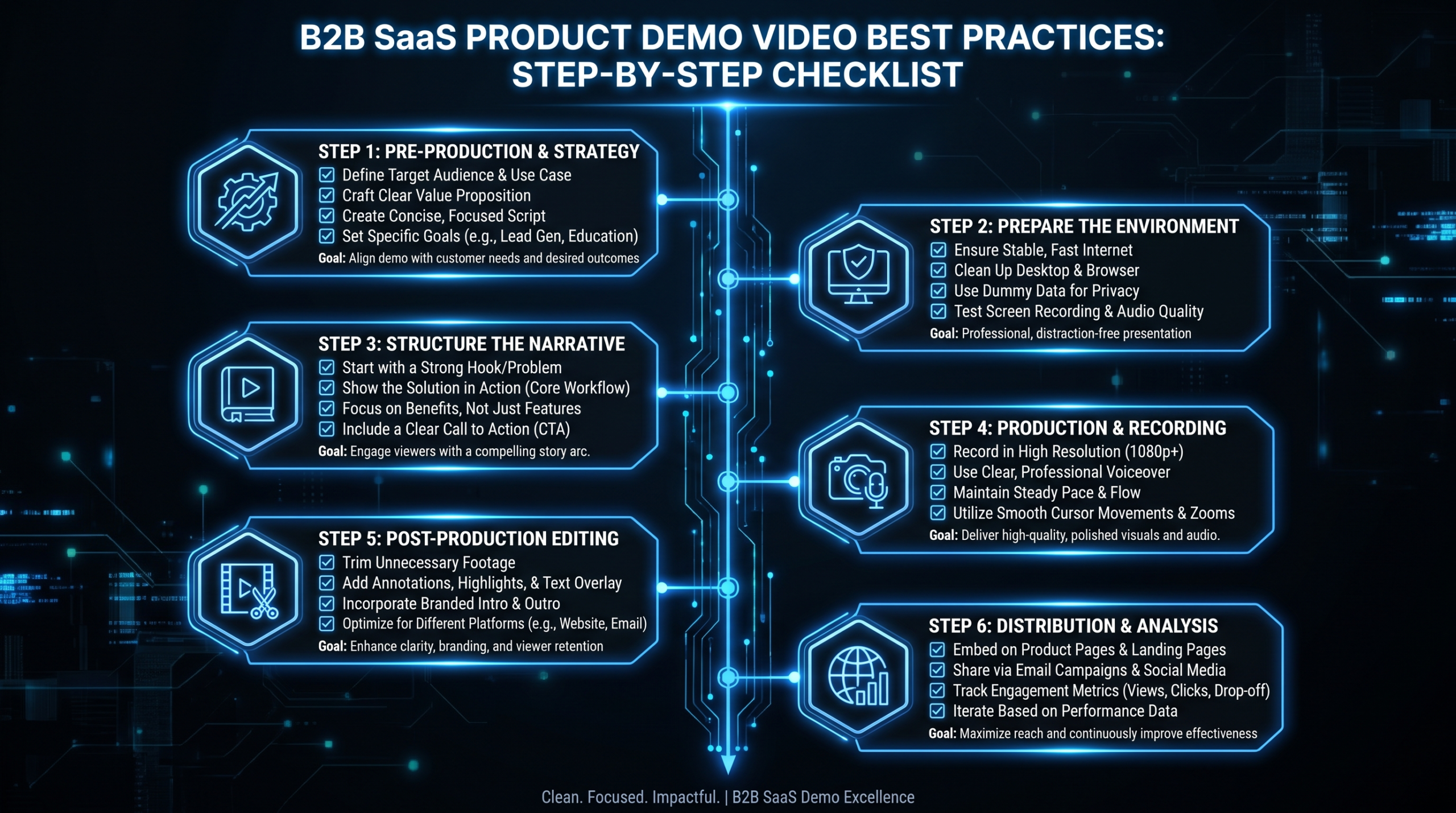
What to steal: Match video depth to buyer stage. Short awareness-level videos for cold audiences, medium-depth demos for mid-funnel evaluation, detailed feature walkthroughs for late-stage buyers — not the same video for everyone at every stage. For more on production approach, see our product demo video production guide.
Type 3: Customer Story Videos
Customer story videos — testimonials, case studies, success interviews — are among the highest-converting B2B video formats because they transfer trust from existing customers to prospects. The key variable is authenticity: B2B buyers have been trained to filter out scripted soundbites. The examples below succeed precisely because they don't sound like marketing.
Example 6: Slack — "So Yeah, We Tried Slack"
Slack's promotional video "So Yeah, We Tried Slack" (released around 2014) remains a reference point for the customer testimonial format done well. Rather than assembling polished talking heads to deliver scripted praise, the video captured real employees at partner companies describing Slack in their own words — often haltingly, occasionally struggling to articulate exactly what changed when their team started using it. That struggle was the point.
The video avoided studio lighting, scripted soundbites, and productivity statistics entirely. No claims of percentage improvements. Just real people, in their actual offices, explaining in imperfect language why they couldn't go back. The unpolished authenticity was the persuasive mechanism — it spread because it felt true rather than manufactured. Visit slack.com to see how their customer story approach has evolved since.
What to steal: Give customers a topic, not a script. Ask "what was working differently after six months?" rather than "tell us how much you love this product." The imperfect answer — where the customer has to think, or says something unexpected — outperforms the scripted answer every time in B2B credibility.
Example 7: Salesforce — The Systematic Customer Success Film Model
Salesforce has built one of the most comprehensive B2B customer story video programs, spanning industries, company sizes, and specific product lines. Their approach produces mini-documentaries of three to five minutes that follow a narrative arc: the business problem, the adoption process, and the specific outcomes achieved after deployment. Each story is indexed by industry vertical and buyer role so prospects can find the most relevant parallel to their own situation.
The production quality is high — on-location footage, executive interviews, data callouts, ambient B-roll — which signals Salesforce's enterprise positioning. The structure, however, is accessible: a customer interview filmed on-site, ambient footage of the business, and a clear before/after narrative is reproducible for any company at a fraction of Salesforce's production budget.
What to steal: Segment customer stories by the industry or role categories your buyers occupy. A healthcare SaaS buyer evaluating your product will respond to a healthcare customer story far more than a generic one, even if the underlying product benefits are identical. Industry-indexed libraries make the same effort work harder.
Type 4: Thought Leadership Videos
Thought leadership videos build organic authority over time. They don't convert leads today — they earn the trust and search equity that converts leads six months from now. The commitment required is real: consistent publishing schedules, genuine expert content, and patience with slow initial traction. The two examples below represent the extreme ends of the thought leadership budget spectrum.
Example 8: Moz — Whiteboard Friday
Moz's Whiteboard Friday series — a weekly video program running since 2007 — is the benchmark thought leadership video format in B2B content marketing. Each episode features an SEO expert explaining a concept, answering a question, or working through a framework at a literal whiteboard, filmed simply with a camera and a consistent format. The production is deliberately unpretentious; all the value is in the educational content.
Whiteboard Friday built Moz's domain authority, email subscriber base, and brand reputation over years, not months. Individual episodes rank organically for specific SEO questions, generating consistent search traffic to moz.com long after initial publication. The lesson isn't the whiteboard format — it's the commitment. Consistent quality over hundreds of episodes compounds into an asset that no single viral video can replicate. See the full archive at moz.com/blog.
What to steal: Pick a repeating format with a consistent presenter and a recognizable visual context. Commit to that format for at least 12 months before measuring results. Thought leadership video is a compounding investment — the first 20 episodes matter less than the first 100.
Example 9: Wistia — "One, Ten, One Hundred"
Wistia, the video hosting platform for B2B companies, produced a documentary series called "One, Ten, One Hundred" in which they commissioned one creative agency to produce the same video concept at three distinct budget levels: $1,000, $10,000, and $100,000. The resulting three films showed viewers exactly how production quality changed — and, crucially, where incremental budget made the most meaningful difference.
The series succeeded because it answered the exact question Wistia's target audience was asking before any purchase decision: how much does video quality actually change with budget? By answering that question with a rigorous, entertaining experiment rather than a whitepaper, Wistia positioned themselves as the authoritative voice on video production value in B2B — not just a hosting platform. The series generated significant organic coverage and became a go-to reference for marketing teams evaluating video investment. Visit wistia.com to find the series and their broader video resource library.
What to steal: The best thought leadership video content answers the exact questions your buyers are searching before they've decided to buy anything. Wistia's audience was asking "does budget actually change video quality?" The series answered it definitively, at depth, in an entertaining format. Find your buyer's pre-purchase questions and build video content around the honest answers.
Type 5: Brand & Demand Gen Videos
Brand videos build emotional connection and long-term memorability. Demand gen videos drive near-term pipeline. The strongest B2B marketing programs run both in parallel — brand content for the roughly 95% of potential buyers not actively evaluating today, and demand gen content for the roughly 5% who are.
Example 10: Shopify — "Let's Make Something"
Shopify's brand video series "Let's Make Something" (and its subsequent iterations) focuses on the emotional experience of entrepreneurship — the risk, the ambition, the uncertainty of starting something — rather than Shopify's product features. The videos feature small business owners and makers explaining why they built their business. The product connection is implied, not stated: if you're building a business, Shopify is how you do it online. The videos don't need to say that explicitly.
This approach works in B2B contexts because Shopify's core buyers — independent merchants and small business owners — are emotionally invested in their business identity. A video that validates and celebrates that identity earns more brand affinity than any feature comparison table. The product shows up as the infrastructure that enables the story, not the hero of the story. Visit shopify.com to see their current brand video content.
What to steal: In brand videos, make your buyer the hero — not your product. The question to answer is not "what does our product do?" but "what does our buyer want to become?" The product earns its place as the tool that makes that transformation possible. For a deeper look at narrative frameworks, see our guide to B2B storytelling video.
Example 11: LinkedIn Marketing Solutions — Silent-First Video Ads
LinkedIn Marketing Solutions runs B2B video advertising campaigns on their own platform, and their approach to video ad creative has become a widely adopted model. Their ads are designed first for a silent, scrolling audience — text overlays carry the core message, and the visual narrative communicates the value proposition without audio. Sound is treated as a bonus for viewers who tap to unmute, not a requirement for the ad to work.
LinkedIn's autoplay defaults to muted, which means any video ad that depends on audio to communicate its message loses the majority of impressions. Their own campaigns, by contrast, layer captions and headline text directly into the video frame, ensuring the message lands regardless of audio state. This silent-first design principle has since become standard practice across B2B LinkedIn advertising. See their advertising resources at LinkedIn Marketing Solutions.
What to steal: Design every B2B social video to work without audio first. Add captions, text overlays, and a visual narrative that communicates your core message in silence. Then add voiceover or music as an enhancement for viewers who choose to listen — not a dependency for viewers who don't.
Example 12: Notion — Product-Led Short-Form Video for Social
Notion's social video strategy is a model for product-led growth executed through video content. Their short-form videos — distributed primarily on YouTube and LinkedIn — show real Notion workspaces being configured in real time: building a marketing content calendar, setting up a product roadmap, creating a weekly review template. The videos are practical, specific, and immediately actionable. The viewer can open Notion and replicate what they just watched within minutes.
This approach avoids the common pitfall of top-down B2B brand video (CEO articulates vision, product shown abstractly). Notion's videos are ground-level: this is a specific thing you can build right now. That specificity makes the content genuinely useful to non-customers, which earns organic sharing and extends reach beyond paid promotion. Visit notion.so and their YouTube channel for their current short-form video approach.
What to steal: Short-form B2B social video performs best when it's immediately actionable. Teach a specific workflow, template, or technique. Let the product appear as the natural tool that enables the task. The viewer's reaction — "I can do that" — is more valuable than any brand impression.
B2B Video Type Comparison Table
Here's how the five B2B marketing video types compare across the dimensions that matter most to B2B SaaS and service marketing teams planning their video program:
B2B Marketing Video Types: Key Dimensions
| Video Type | Primary Goal | Funnel Stage | Typical Length | Production Complexity | Conversion Timeline |
|---|---|---|---|---|---|
| Product Explainer | Educate on problem + solution | Top / Mid | 60 sec–3 min | Medium (animation or screen record) | Weeks–months |
| Product Demo | Show capability, drive trial/sales meetings | Mid / Bottom | 2–8 min | Low–Medium (screen record + voiceover) | Days–weeks |
| Customer Story | Build trust, transfer credibility | Mid / Bottom | 2–5 min | Medium–High (interview + B-roll) | Days–weeks |
| Thought Leadership | Build authority, earn organic traffic | Top (awareness) | 5–20 min | Low–Medium (talking head + graphics) | Months–years |
| Brand / Demand Gen | Emotional affinity, pipeline top-up | All stages | 15 sec–3 min | Medium–High (cinematic or campaign) | Months |
The 12 Examples: Type, Budget Range, and Key Success Factor
| Example | Company | Video Type | Estimated Budget Range | Key Success Factor |
|---|---|---|---|---|
| 1. Classic Explainer | Dropbox | Explainer | $2K–10K (2009 benchmark) | Problem-first narrative |
| 2. Self-Demo Production | Loom | Explainer | Minimal (uses own product) | Authenticity via self-recording |
| 3. Single Use-Case Library | Intercom | Explainer | $3K–8K per video | Specificity per use case |
| 4. Self-Qualifying Demo | Gong | Demo | $5K–15K | Honest complexity shown |
| 5. Layered Demo Strategy | HubSpot | Demo | $5K–20K per video | Stage-matched depth |
| 6. Unscripted Testimonial | Slack | Customer Story | $5K–15K | Unscripted authenticity |
| 7. Mini-Documentary Series | Salesforce | Customer Story | $15K–50K+ | Industry segmentation |
| 8. Weekly Series | Moz | Thought Leadership | $500–2K per episode | Consistency over years |
| 9. Budget Documentary | Wistia | Thought Leadership | $100K+ (full series) | Unique angle, genuine utility |
| 10. Buyer-as-Hero Brand Film | Shopify | Brand | $30K–100K+ | Emotional identity validation |
| 11. Silent-First Video Ads | Demand Gen | $2K–10K production | Silent-first design | |
| 12. Product-Led Social Video | Notion | Social / Demand Gen | $500–3K per video | Immediately actionable content |
What These Examples Have in Common
Across all 12 examples — spanning different industries, budgets, and formats — five principles appear consistently.
1. One Audience, One Message
Every example targets a specific buyer, not "everyone who might buy our product." Salesforce's customer stories are categorized by industry. HubSpot's demos are matched to buyer stage. LinkedIn's ads are segmented by job title. Broad B2B videos underperform because they dilute their message trying to speak to everyone simultaneously. Precision wins.
2. The Product Is the Secondary Character
In the strongest examples — Slack, Shopify, Notion, Dropbox — the product appears after the person or the problem. The buyer's situation or the human story leads; the product follows as the resolution. In B2B video, leading with the product is almost always a structural mistake. Lead with the buyer's world, then introduce the solution.
3. The Video Works Without Sound
LinkedIn's silent-first design principle applies broadly across the B2B video landscape. All of these examples either include captions, text overlays, or visual narrative structures that communicate the core message without audio. LinkedIn autoplay is muted by default. Mobile video is frequently watched in contexts where sound is inappropriate. Design for silence, then enhance with audio.
4. The Video Serves a Function Beyond Marketing
The strongest B2B videos are useful tools, not just promotional assets. Intercom's feature explainers reduce customer support tickets. Gong's demos reduce repetitive early-stage sales questions. Moz's Whiteboard Friday reduces churn by educating existing customers. When a marketing video is also a product education or customer success resource, it earns attention it wouldn't otherwise receive and justifies production investment more easily.
5. Consistent Publishing Beats Viral Moments
Moz's Whiteboard Friday ran for years before becoming a category-defining asset. Gong's video library was built video by video over multiple quarters. Loom's library grew episode by episode. The companies with the strongest B2B video presence treated video as an ongoing program — not a campaign sprint with a defined end date. The compounding effect of consistent publication is the difference between a video library and a video archive.
How to Execute B2B Video at Scale
The gap between "inspired by these examples" and "actually publishing video consistently" is an execution problem, not a strategy problem. Most B2B marketing teams understand which formats they should be using. The challenge is building the production capacity to publish consistently without it consuming the entire marketing team's bandwidth.
A three-person marketing team cannot simultaneously run a weekly thought leadership series, maintain a demo video library, produce customer case study films, and develop social content. Something gets deprioritized — usually the long-term brand and thought leadership work, leaving only the bottom-of-funnel content that's hardest to rank for organically.
The operational solution most Series A–C SaaS companies converge on is a dedicated video editing partner functioning as an extension of the marketing team — not a one-off production agency hired per project. For teams producing eight or more videos per month, a dedicated team model typically delivers the lowest per-video cost while maintaining the brand consistency that a rotating freelancer pool cannot. Our SaaS video production guide covers how this model works in practice, including how to structure a brief, manage feedback cycles, and maintain brand consistency across a high-volume library.
Video Editing Company (VEC) works exclusively with B2B SaaS marketing teams on this dedicated team model — senior editor, junior editor, project manager, and creative director assigned to your account, flat monthly retainer, and a 90-day output guarantee. If your team is evaluating how to scale from occasional video production to a consistent program, see our pricing plans for the economics of dedicated team engagement starting at $5K/month.
Frequently Asked Questions
What types of B2B marketing videos convert best?
Product demo videos and customer story videos typically generate the highest direct conversion impact, because they serve buyers actively evaluating solutions. Explainer videos convert top-of-funnel interest into mid-funnel intent. Thought leadership videos build organic traffic and long-term authority. The right mix depends on your funnel: early-stage companies often prioritize explainers and demos; established companies with active sales teams benefit most from customer stories and systematic thought leadership content.
How long should a B2B marketing video be?
Match length to intent. LinkedIn social ads perform best under 60 seconds. Product explainers typically run 90 seconds to 3 minutes. Product demos can run 3–8 minutes for audiences actively evaluating options. Customer case study films run 2–5 minutes. Thought leadership content — webinars, whiteboard-style videos, documentary series — can run 10–20 minutes for audiences who self-select into it. The rule: make it as long as the value demands, then cut it shorter. For demo-specific length guidance, see our product demo video production guide.
Can small B2B teams produce high-quality marketing videos without big budgets?
Yes. Loom's approach — recording product walkthroughs in their own tool — has minimal production cost beyond time. Moz's Whiteboard Friday is produced with a camera, a whiteboard, and one presenter in a consistent format. Dropbox's category-defining explainer was made at a budget far below what the company's eventual valuation would suggest. The constraint is not budget — it's choosing the right format for the resources available. Simple, consistent, genuinely useful content outperforms expensive, infrequent productions in almost every B2B context.
How do you measure the ROI of B2B marketing video?
Track metrics tied to the video's specific goal rather than vanity metrics like view count. For top-of-funnel explainers: organic traffic, video completion rate, and email capture from related content. For demo videos: trial sign-ups, demo requests, and sales-qualified leads influenced. For customer stories: influence on closed deals tracked via CRM attribution. For thought leadership: keyword rankings, returning visitors, and newsletter subscriber growth. View count tells you reach; the metrics above tell you impact. Most B2B teams undertrack video because they don't set goals before production — define success metrics before you start shooting.
How many B2B marketing videos should a company publish per month?
There's no universal benchmark, but teams building consistent video programs typically publish 4–12 videos per month across formats — a mix of social clips, product demos, and longer-form content. Consistency matters more than volume: 4 videos per month for 12 months builds more compound value than 20 videos in a sprint followed by a pause. If your team is currently producing zero or one video per month, the priority is building a repeatable production process and scheduling rhythm before trying to scale output. Volume without process leads to inconsistent quality and burnout, not a content library.
Ready to Scale Your B2B Video Production?
VEC provides dedicated video editing teams for B2B SaaS marketing teams — senior editor, junior editor, project manager, and creative director assigned exclusively to your account. Plans from $5K/month with a 90-day output guarantee: double your video output in 90 days, or month 4 is free.
Book a Free Strategy Call View Pricing Plans