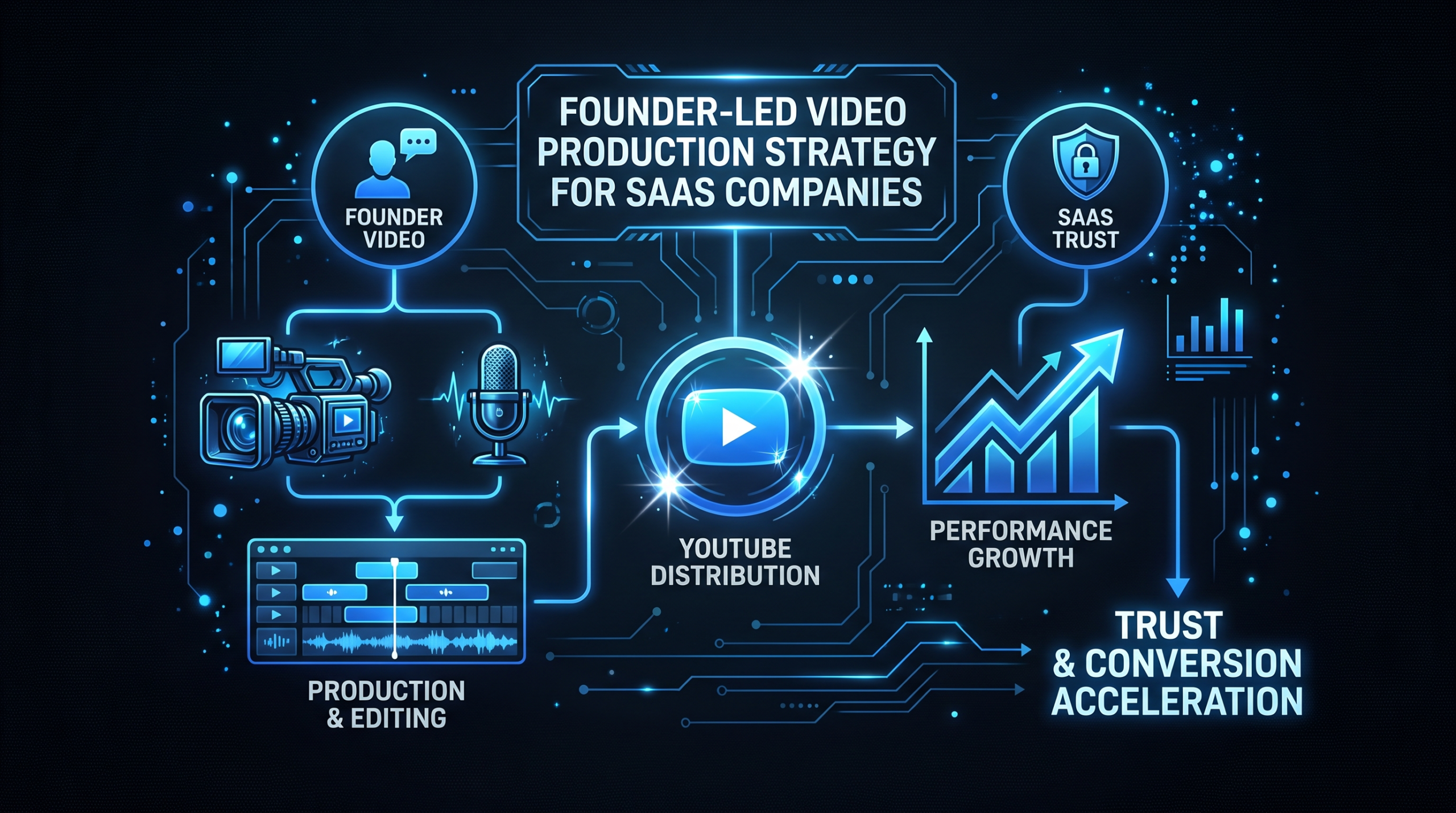
Founder-Led Video Examples for SaaS
TL;DR
Founder-led videos convert at higher rates than polished brand content because buyers trust the person behind the product, not just the logo in front of it. This page breaks down five real examples from Loom, Superhuman, Notion, HubSpot, and Drift — showing what each does right and what you can take from it. It also covers the three formats that drive results, how to produce them on any budget, and what production costs look like by stage. If your founders are not on camera yet, this is where to start.
Table of Contents
- Key Takeaways
- What Are Founder-Led Videos — and Why Do SaaS Buyers Watch?
- 5 Founder-Led Video Examples Worth Studying
- What Separates High-Converting Founder Videos?
- How Do You Produce a Founder-Led Video?
- How Much Does Founder-Led Video Production Cost?
- Which Format Fits Your SaaS Stage?
- Frequently Asked Questions
Key Takeaways
- 5 verified examples below — all from recognized SaaS companies — each showing a distinct approach: origin story, product philosophy, near-failure narrative, contrarian positioning, and cross-company lessons.
- 3 formats drive 80% of results: the origin story (top of funnel), the product-led insight (mid-funnel), and the thought leadership interview (authority / retargeting). Each has a different strategic role — mixing them up costs pipeline.
- Production quality has a lower floor than founders think. A clip-on lavalier mic ($50-80), stable framing, and a light source in front of the face outperform a poorly-delivered 4K studio shoot every time.
- 1 founder shoot generates 10-30+ reusable assets: a long-form video, 5-8 social clips, audiograms, email snippets, and a blog post from the transcript. The repurposing ROI — not the video itself — is where the format earns its budget.
- Founder-led video costs range from $0 (DIY iPhone) to $25,000+ (full agency campaign), with the largest ROI typically coming in the $500-5,000 range for Series A-B teams.
What Are Founder-Led Videos — and Why Do SaaS Buyers Actually Watch Them?
A founder-led video is content where the CEO, co-founder, or executive appears on camera to speak directly to the audience — about the problem they solved, the product they built, or the ideas shaping their industry. It is distinct from animated explainer videos, product demos narrated by an anonymous voice, or branded brand films where no individual takes ownership of the story.
In SaaS video production, the founder-led format has grown because the buying environment shifted. Series A–C buyers are increasingly skeptical of polished vendor messaging. A founder on camera — name, face, and conviction visible — changes the conversation from "what does this product do?" to "do I trust the people who built this?"
That trust dynamic is particularly sharp in B2B SaaS, where enterprise buyers research vendors extensively before any sales call. A founder video surfacing during that research phase — in a Google search, a LinkedIn scroll, or a YouTube recommendation — creates the kind of familiarity that accelerates deals without a single SDR interaction. Annual research from Edelman's Trust Barometer consistently finds that company founders as visible spokespersons generate meaningfully higher credibility scores than brand-level advertising alone.
There are three core types you will see across the examples below:
- The Origin Story: The founder explains the problem they personally experienced, why existing solutions failed, and why they built this. Strongest at the top of funnel for building brand affinity.
- The Product-Led Insight: The founder walks through the product's core philosophy or a specific capability, often layered with screen recording. Strongest at mid-funnel for converting awareness to intent.
- The Thought Leadership Interview: The founder discusses industry trends, business philosophy, or hard-won lessons — often in a podcast or fireside format. Builds long-term authority and recurring viewership.
For a deeper look at why this format outperforms standard brand content in the SaaS context, see our full guide to founder-led video for SaaS.
5 Founder-Led Video Examples Worth Studying
The examples below are publicly available, from recognized SaaS companies, and each illustrates a distinct approach — not a list of "viral moments." Each has a clear strategic logic you can extract and apply regardless of your company stage.
1. Loom — Joe Thomas: The $1B Origin Story
Format: Keynote-style founder story • Ideal for: Top-of-funnel brand trust • Where it lives: YouTube, conference circuit
Why it works: Joe Thomas opens with the existential moment — two weeks of runway, a product that hadn't found its market, a team ready to quit. That crisis framing pulls viewers in before they even understand what Loom does. The product becomes the resolution to a human problem the audience already feels, not a feature list they have to evaluate. Loom's eventual $975M acquisition by Atlassian is framed not as a success story but as the logical outcome of a series of hard decisions made under pressure.
What to steal: Structure your origin story around a crisis moment, not a company milestone. Buyers trust vulnerability more than success narratives. Open with the hardest thing that almost stopped you — that is where the brand DNA actually lives.
2. Superhuman — Rahul Vohra: Product Philosophy as Thought Leadership
Format: Podcast / long-form interview • Ideal for: Mid-funnel authority + retargeting • Where it lives: YouTube, podcast platforms
Why it works: Rahul Vohra built Superhuman by obsessing over a precise, measurable definition of product-market fit. This video is not a product pitch — it is the intellectual framework behind Superhuman's operating philosophy. Vohra positions himself as a practitioner-thinker, which is a category that resonates deeply with the VP Engineering and Head of Product audience Superhuman targets. Buyers who watch this video arrive at a sales conversation already aligned with Superhuman's worldview.
What to steal: Your founder's mental models are underrated content. What proprietary frameworks does your team use internally that the market hasn't articulated yet? The framework is the marketing. Pair this with your product demo video strategy and you compound the credibility across two content types.
3. Notion — Ivan Zhao: The Near-Failure Narrative
Format: Long-form interview • Ideal for: Top-of-funnel narrative + category differentiation • Where it lives: YouTube
Why it works: Ivan Zhao describes how Notion nearly ran out of database capacity during a COVID-driven usage surge — a crisis most CEOs would hide. He shares it openly because it illustrates how a small, focused team outexecutes against problems that would break a larger, more complex organization. The story reinforces Notion's "do more with less" brand DNA at a level no product page can replicate.
What to steal: Counter-intuitive near-failure stories build more trust than success narratives. Choose a crisis that, in retrospect, reveals your company's values. Structure it as: what happened → what you chose → why that choice defines who you are. Then pair the video with your case studies page so buyers can see the same values in action with real customers.
4. HubSpot — Dharmesh Shah: Contrarianism as Brand
Format: Podcast interview • Ideal for: Brand authority + analyst / press audience • Where it lives: YouTube, podcast platforms
Why it works: Dharmesh Shah does not talk about HubSpot features. He talks about the decisions HubSpot made that everyone else thought were wrong. "Zigging vs. zagging" positions the founder as someone who sees what others miss — a category that is impossible to replicate with brand advertising. Every time a buyer encounters a HubSpot product, Dharmesh's intellectual credibility is a layer of trust underneath it. This is long-cycle B2B positioning done through a single 55-minute conversation.
What to steal: Identify the three things your company believes that your market currently thinks are wrong. That is your founder video content for the next six months. Contrarian takes generate repeat viewership — viewers either agree and feel validated, or disagree and keep watching. Either way, you own their attention.
5. Drift — David Cancel: Lessons at the Intersection of Companies
Format: Podcast / startup advice interview • Ideal for: Ecosystem authority + recruiting • Where it lives: YouTube, podcast platforms
Why it works: David Cancel draws on experience across multiple companies — HubSpot, Drift, and several before. Multi-company founders have compounding credibility: each company adds a data point to the expertise claim. The lesson density is high, which keeps buyers watching longer and creates 8-12 clippable moments per hour of content. Those clips become the distribution machine for the full-length video.
What to steal: Frame your founder's prior work — including pivots, acquisitions, and even failures — as accumulated insight, not just a biography. Buyers are not just buying the product; they are buying access to the judgment of the person who built it. Make that judgment visible and accessible through a consistent video cadence. See how outsourcing video editing makes that cadence sustainable for lean marketing teams.
Each example reflects a different company stage and primary channel. What they share: the founder is the protagonist, the story drives the watch time, and the product is the natural conclusion — not the opening pitch. The founder-led video strategy guide expands on how to architect a full content program around these formats.
What Separates High-Converting Founder Videos From the Rest?
Most founder videos fail not because of production quality — they fail because the founder has not been coached on structure. A charismatic person talking unscripted for 40 minutes is not a founder-led video strategy; it is an expensive podcast episode that will not rank, will not repurpose well, and will lose viewers in the first 90 seconds.
Here is what the five examples above share at the structural level:
Founder Video Format Comparison
| Format | Best Funnel Stage | Ideal Length | Primary Distribution | Estimated Production Cost |
|---|---|---|---|---|
| Origin story (self-filmed) | Top of funnel | 2–5 min | LinkedIn, YouTube homepage | $0–500 |
| Product insight (screen + camera) | Mid-funnel / intent | 8–20 min | YouTube, website, sales assets | $1,000–5,000 |
| Podcast / interview (studio) | Top / awareness | 30–60 min | YouTube, Spotify, Apple Podcasts | $500–3,000 |
| Conference / keynote (full crew) | Brand authority | 20–45 min | YouTube, website hero | $3,000–15,000 |
| Social clip series (from long-form) | Retargeting / nurture | 30–90 sec each | LinkedIn, X, Instagram Reels | $300–2,000 per clip set |
The structural formula all five examples follow
- Open with a real, specific problem — not a general trend statement. "Email was broken" is vague. "I was spending four hours a day in my inbox and still missing the emails that mattered" is a hook.
- Personal stakes — the founder frames the problem as something they personally experienced and could not ignore. Buyers trust the practitioner over the abstract expert.
- The counter-intuitive decision — every strong founder story has a moment where they chose the path that looked wrong to outsiders. That is where the brand DNA lives.
- The product as natural conclusion — the company they built is the only logical outcome of the beliefs they have just expressed. The sell is implicit, not a pitch.
- Clippable moments — each video contains 4-8 moments that compress cleanly into 30-60 second social clips. The long-form is the source material; the clips are the distribution engine.
This structure applies whether your founder is producing content in-house or working with a SaaS video production partner. The formula is the same — what changes is who operates the camera, handles the edit, and manages the repurposing workflow downstream. Our breakdown of video production agency pricing models covers how to structure that relationship cost-effectively.
How Do You Produce a Founder-Led Video?
The honest answer is that production quality has a much lower floor than most SaaS founders assume. Several of the highest-viewed founder videos — including examples in this list — were recorded in home offices, conference backrooms, and podcasting studios that cost under $2,000 to set up.
What matters is not the equipment tier. It is whether the three technical minimums are respected and whether the pre-production brief has been done.
Pre-production: the brief that saves post-production time
Founders often approach a video recording like a casual podcast — show up and talk. That produces an unstructured recording that takes twice as long to edit and delivers a fraction of the impact. Before any shoot, write a one-page brief that covers: the single thing viewers must leave knowing, the specific story or problem anchoring the video, the three supporting points, and one clear ask at the end (watch another video, visit a page, book a call).
For product insight videos, the brief should also specify which screen recording segments appear, what the demo is demonstrating, and where the founder's face is visible versus the product. Our guide to product demo video production covers the brief and storyboard format in detail.
Shooting: the three non-negotiable technical minimums
You can record a high-performing founder video with a modern smartphone if three constraints are respected:
- Sound quality first. A $50-80 clip-on lavalier microphone eliminates 90% of audio problems. Bad audio destroys watch time faster than any visual shortcoming — this is non-negotiable.
- Stable framing. Eye level, face filling the upper two-thirds of the frame, camera on a tripod or fixed surface. No handheld motion.
- Controlled light. Face the light source — a window, ring light, or softbox. Never shoot with a window behind the founder. Good front light adds perceived production value that $10,000 of camera gear cannot replicate.
For formal productions — website hero videos, product launch campaigns, conference keynotes — you will want a proper crew, a controlled studio environment, and a professional post-production workflow. That is where a dedicated editing team becomes the cost-efficient path. See our breakdown of what professional video editing services include at each production tier.
Post-production: where founder-led content lives or dies
The edit separates a rambling 50-minute recording from a tight, watchable 38-minute interview. For founder videos specifically, post-production covers:
- Content editing — cutting repeated points, removing filler, tightening transitions to maintain energy.
- Graphics and B-roll — lower thirds with name and title, screen recordings, product screenshots, chapter markers.
- Social clip extraction — identifying the 5-8 best 30-90 second moments for short-form distribution.
- Thumbnail creation — for YouTube, a founder's face in the thumbnail consistently outperforms abstract graphics for interview-format content. CTR is heavily thumbnail-driven.
Most SaaS marketing teams underestimate the post-production volume a founder video program generates. A monthly cadence of one long-form interview produces 5-8 short clips, 1-2 audiograms, and a written transcript piece per shoot. If your team is managing that in-house, the workload compounds fast. Many Series A-B teams use dedicated editing support to absorb the repurposing volume. Read how outsourcing video editing works in practice for marketing teams at this stage, or review the agency pricing models that make the most sense for a consistent founder video program.
How Much Does Founder-Led Video Production Cost?
Founder-led video has one of the widest production cost ranges of any video format — because the format scales from a smartphone in a home office to a full documentary crew on a conference stage. What you pay depends almost entirely on the production tier, not the video type itself.
Founder-Led Video Production Costs by Approach (2026)
| Production Approach | Best For | Est. Cost Per Video | Monthly Cost (4 videos/mo) |
|---|---|---|---|
| DIY — iPhone + lavalier mic | Pre-seed to Seed | $0–500 (equipment only) | $0–200 (editing only) |
| Rent-a-studio + independent editor | Seed to Series A | $500–2,500 | $1,500–5,000 |
| Professional production (small crew + editor) | Series A to B | $2,500–8,000 | $5,000–12,000 |
| Full agency (crew, director, studio, post) | Series B+ / enterprise | $8,000–25,000+ | Custom retainer |
| Dedicated editing subscription (long-form + clip repurposing) | Any stage, high-volume | $300–600 per clip set | $2,500–9,500 (dedicated plan) |
For Series A–C SaaS teams producing a consistent volume of founder-led content, a dedicated editing model or retainer typically delivers the best cost-per-deliverable. VEC's Growth plan ($5K/mo) covers a full month of repurposing from two to four founder shoots; the Core plan ($9.5K/mo) adds a dedicated senior editor for more complex productions. See the full pricing page for current plan details.
For context on how these costs stack up against other video formats, our video editing cost per minute breakdown and hourly rate comparison by country give a broader market view. For per-deliverable cost benchmarks, the explainer video cost breakdown is a useful reference point on what comparable production effort costs in a different video type.
The most important cost variable in founder-led video is not the shoot — it is consistency. One high-quality shoot every two months will not build an audience or move the pipeline needle. The teams that see measurable results produce two to three founder-on-camera pieces per month and repurpose each one aggressively across channels. That repurposing workload is where a dedicated editing team earns back its cost — typically within the first quarter as clips drive attributed pipeline conversations.
Which Founder-Led Video Format Fits Your SaaS Stage?
Not every format works at every stage. A seed-stage founder uploading 50-minute podcast interviews to a 200-subscriber YouTube channel is misallocating production resources. A Series B founder who only posts casual iPhone clips is leaving significant trust capital on the table. Stage determines format efficiency.
Founder Video Format by Company Stage
| Stage | Recommended Format | Primary Goal | Distribution Priority |
|---|---|---|---|
| Pre-seed / Seed | Short origin story (3–5 min), LinkedIn native video | Category creation + brand trust | LinkedIn, Product Hunt, X |
| Series A | Product insight videos (8–15 min) + social clip engine | Demand generation + SEO | YouTube, LinkedIn, outbound sequences |
| Series B | Podcast / interview series + dedicated clip program | Thought leadership + audience building | YouTube, Spotify, sales assets |
| Series C+ | Conference keynotes + documentary-style brand films | Market positioning + recruiting | Website, press coverage, events |
The five examples above skew toward Series A and B formats — long-form interview with clip repurposing — because that is where the format delivers the highest ROI relative to production cost. For earlier-stage teams building a minimal viable founder video program, the founder-led video guide covers the setup, briefing process, and distribution strategy in full.
One format worth highlighting separately: the customer plus founder co-interview. Instead of a founder talking about their own product, the founder and a recognizable customer talk through how they work together — a buyer from the same industry the video is targeting. This format combines founder credibility with peer social proof in a single video. The result maps directly to the buyer persona represented by the customer. Pair the transcript with a formal case study and you have compressed a full mid-funnel content sequence into one 20-minute shoot.
For teams scaling video output beyond what an in-house headcount can manage, the VEC model provides dedicated editing teams that learn your founder's style and handle the full repurposing workflow — from the raw long-form cut to the full social clip set — without the overhead of hiring full-time editors. Explore the full range of editing services or read how SaaS teams structure the handoff when they outsource their video editing program. Wistia's State of Video report documents the patterns across the largest B2B video hosting dataset if you need benchmark data to size the investment internally.
Frequently Asked Questions
What is a founder-led video?
A founder-led video is content where the CEO, co-founder, or executive appears on camera to speak directly to the audience about the product, company vision, or their domain expertise. Unlike animated explainers or brand ads with voiceover, founder-led video centers on a specific individual's story and credibility. Common formats include origin stories, product insight walkthroughs, long-form podcast interviews, and conference keynotes.
Why do founder-led videos outperform branded content for B2B SaaS?
B2B buyers research vendors extensively before any sales conversation. A founder speaking candidly on camera — about failures, hard decisions, and hard-won beliefs — creates personal trust that product pages and brand videos cannot replicate. The founder acts as an implicit guarantee: if the person who built this is willing to put their name and face behind it, buyers interpret that as a credibility signal. This is especially effective in long sales cycles where multiple stakeholders need to align before a purchase decision.
How long should a founder-led video be?
It depends on the format and platform. Origin stories and social clips perform best at 2–5 minutes. Product insight videos hold attention at 8–20 minutes on YouTube and as sales assets. Podcast and interview formats can run 30–60 minutes when the content is genuinely dense — but only if you have a corresponding clip strategy to surface the best moments in short form. Never pad to fill a target length; the video ends when the idea is complete.
Do you need professional production for founder-led video content?
Not at first. Early-stage founders consistently outperform over-produced content by being direct and credible on camera. The three non-negotiables are: a clip-on lavalier microphone ($50–80) for clean audio, stable framing with the camera at eye level, and a light source facing the founder. Beyond those three, increasing production investment returns diminishing gains until you are distributing content to large audiences via paid ads, website hero sections, or conference-tier events. Start minimal, get consistent, then invest in production quality.
How do you repurpose founder-led video content efficiently?
One 30–60 minute founder video shoot generates: one full-length YouTube video, 5–8 short social clips (30–90 seconds each for LinkedIn, Reels, and X), audiograms for podcast distribution, a written blog post or newsletter from the transcript, and 3–5 email or sales outreach snippets. The repurposing workflow — not the shoot itself — is where dedicated editing support earns its cost. A team that knows your founder's style extracts clips and reformats deliverables at a fraction of the time an internal team manages ad hoc. See the full list of video editing deliverables VEC handles across plans.
Ready to Turn Your Founders Into Your Best Marketing Asset?
VEC provides dedicated editing teams for B2B SaaS companies — handling the full founder video workflow, from raw footage to published clips across every channel. Guaranteed to double your video output in 90 days, or month 4 is free.
See Pricing Plans Book a Free Strategy Call