
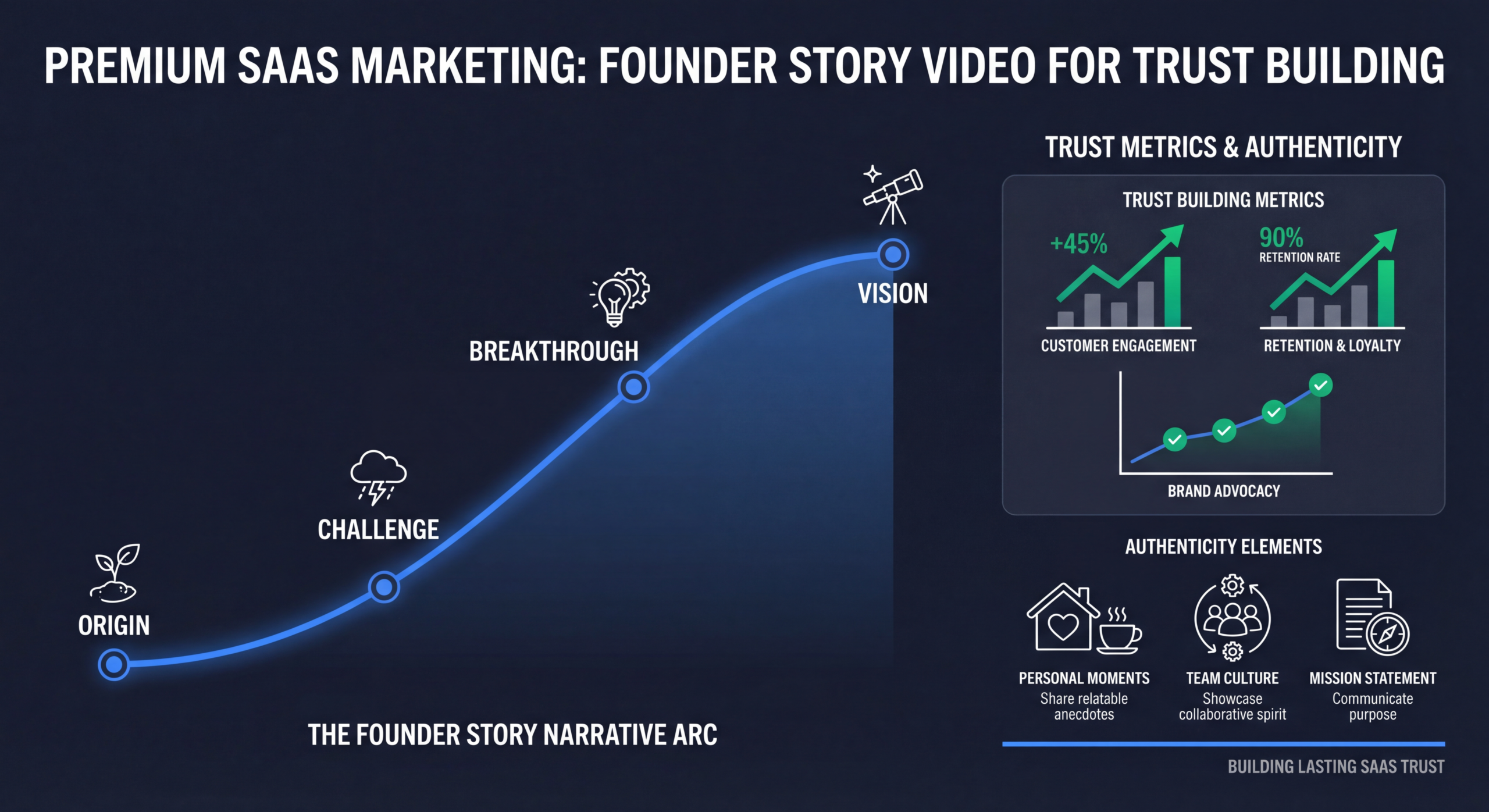
Founder Story Video: Build Trust With Your Origin Story
People don't buy software. They buy from people they trust. And in a market where every SaaS homepage looks the same - gradient backgrounds, feature grids, "trusted by 500+ companies" - your origin story is the one thing competitors literally cannot copy.
A founder story video puts a face, a voice, and a motivation behind your product. It answers the question every prospect subconsciously asks: "Why should I trust these people with my money?"
Yet most B2B companies skip this entirely. They'll spend $50K on a product demo and $0 telling the world why their company exists. That's a strategic mistake - and the data backs it up.
This guide covers everything: storytelling frameworks that actually work, production planning, real examples from SaaS companies, distribution strategy, and budgeting. Whether you're a seed-stage founder or a Series C CEO, your origin story deserves to be told well.
Table of Contents
- Why Founder Story Videos Build Unshakable Trust
- Anatomy of a High-Performing Founder Story Video
- 3 Storytelling Frameworks That Actually Work
- Production Guide: From Script to Final Cut
- 5 SaaS Founder Videos That Drove Real Results
- Where to Use Your Founder Story Video
- 7 Mistakes That Kill Founder Story Videos
- What a Founder Story Video Costs (Realistic Budget)
- Frequently Asked Questions
Why Founder Story Videos Build Unshakable Trust
SaaS buying decisions aren't purely rational. Research from Gartner shows that emotional connection with a brand is the single strongest driver of B2B loyalty - more than price, features, or even customer service.
A founder story video creates that connection by doing three things simultaneously:
1. It humanizes your brand
Behind every SaaS product is a person who got frustrated enough to build something. That frustration - that origin moment - is universally relatable. When a prospect watches your founder explain why they left a comfortable job to solve a specific problem, something shifts. You stop being "another vendor" and become someone they understand.
2. It demonstrates conviction
Founders who share their story on camera signal confidence. If you believe in your product enough to put your face on it, prospects believe in it too. This is especially powerful for early-stage companies competing against established players - your passion becomes a competitive advantage.
3. It creates asymmetric information
Your competitors can copy your feature set. They can copy your pricing page. They cannot copy your origin story. This makes founder videos one of the few truly defensible marketing assets a company can create.
The trust equation: Credibility + Reliability + Intimacy = Trust. A founder story video hits all three - your track record (credibility), your commitment to the problem (reliability), and the personal vulnerability of sharing your story (intimacy).
What the data says
LinkedIn research found that executive thought leadership content directly influences purchase decisions for 49% of B2B decision-makers. Edelman's trust barometer shows that 63% of people trust "technical experts at the company" more than any other spokesperson - including the marketing team.
Translation: when your founder tells the story, it carries more weight than any polished brand video ever could.
Anatomy of a High-Performing Founder Story Video
Not all founder videos are created equal. The ones that drive results follow a consistent structure - not because they're formulaic, but because they respect how humans process narrative.
| ELEMENT | PURPOSE | DURATION |
|---|---|---|
| The Hook | Grab attention with a surprising statement or moment | 0:00-0:15 |
| The Problem | Describe the frustration that led to the company | 0:15-1:00 |
| The Turning Point | The moment you decided to build the solution | 1:00-1:45 |
| The Vision | What you're building toward and why it matters | 1:45-2:30 |
| The Proof | Results, customers, or traction that validates the mission | 2:30-3:00 |
| The Invitation | Soft CTA to join the journey | 3:00-3:30 |
Total runtime: 2-4 minutes is the sweet spot. Long enough to build emotional connection, short enough to hold attention. LinkedIn data shows video completion rates drop sharply after 3 minutes for B2B content.
Production quality matters (but not how you think)
This isn't about Hollywood production value. It's about intentional production value. The most effective founder videos look professional but not overproduced. Think: clean audio, good lighting, natural environments - not green screens and dramatic drone shots.
The authenticity of the founder's delivery matters 10x more than the production budget. A genuine, slightly imperfect delivery in a well-lit office beats a scripted performance in a rented studio every time.
3 Storytelling Frameworks That Actually Work
If you sit down to record a founder story without a framework, you'll ramble. Every time. Here are three proven structures - pick the one that fits your personality and story.
Framework 1: The Frustration Arc
Best for: founders who built the product to solve their own problem.
Structure
- "I was in [role] at [company]..." - Establish credibility and context
- "Every day I dealt with [specific problem]..." - Build empathy
- "I tried [existing solutions] but they all [fell short because]..." - Validate the gap
- "So I built [product] to [solve it differently]..." - Introduce the solution
- "Today, [metric/customer proof]..." - Prove it works
Framework 2: The Mission Arc
Best for: founders driven by a bigger vision (industry transformation, social impact, etc.).
Structure
- "I believe [bold statement about the future]..." - Lead with vision
- "But right now, [industry] is stuck because..." - Identify the barrier
- "My experience at [previous role/company] showed me..." - Provide authority
- "We built [product] to make that future real..." - Connect product to mission
- "Join us in [invitation]..." - Soft CTA
Framework 3: The Before/After Arc
Best for: founders who can show a dramatic contrast between "life without" and "life with" their product.
Structure
- "This is what [process] looks like today..." - Show the pain
- "We used to do this too at [company]..." - Shared experience
- "Here's what changed..." - The turning point
- "Now, [product] makes it possible to..." - The transformation
- "[Customer X] went from [before] to [after]..." - Social proof
Production Guide: From Script to Final Cut
A founder story video has three phases: pre-production, shoot day, and post-production. Here's exactly what each involves.
Pre-Production (1-2 weeks)
Script development
Don't write a full script word-for-word. Founders reading off teleprompters sound like founders reading off teleprompters. Instead, create a talking points outline with:
- 5-7 key beats (the narrative arc from above)
- 2-3 specific anecdotes or data points per beat
- Exact opening and closing lines (these matter most)
- Natural transition phrases between sections
Location scouting
Best locations for founder videos:
- Your actual office - authentic, shows the real environment
- A meaningful location - where the idea started, your first office, etc.
- A neutral, well-lit space - simple background, no distractions
Avoid: rented studios (feels corporate), busy coffee shops (audio nightmare), green screen backgrounds (uncanny valley).
Technical prep
- Camera: cinema camera or high-end mirrorless (Sony A7IV, Canon R5, etc.)
- Audio: lavalier mic + shotgun mic (dual recording for safety)
- Lighting: key light + fill + hair light (3-point setup minimum)
- B-roll shot list: product demos, team moments, office environment, whiteboard sessions
Shoot Day (4-6 hours)
Interview approach
The best founder videos aren't monologues - they're guided interviews. Have someone (not the founder) ask questions off-camera. This creates a conversational tone that's impossible to achieve from reading a script.
Key questions to ask:
- "Tell me about the moment you realized you had to build this."
- "What were you most afraid of when you started?"
- "What's a story from an early customer that still motivates you?"
- "What do you want this company to look like in 5 years?"
- "What would you tell someone evaluating your product right now?"
Record 45-60 minutes of conversation. You'll use 3-4 minutes. The excess gives your editor options and ensures you capture genuine moments.
B-roll capture
Spend 1-2 hours capturing supplementary footage:
- Founder working at their desk, whiteboarding, or reviewing product
- Team interactions (standup meetings, design reviews, lunch together)
- Product in action (screen recordings, user interface)
- Office environment (establishing shots, details that show culture)
Post-Production (1-2 weeks)
The editing process
This is where 45 minutes of raw footage becomes a 3-minute masterpiece. Here's the typical workflow:
Critical editing decisions:
- Pacing: Cut anything that doesn't advance the story. If a section doesn't make you feel something, delete it.
- Music: Subtle, emotional underscore - not corporate stock music. Instrumental only. The founder's voice is the star.
- Graphics: Minimal. A few key stats or pull quotes as text overlays. Don't turn it into a motion graphics piece.
- Color: Warm, cinematic grade. Avoid cold, clinical looks - this is supposed to feel human.
5 SaaS Founder Videos That Drove Real Results
Theory is great. Real examples are better. Here are five founder story videos from SaaS companies that measurably impacted their business.
1. Stripe - Patrick and John Collison
Stripe's early video with the Collison brothers telling their story of building payment infrastructure became a recruiting tool as much as a marketing asset. The authenticity - two brothers frustrated with online payments - resonated with both customers and engineering talent.
Result: Consistently cited by candidates as a reason they applied. Viewed over 2M times across platforms.
2. Slack - Stewart Butterfield
Stewart's story of Slack emerging from a failed video game company (Glitch) is one of the most compelling founder narratives in SaaS. The video emphasized the accidental origin - they built internal communication tools for themselves, then realized the tools were more valuable than the game.
Result: Established Slack's brand as authentic and human in a market full of "enterprise communication solutions."
3. Basecamp - Jason Fried
Jason's matter-of-fact approach to explaining why Basecamp exists - "we were a web design agency and every project management tool was terrible" - set the tone for the entire brand. No hype, no hyperbole, just a founder explaining a real problem.
Result: Defined Basecamp's opinionated brand voice and drove thousands of sign-ups from people who shared the frustration.
4. Notion - Ivan Zhao
Ivan's quiet, thoughtful video about wanting to create "the next generation of software tools" - where anyone could build their own tools without coding - felt more like a TED talk than a product pitch. The vulnerability of nearly running out of money made it compelling.
Result: Shared widely in product and design communities, becoming a catalyst for Notion's community-led growth.
5. Calendly - Tope Awotona
Tope's origin story - an immigrant entrepreneur who depleted his savings to build a scheduling tool - combined personal vulnerability with product utility. The video humanized a category that felt purely transactional.
Result: Drove significant PR coverage and became a cornerstone of Calendly's brand narrative.
Where to Use Your Founder Story Video
Creating the video is half the work. Distribution determines the ROI. Here's where founder story videos perform best:
Primary placements (highest impact)
| PLACEMENT | WHY IT WORKS | FORMAT |
|---|---|---|
| About Us page | Already visited by prospects doing due diligence | Full-length (2-4 min) |
| Homepage | Differentiates from competitors immediately | Short version (60-90 sec) |
| LinkedIn (founder's profile) | Highest organic reach for B2B video content | 60-sec clip with captions |
| Sales decks | Adds personality to otherwise sterile presentations | 60-sec embed in first 3 slides |
| Investor materials | VCs invest in founders, not just products | Full-length or custom cut |
Secondary placements (extended reach)
- Email signatures: Link to the video in your founder's email signature. Every email becomes an awareness touchpoint.
- Onboarding sequences: New customers who understand your "why" are more likely to become advocates.
- Careers page: Candidates want to work for founders they believe in. This video directly impacts recruiting.
- Conference presentations: Open your talk with a 60-second clip instead of a text-heavy slide about your company.
- PR and media kits: Journalists covering your company will reference the video for context and quotes.
Ready to Tell Your Founder Story?
Our team specializes in producing authentic founder videos for SaaS companies. Let's talk about bringing your origin story to life.
Book a Free Strategy Call See Pricing7 Mistakes That Kill Founder Story Videos
After producing dozens of founder videos, we've seen the same mistakes repeatedly. Avoid these:
1. Making it a product demo in disguise
The moment you start walking through features, you've lost the narrative. Your founder story is about why, not what. Product features belong in demo videos.
2. Over-scripting the delivery
Reading from a teleprompter kills authenticity. Use talking points, not scripts. If the founder stumbles on a word or pauses to think, that's good - it feels real.
3. Neglecting audio quality
Viewers will forgive slightly imperfect video. They will not forgive bad audio. Invest in professional microphones and a quiet recording environment.
4. Making it too long
Nobody watches an 8-minute founder video unless you're Steve Jobs. Target 2-4 minutes for the primary version. Create shorter cuts for social media.
5. Skipping the vulnerability
A founder story without struggle is just a press release on camera. Share what was hard. Share what kept you up at night. That's what makes people connect.
6. Using stock music that screams "corporate"
You know the music - upbeat ukulele or inspirational piano. It instantly signals "this is a marketing video" and undermines authenticity. Use ambient, subtle underscore instead.
7. Filming once and never updating
Your story evolves. The video you made at Series A won't represent you at Series C. Plan to reshoot every 18-24 months or after major milestones.
What a Founder Story Video Costs (Realistic Budget)
Pricing varies dramatically based on production quality, location, and team size. Here's what to expect:
| TIER | WHAT YOU GET | COST RANGE |
|---|---|---|
| DIY/Internal | In-house team, basic equipment, simple edit | $500-$2,000 |
| Mid-Range | Professional crew, 1 location, 1 revision round | $3,000-$8,000 |
| Premium | Full production, multiple locations, custom music, multi-format delivery | $8,000-$25,000 |
| Enterprise | Multi-day shoot, documentary style, full post suite | $25,000-$75,000+ |
For most Series A-C SaaS companies, the $5,000-$15,000 range delivers the best value. You get professional quality without unnecessary complexity.
Pro tip: While you have the crew on-site, capture footage for 3-5 additional short clips (social media teasers, email headers, website background). The marginal cost is minimal and you multiply the ROI of the shoot.
Where to allocate the budget
- 40% - Crew and equipment (camera, audio, lighting, operator)
- 25% - Post-production (editing, color, audio mix, graphics)
- 15% - Pre-production (scriptwriting, storyboard, logistics)
- 10% - Music licensing
- 10% - Multiple format exports and platform optimization
Free: B2B Video Brief Template
Plan your founder story video with our proven brief template. Includes the storytelling framework, shot list, and production checklist used by 200+ SaaS companies.
Download the TemplateReady to get started? Explore our case studies.
Frequently Asked Questions
How long should a founder story video be?
2-4 minutes for the primary version. Create 60-second and 30-second cuts for social media and ads. LinkedIn data shows B2B video engagement drops significantly after 3 minutes.
Does the founder need to be on camera the whole time?
No. The best founder videos intercut between the founder speaking and B-roll footage (product shots, team moments, office environment). Aim for 60% on-camera, 40% B-roll.
What if the founder isn't a natural speaker?
Most founders aren't. That's why we use interview-style recording - a producer asks questions off-camera, and the founder responds naturally. This is far more effective than reading a script.
Should we hire a local crew or work with a video agency?
For a one-time founder story, a specialized video production partner typically delivers better results than piecing together freelancers. They handle pre-production through delivery as a cohesive process.
How often should we update the founder story video?
Every 18-24 months, or after a major milestone (funding round, acquisition, pivot, hitting a revenue milestone). Your story evolves and the video should reflect where you are now.
Can we use the founder video for investor pitches?
Absolutely. Many VCs specifically look for founder videos during due diligence. It gives them a sense of the founder's passion and communication ability - two factors that heavily influence investment decisions.

