

B2B video production has fundamentally changed how marketing teams generate pipeline, shorten sales cycles, and build brand authority. Yet most B2B companies still approach video production the way they did in 2020—one-off projects, bloated budgets, and no clear connection to revenue. This guide gives you the modern framework for B2B video content that actually moves business metrics.
Whether you're building your first B2B video marketing program or scaling an existing one, you'll find the production process, budgeting framework, and measurement system you need to make video your highest-ROI channel.
B2B video production isn't just "corporate video." It operates under fundamentally different constraints than B2C. Understanding these differences is what separates video that generates pipeline from video that collects dust on a YouTube channel:
The key implication: B2B video production doesn't need to go viral. It needs to reach the right 500 people and move them through a buying process. A customer story video with 2,000 views that influences $500K in pipeline is infinitely more valuable than a brand video with 500K views and zero leads.
B2B video content needs to be more substantive and less flashy than B2C. Your audience is sophisticated—they're VPs, directors, and C-suite executives who can smell a hard sell from a mile away. The production quality sweet spot is "polished but authentic." Think: well-lit, good audio, clean editing—but not overproduced corporate video that feels scripted and sterile.
This is why the best B2B video marketing feels like having a conversation with a smart colleague, not watching a commercial. See how leading SaaS companies approach this in our case studies.
Not all B2B video production delivers equal ROI. Here are the eight types that consistently move the needle, with when and why to use each:
| Video Type | Avg. Length | Best Channel | Pipeline Impact |
|---|---|---|---|
| Customer Testimonials | 2–3 min | Website, Sales | ⭐⭐⭐⭐⭐ |
| Product Demos | 3–8 min | Website, YouTube | ⭐⭐⭐⭐⭐ |
| Explainer/Overview | 60–90 sec | Website, Ads | ⭐⭐⭐⭐ |
| Thought Leadership | 60–90 sec | ⭐⭐⭐⭐ | |
| Webinar Recordings | 30–60 min | YouTube, Email | ⭐⭐⭐⭐ |
| How-To/Tutorial | 5–15 min | YouTube, Help Center | ⭐⭐⭐ |
| Event Recaps | 2–5 min | LinkedIn, Email | ⭐⭐⭐ |
| Culture/Recruiting | 2–3 min | Careers Page, LinkedIn | ⭐⭐ |
Nothing closes deals like hearing a peer at a similar company describe the exact problem your prospect has—and explain how your product solved it. Structure every testimonial around: Challenge → Search → Decision → Implementation → Results. Always include specific numbers. "We reduced onboarding time by 62%" hits harder than "it really helped."
Two tiers: the 2-minute sizzle reel for TOFU (show the "aha" moment fast) and the detailed walkthrough for MOFU/BOFU (prove it works for their use case). Record screen captures with face-cam in a corner. Post-produce with zoom-ins on key actions, clean transitions, and captions.
Your CEO, VP of Product, and subject matter experts sharing real insights—not scripted corporate messaging. Hot takes on industry trends, lessons from failures, predictions. These build the personal brands that make your company brand magnetic on LinkedIn.
Webinars are the most underutilized asset in B2B video production. One 45-minute webinar can yield: 6–8 social clips, a full YouTube video, a blog post, a podcast episode, and an email series. The recording is the raw material; the repurposing is where the ROI lives. Learn about our repurposing approach.
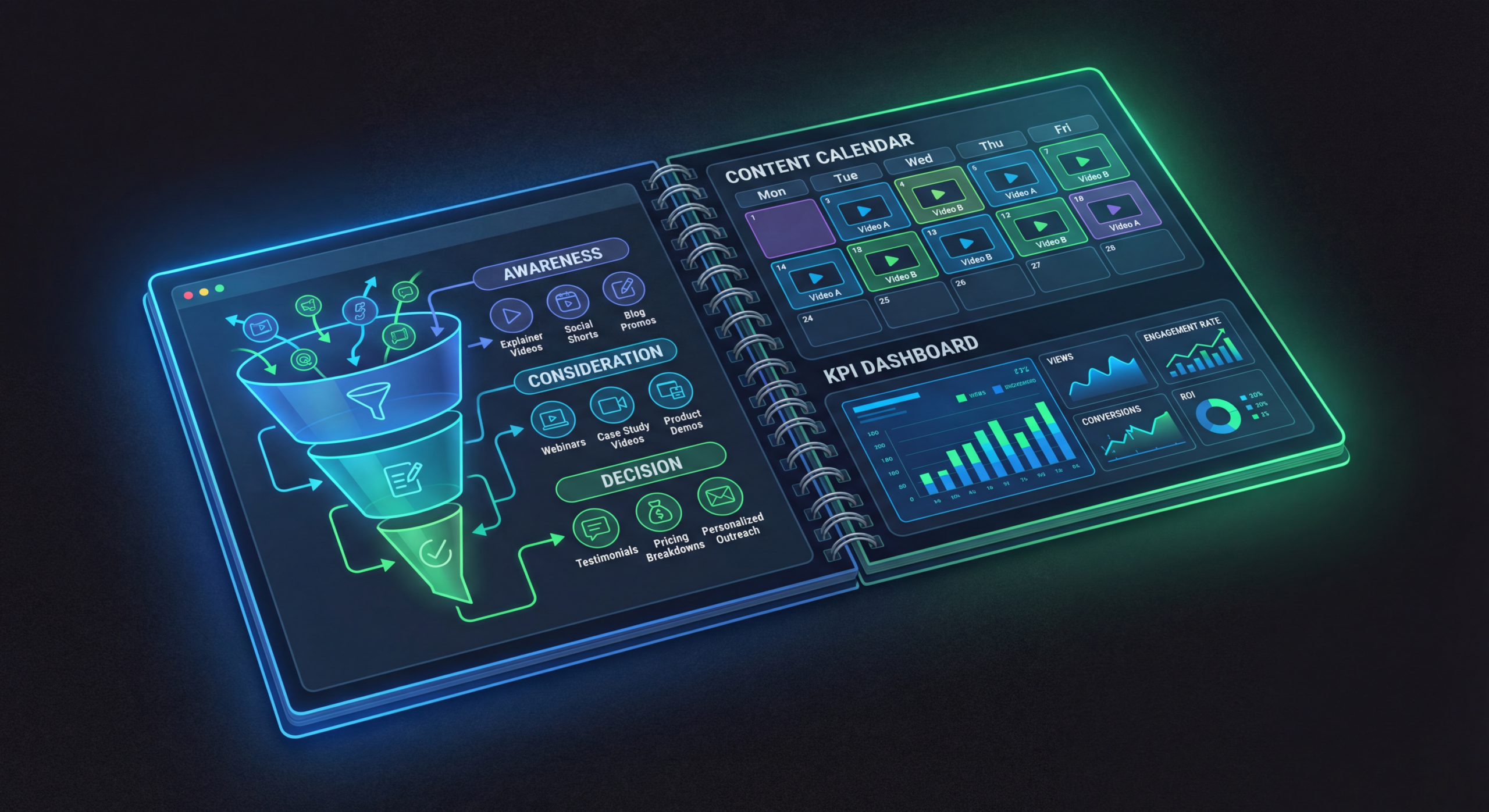
Every video in your B2B video marketing strategy should have a clear job in the funnel. Here's the framework:
Critical insight: Most B2B companies over-invest in awareness-stage video and under-invest in decision-stage video. Flip it. The videos that directly influence closed-won revenue are customer stories and detailed demos. Put 60% of your B2B video production budget on MOFU + BOFU content.
A repeatable production process is what turns B2B video production from chaotic one-off projects into a scalable content engine. Here's the 6-phase framework:
Here's what a realistic B2B video production timeline looks like for a typical project:
For ongoing B2B video production (not one-off projects), the phases overlap. While one batch is in post-production, the next batch is in pre-production. A dedicated team working on retainer can maintain a 2-week turnaround from brief to final deliverable. This is the model we use at VEC—see how it works.
Budget is the most common question (and most common excuse) in B2B video production. Here's the reality:
| Video Type | DIY/In-House | Freelancer | Agency (per unit) |
|---|---|---|---|
| Customer Testimonial | $200–$500 | $800–$2,000 | $500–$1,500 |
| Product Demo | $100–$300 | $500–$1,500 | $300–$800 |
| Animated Explainer | N/A | $2,000–$5,000 | $1,500–$4,000 |
| Thought Leadership Clip | $50–$150 | $300–$800 | $150–$400 |
| Webinar Repurposing (6+ clips) | $200–$500 | $800–$2,000 | $500–$1,200 |
The retainer advantage: Per-unit costs drop 40–60% on a retainer model versus project-based pricing. A team that produces 20+ videos/month for you costs less per video than hiring a freelancer for 5. At VEC, our plans start at $5K/month for dedicated team access—that's $166–$333 per video at volume.
Frame video production as a revenue investment, not a marketing expense:
Stop starting projects without clarity. Our production brief template ensures every video has a clear goal, audience, message, and success metric—before anyone hits record.
Download the Template →The measurement framework that connects B2B video content to revenue. Track these at three levels:
Setup tip: Use UTM parameters on every video CTA link. Integrate your video hosting platform (Vidyard, Wistia, or even YouTube) with your CRM (HubSpot, Salesforce). This lets you see exactly which videos each prospect watched—and attribute revenue accurately.
Filming before defining the goal, audience, and distribution plan is the fastest way to waste budget. Every video needs a brief first.
A $50,000 brand video with cinematic lighting isn't 50× more effective than a well-lit webcam interview. Match production quality to content type. Testimonials can be authentic and raw. Explainers need polish. Not everything needs a film crew.
Every video needs to tell the viewer what to do next. Watch another video. Visit a page. Book a demo. No CTA = no conversion, no matter how good the content.
80%+ of LinkedIn video is watched on mute. No captions = no message. Burned-in captions are table stakes for every B2B video in 2026.
The biggest ROI in B2B video production comes from repurposing. One recording should yield 8–12 assets. If you publish a video once on one platform and move on, you're capturing 10% of its value.
"Post it and they will come" doesn't work. Every video needs a distribution plan: which platforms, what format per platform, paid amplification budget, email/sales integration.
Views are vanity. Pipeline is sanity. If you can't connect video to leads and revenue, leadership will cut the budget. Set up attribution from day one.
We help B2B marketing teams double their video output in 90 days—or month 4 is free. Get a dedicated team that understands your product and your audience.
Book a Strategy Call → See PricingB2B video production costs range from $100–$500 per video for in-house screen recordings to $1,500–$5,000 per video for agency-produced animated explainers. On a retainer model with a dedicated team, costs drop to $150–$400 per video at volume. Most B2B SaaS companies invest $5,000–$16,000 per month for a full video content program that produces 15–40+ assets monthly.
Customer testimonial and case study videos consistently deliver the highest pipeline impact in B2B. They combine social proof with specific results in a format that resonates with multiple stakeholders in the buying committee. Product demos are a close second, especially for SaaS companies where showing the product in action is critical for evaluation-stage buyers.
It depends on the platform and purpose. For LinkedIn, keep videos under 90 seconds. For YouTube tutorials and demos, 5–15 minutes is the sweet spot. Customer testimonials work best at 2–3 minutes. Explainer videos should be 60–90 seconds. The key metric isn't length—it's retention. A 10-minute video where 70% of viewers reach the end is better than a 30-second video where 80% bounce after 5 seconds.
For companies producing fewer than 8 videos per month, one in-house hire may work. But for the 15+ monthly assets needed to build real pipeline impact, a dedicated agency team on retainer is typically more cost-effective. You get strategists, editors, motion designers, and distribution experts for less than two full-time hires, with significantly higher output and no ramp-up time per project.
Measure B2B video ROI at three levels: engagement (views, watch time, completion rate), conversion (CTR, video-sourced leads, landing page lift), and revenue (video-influenced pipeline, attributed closed-won, sales cycle impact). Use UTM parameters on all video CTAs and integrate your video platform with your CRM to track which videos prospects watched before entering your pipeline.
A single B2B video project typically takes 4–6 weeks from brief to published asset: 1 week for strategy and brief, 1–2 weeks for pre-production, 1 week for filming/recording, 1–2 weeks for post-production, and 1 week for review and distribution. With a dedicated team on retainer, ongoing production can achieve 2-week turnaround by overlapping phases across multiple projects.
