What Is a Medical Explainer Video? (2026 Guide)
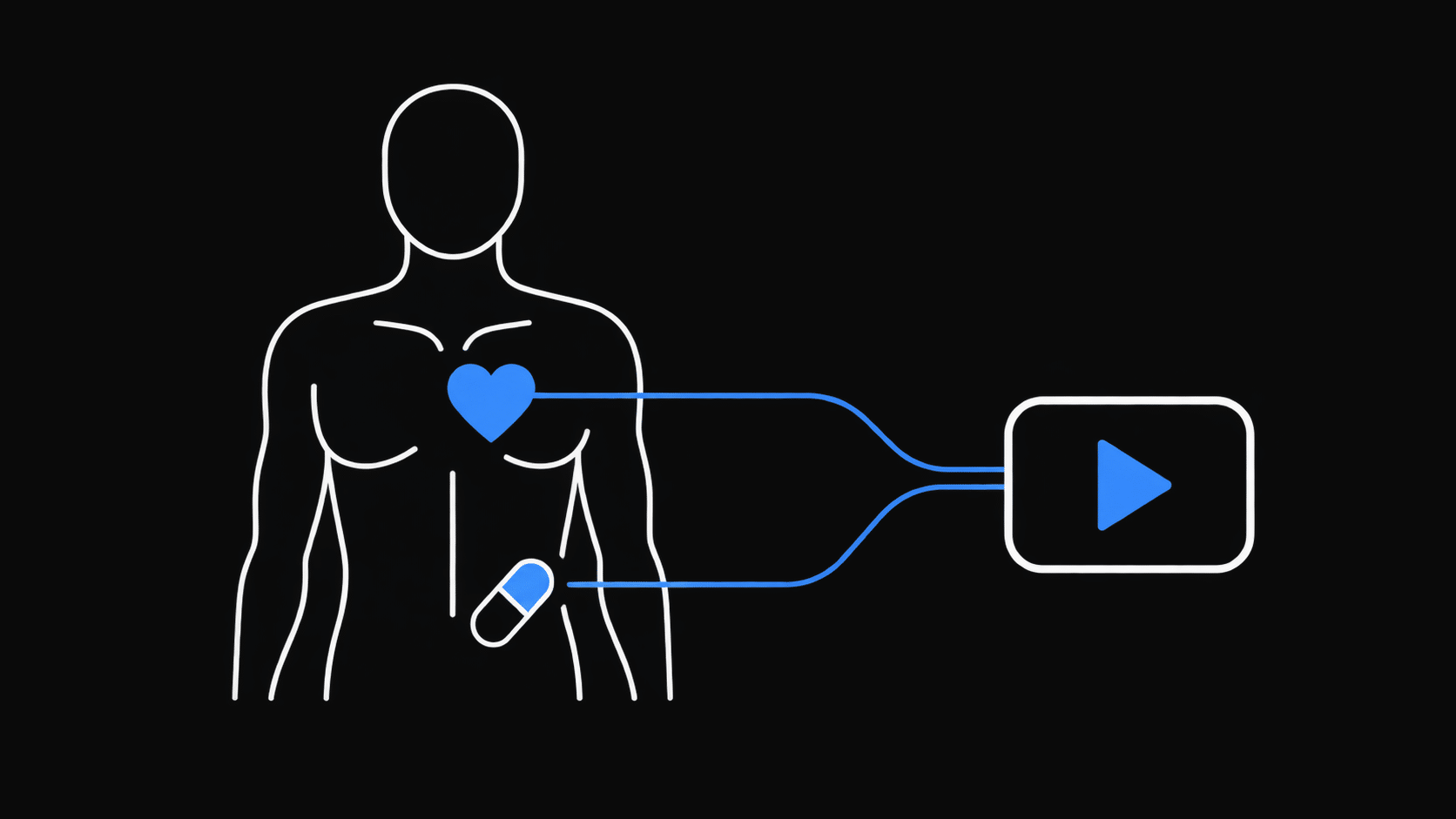
A medical explainer video is a short, scripted video, usually animated, that explains a health condition, treatment, device, procedure or healthcare service in plain language to one defined audience, such as patients, clinicians or healthcare buyers.
Key Takeaways
- One video, one audience. A patient-education video and a clinician-facing product video need different vocabulary, length and proof. Pick one before you write a word.
- Animation is the default for a reason. 2D animation and motion graphics can show what happens inside the body or a device without filming it, and they carry no patient likeness to manage.
- Accuracy has an owner. A clinician or medical-legal reviewer signs off on the script before any visuals are built. Fixing a claim after animation is the most expensive revision there is.
- Compliance shapes the brief. Drug promotion, patient testimonials and captions each trigger specific rules covered below. This guide is not legal advice.
- Cost follows scope, not runtime. Script complexity, number of unique scenes, review rounds and revisions move the price more than minutes.
Written by the VEC Editorial Team. Sources last checked October 24, 2026.
Table of Contents
- What types of medical explainer videos are there?
- Why do healthcare teams use explainer videos?
- Which style fits a medical explainer video?
- How should a medical explainer script be structured?
- What rules apply to medical explainer videos?
- Is a medical explainer the same as a healthtech explainer?
- What does a medical explainer video cost?
- How do you brief and review one?
- Can VEC produce medical explainer videos?
- FAQ
What types of medical explainer videos are there?
Most medical explainer videos fall into five types, separated by who watches them and what they are meant to do afterwards. The type decides the script, the tone and the amount of review the video needs.
Five Types of Medical Explainer Videos
| Type | Main audience | Goal | Review sensitivity |
|---|---|---|---|
| Patient education | Patients and caregivers | Explain a condition, procedure or aftercare | High: clinical accuracy and readability |
| Mechanism of action | Clinicians and prescribers | Show how a drug or therapy works | Very high: regulated promotion rules |
| Medical device or product | Clinicians, procurement | Show what a device does and how it is used | High: claims must match approved labeling |
| Service or practice overview | Prospective patients | Explain how a clinic, program or service works | Medium: pricing and outcome claims |
| Healthcare software or platform | Hospital buyers, practice managers | Explain what a digital product does and why it matters | Medium: security and privacy claims |
The same topic can appear in more than one row. A diabetes program might need a patient-education video for enrollees and a service overview for the employers who pay for it. Treat those as two videos with two scripts, not one video with a compromise voice.
Why do healthcare teams use explainer videos?
Healthcare teams use explainer videos because medical information is hard to absorb as text, and animation can show internal processes that cannot be filmed. The goal is understanding that leads to a decision or an action, not entertainment.
The U.S. Department of Health and Human Services' Healthy People 2030 programme defines personal health literacy as the degree to which individuals can find, understand and use information and services to make health-related decisions, and organizational health literacy as the degree to which organizations make that possible (health.gov literature summary, checked October 24, 2026). Under that second definition, producing a clear explainer is part of how an organization does its job, not only a marketing task.
What a good explainer does that a brochure cannot
It controls pacing, so a viewer sees step one before step two. It pairs narration with a visual, which helps people who struggle with dense text. It can be captioned, translated and reused across a website, a patient portal, a sales deck and a waiting-room screen. And a diagram of what a stent or an infusion pump does is often easier to animate than to film.
Where the video lives decides how it is built
A video for a sales call can carry more product detail than one for a patient portal. A video that autoplays on a landing page needs to make sense in the first few seconds with sound off. Decide the placement first; it sets the length, the captions and the opening frame.
Which style fits a medical explainer video?
For most medical subjects, 2D animation or motion graphics is the best fit, because both can depict anatomy, mechanisms and workflows without live subjects. Live action fits when human presence is the message, such as a clinician introducing a practice.
Medical Explainer Video Styles Compared
| Style | Best for | Watch out for |
|---|---|---|
| 2D character animation | Patient stories, empathy-led education | Character design needs inclusive, careful depiction |
| 2D motion graphics | Mechanisms, workflows, data, software | Can feel clinical if the pacing is cold |
| Whiteboard or hand-drawn | Simple concepts, low-complexity topics | Limited for anatomy or detailed devices |
| Live action | Clinician introductions, facility tours | Releases, consent and likeness management |
| Hybrid (live plus 2D overlays) | A real clinician explaining with diagrams | Two production tracks to coordinate |
If you are weighing animation against filming, our animation vs live action cost comparison lays out where each approach saves or costs more, and 2D animation examples shows what the style looks like in practice. VEC works in 2D and motion graphics and does not produce 3D, so anything that needs a photorealistic 3D organ render is outside what we offer.
How should a medical explainer script be structured?
A reliable structure is problem, mechanism, outcome, next step, written in plain language and kept to one idea per sentence. Plain language is not dumbing down; it is a documented requirement for U.S. federal public content under the Plain Writing Act of 2010 (plainlanguage.gov guidelines, checked October 24, 2026), and the same discipline helps any health audience.
The four-beat structure
- Problem. Name the situation the viewer is in, in their words, not the department's.
- Mechanism. Show what happens, in order, with one visual per step.
- Outcome. Say what the viewer can expect, hedged to what the evidence or approved labeling supports.
- Next step. Give one action: call, book, read the full instructions, talk to your clinician.
Write for the narrator, then cut
Read the script aloud. Anything you stumble over, the narrator will stumble over. Replace jargon with the term a patient would use, or define it once on first use. Keep each sentence to a single thought, and cut any line that does not change what the viewer understands or does. Medical scripts tend to run long because every stakeholder wants a caveat added; resist by moving the legal and safety information into on-screen text and the description, where it can be complete without slowing the narration.
Do not let the visuals promise more than the script
An animation that shows a tidy recovery arc implies an outcome. If the script hedges, the visuals must hedge too. Review the storyboard against the claims list, frame by frame, before animation begins.
What rules apply to medical explainer videos?
Three areas come up most often: regulated promotion of prescription drugs, privacy rules when real patients appear, and accessibility. Which apply depends on what you are promoting, who you are, and where you publish, so treat this section as a checklist of questions for your counsel, not as legal advice.
Prescription drug promotion
In the United States, FDA's Office of Prescription Drug Promotion reviews prescription drug advertising and promotional labeling to make sure the information is not false or misleading (FDA OPDP, checked October 24, 2026). If your explainer promotes a prescription drug, expect the script, visuals and on-screen safety information to go through your regulatory and legal review first.
Patient testimonials and privacy
If a covered entity features a real patient, privacy rules come into play. The HIPAA authorization rule says a covered entity must obtain an authorization for any use or disclosure of protected health information for marketing, with narrow exceptions for face-to-face communication and promotional gifts of nominal value (45 CFR 164.508, via Cornell LII, checked October 24, 2026). Animation sidesteps much of this because no real person appears, but a "story" built from a real patient's details can still raise the question. Our guide to HIPAA and video marketing rules goes through what is generally allowed.
Captions and accessibility
The W3C's WCAG 2.2 success criterion 1.2.2 asks for captions on prerecorded audio content in synchronized media so that people who are deaf or hard of hearing can follow the video (W3C Understanding SC 1.2.2, checked October 24, 2026). For a patient-facing health video, captions are also a practical necessity: many people watch muted, and medical terms are easier to follow when they are on screen.
Pre-Production Compliance Questions
| Question | Why it matters | Who answers it |
|---|---|---|
| Are we promoting a prescription drug or a regulated device? | Triggers regulatory review of claims and safety text | Regulatory affairs or counsel |
| Does a real patient or their data appear? | Privacy authorization and release requirements | Privacy officer or counsel |
| Where will it be published, and in which countries? | Rules and approved language differ by market | Regulatory and legal |
| Are captions and a transcript included? | Accessibility and muted viewing | Producer |
| Who signs off on clinical accuracy? | Names an owner before animation starts | Medical or clinical lead |
Is a medical explainer the same as a healthtech explainer?
No. A medical explainer teaches viewers about a health topic, treatment or device, while a healthtech explainer sells a software product to healthcare buyers. They share a plain-language discipline but differ in audience, proof and call to action.
A medical explainer is judged on whether the viewer understands the subject and acts appropriately. A healthtech explainer is judged on whether a hospital administrator or practice manager understands what the software does, how it fits their workflow and why it is safe to adopt. If you are selling a platform to healthcare buyers, start with our guide to healthtech explainer videos that build trust, which covers security messaging and buyer proof. If you want to see how finished B2B explainers are structured across industries, browse explainer video examples.
Some projects sit in both camps, such as a remote-monitoring product that needs a clinician-facing mechanism video and a patient-facing how-to. Write them as separate videos and share the visual style so the family looks consistent.
What does a medical explainer video cost?
The cost depends on scope, not runtime, and published prices vary widely by studio, so treat any single number you see online as a starting point for a quote rather than a standard. The drivers below move the price most.
What Moves the Price of a Medical Explainer Video
| Cost driver | Pushes cost up | Keeps cost down |
|---|---|---|
| Script complexity | Detailed mechanisms, multiple audiences | One idea, one audience |
| Number of unique scenes | Many bespoke illustrations | Reusable assets and a consistent set of icons |
| Review layers | Clinical, regulatory and legal rounds | One consolidated feedback round per milestone |
| Voice and language | Multiple languages, custom talent | One narrator, captions for other languages |
| Revisions after animation | Script changes late in the process | Locked script and approved storyboard |
| Source assets | Starting from nothing | Existing brand kit, approved diagrams |
For general market ranges across freelancers, studios and subscription teams, see our explainer video cost breakdown, and if the question is whether animation is worth it at all, read is animation expensive?. VEC's own pricing is flat monthly plans, not per-video quotes: Growth is $5K per month, Core is $9.5K and Scale is $16K, and you can see what each includes on the pricing page.
The practical way to control cost is to lock the script early. A script that changes after the storyboard is approved forces rework in every scene it touches. If your product line needs a series, such as several procedure videos in a shared style, a subscription model usually spreads the setup effort better than commissioning each video separately.
How do you brief and review a medical explainer video?
Give the production team five things up front: the audience, the single message, the approved source material, the review chain and the publishing placement. Then run review in stages, so each approval locks something before the next stage starts.
The brief
- Audience: who watches, what they already know, what language level they read at.
- Message: the one sentence the viewer should be able to repeat.
- Source material: approved labeling, clinical references, brand guidelines and any diagrams you already own.
- Review chain: names, roles and the order in which they sign off.
- Placement: website, patient portal, sales deck, conference screen, with the required captions and formats.
The review stages
- Script lock. Clinical accuracy and regulatory review happen here, before any visuals exist.
- Storyboard approval. Check that each frame matches the script and does not imply more than it says.
- Animatic or rough cut. Check timing, narration and on-screen text.
- Final cut. Check captions, safety text, audio levels and export formats.
Consolidating feedback into one document per stage prevents conflicting comments from different reviewers. Our how it works page describes how a dedicated VEC team handles onboarding, review rounds and delivery, and the same structure applies when a healthcare marketing team supplies the script and approved assets.
See what pacing looks like
The clip below is a 2D explainer for a software company, not a medical video. It is included to show the pacing and one-idea-per-scene structure that carry over to health subjects.
Can VEC produce medical explainer videos?
VEC builds dedicated video editing teams for B2B companies, post-production only, and can edit and animate 2D medical explainers from a script, storyboard and approved assets that you supply. We do not shoot footage, produce 3D, or provide clinical or regulatory review, so those pieces stay with your team or specialist partners.
That makes VEC a fit when a healthcare company or healthtech vendor needs a continuous stream of explainers, cut-downs, captions and localized versions rather than a single one-off film. Plans run $5K, $9.5K and $16K per month, with a guarantee to double your video output in 90 days or month 4 is free. If you want to see the kind of work we deliver, our case studies show finished projects, and our guide to what is included in video editing services explains the scope of a retainer.
Frequently Asked Questions
What is a medical explainer video?
A medical explainer video is a short, scripted video, usually animated, that explains a health condition, treatment, device, procedure or healthcare service in plain language to a defined audience. It is built around one message and ends with one clear next step for the viewer.
How long should a medical explainer video be?
Long enough to deliver one idea and no longer. Many teams aim for roughly one to two minutes for a single concept, and longer only when the placement, such as a patient portal or sales call, supports it. Complex topics are often better split into a short series than stretched into one long video.
Is a healthcare explainer video the same as a medical explainer video?
In search and in practice the terms overlap. People who search for either usually want an animated video that explains a health topic or service. The useful distinction is the audience: patient education, clinician education, or healthcare buyers.
Do medical explainer videos need clinical or legal review?
Yes, in most cases. A named clinical or medical reviewer should confirm accuracy at script stage, and regulatory or legal review applies when you promote a regulated product or feature real patients. Ask your counsel which rules apply to your product and market.
Should a medical explainer be animated or live action?
Animated is usually the better choice for explaining internal processes, devices and workflows, because it shows what cannot be filmed and avoids patient likeness issues. Live action fits when a real clinician or facility is the point of the video, and hybrids combine both.
Need Explainer Videos for a Healthcare Brand?
VEC provides dedicated video editing teams for B2B companies, with plans from $5K per month and a guarantee to double your video output in 90 days or month 4 is free. Send us your script and approved assets and we will outline the setup.
Book a Free Strategy Call See Pricing