HIPAA and Video Marketing: What Is Allowed
TL;DR
- HIPAA applies to video marketing when Protected Health Information (PHI) is involved — patient testimonials, identifiable imagery, and analytics tools that link health data to individuals all carry risk.
- Patient video testimonials require HIPAA-compliant written authorization that goes beyond a standard release form.
- Standard analytics pixels (Google, Meta) are not HIPAA-compliant on healthcare pages — they can transmit PHI to third parties without a Business Associate Agreement (BAA).
- Remarketing on health-condition-specific audiences falls into a gray zone regulated both by HIPAA and platform policies.
- Video platforms hosting PHI-adjacent content may need a signed BAA before use.
- This post is educational and does not constitute legal advice. Consult qualified HIPAA legal counsel before making compliance decisions.
Table of Contents
- What HIPAA Actually Governs in a Marketing Context
- Patient Testimonials on Video: What's Permitted
- Patient Imagery and Footage: Where PHI Hides
- Analytics Pixels and Video Platforms: The Hidden Compliance Risk
- Remarketing on Health Topics: Where the Rules Get Murky
- Third-Party Video Platforms and the BAA Requirement
- A Practical Compliance Framework for Health Marketing Teams
- FAQ
Healthcare is one of the highest-value categories for video marketing. Patient outcome stories build trust faster than any white paper. Product demos of health SaaS convert at higher rates when they show real clinical workflows. And video-first content strategies are driving measurable growth across the digital health sector — as covered in our HealthTech video marketing guide.
But HIPAA video marketing is not the same as HIPAA-free video marketing. Healthcare marketers who borrow patient testimonials, embed analytics pixels on health-condition pages, or host clinical content on standard platforms are operating in compliance territory that carries real regulatory risk.
This guide breaks down what HIPAA actually covers, what it permits in a marketing context, and what healthcare marketing leaders need to put in place before hitting publish. No legal advice — just a practical framework your team can apply with counsel's sign-off.
What HIPAA Actually Governs in a Marketing Context
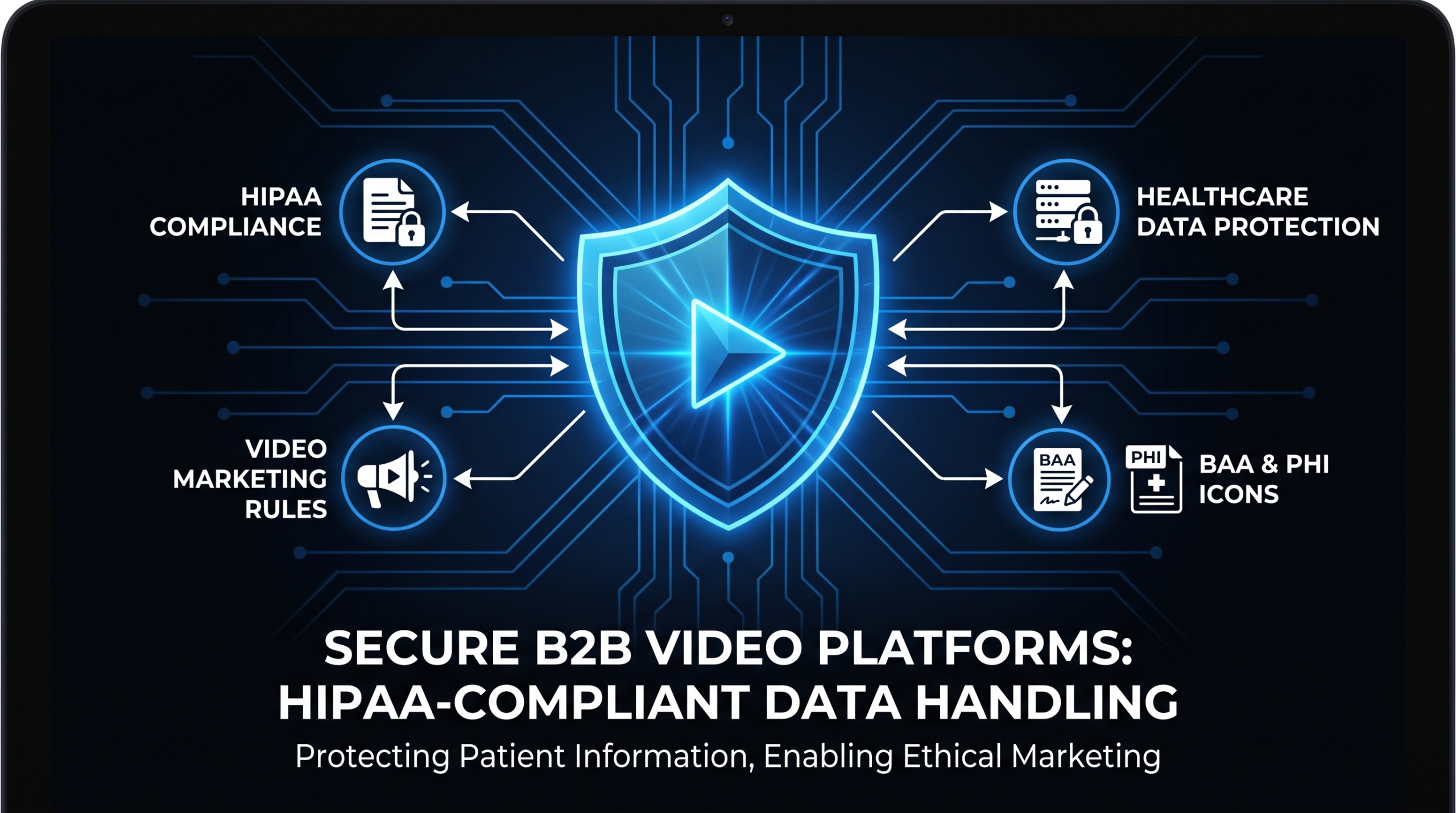
HIPAA — the Health Insurance Portability and Accountability Act — regulates how covered entities and their business associates handle Protected Health Information. The law is widely misunderstood in marketing circles. It does not prohibit healthcare marketing broadly. It restricts specific uses and disclosures of PHI without patient authorization.
Covered Entities vs. Business Associates
HIPAA compliance obligations flow from entity type. Covered entities include healthcare providers who transmit health information electronically (hospitals, physician practices, telehealth platforms), health plans, and healthcare clearinghouses. If your business falls into one of these categories, HIPAA applies to your marketing directly.
Business Associates (BAs) are vendors that handle PHI on behalf of covered entities — analytics platforms, email service providers, video hosting tools, and marketing agencies can all qualify as BAs under the right circumstances. BA obligations are enforceable via a signed Business Associate Agreement (BAA). Without a BAA, a covered entity cannot share PHI with a third-party vendor, including for marketing purposes.
Health SaaS companies occupy a nuanced position. Many are not themselves covered entities, but they may handle PHI on behalf of covered entities and therefore carry BA obligations. Digital health apps that collect patient data are subject to additional FTC rules and state law overlays, even when HIPAA does not directly apply.
What Makes Patient Information "Protected"
PHI is any individually identifiable health information held by a covered entity or BA that relates to: past, present, or future physical or mental health or condition; healthcare provided to the individual; or past, present, or future payment for healthcare. There are 18 identifiers that can make information individually identifiable — name, geographic data, dates of birth, phone numbers, email addresses, and more.
In video marketing, the relevant PHI risk areas are:
- A patient appearing on camera who is identifiable by face, voice, or context
- A patient's name, condition, or treatment mentioned in commentary or captions
- Analytics data that links a user's health-condition page visit to their identity
- Form submissions on health-related pages captured by advertising pixels
Crucially, HIPAA's marketing rule — codified under 45 CFR § 164.508 — specifically requires patient authorization before using or disclosing PHI for marketing communications, with narrow exceptions. Any video marketing activity that involves PHI without valid authorization is potentially a HIPAA violation, regardless of how benign the intent.
Patient Testimonials on Video: What's Permitted
Patient video testimonials are among the most persuasive assets in healthtech marketing. They outperform written reviews because authenticity reads on camera in ways text cannot replicate. But the compliance requirements for HIPAA video testimonials are more demanding than most healthcare marketing teams realize.
Written Authorization Is Not Optional
A standard model release form — the kind a photo agency or ad agency uses — is not sufficient for healthcare video testimonials. HIPAA requires a separate, specific written authorization for uses of PHI in marketing materials. According to HHS guidance on the marketing rule under HIPAA, this authorization must:
- Describe the PHI to be used or disclosed with specificity
- Name the persons authorized to make the disclosure and to whom disclosure may be made
- State the purpose of the use or disclosure
- Include an expiration date or event
- Be signed and dated by the patient (or their personal representative)
- Advise the patient of their right to revoke authorization
- State whether the covered entity is receiving remuneration for the disclosure
A patient who signs this authorization has given consent specifically for that use. If the video will be used in new ways — on a new platform, in a new campaign — additional authorization may be required depending on how the original authorization was scoped.
What a Compliant Patient Video Authorization Covers
Healthcare marketing teams commonly build authorization packages that specify: the video(s) to be produced, the channels on which the content may be distributed (website, paid social, email, trade shows), the duration of use, and whether the covered entity is receiving value in exchange for the testimonial.
The "remuneration" disclosure requirement trips up many teams. If a patient receives anything of value — a gift card, complimentary services, public recognition — that must be disclosed in the authorization. "Value" is interpreted broadly; consult counsel on what qualifies.
Patient Video Use: Compliant vs. Non-Compliant Scenarios
| Scenario | Compliant? | Key Requirement |
|---|---|---|
| Patient testimonial with HIPAA-specific written authorization, scoped to website and paid social | Yes | Valid authorization covering those channels |
| Patient testimonial with standard model release only | No | HIPAA authorization required separately |
| Testimonial repurposed to a new channel not listed in the original authorization | No | New or amended authorization needed |
| Actor playing a patient in a scripted scenario (no real PHI) | Yes | No PHI involved — standard release sufficient |
| Case study video with patient name and diagnosis, authorization expired | No | Expired authorization no longer valid |
| Video featuring anonymized patient story (no identifiers) reviewed by legal | Likely yes | De-identification must meet Safe Harbor or Expert Determination standard |
| Employee testimonial about using the company's own health product | Generally yes | Standard employment release; no PHI from covered entity context |
Patient Imagery and Footage: Where PHI Hides
PHI in video is not limited to what patients say. It includes what the camera captures. Healthcare marketers producing facility tour videos, clinical workflow demos, or patient-experience content need to assess PHI risk before the camera rolls — not after.
Faces, Voices, and Facility Footage
A patient walking through a frame in a hospital corridor is identifiable by face and, in context, by the fact of their presence at that facility. A voice alone can constitute a HIPAA identifier. Even a patient's hand visible in a clinical procedure video can be identifiable if other context narrows down who was treated.
In practice, this means healthcare video productions need pre-shoot PHI audits: which areas of the facility are permissible to film without patient consent, what signage or patient alerts are required, and how footage will be reviewed before use. Many covered entities designate a Privacy Officer to approve marketing video scripts and footage before production begins.
Stock Footage and Actor Alternatives
The most operationally clean approach to patient-facing healthcare video is to avoid real patient footage entirely and use actors or stock footage instead. This eliminates HIPAA risk from PHI in video, though it does not eliminate compliance obligations if the surrounding content (captions, landing page text) includes PHI from real patients.
When accuracy matters — a product demo of actual clinical software, for example — teams commonly film the clinical environment with actors playing patients, or use screen recordings of de-identified or synthetic data environments. VEC's video production team regularly works with healthtech clients to script and produce clinically accurate demos that carry zero PHI risk because no real patient data appears on screen.
Analytics Pixels and Video Platforms: The Hidden Compliance Risk
This is where HIPAA video marketing risk is most frequently underestimated. A healthcare company can have a perfectly authorized patient testimonial, zero real patient imagery, and still create a HIPAA violation through the analytics stack embedded on the page that hosts that video.
How Standard Analytics Tools Create HIPAA Risk
Standard analytics tools — including Google Analytics, Google Ads conversion tags, and Meta Pixel — are designed to collect user behavior data and transmit it to the platform's servers for ad targeting and attribution. When those tools fire on a page that reveals health information (a condition-specific landing page, a treatment overview page, a patient intake flow), they can transmit PHI to a third party.
Under HIPAA's Privacy Rule, transmitting PHI to a third party without a BAA is a violation, even if the transmission happens automatically via a pixel and no human at either company intended to share it. The HHS Office for Civil Rights has issued enforcement guidance on tracking technologies, clarifying that covered entities using tracking technologies on authenticated and unauthenticated web pages that relate to health information must ensure those tools are not transmitting PHI without a BAA — or must remove them from those pages.
The practical implication: standard ad pixels that do not offer a HIPAA-compliant BAA cannot be deployed on health-condition-specific pages by covered entities or their BAs. Many covered entities have responded by removing or significantly limiting tracking on clinical and patient-facing pages, while maintaining tracking on purely marketing and careers pages that carry no health-specific content.
How Video Embeds Compound the Risk
Video platforms embedded via iFrame or JavaScript typically load their own tracking code alongside the video player. A Wistia, Vimeo, or YouTube embed on a health-condition page may fire that platform's analytics independently of any pixel the healthcare company intentionally added. Healthcare marketers commonly overlook this because the platform's tracking is invisible in their own tag management system.
Before embedding any third-party video player on a health-sensitive page, the compliance question is: does this player transmit user data to the platform's servers? If yes, is there a BAA in place? What data does the platform collect?
Video Platform Compliance Considerations for Healthcare
| Platform | BAA Available? | Default Tracking | Healthcare-Safe Default? |
|---|---|---|---|
| Wistia | Yes (enterprise plans) | User engagement, play events | Requires BAA + privacy mode configuration |
| YouTube | No | Extensive (Google ads ecosystem) | No — not suitable for PHI-adjacent pages |
| Vimeo | Case-by-case (enterprise) | Play analytics, viewer data | Consult Vimeo legal + your counsel |
| Loom | No standard BAA | View tracking, engagement | Not suitable for PHI-bearing content |
| Cloudflare Stream | Via Cloudflare BAA | Minimal by default | Possible with Cloudflare enterprise BAA |
| Self-hosted (S3 + CloudFront) | AWS BAA available | None (platform-level) | Yes, with AWS BAA and no third-party player scripts |
Note: Platform BAA availability and terms change. Verify current BAA availability directly with each platform and with your legal counsel before relying on any platform for PHI-adjacent content.
For a deeper view of how video hosting fits into a SaaS marketing stack, see our guide to SaaS video production strategy.
Remarketing on Health Topics: Where the Rules Get Murky
Remarketing — serving ads to users who visited specific pages on your site — is a standard digital marketing tactic. In healthcare, it intersects HIPAA in ways that require careful navigation.
Health Condition Targeting and Sensitive Categories
If your video content lives on a page that implies a health condition (e.g., a page about managing Type 2 diabetes, or a landing page for a fertility clinic), and a standard remarketing pixel fires when users visit that page, you have potentially created a list of people who are identifiable by their health condition. Using that list to serve targeted ads is, under most interpretations, a use of PHI for marketing purposes without authorization.
Both Meta and Google have separately addressed this through their advertising policies. Meta's Special Ad Categories restrict targeting around health and medical topics. Google's restricted data processing mode limits how click and conversion data is handled on sensitive pages. Neither of these platform controls, however, substitutes for HIPAA compliance obligations on the covered entity's side.
What Healthcare Marketers Can Remarket With
The common approach among compliant healthcare marketing teams is to build remarketing audiences from behavior on non-sensitive pages — blog content about general wellness topics, general company information pages, resources that do not imply a specific health condition — while excluding condition-specific clinical and intake pages from pixel tracking entirely.
Video ad remarketing on YouTube or Meta follows the same logic: if the video ad is being served based on a health-condition audience signal, the HIPAA and platform-policy considerations both apply. If the audience is built from behavioral signals on non-sensitive pages, the risk profile is lower — though counsel should validate the specific implementation.
The practical rule many healthcare marketing teams apply: track marketing intent (visited general pricing, careers, blog), not health condition (visited specific disease or treatment page). Keep those two page categories completely separate at the pixel and data layer.
Third-Party Video Platforms and the BAA Requirement
A Business Associate Agreement is a contract required by HIPAA whenever a covered entity shares PHI with a third-party vendor. A BAA does not make a vendor HIPAA compliant on its own — the vendor must also have appropriate safeguards — but without one, the covered entity is exposed regardless of what safeguards the vendor has in place.
When a Video Platform Needs a BAA
A video platform needs a BAA when it will have access to PHI. This applies when:
- The platform hosts video content that includes PHI (patient testimonials, clinical recordings)
- The platform processes analytics that could be combined with PHI to identify individuals
- The platform is used to deliver video communications to patients (telehealth recordings, patient education)
Platforms that host purely marketing content with no real patient data — a brand overview video, a product demo using synthetic data, an animated explainer — generally do not need a BAA because no PHI is being shared with them. The line gets blurry when analytics data from health-condition pages flows to the platform's servers.
Negotiating BAAs with Video Vendors
Enterprise video platforms that offer BAAs typically do so at higher plan tiers. The BAA negotiation covers what PHI the vendor may access, what safeguards they will apply, how they will notify the covered entity of breaches, and what happens to PHI when the contract ends. Healthcare organizations commonly go through a security review process with new video vendors before signing a BAA — expecting documented access controls, encryption standards, and incident response procedures.
If a vendor will not sign a BAA, covered entities have two options: do not use that vendor for any PHI-touching use case, or structure the use case so no PHI is accessible to the vendor. For a video editing partner, this typically means: the agency receives raw footage that has been PHI-reviewed and cleared before delivery, and the agency has signed a BAA covering any residual patient data that may be present.
VEC operates with healthcare clients under BAA arrangements where required, and our dedicated team model is structured to support compliant content workflows — from secure file transfer to privacy-reviewed delivery. See our pricing page for plan details.
A Practical Compliance Framework for Health Marketing Teams
Healthcare marketing teams do not need to stop producing video. They need a compliance process that runs alongside content production — not instead of it. The framework below reflects patterns commonly used by health SaaS and provider marketing teams, validated against HHS guidance. Adapt it with your own legal counsel.
HIPAA Video Marketing Compliance Checklist
- Classify every page on your site as PHI-sensitive or PHI-neutral before placing any pixel
- Remove standard ad pixels (Google, Meta) from all PHI-sensitive pages; replace with HIPAA-compliant alternatives where available and counsel-approved
- Audit every video embed on PHI-sensitive pages — does the player fire tracking code? Is a BAA in place with the platform?
- Establish a HIPAA-specific patient video authorization template (separate from your standard model release)
- Document authorization scope per video asset: channels permitted, expiration, remuneration disclosure
- Build a PHI review step into pre-production for any video shot at a clinical facility or featuring real patients
- Confirm BAA status with any vendor who will receive video files containing real patient footage
- Restrict remarketing audience builds to non-sensitive page behavior only; document exclusions
- Designate a Privacy Officer or compliance contact as part of the video production approval workflow
- Review this framework with qualified HIPAA counsel annually, or after any significant platform or regulation change
HIPAA-Compliant Video Marketing Is Possible — and Competitive
The compliance overhead is real. But healthcare companies that build HIPAA-compliant video marketing workflows gain something competitors often lack: the ability to use authentic patient stories confidently. Properly authorized patient testimonials, clinical workflow demos, and patient-education videos differentiate health brands in ways that stock footage and scripted actors cannot fully replicate.
The investment is in the process — authorization templates, legal review, pixel audits, BAA contracts — not in producing less video. Teams that get the process right produce more compelling content over time, because they are not constantly pulling published assets due to compliance concerns discovered after the fact.
For healthtech marketing leaders building a video content engine, the HealthTech video marketing hub covers broader strategy beyond compliance — content mix, production models, and distribution approaches that work for this vertical. For the operational side — how to hand off raw footage, manage a dedicated editing team, and build consistent output volume — the outsourcing video editing guide is the right starting point.
Disclaimer: This post is for educational purposes only and does not constitute legal advice. HIPAA requirements are complex, fact-specific, and subject to regulatory interpretation that changes over time. Consult qualified HIPAA legal counsel before implementing any compliance program or making decisions based on this content.
Frequently Asked Questions
Do HIPAA rules apply to all healthcare companies doing video marketing?
HIPAA applies directly to covered entities — healthcare providers, health plans, and healthcare clearinghouses — and to their business associates who handle PHI. Health SaaS companies that are not covered entities may not be directly subject to HIPAA, but often carry BA obligations if they handle PHI on behalf of covered entities. Additionally, the FTC has separate rules for health apps and telehealth services that operate outside HIPAA's direct reach. Whether HIPAA applies to your organization is a legal determination — not a marketing one.
Can a healthcare company use a patient testimonial video it produced before knowing HIPAA authorization was required?
A video produced without proper HIPAA authorization cannot be legally published or continued in use by a covered entity if it contains PHI. The organization has two options: obtain retroactive authorization (which requires the patient's current, voluntary agreement) or discontinue use of the video. Continuing to use an unauthorized patient testimonial is a HIPAA violation regardless of when it was produced. Legal counsel should advise on any remediation steps and any breach notification obligations that may apply.
Is YouTube safe to use for healthcare video marketing?
YouTube is appropriate for healthcare marketing content that does not involve PHI — general health education, company overviews, animated explainers using no real patient data. YouTube does not offer a HIPAA BAA, so it is not suitable for content that includes identifiable patient information or for embedding on pages that handle PHI. Additionally, YouTube's advertising ecosystem connects view behavior to Google's ad targeting infrastructure, which creates tracking risk on health-condition-specific pages. Many covered entities use YouTube for top-of-funnel awareness content and self-hosted or BAA-covered platforms for any patient-specific content.
What does "de-identified" patient data mean in a video context?
Under HIPAA, information is de-identified if it meets either the Safe Harbor method (all 18 specified identifiers removed and no actual knowledge that remaining information could re-identify the individual) or the Expert Determination method (a qualified statistician certifies that re-identification risk is very small). In video, de-identification might mean blurring a face, altering a voice, removing all name references, and ensuring the clinical context does not narrow down who the patient is. True de-identification in video is technically demanding — consult your Privacy Officer and legal counsel on whether a specific piece of footage meets the standard before publishing.
Do video editing agencies need to sign a BAA with healthcare clients?
If a video editing agency receives raw footage or other content that contains PHI — identifiable patient faces, health condition references, clinical data visible on screens — the agency is functioning as a business associate and a BAA is required before the covered entity can share that material. The BAA obligates the agency to protect the PHI, report breaches, and return or destroy PHI at contract end. If the footage has been reviewed and cleared of all PHI before delivery, a BAA may not be required — but confirming this with legal counsel before file transfer is the standard practice for compliant healthcare video production partnerships.
Building a Video Content Engine for HealthTech?
VEC works with digital health companies and health SaaS teams who need consistent, high-quality video output — from product demos and patient education content to brand films and sales enablement videos. Our dedicated editing teams operate within compliant content workflows and can work alongside your legal and privacy teams.
Book a Free Strategy Call See How It Works See Pricing