Healthtech Explainer Videos That Build Trust
TL;DR
- Healthtech explainer videos fail when they prioritize product features over patient or clinician outcomes — trust is built by leading with problems, not solutions.
- The most effective structure follows a 4-part framework: Acknowledge the pain → Explain the mechanism → Demonstrate the evidence → Remove the risk.
- Compliance considerations (HIPAA, FDA, FTC) are not optional — they shape script, visuals, and claims from the first draft.
- Animated videos outperform live-action for complex mechanism explanations; live-action wins for testimonials and clinician credibility.
- Distribution to health-industry buyers requires a different channel mix than standard SaaS — LinkedIn, medtech conferences, EHR marketplaces, and direct outreach each serve distinct funnel stages.
Table of Contents
Most healthtech companies produce explainer videos the same way a SaaS productivity tool does: feature tour, logo animation, upbeat music, call to action. Then they wonder why clinicians, hospital administrators, and health system procurement committees aren't converting.
The health industry operates under a fundamentally different trust calculus. Your buyer — whether a CMO evaluating a remote patient monitoring platform or a hospital CFO reviewing a claims automation solution — is conditioned to be skeptical. They have seen vendor after vendor promise to "transform patient outcomes." They have signed contracts with companies that underdelivered. They answer to regulators, insurers, and in many cases, directly to patients. A glossy explainer video that reads like a pitch will not close that gap.
This guide covers what actually works: the structural frameworks, script patterns, compliance guardrails, production decisions, and distribution strategies that help healthtech marketers produce explainer videos their buyers trust enough to act on. For broader context on the video marketing strategy for healthtech companies, start there first — this post zooms in specifically on the explainer video format.
Why Healthtech Explainer Videos Are Different — and Why Most Fail
A healthtech explainer video has the same surface goal as any B2B explainer: make a complex product understandable in 90–180 seconds. But the stakes and the audience dynamics are fundamentally different in two ways.
The Credibility Gap Is Larger
Health industry buyers have been burned by vendor promises disproportionately more than buyers in other verticals. EHR implementations that took years and cost multiples of budget. Clinical decision support tools that clinicians ignored. Patient engagement platforms with low adoption rates. This history means your explainer video enters a context of earned skepticism. Claims that would land as compelling in a SaaS growth context ("save 40% on administrative overhead") land as suspect in a hospital procurement context unless they're backed by something verifiable.
The implication for your video: every claim needs a source, a hedge, or a story. Preferably all three.
The Buyer Committee Is More Complex
Healthcare decisions almost never have a single buyer. A hospital health IT platform evaluation might include the CMIO, CNO, IT security team, compliance officer, CFO, and clinical champions who will actually use the system. Each has a different concern. Clinicians want to know if it disrupts their workflow. IT wants to know about integrations and security. Finance wants ROI clarity. Compliance wants to know about HIPAA and liability.
A single 90-second explainer can't speak to all of these — but it can be architected so that the primary message lands for your main buyer persona, with secondary content (longer versions, clinical proof modules, security one-pagers) available for the rest of the committee. The explainer is your door-opener, not your full sales deck.
The Most Common Failure Modes
- Leading with the product, not the problem. "Our AI-powered platform integrates with your EHR to automate prior authorization" tells the buyer what you built. It does not tell them what you understand about why prior authorization is destroying their team's time.
- Making unsubstantiated outcome claims. "Our platform reduces readmissions by 23%" sounds specific and compelling — but without a citation, it reads as invented. Health buyers know the difference.
- Using generic healthcare visuals. Stock footage of stethoscopes, doctors in white coats, and abstract data dashboards signals that you don't understand their specific context. A hospital administrator watching a prior auth automation video wants to see something that looks like their billing department, not a hospital from a Getty Images search.
- Missing the "so what" for the buyer's accountability. Health industry buyers are often evaluated on safety, compliance, and quality metrics — not just efficiency. Explainer videos that only speak to speed or cost miss the deeper drivers of their decisions.
The 4-Part Framework for a Trustworthy Healthtech Explainer
The most effective healthtech explainer videos follow a specific narrative architecture. It is not the standard "Problem → Solution → Features → CTA" structure that works in horizontal SaaS. It goes deeper on problem acknowledgment and evidence before asking for anything.
Part 1: Acknowledge the Pain With Specificity
Open by naming the problem in the buyer's language, not yours. Not "healthcare administrative burden" but "your billing team is spending three hours per case manually tracking prior authorization status — time they don't have." The specificity signals that you understand their world. Vague pain statements feel like a vendor guessing; precise ones feel like a peer observing.
The best healthtech explainers spend 20–30% of their runtime on the problem, which feels counterintuitive if you've been coached to "get to the solution fast." But in health, showing you understand the problem deeply is itself a trust signal. It says you've been in the room. You've talked to their people.
Part 2: Explain the Mechanism, Not Just the Outcome
Health industry buyers are trained to ask "how does it actually work?" before they believe any outcome claim. The mechanism explanation is what transforms a "sounds interesting" into a "I understand why this would work." For a clinical decision support tool, that means briefly showing the data sources, the model architecture at a high level, and the clinical workflow touchpoints — not just "our AI analyzes patient data to flag risk."
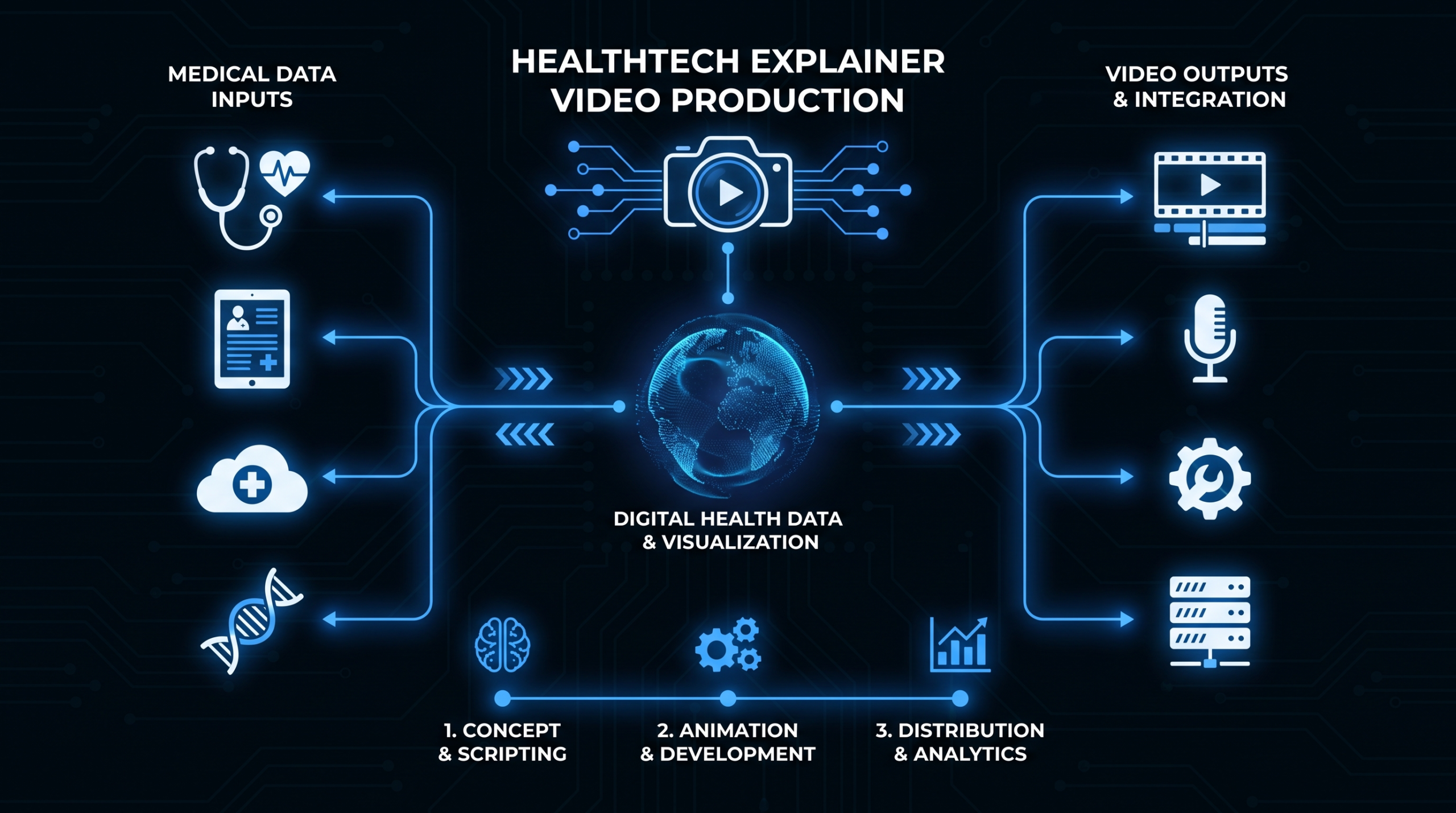
Animation is often the best format for mechanism explanations because it can visualize processes (data flows, signal detection, workflow automation) that are impossible to show with live footage. This is one reason animated explainers tend to outperform live-action for the explanation phase of a healthtech video.
Part 3: Demonstrate the Evidence
This is where healthtech explainers diverge sharply from standard B2B video. A brief, specific evidence moment — a named pilot result, a peer institution's experience, a quote from a named clinician — dramatically increases credibility. "A regional health system using our platform reported a 30% reduction in prior auth turnaround time in their first 60 days" (cited, named, specific) outperforms "companies using our platform save significant time." The evidence does not need to be exhaustive; one concrete data point, properly attributed, is worth ten vague claims.
If you don't have publishable outcomes data yet, a clinical advisor or health system design partner quote serves the same function. The buyer is not looking for a peer-reviewed study in an explainer video — they're looking for evidence that someone like them has tried this and it worked.
Part 4: Remove the Risk
Healthcare procurement carries significant change risk. Every buying decision has a downside scenario the buyer is managing against: implementation failure, clinician revolt, regulatory exposure, vendor lock-in. The close of your healthtech explainer should speak directly to the risk removal story — implementation support, integration guarantees, security certifications, pilot-first engagement models. This is not the same as a generic "we make it easy to get started." It's a direct acknowledgment that switching costs are real and you have a plan for them.
Script Flow for a Skeptical Health-Industry Audience
The best healthtech explainer scripts share a specific sentence-level rhythm. Here is how the flow maps to timing for a 2-minute video:
Healthtech Explainer Script Flow — 2-Minute Version
| Segment | Time Range | Purpose | Tone |
|---|---|---|---|
| Pain hook | 0:00–0:20 | Name the problem in buyer's language | Empathetic, observational |
| Stakes escalation | 0:20–0:35 | Show what happens if the problem goes unsolved | Honest, non-alarmist |
| Product introduction | 0:35–0:50 | Name the product + category + primary mechanism | Confident, specific |
| Mechanism walkthrough | 0:50–1:20 | Show how it works (3–4 core steps) | Clear, visual-led |
| Evidence moment | 1:20–1:35 | One specific outcome, attributed | Credible, understated |
| Risk removal + CTA | 1:35–2:00 | Address implementation concern + clear next step | Reassuring, action-oriented |
Words to Avoid in Healthtech Explainer Scripts
Certain phrases are automatic credibility destroyers in health industry video because they have been used so many times they have become invisible — or worse, trigger skepticism.
- "Transform patient outcomes" — overused to the point of meaninglessness. Name the specific outcome you affect.
- "Seamless integration" — every healthcare vendor promises this; no buyer believes it without specifics (which EHRs? which HL7 version? which API protocol?).
- "AI-powered" without mechanism — say what the AI does, not just that it exists.
- "Comprehensive solution" — signals you are not sure what your product actually does better than anything else.
- "World-class" / "best-in-class" / "industry-leading" — unverifiable superlatives that busy health buyers have learned to tune out.
Words and Phrases That Land in Health Industry Video
- Specific clinical or operational context: "in a 200-bed community hospital," "for care managers handling complex chronic cases"
- Integration specificity: "built on FHIR R4," "native Epic integration," "HL7 2.x compatible"
- Risk anchoring: "pilot before you commit," "no long-term contract required in the first 90 days," "SOC 2 Type II certified"
- Outcome with attribution: "one health system in their first quarter reported…" with a source or case study link
The goal is the language of someone who has spent time in their environment — not the language of a vendor who has spent time in a sales training.
Compliance Considerations You Cannot Skip
Every healthtech explainer video that makes a clinical or operational claim operates inside a regulatory framework. Ignoring this is not a creative shortcut — it is a liability. Here is the landscape every healthtech marketing leader needs to understand before finalizing a script.
Compliance Framework by Healthtech Category
| Product Category | Primary Regulatory Body | Video-Specific Constraint | Safe Framing Approach |
|---|---|---|---|
| SaMD / medical device software | FDA (21 CFR Part 820 / 830) | Intended use claims require cleared/approved language; off-label claims prohibited | Match script claims exactly to cleared intended use; include indicated use statement |
| Clinical decision support | FDA (non-device CDS pathway) | If video implies "diagnosis" or "treatment recommendation," may trigger device classification | Frame as "information for clinician review," never as autonomous clinical decision |
| Health SaaS (non-device) | FTC (advertising claims), HHS/OCR (HIPAA) | Outcome claims must be substantiated; no patient identifiers in visuals | Cite source for every specific outcome claim; use de-identified or synthetic patient data in demos |
| Remote patient monitoring | FDA (if device-connected), CMS (reimbursement claims) | Reimbursement/billing claims (CPT codes, coverage) must be accurate and current | Add "billing codes subject to payer policy" disclaimer; review CPT accuracy quarterly |
| Behavioral health / mental health tech | FTC, state licensing boards | Efficacy claims for mental health interventions require clinical backing | Cite peer-reviewed evidence or IRB-approved study; avoid "treats" or "cures" language |
The Practical Compliance Review Process
Most healthtech companies with a mature marketing function have a legal-medical-regulatory (LMR) review process for any public-facing content. For explainer videos, the review checkpoint should happen at two stages: script approval (before any production spend) and final cut approval (before distribution). Catching a non-compliant claim at the script stage costs a rewrite; catching it after the video is produced and voiced costs a full reshoot of affected scenes.
For teams building this process for the first time, the key elements are: a compliance checklist aligned to your specific product classification, a named approver with regulatory authority, a version-controlled review log, and a shelf-life policy (because regulatory guidance changes, and a video that was compliant in 2024 may not be compliant in 2026).
HIPAA and Patient Data in Video
Never use real patient data, real patient imagery, or screen recordings containing protected health information (PHI) in a healthtech explainer video — even in a blurred or cropped form — without explicit HIPAA-compliant authorization. This applies equally to demo walkthroughs, before/after dashboards, and clinical workflow recordings. Use synthetic or de-identified data sets for all in-product demonstrations, and document that the data is synthetic in your internal review process.
Production: Format, Length, and Style Decisions
The right production choices for a healthtech explainer depend on your product type, your primary buyer persona, and where the video will live in your funnel. There is no single right answer — but there are well-established patterns that reduce production risk.
Animated vs. Live-Action: When to Use Each
Animated vs. Live-Action for Healthtech Explainers
| Format | Best For | Healthtech Use Case | Typical Cost Range |
|---|---|---|---|
| 2D animation | Mechanism explanations, data flows, process walkthroughs | AI diagnostic pipeline, prior auth automation, care coordination workflow | $8K–$25K for 90–120 sec |
| Motion graphics + screen recording | SaaS UI walkthroughs with annotation | EHR dashboards, telehealth platforms, revenue cycle management UIs | $4K–$12K for 90–120 sec |
| Live-action (professional shoot) | Clinician credibility, testimonials, culture/mission stories | CMO endorsement, clinical champion testimonial, patient outcome story | $10K–$40K depending on location and crew |
| Hybrid (animation + live) | Mechanism + human credibility in same piece | Remote patient monitoring: animated data flow + real clinician voiceover | $15K–$35K for 2–3 min |
For a full breakdown of what drives production costs across these formats, see our explainer video cost breakdown guide. For healthtech companies evaluating their full video production budget, our healthtech video production cost guide covers the complete picture including clinical validation videos, conference content, and sales enablement assets.
Length Guidelines by Funnel Stage
Health industry buyers are not short on patience for content that is relevant to their decision. The "keep it under 90 seconds" rule that dominates B2C video thinking does not apply the same way in B2B healthtech. Procurement committees watching a product overview in an evaluation context will engage with a 3–4 minute video if it answers their specific questions.
- Top-of-funnel (awareness, LinkedIn, conference): 60–90 seconds. Problem-focused, no deep product detail, strong visual hook.
- Mid-funnel (website homepage, email outreach): 90–150 seconds. Full trust framework (see §2), one evidence moment, clear CTA.
- Bottom-of-funnel (RFP support, procurement decks): 3–5 minutes. Full mechanism walkthrough, multiple evidence points, compliance and security context, integration details.
Voice and Music Choices
Health industry video has a distinct audio aesthetic. The upbeat corporate pop tracks and fast-paced energetic narration that work in productivity SaaS video feel jarring in a clinical context. Health buyers respond better to measured pacing, authoritative but warm narration voices, and ambient or minimal orchestral music beds. When in doubt, err toward understatement — a calmer voice signals confidence, not timidity.
For AI voiceovers: the gap between synthetic and professional human voices has narrowed significantly, but health industry buyers — particularly clinicians — are still more attuned to "uncanny valley" audio than most audiences. If budget allows, invest in a professional human voiceover for your primary healthtech explainer video. It signals quality that extends to your product's credibility.
Distribution Strategy: Where Healthtech Explainer Videos Actually Convert
The distribution strategy for a healthtech explainer video is substantially different from standard B2B SaaS because the buyer population is more fragmented, more relationship-driven, and more resistant to standard digital advertising channels.
Channels That Work — and Why
LinkedIn (organic + paid): The highest-concentration channel for health system leaders, health IT decision-makers, and medtech executives. Organic posts featuring a short (60-second) version of your explainer with a hook-first caption consistently outperform blog post links for engagement. Paid LinkedIn video ads targeting by job title (Chief Medical Officer, VP of Clinical Informatics, Health IT Director) and company size work for awareness; they rarely drive direct demo requests but warm audiences for outbound follow-up.
Email sequences: Embedding a video thumbnail (linked to a landing page with the full video) in a cold outreach sequence typically improves reply rates compared to text-only sequences. The key is context: the email should explain why this specific person is receiving this specific video. Generic "watch our explainer" emails land in trash. Personalized "given that your health system is expanding into value-based care contracts, this 2-minute overview of how we help care coordination teams manage complex patients may be relevant" emails open.
Healthcare conference and event environments: HIMSS, ViVE, HLTH, and similar events are still among the highest-leverage distribution channels for healthtech video. A looping version of your explainer at a booth, a QR code linking to the full video on a physical leave-behind, or a post-conference email sequence featuring the video to everyone you scanned — all of these drive qualified engagement from buyers who are already in evaluation mode.
EHR and health IT marketplaces: Epic App Orchard, Cerner Store, and similar marketplaces increasingly support video content. A well-produced 90-second explainer embedded on your marketplace listing differentiates you from text-only competitors and gives evaluators a visual context they can share with colleagues without scheduling a demo.
Sales enablement: This is often the most overlooked distribution channel. Your sales team sending a relevant explainer video as a follow-up to a discovery call — timed to the specific objection or question the buyer raised — is one of the highest-conversion uses of healthtech video. Unlike a generic nurture email, a video link with a note like "you mentioned your team was concerned about EHR workflow disruption — this 90-second walkthrough shows exactly how the integration works" answers the specific question while maintaining the human relationship.
For a full strategic overview of how healthtech companies structure their video marketing across the entire funnel, see our healthtech video marketing guide.
Where Video Usually Underperforms in Healthtech
- YouTube (organic): Low health-industry buyer concentration; works for patient education content but not B2B healthtech explainers targeting procurement committees.
- Instagram and TikTok: Wrong audience demographics for enterprise health IT buyers, though consumer healthtech (wellness apps, patient-facing tools) may see engagement.
- Display retargeting: Health system IT teams often operate on restricted networks with ad blockers; display reach is lower than in other verticals.
Measuring Healthtech Explainer Video Performance
The metrics that matter for a healthtech explainer video are different from standard engagement metrics. Watch-through rate to 75% is more meaningful than total views. Video-to-demo-request attribution (trackable with UTM parameters and a dedicated landing page per video version) is more meaningful than likes and shares. Wistia's research on business video engagement (published on the Wistia Learning Center) and the annual Wyzowl State of Video Marketing report both provide useful benchmarks for B2B video performance that you can adapt to your healthtech context.
Building a Healthtech Video Library That Compounds
The highest-performing healthtech marketing teams don't think about explainer videos as one-off production projects. They build a structured video library that covers multiple buyer personas, multiple funnel stages, and multiple objection categories — and each video reinforces the others.
The Core Healthtech Video Library (Priority Order)
- Primary product explainer (90–120 sec): Your door-opener. One video, one primary buyer persona, the full trust framework. This is the video you reference in every other channel.
- Clinical workflow walkthrough (2–3 min): A deeper-dive video for clinician evaluators. Shows the product in their specific workflow context, not a generic demo. Often the most-viewed video in a late-stage evaluation.
- Integration and security overview (60–90 sec): Addresses the IT and compliance buyer. Covers EHR integrations, security certifications, data handling. Often the video the CISO watches before signing off.
- Clinical evidence / case study video (90–150 sec): One or two named health system outcomes, narrated by a clinical champion or animated with specific data. The video that gets shared inside a health system during internal evaluation.
- Implementation and onboarding overview (60–90 sec): Directly addresses the "implementation is our biggest risk" objection. Shows the go-live process, timelines, support structure, and what happens if something goes wrong.
VEC works with healthtech companies at Series A through growth stage to build this kind of structured video library — not as a one-time project but as an ongoing production capacity. Our dedicated team model means the same editors who built your primary explainer also build your clinical walkthrough and your case study video, so the visual language stays consistent across the library. See our pricing page for how teams are structured, or review our approach to SaaS video production for the broader methodology.
Repurposing Your Healthtech Explainer Across Formats
A well-produced 2-minute healthtech explainer is not a single asset — it's a source file for multiple derivative formats:
- 60-second LinkedIn cut: Opening problem + product name + one evidence moment + CTA. Optimized for autoplay, no sound required for the first 5 seconds.
- GIF or animated still for email: A 3–5 second loop from the most visually compelling section of the video, used as a thumbnail in email sequences.
- Audio-only export for podcast outreach: Some health industry podcasts (particularly physician and health IT podcasts) accept client-supplied audio content for sponsorship formats.
- Slide-adapted stills for conference decks: The visual frames from your animated explainer translate directly into presentation-ready graphics for pitch decks and conference presentations.
The marginal cost of producing these derivative formats from an existing master file is dramatically lower than producing them independently. Planning for derivatives at the production stage — capturing higher-resolution exports, saving source files, briefing the editor on which segments will be repurposed — is the difference between a $15K asset and a $15K asset that does the work of $40K in production.
For teams considering whether to handle this in-house or outsource it, our guide on how to outsource video editing covers the decision framework in detail, including what to keep in-house and what to hand off for efficiency.
Frequently Asked Questions
How long should a healthtech explainer video be?
For a primary top-to-mid-funnel explainer, 90–150 seconds is the standard range for health industry B2B buyers. Awareness placements (LinkedIn, conference) work best at 60–90 seconds; late-stage evaluation content (website, sales follow-up) can extend to 3–5 minutes if it is answering specific evaluation-stage questions. The key variable is not time but information density — a 90-second video that answers the buyer's three core questions outperforms a 3-minute video that repeats the same point in different ways.
Do healthtech explainer videos require legal or compliance review?
Yes, any healthtech video making clinical or operational outcome claims should go through legal-medical-regulatory (LMR) review before publication. The specific requirements depend on your product classification — SaMD and FDA-cleared products have stricter constraints than general health SaaS tools. At minimum, every specific claim in the script should have a source or a hedge, and any in-product screen recordings should use synthetic or de-identified patient data to avoid HIPAA exposure. Build LMR review into your production calendar as a non-negotiable checkpoint at script approval and final cut.
What does a healthtech explainer video cost to produce?
Production costs vary widely by format and complexity. A professional 2D animated healthtech explainer typically ranges from $8K–$25K for a 90–120 second piece from a specialist agency. Motion graphics with screen recording runs $4K–$12K for the same length. Live-action with a professional shoot starts around $10K and scales with location, crew size, and talent. These are market ranges, not fixed prices — see our detailed explainer video cost breakdown for a full factor-by-factor analysis.
Should we use animation or live-action for our healthtech explainer?
Use animation when you need to visualize a mechanism, process, or data flow that can't be filmed — AI diagnostic logic, care coordination workflows, claims automation pipelines. Use live-action when you need human credibility — a named clinician endorsing the product, a patient outcome story, a CEO message. Hybrid formats (animated mechanism + real clinician voiceover or on-camera moment) are increasingly common and often outperform pure animation or pure live-action because they pair mechanism clarity with human trust signals.
How do we measure the ROI of a healthtech explainer video?
Track three levels: engagement (watch-through rate to 75%, video completion), pipeline attribution (demo requests from video-led landing pages, sales outreach videos that generated responses), and deal influence (was the video viewed before or during an evaluation that converted). UTM tracking on every video link and a dedicated landing page per video version gives you the data to calculate pipeline contribution. Wistia's engagement analytics and HubSpot video tracking both integrate well with standard health IT CRM stacks for this purpose.
Ready to Build a Healthtech Explainer That Actually Converts?
VEC's dedicated teams specialize in B2B video for health-industry buyers — structured frameworks, compliance-aware scripts, and production quality that signals credibility to skeptical procurement committees. Talk to our team to see how we've helped healthtech companies at Series A through growth stage build video libraries that accelerate their sales cycle.
Book a Free Strategy Call See Pricing & Plans