2D Animation Examples for Business (+ Cost)
TL;DR
The 4 main 2D animation styles for business are flat design, character animation, isometric, and cutout. A 60–90 second professional video typically costs $2,500–$15,000 depending on style and studio tier. This page shows 6 real B2B examples you can watch right now — Dropbox, HubSpot, Slack, Headspace, and Freshworks — with a cost table by hiring model and a framework for choosing the right style.
Table of Contents
Key Takeaways
- 4 core 2D styles appear in business video: flat design, character animation, isometric, and cutout — each with distinct production timelines, costs, and use cases.
- $3,000–$8,000 per 60-second video is the mid-market range for professional flat design 2D animation from an established studio.
- Flat design dominates SaaS explainers — fastest to produce, lowest cost, most legible at mobile sizes, and easiest to update as products evolve.
- Character animation drives higher watch time and brand recall in B2B content, according to industry practitioners; it works best for emotional narratives and customer journey stories.
- 5–7 business days is a realistic turnaround for a 60-second flat design explainer at a professional studio; character animation typically requires 3–6 weeks for the same length.
- See full per-minute cost tables in our guide to 2D animation production cost.
What Is 2D Animation, and Why Do B2B Companies Use It?
2D animation renders characters, objects, and environments in a flat two-dimensional plane. Unlike 3D, nothing is modeled, lit, or rendered volumetrically — everything is drawn or assembled as flat layers and animated using keyframes, rigging, or path-based motion in tools like Adobe After Effects, Animate, or Toon Boom Harmony.
B2B companies use 2D animation because it solves a communication problem live action cannot: you cannot film a concept, an integration flow, or a future state of software. A product screen recording shows the UI, but it cannot convey what a team's entire workflow looks like before and after your product enters the picture. Animation can — efficiently, at any level of abstraction, and without a crew, location, or casting budget.
The economic case is just as strong. A 60-second flat design 2D explainer typically costs $3,000–$8,000 and can remain evergreen for 2–3 years. A comparable live-action shoot — crew, location, talent, post-production — commonly runs $10,000–$30,000 for similar visual quality. Wyzowl's annual video marketing report consistently finds that B2B buyers prefer video over text-only content when evaluating complex products, which is why animated explainers remain a core format across SaaS content programs.
2D animation also fits cleanly into SaaS video production workflows. Deliverables can be resized for any platform — LinkedIn 1:1, YouTube 16:9, Instagram 9:16 — without the reshooting constraints of live action. Source files are editable, so when your product changes, you update the animation rather than rebuild from scratch. For a full overview of what animation services include at each production tier, see our guide to video animation services.
What Are the 4 Main Types of 2D Animation Style for Business?
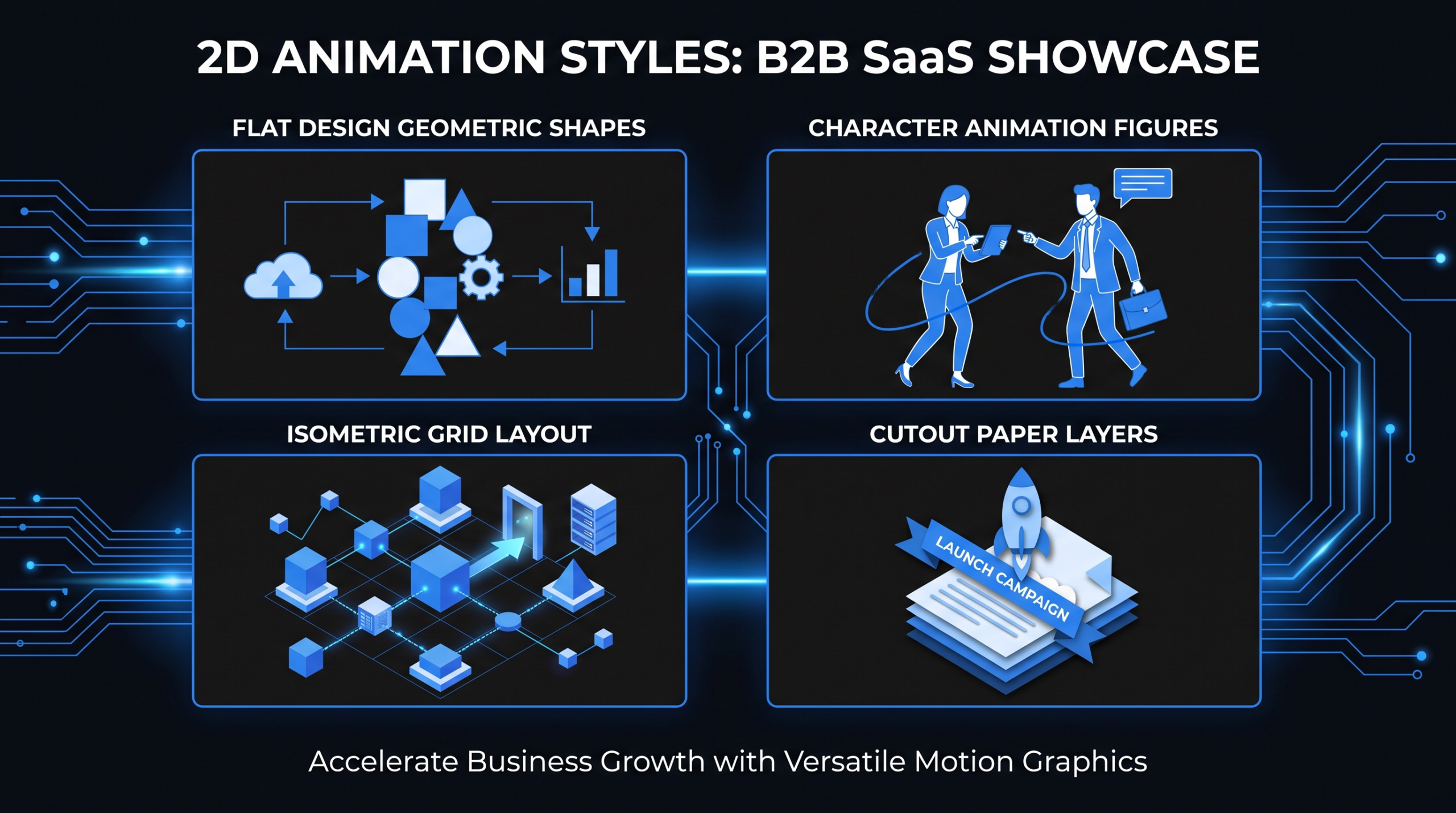
The term "2D animation" covers a range of visual approaches with very different cost profiles, production timelines, and best uses. Here are the four styles you will encounter most often in B2B content — each shown with a real, watchable example.
1. Flat Design Animation
Flat design animation uses geometric shapes, solid colors, and minimal gradients — no depth cues, no textures, no shadows. Characters are simplified; backgrounds are clean. Motion comes from smooth transitions, shape morphing, and kinetic typography rather than character performance.
This is the default style for SaaS explainer videos because it is fast to produce, cost-efficient, easy to update, and highly legible at small screen sizes. Most explainer video examples published by tech companies since 2015 use some variation of flat design. It also pairs naturally with corporate animation projects that prioritize clarity and information density over emotional storytelling.
Typical cost: $2,500–$8,000 per 60-second video at a professional studio. Fastest production cycle — studios commonly deliver in 2–3 weeks from approved script.
Example — HubSpot Academy: Inbound Marketing Animated Explainer
HubSpot's Academy animated explainer uses flat characters on clean, colored backgrounds to walk prospects through their inbound methodology. High information density, low visual noise — a model for B2B flat design done well.
2. Character Animation
Character animation gives on-screen figures articulated movement, facial expressions, and emotional performance. Characters walk, gesture, react, and carry the narrative forward. This style requires more production time: characters need to be designed, rigged, and animated with a bone system or frame by frame.
The payoff is engagement. When a character on screen shows frustration before your product appears and relief after, viewers connect emotionally. Consumer apps pioneered this format, but it is increasingly common in B2B for product demo video production, onboarding sequences, and brand storytelling — any content where emotional resonance matters more than pure information transfer.
Typical cost: $5,000–$15,000 per 60–90 second video. Allow 3–6 weeks for character design, rigging, and animation.
Example — Headspace: "Meditation Tips — Elephant: Slow and Steady"
Headspace's animation series pairs Andy Puddicombe's narration with simple but emotionally expressive 2D characters. The brand built a global audience largely on the back of this animation style — one of the clearest examples in any industry of character animation creating sustained brand equity at scale.
3. Isometric Animation
Isometric animation uses a two-dimensional representation of three-dimensional space — the classic "tilted grid" perspective that makes objects appear spatial without being fully 3D rendered. Everything is drawn as flat layers, arranged so the composition reads as having depth.
This style excels at showing complex environments: server rooms, office ecosystems, product dashboards, data flows, and multi-system integrations. It is particularly effective in animated ads and enterprise software explainers where the audience needs to visualize how many components fit together. Once an isometric environment is built, individual scenes can be reused across multiple videos.
Typical cost: $6,000–$18,000 per 60-second video. The environment design (building the isometric world) is the expensive component; subsequent videos in the same world cost significantly less.
Example — Dropbox: Product Animated Explainer (Modern)
Dropbox's product explainer uses flat-isometric composition to show multiple workspace integrations and file-sharing scenarios simultaneously — a style now widely adopted across enterprise SaaS for demonstrating platform-level connectivity.
4. Cutout Animation
Cutout animation builds characters and objects from separate flat "cut out" layers — a body, limbs, head, each piece animated independently. The technique originated with physical paper cutouts but is now done digitally in After Effects or Animate. It is cost-efficient for ongoing production because you build the character assets once and reuse them across many scenes.
Modern digital cutout animation is far smoother than the original paper style. The result is a handcrafted, tactile visual quality that works well for brands that want warmth over corporate polish, and for any product explanation targeting a non-technical audience.
Typical cost: $3,000–$10,000 per 60-second video. Closer to flat design in production time once asset libraries are assembled.
Example — Dropbox: Original Explainer Video (Common Craft, 2009)
The video that helped Dropbox raise $48 million in early funding. Made by Common Craft, this paper-cutout style animation made cloud synchronization understandable for a mass audience. It remains one of the most-studied explainer videos in the industry and is cited regularly as proof that simplicity beats production value when the script is strong.
More 2D Animation Examples from B2B Companies
Beyond the style breakdowns above, here are two more B2B animation examples worth studying for their narrative structure and production approach.
Slack — "What Is Slack?" (2021)
Slack's animated explainer uses flat-design motion graphics to explain a product whose core value proposition — reducing communication clutter — is almost impossible to show with live action. The visual style reinforces the message: clean color blocks for channels, smooth transitions for integrations, and a typographic rhythm that matches the product's own UX language. The video has earned millions of views and is a strong model for motion-graphics-led B2B explainers where the product itself is the hero.
Freshworks (formerly Freshdesk) — Customer Support Explainer
Freshdesk's animated explainer shows how a support ticket flows through their platform from first contact to resolution — a classic use case for 2D character animation combined with UI screen sequences. Even at over a decade old, the structural logic holds: open on the pain (email chaos), introduce the solution, walk through the workflow step by step, close on the outcome. This "before/after" narrative structure is still the template most B2B animation studios use today. It is also a clear example of how a modest production budget, well-scripted, outperforms a high-budget video with a weak message.
How Much Does 2D Animation Cost?
2D animation cost is primarily driven by three variables: style complexity, number of unique characters or environments, and hiring model. The table below shows ranges by hiring model across the three most common styles. For a full per-minute breakdown, see our dedicated guide to 2D animation production cost and our cross-format comparison of animation cost per minute.
2D Animation Cost by Hiring Model and Style (Per 60-Second Video)
| Hiring Model | Flat Design | Character Animation | Isometric |
|---|---|---|---|
| Freelancer (Upwork / Fiverr) | $500–$2,500 | $1,500–$5,000 | $2,000–$6,000 |
| Mid-tier animation studio | $3,000–$8,000 | $6,000–$15,000 | $7,000–$18,000 |
| Premium studio / top agency | $8,000–$20,000 | $15,000–$40,000+ | $15,000–$35,000 |
| In-house animator | $60K–$100K/yr salary + tools | $80K–$130K/yr (specialist) | $80K–$130K/yr |
| Video subscription (e.g., VEC) | Included in Growth plan ($5K/mo) | Core ($9.5K/mo) or Scale ($16K/mo) | Scale plan ($16K/mo) |
The key cost driver within each tier is complexity: how many unique characters, how many scenes, and how many brand assets need to be custom-built versus adapted from a style library. A flat design explainer with 3 scenes and no characters can be delivered in 5–7 business days for $3,000–$5,000. A character animation with 4 original characters, 8 scenes, and a custom audio mix is a 4–6 week project at $12,000–$25,000.
Additional Cost Factors
- Script and storyboard: Add $500–$2,000 if you need the studio to write and board — most studios offer this as a separate service.
- Voiceover talent: $200–$1,500 for a professional VO artist depending on length and language requirements.
- Music licensing: $50–$500/year for a stock music library subscription; $500–$5,000+ for custom composition.
- Format variations: Adding a 9:16 vertical cut and 1:1 square version at delivery typically adds 20–30% to the base price; requesting them after delivery is more expensive still.
For a comparison of 2D vs 3D animation cost, our dedicated guide covers the production differences that drive the price gap. If you are deciding between a studio and an independent animator, see our breakdown of how much it costs to hire an animator. For animated explainer videos specifically, the explainer video cost breakdown covers scripting, voiceover, and revision pricing in full detail.
Which 2D Animation Style Should You Choose?
Choose based on three factors: message complexity, audience, and budget. Here is a practical matching guide:
2D Animation Style Selection Guide
| Style | Best Message Type | Best Audience | Typical Budget |
|---|---|---|---|
| Flat Design | Product explanation, feature overview, process walkthrough | Technical or technical-adjacent B2B buyers | $3K–$8K / 60 sec |
| Character Animation | Pain-point narrative, brand story, user journey | Broad audiences; high-emotion campaigns | $6K–$15K / 60 sec |
| Isometric | System architecture, workflow visualization, infrastructure | IT, DevOps, platform buyers | $7K–$18K / 60 sec |
| Cutout | Educational content, how-it-works, warm brand stories | Non-technical audiences, community-facing brands | $3K–$10K / 60 sec |
For a broader review of all formats — including 3D, motion graphics, and mixed media — see our full guide to animation styles for business. If you are comparing 2D animation against live action for an upcoming campaign, our corporate animation guide covers the production and cost trade-offs in depth.
Most SaaS companies start with flat design because it is fast, affordable, and easy to update as the product evolves. Character animation enters the picture when you have already made the case for the product and need to build brand loyalty or tell a customer story. These are not competing choices — they serve different parts of the funnel.
How to Commission 2D Animation for Your Business
Here is the practical path most B2B marketing teams follow when commissioning animation for the first time:
- Define a single objective. One video, one job. "Explain what our platform does to a first-time visitor in 90 seconds" is a good brief. "Explain everything about our platform" is not. The best animated explainers answer one question cleanly.
- Choose your style from the guide above. If you are unsure, flat design is the correct default — fastest, most affordable, and easiest to keep up to date. If you need a style recommendation matched to your specific campaign, our video editing services overview covers what is included at each level.
- Write or commission the script. A 60-second video needs approximately 140–160 words. Lock the script before any animation starts — changes after the animating phase cost significantly more than changes at the storyboard stage.
- Select a production model. The options — freelancer, studio, subscription service — have very different cost profiles, turnaround times, and quality floors. See how they compare in our guide to video production agency pricing models. For companies producing animation on an ongoing basis, outsourcing video editing to a dedicated team is typically more cost-effective than project-by-project commissioning above four or five videos per quarter.
- Budget for revisions upfront. Most studios include two or three revision rounds. Agree on the definition of "one revision" before the contract is signed.
VEC provides dedicated animation teams on retainer for B2B SaaS companies. If you want to see how other companies have scaled their animated video output without hiring in-house, our case studies document the before/after across output volume, turnaround time, and cost per finished minute.
For a full walkthrough of how animation delivery works within VEC's service model — and what is included across Growth ($5K/mo), Core ($9.5K/mo), and Scale ($16K/mo) plans — see our how it works page.
Frequently Asked Questions
What is the most popular 2D animation style for SaaS companies?
Flat design animation is by far the most common style for SaaS explainer videos. It is fast to produce, easy to update when your product changes, and the clean aesthetic matches the UI design language most SaaS companies already use. Character animation is the second most popular, often layered on top of flat design to add emotional narrative at key funnel stages.
How long does it take to produce a 2D animated video?
A 60-second flat design explainer typically takes 2–4 weeks from approved script to final delivery: one week for storyboard and style frames, one to two weeks for animation, and three to five days for revision rounds. Character animation adds one to three weeks for character design and rigging before animation begins. Rush delivery is possible at most studios at a 25–50% premium.
How much does 2D animation cost per minute?
At a professional mid-tier studio, flat design 2D animation costs approximately $3,000–$8,000 per finished 60-second video. Character animation runs $6,000–$15,000 per minute. Isometric style is $7,000–$18,000 per minute. For full per-minute rate tables across styles and regions, see our guides to animation cost per minute and video editing cost per minute.
What is the difference between 2D animation and motion graphics?
Motion graphics animate text, shapes, and graphical elements without characters or narrative arc. 2D animation encompasses motion graphics but also includes character-based storytelling and cutout formats. Most SaaS explainer videos blend both: motion graphics for data and UI sequences, 2D character animation for narrative scenes. The distinction matters primarily when scoping a project and comparing studio costs, since character animation specialists charge more than pure motion graphics artists.
Can I use 2D animation for social media ads?
Yes — and it performs well. 2D animated ads typically outperform static image ads in B2B feed placements because they hold attention during auto-play. Short-form flat design animation (6–15 seconds) works well for top-of-funnel awareness on LinkedIn and YouTube pre-roll. Character animation works well for retargeting where the audience already knows your brand. For real B2B examples with cost breakdowns, see our collection of animated ads examples.
Scale 2D Animation Without Hiring In-House
VEC provides dedicated animation teams on retainer for B2B SaaS companies — flat design explainers to full character animation. Growth $5K/mo · Core $9.5K/mo · Scale $16K/mo. Guarantee: double your video output in 90 days or month 4 is free.
See Pricing Book a Free Strategy Call