Animation vs Live Action: Cost Comparison
TL;DR — Key Takeaways
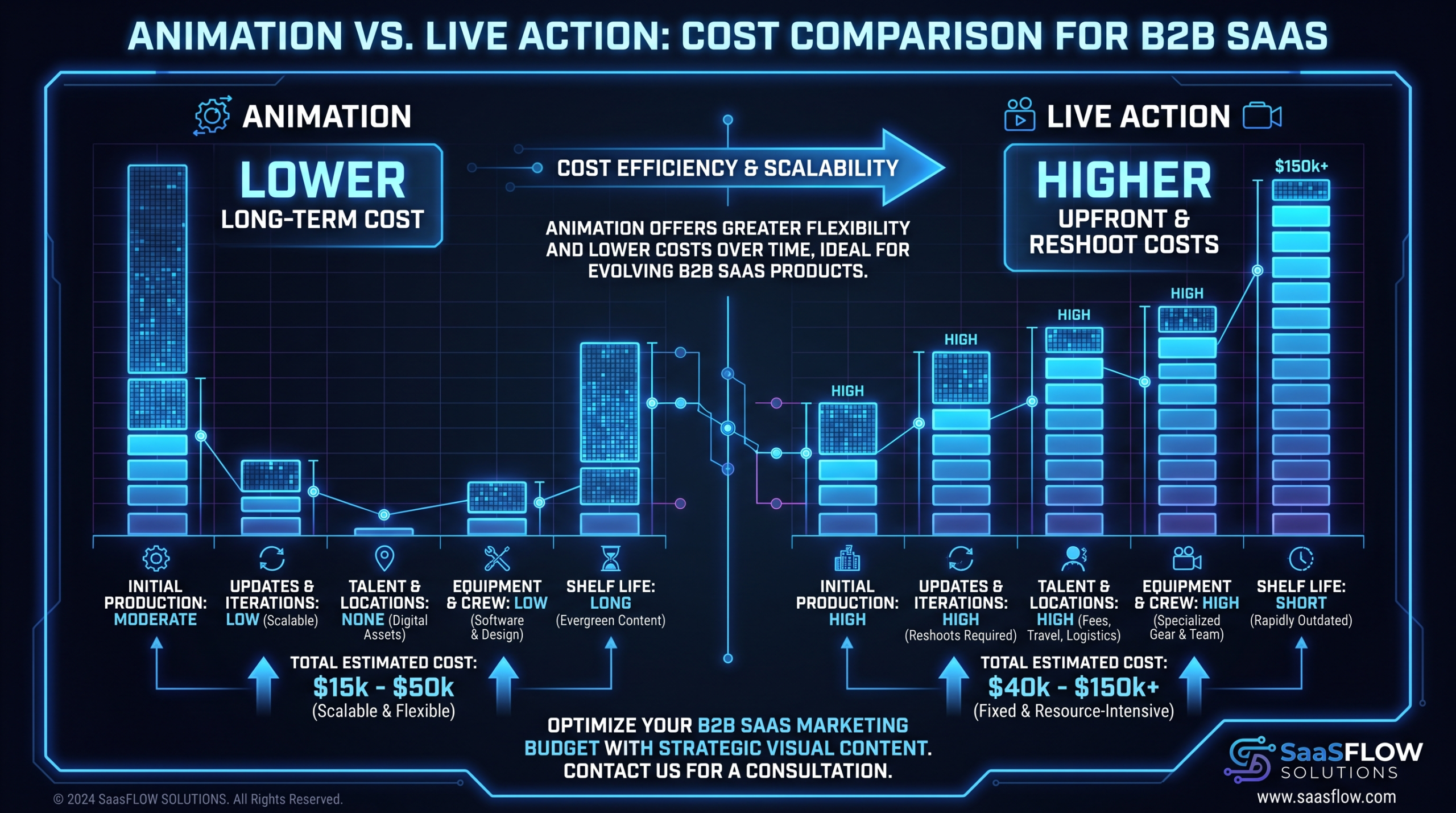
- Animation typically costs more upfront but revisions are cheaper and no reshoots are ever needed — total project cost often converges over multiple rounds.
- Live action has lower initial production costs for talking-head and interview content, but reshoots and location fees make scope changes expensive.
- For SaaS product explainers, animation commonly runs $5,000–$20,000 for 60–90 seconds; live-action product demos often run $3,000–$12,000 for similar length.
- Localization strongly favors animation: swapping voiceovers on an animated video costs a fraction of re-shooting live action in multiple languages.
- Hybrid formats — screen recordings with animated overlays, or live-action footage with motion graphics — often deliver the best cost-per-result for B2B content at scale.
Table of Contents
- What Actually Drives Animation vs Live Action Costs
- Animation Costs by Video Type
- Live Action Costs by Video Type
- Head-to-Head Cost Comparison Table
- Revisions, Reshoots, and Hidden Cost Differences
- Localization: Which Format Scales More Cost-Efficiently
- Budget Scenarios by Team Size and Industry
- Decision Framework: When to Use Each Format
- FAQ
Most budget conversations about animation vs live action start with the wrong question: "Which is cheaper?" The real question is: cheaper for what, at what volume, with how many revisions, in how many markets?
A 90-second animated SaaS explainer can cost $8,000 or $40,000 depending on style, studio, and complexity. A live-action talking-head video can run $1,500 or $15,000 depending on crew size, location, and post-production scope. Neither format is categorically cheaper — but each has structural cost advantages in specific use cases.
This guide breaks down animation vs live action cost by video type, compares revision economics, and gives you a practical decision framework for B2B SaaS, ecommerce, education, healthcare, and enterprise content programs.
What Actually Drives Animation vs Live Action Costs
Animation and live action have completely different cost structures. Understanding the drivers explains why one format wins in certain scenarios — even when the sticker price is higher. Wistia's video production cost guide is a useful starting reference for general production benchmarks, though B2B SaaS-specific ranges often diverge from general market averages.
Animation Cost Factors
Animation is labor-intensive upfront. The cost of an animated video is determined primarily by:
- Animation style. Motion graphics and 2D flat animation are the most affordable styles. Character-based 2D animation with complex movements costs more. 3D animation — especially with realistic environments or product renders — is the most expensive.
- Length. Animated video pricing is almost always quoted per finished minute or per 30-second segment. Most agencies add a base setup fee (scriptwriting, storyboarding, style frames) then charge per second of output.
- Complexity per scene. A simple talking-head avatar over a background costs far less than a multi-scene narrative with 10+ characters, UI screen recordings, and data visualization animations.
- Voiceover and sound design. Professional voiceover adds $500–$2,500+ depending on talent and usage rights. Custom music adds another $500–$3,000 vs. stock music licensing (~$50–$300).
- Revisions included. Most animation studios include 2–3 revision rounds in their base price. Additional rounds typically cost $300–$1,500 each depending on scope.
Live Action Cost Factors
Live action has distributed costs across pre-production, production, and post-production. Each phase can expand scope and budget independently:
- Pre-production. Scripting, casting, location scouting, and shoot planning. For simple interview setups, this can be minimal. For branded films with actors and multiple locations, pre-production alone can run $2,000–$10,000.
- Production crew. A single videographer with basic gear might charge $500–$1,500 per day. A full crew (director, DP, sound, lighting, production assistant) typically runs $3,000–$8,000+ per day in major markets.
- Location fees. Studios cost $500–$3,000/day. Licensed locations (offices, restaurants, event spaces) can run $1,000–$5,000/day plus insurance. Remote and outdoor shoots add travel costs.
- Talent fees. Real employees are free; professional actors add $500–$5,000/day depending on union status and usage rights.
- Post-production. Editing, color grading, sound mix, motion graphics overlays, and exports. A well-edited 3-minute video might need 15–30 hours of post work at $50–$150/hr. See our breakdown of video editing cost per minute for more detail on post-production rates.
Animation Costs by Video Type
Animation pricing varies significantly by use case, style, and the studio tier you're working with. Here are realistic ranges for the most common B2B video formats.
Product Explainer Videos
Animated explainers are the most common animation format in B2B SaaS. A 60–90 second explainer with motion graphics, UI screen animation, and professional voiceover typically runs:
- Motion graphics / 2D flat: $4,000–$12,000 for 60–90 seconds at a mid-tier studio
- Character-based 2D animation: $8,000–$20,000 for the same length
- 3D product visualization: $15,000–$50,000+ depending on model complexity
- Freelance / low-cost studios: $1,500–$5,000 — quality varies considerably
For deeper context on what drives these numbers, our explainer video cost breakdown walks through each production phase. Also worth reviewing: our guide on when to use animation vs. live-action for strategic context beyond cost.
Product Demo Videos
Animated product demos — common in SaaS where the product is digital — often use screen recordings with animated callouts, zooms, and motion graphics overlays rather than full character animation. This format is more affordable:
- Screencap + motion graphics overlay (2–4 minutes): $3,000–$9,000
- Fully illustrated UI walkthrough (2–4 minutes): $8,000–$20,000
- 3D product animation for physical products: $12,000–$40,000+
The cost advantage of animation for demos is significant when your product changes frequently. Updating a screen recording animation is a few hours of work; re-shooting a live demo video requires a full new production day. For more on SaaS demo video production, see our product demo video production guide.
Training and Onboarding Videos
Training video animation tends to favor simplicity — talking-head avatar with illustrated UI, or motion graphics over screen recordings. Costs per finished minute in this format commonly run $1,500–$6,000 for 2D motion graphics styles, though character animation or illustrated scenarios cost more. A 10-module onboarding series (3–5 minutes each) might total $30,000–$80,000 fully animated, vs $15,000–$40,000 as a screencap-plus-voiceover production.
Social Media Clips and Short-Form
Animated social clips (15–60 seconds) for LinkedIn, Instagram, or YouTube Shorts typically run $800–$4,000 per clip at a professional studio. Motion graphics templates and pre-built style systems can reduce per-unit cost significantly when producing at volume — a library of 20+ clips from a single template system can cost 30–50% less per clip than commissioning each individually.
Live Action Costs by Video Type
Live action has lower entry costs for simple formats but scales poorly for complex, multi-location, or frequently-updated content.
Brand and Thought Leadership Videos
A polished 2–3 minute brand video with a CEO interview, b-roll footage, and professional post-production typically runs:
- Basic setup (single camera, studio location, 1 interview): $2,500–$6,000
- Mid-tier production (multi-camera, professional lighting, branded b-roll, motion graphics): $6,000–$15,000
- High-production brand film (director, multi-day shoot, actors, professional edit): $15,000–$50,000+
Thought leadership content — a talking-head expert video for LinkedIn or a webinar highlight reel — is often the most cost-effective live action format. With a well-lit home or office setup and a freelance editor, a polished 5-minute video can cost $500–$2,000 in post-production alone.
Customer Testimonials and Case Studies
Customer story videos require location travel to film at the client's site (or coordinating remote production). Budget typically:
- Remote self-shot (loaner kit or in-home setup + editing): $1,000–$3,500
- On-location (videographer travel, 1-day shoot, professional edit): $4,000–$10,000
- Full case study film (multi-location, b-roll, interviews, motion graphics): $8,000–$20,000
These videos are inherently live action — the authenticity of a real customer on camera can't be replicated in animation. Cost is justified when the video will be used in a sales context where social proof is the primary objective.
Live Social Media Content
Short-form live action social content — clips from events, product unboxings, quick tips from team members — is often the cheapest form of video production. A smartphone shoot with a professional editor to clean it up can produce a polished 30–60 second social clip for $300–$1,200. At this price point, live action is almost always cheaper than animation for raw social output volume.
Head-to-Head Cost Comparison Table
Animation wins on revision cost and longevity; live action wins on authenticity and per-unit cost for simple content. This table makes the comparison concrete by use case.
Animation vs Live Action Cost by Video Type
| Video Type | Animation Cost Range | Live Action Cost Range | Better Value |
|---|---|---|---|
| SaaS product explainer (60–90 sec) | $5,000–$15,000 | $3,000–$10,000 | Live action (slightly); animation if product changes often |
| Product demo video (2–4 min) | $4,000–$12,000 | $4,000–$12,000 | Animation for digital products; live action for physical |
| Training / onboarding series (per module) | $3,000–$8,000 | $1,500–$5,000 | Live action for talent-led; animation for UI-heavy content |
| Customer testimonial / case study | Not suitable | $2,500–$10,000 | Live action (animation can't replicate authenticity) |
| Brand / thought leadership film | $10,000–$30,000 | $5,000–$25,000 | Live action for executive presence; animation for abstract concepts |
| Social media clips (15–60 sec) | $800–$4,000 | $300–$2,000 | Live action for volume; animation for evergreen brand content |
| Localized multi-language video (per new language) | $500–$2,000 | $3,000–$10,000+ | Animation — significant advantage at scale |
The "better value" column shifts depending on your context. Volume, revision cadence, product update frequency, and localization needs all tip the balance. Use this as a starting point, not a rule.
Revisions, Reshoots, and Hidden Cost Differences
Revision and reshoot economics are where animation's true cost advantage — or disadvantage — becomes clear. Initial production cost is only part of the picture.
Animation Revision Costs
Animation revisions fall into two categories with very different cost profiles:
- Text, color, and asset swaps: Updating on-screen text, changing brand colors, swapping icons, or adjusting voiceover timing typically costs $150–$600 per round. These changes are cheap because the animation rig doesn't need to be rebuilt.
- Structural changes: Adding a new scene, changing the narrative arc, redesigning a character, or altering the storyboard after animation has started is expensive — often $1,500–$8,000+ depending on how late in production the change comes. Think of this like construction: moving a wall during framing is easier than after the drywall is up.
The practical implication: animation rewards front-loaded clarity. A well-locked script and approved storyboard before production starts reduces revision costs dramatically. Agencies that rush past the concept approval phase often end up with costly structural revision requests.
Live Action Reshoot Costs
Live action reshoots are almost always expensive, regardless of scope. Reassembling a crew, rescheduling talent, re-booking a location, and coordinating logistics adds up fast even for minor changes:
- Pickup shots (1–2 new clips, same location): $500–$2,500
- Partial reshoot (1 scene, same talent, new location): $2,000–$7,000
- Full reshoot (wrong tone, wrong message, major change): Often 60–80% of the original production budget
Live action edits that stay in post-production — reordering scenes, cutting to a shorter version, swapping background music, adjusting color grading — are reasonably affordable ($300–$2,000 depending on scope). It's physical reshoots that destroy budgets.
What This Means for Your Budget
If you expect your messaging to evolve — new pricing, product changes, new markets — animation is almost always cheaper over the full lifecycle. A 60-second animated explainer that costs $10,000 to produce and $800 to update with new messaging beats a $6,000 live action video that costs $5,000 to reshoot when the product changes.
For content with a fixed shelf life (event videos, campaign-specific content, testimonials), live action's lower initial cost wins because you're not expecting to update it.
Localization: Which Format Scales More Cost-Efficiently
Localization is one of the clearest cost differentiators between formats — and it's frequently underweighted in initial budget planning.
For B2B teams selling into multiple markets (enterprise healthcare, SaaS targeting APAC or EMEA, education platforms with international users), video localization costs compound quickly. Here's how the economics break down:
Localizing an animated video typically involves replacing the voiceover track, adjusting any on-screen text in the animation file, and exporting a new cut. Budget per language:
- Professional voiceover (1,000–1,500 words): $400–$1,500 per language depending on talent market
- On-screen text revisions: $200–$600 per language (motion designer time)
- Total per language: commonly $600–$2,000 per language for a 90-second animated explainer
Localizing a live action video creates harder choices. Options include:
- Dubbing: $800–$3,000+ per language, often sounds unnatural for serious B2B content
- Subtitles only: $200–$600 per language (cheap, but limits reach with audiences who prefer native-language audio)
- Reshoot in target language: Full production cost repeated per market — effectively 2x–5x the original budget for 2–5 language versions
Wyzowl's annual video marketing statistics report consistently shows that multilingual video is among the highest-ROI investments for global B2B teams — which makes localization cost a strategic consideration, not just a line item. A company targeting 5 languages with a 2-minute explainer can localize an animated version for roughly $5,000–$10,000 total. Localizing a live action version at comparable quality (native-language reshoot) commonly runs $25,000–$60,000. For global content programs, this is often the deciding factor.
Budget Scenarios by Team Size and Industry
Abstract ranges are useful; concrete scenarios are more useful. These scenarios show how format choice affects real content budgets across common B2B contexts.
Budget Scenarios: Animation vs Live Action by Use Case
| Scenario | Format | Estimated Budget | Key Driver |
|---|---|---|---|
| Series A SaaS: 1 homepage explainer | Animation (motion graphics) | $6,000–$12,000 | No camera crew needed; UI-native |
| Series A SaaS: 1 homepage explainer | Live action (CEO walkthrough) | $3,000–$7,000 | Lower initial cost if product is stable |
| B2B ecommerce: 5 product demo videos | Live action (product on camera) | $8,000–$25,000 total | Physical products require camera; animation overkill |
| Healthcare SaaS: HIPAA compliance training (10 modules) | Animation (screencap + voiceover) | $20,000–$50,000 | Avoids filming patients; easier to update for regulation changes |
| Enterprise HR platform: 3-language onboarding series | Animation | $30,000–$60,000 (all 3 languages) | Localization at 3x is far cheaper than 3 live-action productions |
| Enterprise HR platform: 3-language onboarding series | Live action (reshoot per language) | $60,000–$150,000+ | Full crew + talent per language market |
| Education platform: 20 course intro clips | Hybrid (screen + instructor + motion graphics) | $15,000–$40,000 total | Instructor builds trust; animation keeps UI content updatable |
| Scale-stage SaaS: Monthly social content (20 clips) | Live action (repurposed from webinars, interviews) | $3,000–$8,000/month editing only | Raw footage already exists; editing + social cuts is the spend |
Notice the healthcare and enterprise localization scenarios: animation's cost advantage grows as volume and localization requirements increase. For a small startup producing one or two videos per year, the difference may not justify the animation premium. For teams running ongoing content programs, it often does.
Teams working at scale on video production — particularly those managing B2B SaaS content programs — frequently find that outsourcing video editing and post-production to a dedicated team cuts total cost per finished video by 30–60% compared to per-project agencies.
Decision Framework: When to Use Each Format
Use this framework to match format to use case before committing budget. The right answer is usually context-specific — but these signals point clearly in most situations.
Choose Animation When...
- Your product is digital. Software interfaces, dashboards, and abstract workflows are easier to communicate in animation than on-screen recordings with camera gear.
- Your messaging will change. If pricing, features, or positioning evolve every 6–12 months, animation's cheaper update cost matters significantly over a 2–3 year content lifecycle.
- You need multiple language versions. Localization economics heavily favor animation at 3+ languages.
- You're explaining a complex concept. Abstract processes (API workflows, data pipelines, supply chain logic) are clearer in animation where you can visualize the invisible.
- Your brand needs stylistic consistency. A style guide applied to animation ensures every piece looks exactly on-brand — harder to achieve across multiple live-action shoots.
- You're producing at high volume. A template-based animation system can scale to 20–50+ videos with strong cost efficiency. See SaaS video production strategies for how leading teams structure this.
Choose Live Action When...
- Authenticity is the point. Customer testimonials, executive thought leadership, and team culture videos derive their value from real humans on camera. Animation can't replicate this.
- Your product is physical. Physical products — hardware, medical devices, consumer goods — need to be seen on camera for the audience to trust they work as described.
- You're producing simple content at volume. Quick talking-head clips, webinar recaps, event highlights — live action is cheaper and faster for high-volume simple content.
- Budget is constrained and timeline is short. A solid live-action interview video can be planned, shot, and delivered in 1–2 weeks. A comparable animation typically takes 4–8 weeks.
- The content has a short shelf life. Campaign-specific videos, time-sensitive announcements, event content — don't pay the animation premium for content you'll retire in 3 months.
Hybrid Approaches That Cut Costs
The best-performing B2B video content programs often use hybrid formats that combine the cost advantages of both. Common patterns:
- Live interview + motion graphics overlay. Film the expert or executive live (authenticity + low shoot cost), then add animated data visualizations, product UI callouts, and branded lower thirds in post. This approach typically costs 30–50% less than either a full animation or a high-production live-action piece.
- Screen recording + animated transitions. The cheapest format for SaaS product tours: screencap the actual product, then add professional animated transitions, callouts, and voiceover. Often runs $2,000–$6,000 for a 2–3 minute video at a skilled post-production team.
- Live-action hero shot + animated explainer. Open with 15–20 seconds of cinematic live action to establish credibility, then cut to animation for the product explanation. Used by many high-growth SaaS companies to combine brand quality with technical clarity.
VEC's remote post-production teams specialize in exactly this kind of hybrid work — taking raw footage or screencaps from client teams and delivering polished animated-overlay edits on a consistent weekly schedule. Teams on the Growth and Core plans commonly run this workflow to produce 8–15 hybrid format videos per month.
"The best video strategy isn't animation vs live action — it's knowing which use cases each format serves best, then building a content system that uses both deliberately." — VEC creative team
If you're mapping out a larger content program, our guide on what to expect from video editing services covers how to scope and brief post-production work for both formats.
Frequently Asked Questions
Is animation always more expensive than live action?
Not always. Simple motion graphics on a screencap (common for SaaS product walkthroughs) can cost less than a polished live-action video with a professional crew and location. High-end character animation and 3D production are expensive — but mid-tier 2D animation and motion graphics often fall in the same price range as professional live-action video. The real comparison is total cost over the content's lifetime, factoring in revisions, updates, and localization — where animation frequently wins.
How much does it cost to update an animation vs reshoot a live action video?
Minor animation updates — swapping text, updating pricing, changing a logo — typically cost $200–$800 per revision round. A live-action reshoot to change messaging requires reassembling crew, rescheduling talent, and re-booking a location — commonly $2,000–$8,000 even for a single scene. For content you expect to update every 6–12 months, animation's update cost advantage compounds significantly over time.
Which format is better for SaaS product explainer videos?
Animation is generally better for SaaS product explainers, particularly when the product is software. Digital products don't photograph as well as they animate — UI workflows, data flows, and abstract processes communicate more clearly when illustrated. Animation also wins on localization and update costs, which matter for SaaS companies launching in multiple markets or iterating on product positioning. The exception: if your differentiation is the team or founder story, a live-action video can establish authenticity that animation can't match.
How do animation and live action costs compare for training videos?
For training and onboarding videos, the right format depends on the content type. UI-heavy training (software walkthroughs, process documentation) favors animation — screencap with animated callouts is both cheaper and easier to update when the software changes. People-led training (communication skills, leadership, compliance scenarios) often benefits from live action because learners respond better to human demonstration. Hybrid formats — live instructor with animated overlays — frequently offer the best combination of cost and engagement for complex training programs.
What is the most cost-effective video format for global content programs?
Animation is the most cost-effective format at scale for global content programs requiring localization into 3+ languages. A professional-quality animated explainer can typically be localized into a new language for $600–$2,000 (voiceover replacement plus on-screen text updates), compared to $3,000–$12,000+ for a live-action reshoot with native-language talent. For a 5-language program, this difference alone often covers the animation premium several times over. Companies running global content programs at scale — particularly in SaaS, healthcare, and enterprise software — consistently report that animation's localization economics justify the higher upfront investment.
Deciding between animation and live action often comes down to budget. For a full breakdown of what animators charge across different hiring models, see our guide to how much it costs to hire an animator in 2026.
For a direct cost comparison between 2D and 3D animation formats, see our 2D vs 3D animation cost guide — covering freelancer, agency, and in-house rates with three real B2B examples.
For examples of how businesses combine live action with animation — including cost comparisons and real brand case studies — see our guide to hybrid animation for business.
Need Help Choosing Between Animation and Live Action?
VEC works with B2B SaaS teams on both formats — and on hybrid productions that combine the cost advantages of each. Talk to our team about your content program: we'll recommend the format mix that gives you the most output per dollar, and handle all post-production remotely.
Book a Free Strategy Call View VEC Plans