How Is a 2D Medical Animation Video Made?
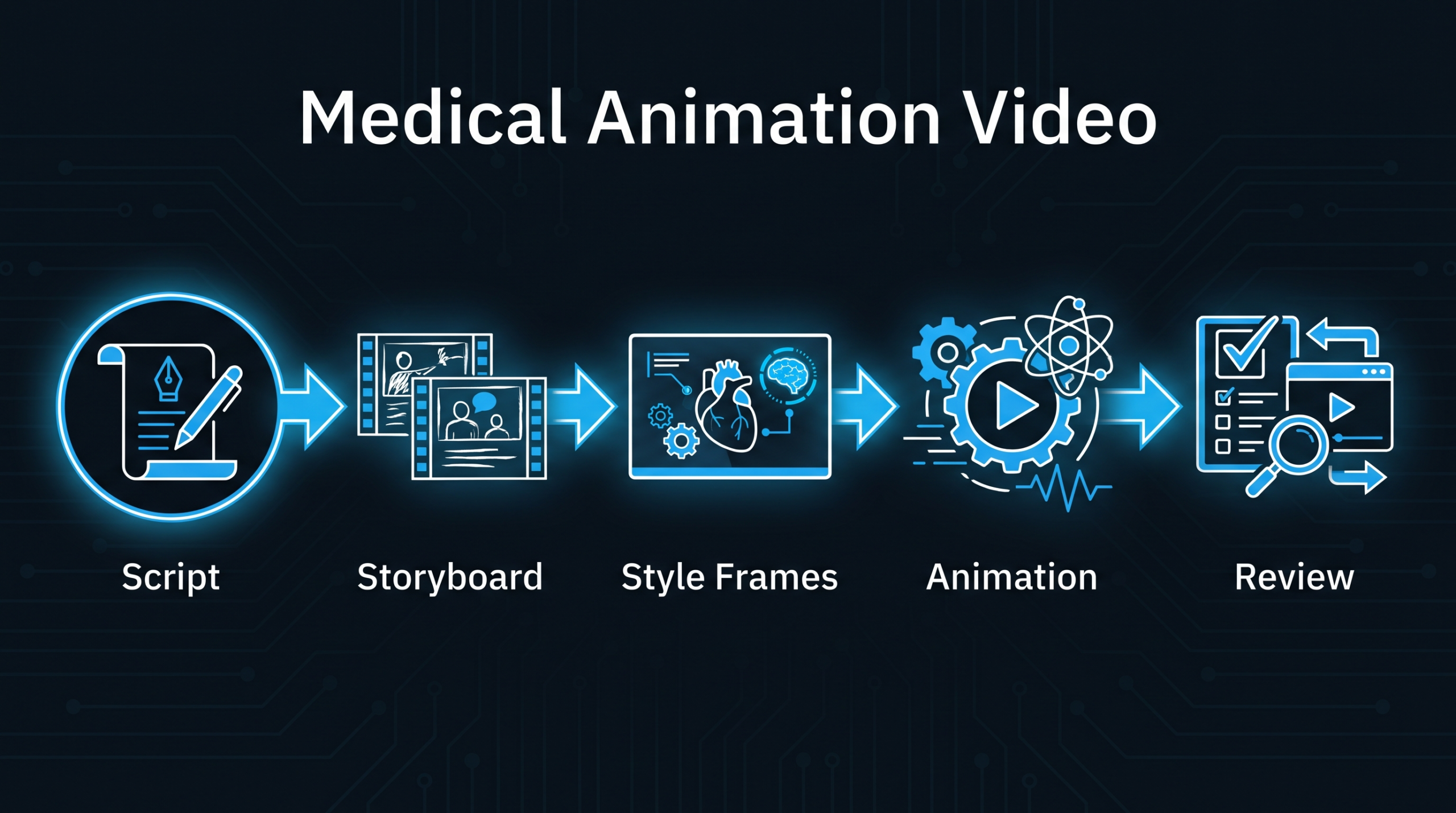
A 2D medical animation video is made in six stages: a medically reviewed script, a storyboard, style frames, animation, voiceover and sound, and a final accuracy and compliance review before delivery. Each stage ends with a sign-off, and the order matters because changes get more expensive the further down the pipeline they land.
Key Takeaways
- The script is the real product. In medical animation the facts, the claims and the reading level are fixed at the script stage; animators only visualize them.
- Review happens three times: medical accuracy on the script, visual accuracy on style frames and animatics, and regulatory or legal review on the near-final cut.
- 2D is the right call for mechanisms, workflows and software. It is not the right call when you need surgical-grade anatomical 3D, and VEC does not do 3D.
- Plan for weeks, not days. A short 2D explainer typically runs several weeks before client review time, and regulated content adds more.
- Cost scales with minutes and style, not with how medical the topic sounds. Typical ranges are in the table below.
Table of Contents
- What Is a 2D Medical Animation Video?
- How Is It Made, Step by Step?
- How Does the Script Get Written and Reviewed?
- What Does the Storyboard Do?
- How Are Style Frames Chosen for Medical Content?
- How Does the 2D Animation Itself Work?
- Where Do Voiceover, Sound and Captions Fit?
- How Does Medical and Regulatory Review Work?
- How Long Does It Take and What Does It Cost?
- Who Should You Hire to Make One?
- How Do You Brief a Medical Animation Project?
- FAQ
What Is a 2D Medical Animation Video?
A 2D medical animation video is a short animated film, usually 60 seconds to a few minutes, that explains a medical or health technology concept with flat, illustrated visuals instead of 3D models or live footage. Typical subjects are how a drug or device works, how a clinical workflow changes, how a patient completes a task, or how a health software platform fits into a hospital's day.
The "2D" matters. Two-dimensional animation moves drawn or vector artwork across a flat canvas, which makes it fast to revise, easy to brand and well suited to explaining a mechanism step by step. It is a different job from a 3D medical render of, for example, a surgical procedure, where a specialist builds an anatomical model and a camera moves through it.
That distinction decides who you hire. VEC builds 2D animated explainers for B2B and healthtech teams as a dedicated team. We do not produce 3D, we do not shoot footage, and we are not a medical illustration studio. If your project needs anatomically exact 3D, you want a specialist; if it needs a clear 2D explainer your marketing team can revise and reuse, the process below is what you should expect. For the broader healthtech picture, our guide to healthtech explainer videos that build trust covers audience and distribution, and our animated explainer video company buyer's guide covers how to choose a provider.
How Is a 2D Medical Animation Video Made, Step by Step?
The pipeline has six stages, and each one produces an artifact you approve before the next begins. Treat the approvals as gates: if a gate is skipped, the cost shows up later as rework.
The 2D Medical Animation Pipeline
| Stage | What gets made | Who signs off | Typical share of schedule |
|---|---|---|---|
| 1. Script | Narration and on-screen text, with sources for every claim | Your subject-matter expert (SME) and marketing lead | Early, before any art |
| 2. Storyboard | Frame-by-frame sketches matched to the script, often with a timed animatic | Marketing lead, SME | Early |
| 3. Style frames | Finished art for key scenes: color, characters, anatomy style | Brand owner, SME | Early to middle |
| 4. Animation | Motion for every scene, transitions, on-screen graphics | Marketing lead | Largest block of production |
| 5. Voice and sound | Voiceover, music, sound effects, captions | Marketing lead, SME for pronunciation | Overlaps with animation |
| 6. Final review | Near-final cut checked for accuracy, claims and compliance | Medical, legal and regulatory reviewers | Often the least predictable block |
Two things are worth noting. First, stages 1 to 3 are cheap to change and stage 4 is expensive to change, so the best-run projects spend their patience early. Second, stage 6 depends on your organization's review calendar rather than the animation team's speed, which is why medical projects slip more often than ordinary explainers.
How Does the Script Get Written and Medically Reviewed?
The script is written first, kept short, and checked line by line against sources your SME supplies. A 60-second explainer carries a modest amount of narration, so each sentence has to carry one idea, and anything that cannot be sourced gets cut or softened.
Good medical scripts follow a few rules:
- One audience per video. A video for clinicians, one for patients and one for hospital buyers use different words. Pick one before writing.
- Plain language by default. Health literacy is defined by the U.S. Department of Health and Human Services' Healthy People 2030 initiative as the degree to which people can find, understand and use information to make health decisions, and organizations have a role in making that possible (health.gov, checked October 24, 2026). In practice that means defining terms on first use and avoiding jargon the audience does not already own.
- Claims travel with their sources. The writer keeps a reference list next to the script so the reviewers can verify each statement without hunting.
- Efficacy language is conservative. If a sentence promises an outcome, it needs evidence your regulatory team will stand behind.
If you are starting from nothing, our explainer video script template with five examples gives you the structure; the medical layer is the sourcing and review you add on top.
What Does the Storyboard Do?
The storyboard turns the approved script into a sequence of sketched frames, one per beat of narration, so everyone can see the video before any animation is built. Many teams add an animatic, which is the storyboard timed to a scratch voiceover so you can judge pacing.
For medical content the storyboard is where anatomical or mechanical logic gets tested. Does the drug travel the route the script describes? Does the device attach in the order the instructions say? An SME who reviews drawings catches errors that read fine on paper, and fixing a sketch costs a fraction of re-animating a scene.
Ask for the storyboard to be annotated with the script line each frame covers. It makes review faster and keeps accuracy comments attached to the exact moment they refer to.
How Are Style Frames Chosen for Medical Content?
Style frames are fully finished still images of two or three key scenes that lock the look of the whole video: color palette, character design, how anatomy is drawn, and how text sits on screen. Approving them before animation starts prevents the most common expensive revision, which is "this looks different from what we imagined."
Medical projects have a few extra style decisions:
| Decision | Options | When each fits |
|---|---|---|
| Anatomy treatment | Stylized and simplified vs. detailed and realistic | Stylized for patient education and software explainers; detailed when clinicians will scrutinize the art |
| Character representation | Abstract figures vs. illustrated people | Abstract when you want to avoid implying a specific patient; illustrated when empathy matters |
| Color use | Brand palette vs. clinical convention | Brand palette for marketing; follow convention where color carries meaning, such as showing risk or flow |
| Text on screen | Minimal labels vs. full callouts | Minimal for short social cuts; fuller callouts for training or sales-enablement versions |
One honest limit: a 2D team draws what your source material shows. For anatomy that has to be correct at illustration level, such as a surgical step or a rare structure, have a credentialed medical illustrator or your SME supply reference art. The Association of Medical Illustrators maintains a directory of professionals and board certification information at ami.org (checked October 24, 2026).
How Does the 2D Animation Itself Work?
Animators build each scene from the approved style frames and move the pieces over time. In practice, 2D medical explainers use three techniques, often mixed in one video:
- Cutout (rigged) animation. Characters and objects are separated into parts and moved with controls, which is efficient and consistent for repeated figures.
- Motion graphics. Shapes, icons, charts and text are animated to show a process, a data flow or a before-and-after. It is the workhorse for software and workflow topics.
- Frame-by-frame animation. Individual frames are drawn for organic motion such as a pulse, a cell dividing or a fluid moving. It is the slowest and most expensive technique, so teams use it sparingly for the moments that need it.
Here is a real finished 2D explainer for a SaaS company, which shows the pacing and clarity a well-built 2D piece reaches. It is a software example rather than a medical one, but the production approach is the same.
If you are choosing between animation and filmed footage for a medical topic, our animation vs live action cost comparison sets out when each makes sense, and 2D vs 3D animation cost explains why 3D is a different budget class.
Where Do Voiceover, Sound and Captions Fit?
Voiceover is recorded after the script is locked and usually before animation is finalized, because animators time motion to the narration. Music and sound effects are added during or just after animation, and captions are built from the final script.
Three practical points for medical content:
- Pronunciation list. Give the voice actor a phonetic sheet for drug names, devices and anatomical terms. Re-recording a single mispronounced term after animation is locked costs a retiming pass.
- Captions are not optional. The Web Content Accessibility Guidelines (WCAG 2.2) success criterion 1.2.2 requires captions for prerecorded audio in synchronized media at Level A (W3C, checked October 24, 2026). Some viewers watch muted or rely on captions, so build them in from the start.
- Neutral tone. Calm, clear narration reads as credible to clinicians. Hype reads as marketing.
How Does Medical and Regulatory Review Work?
Review is layered: your SME checks accuracy at the script and storyboard stages, and your medical, legal and regulatory team checks claims on the near-final cut. The animation team does not replace this step; it builds in room for it.
Whether you need formal regulatory review depends on what the video is. A video about hospital workflow software is not governed like one that promotes a prescription drug. For prescription drug promotion in the United States, the FDA's Office of Prescription Drug Promotion reviews advertising and promotional labeling to ensure the information is not false or misleading (FDA OPDP, checked October 24, 2026). If your video touches drug or device claims, involve your regulatory team before the script is written, not after the animation is finished.
Privacy is a separate track. Patient stories, screen recordings of real systems and any identifiable details need clearance before they appear on screen; see HIPAA and video marketing: what is allowed for the practical rules.
To keep review from stalling the project, set these up at kickoff:
- Name one person who consolidates all reviewer comments into a single list per round.
- Agree how many review rounds are included and who has final say.
- Give reviewers a deadline and say what happens if it passes, because silence is the most common cause of delay.
How Long Does a Medical Animation Video Take and What Does It Cost?
A short 2D explainer commonly takes several weeks from approved script to delivery, and regulated or committee-reviewed content takes longer because of review time. Costs depend on finished minutes and style rather than on subject matter.
The figures below come from VEC's own published guides, which summarize typical market ranges. They are planning ranges, not quotes, and your project can land outside them.
Typical 2D Animation Planning Ranges
| Tier | Typical cost per finished minute | Typical delivery for a 60 to 90 second video | Where it fits |
|---|---|---|---|
| Entry, template-based | About $500 to $1,500 | Varies by provider | Internal training, quick promos |
| Mid-market studio or freelancer | About $2,000 to $6,000 | About 4 to 6 weeks for simple 2D | Product and process explainers |
| Professional agency or dedicated team | About $6,000 to $15,000 | About 6 to 10 weeks for complex characters | Hero explainers, regulated or high-stakes content |
Source: VEC's 2D animation production cost and how long does animation take guides. For a per-minute view, see animation cost per minute, and for why quotes vary so widely, is animation expensive.
Three things move a medical quote up:
- Review rounds. Each extra round of medical or legal comments after animation starts adds revision time.
- Frame-by-frame moments. Organic motion costs more than motion graphics.
- Versions. A clinician cut, a patient cut and a short social cut are three deliverables, not one.
If you will make several videos a quarter, a retainer is usually more economical than one-off quotes. VEC's dedicated team plans start at $5,000 per month; current tiers are on our pricing page.
Who Should You Hire to Make a 2D Medical Animation Video?
Hire for the job you actually have: a credentialed medical illustrator or 3D specialist when the anatomy itself is the deliverable, and a 2D animation team when the deliverable is a clear explanation your marketing team can reuse. The right choice depends on three questions.
| If your video needs… | Consider | Why |
|---|---|---|
| Anatomically exact 3D, surgical steps, or a physician-grade visualization | A specialist medical animation or illustration studio | Requires 3D modeling and anatomical training; VEC does not do 3D |
| A clear 2D explainer for a product, workflow or concept | A 2D animation studio or dedicated team | Faster to revise, easier to brand, lower cost per minute |
| Several explainers, cutdowns and updates each quarter | A dedicated team on a monthly plan | One team learns your style, so later videos start faster |
| One simple internal training video | A template tool or freelancer | Lowest cost when brand polish matters less |
Ask any provider to show finished work in your category, to explain who handles script research, and to say plainly what they do not do. VEC's honest scope is a dedicated post-production and animation team: no filming, no 3D, and you supply the medical source material and review. To see how an engagement runs day to day, read how VEC's dedicated team works.
How Do You Brief a Medical Animation Project?
A good brief answers six questions before anyone opens design software, and it saves more time than any other single step. Send these to your provider at kickoff:
- Who is the one audience, and what do they already know?
- What is the one action you want after they watch: book a demo, ask their doctor, share with a colleague?
- What are the source documents for every claim (studies, labeling, product documentation)?
- Who reviews, in what order, and how many days does each reviewer need?
- Where will it run, and what cutdowns do you need for each channel?
- What is off limits: claims, imagery, competitor mentions, patient identifiers?
Teams that answer these in writing tend to avoid the late-stage rework that makes medical projects feel slow. If you want a team that works from a brief like this on a repeating basis, you can see examples of finished client work on our case studies page.
Frequently Asked Questions
How is a 2D medical animation video made?
It is made in six stages: a medically reviewed script, a storyboard, style frames, animation, voiceover and sound, and a final accuracy and compliance review. Each stage ends with a sign-off, and the script and storyboard stages are where most of the cost and accuracy risk is controlled.
How long does a 2D medical animation video take?
A short, simple 2D explainer commonly takes about four to six weeks, and complex character work can take longer. Medical content adds review time on top, because accuracy and regulatory checks depend on your reviewers' calendars. Locking the script before art starts is the best way to protect the schedule.
How much does a 2D medical animation video cost?
Typical market ranges run from about $2,000 to $6,000 per finished minute for mid-market work and about $6,000 to $15,000 per finished minute for professional agencies or dedicated teams. These are planning ranges, not quotes. Review rounds, frame-by-frame motion and the number of versions all move the total.
What is the difference between 2D and 3D medical animation?
2D animation moves flat, illustrated artwork and suits mechanisms, workflows and software explainers. 3D animation builds a model that a virtual camera can move through, which suits detailed anatomy and procedures. VEC produces 2D only; for 3D medical visualization, hire a specialist studio.
Who checks a medical animation for accuracy?
Your own subject-matter expert and your medical, legal and regulatory reviewers check it. The animation team builds the video from the sources you supply and builds review time into the schedule, but it does not replace clinical or regulatory sign-off.
Does a medical animation video need captions?
Yes, build them in. WCAG 2.2 success criterion 1.2.2 calls for captions on prerecorded audio in synchronized media, and some viewers watch muted. Captions are made from the final locked script so they match the narration exactly.
Planning a 2D Healthcare Explainer?
Tell us the audience, the claim sources and your review process, and we will tell you honestly whether a 2D dedicated team is the right fit, what it would take, and how long it should run.
Book a Free Strategy Call See Pricing