2D Animation Production Cost: 2026
TL;DR
2D animation production cost in 2026 typically ranges from $1,000 for basic whiteboard explainers to $25,000+ for polished studio-quality pieces. The three biggest cost drivers are animation style, video length, and the production tier you hire — freelancer, boutique studio, or dedicated animation team. This guide breaks down every layer of the budget with real market ranges, comparison tables, and a framework for matching your format to your actual spend ceiling.
Table of Contents
You've decided 2D animation is the right format for your next SaaS explainer, onboarding video, or product launch. Now comes the uncomfortable part: what does it actually cost, and why do quotes range from $800 to $80,000 for what looks like the "same thing"?
The range isn't arbitrary. 2D animation production cost depends on a precise set of variables — and most buyers overpay or undershoot because they don't know which variables they're actually paying for. This guide fixes that. You'll see current market rates, the factors that inflate or compress a quote, and a practical framework for budgeting your next project without leaving money on the table.
2D Animation Cost at a Glance
The full market for 2D animation production in 2026 spans an enormous range. Here's the honest high-level picture before we break down why:
2D Animation Production Cost — Full Market Range (2026)
| Budget Tier | Typical Cost per Minute | Who Delivers This | Best For |
|---|---|---|---|
| Entry / DIY-adjacent | $500–$1,500/min | Fiverr/Upwork junior freelancers, template-based tools | Internal training, quick social promos |
| Mid-market | $2,000–$6,000/min | Mid-level freelancers, small studios | YouTube explainers, product overviews |
| Professional agency | $6,000–$15,000/min | Established studios, dedicated B2B animation teams | Investor decks, hero explainers, campaign videos |
| Premium / broadcast | $15,000–$50,000+/min | Award-winning studios, LA/NY animation houses | Brand anthem videos, broadcast campaigns |
The vast majority of B2B SaaS teams operating at Series A–C land in the mid-market to professional agency range. Budget below $2,000/minute and you're usually looking at template-heavy work that sacrifices brand distinctiveness. Budget above $15,000/minute and you're likely paying for creative awards, not ROI.
For context on how 2D animation compares to live-action budgets, see our animation vs. live-action cost comparison — the gap may surprise you.
Cost by Animation Style
The single biggest cost lever in 2D animation is style. The word "2D" covers radically different production workloads — from a simple whiteboard recording to frame-by-frame character animation that rivals theatrical quality. Each style has a distinct price floor and ceiling.
Whiteboard / Explainer Animation
Whiteboard animation (hand-drawn-look illustrations appearing on screen with a simulated drawing effect) is the most economical true animation style. Most whiteboard videos are produced with tools like VideoScribe or Doodly layered with professional voiceover and custom illustration. Expect to pay $800–$3,000 for a 60–90 second piece at the lower end, rising to $4,000–$8,000 for fully custom illustration with high-quality voiceover and sound design.
Vector / Cutout Animation (Flat Design)
This is the dominant style for B2B SaaS: clean flat characters and UI illustrations animated in After Effects or similar tools. The visual language matches modern SaaS brand aesthetics and the production workflow is relatively efficient once character rigs are built. A 90-second custom flat-design animation from a competent studio typically costs $3,000–$10,000, with the range driven by how many custom characters, scenes, and UI mockups are involved.
Motion Graphics (Text + Shape Animation)
Pure motion graphics — animated data visualizations, kinetic typography, UI screencasts with motion overlays — cost less per finished minute than character animation because there are no rigs or character design assets to build. Budget $1,500–$5,000 per minute for professional motion graphics work. For a detailed breakdown of what's included in motion design pricing, see our motion graphics pricing guide.
Rigged Character Animation (2D with Articulated Movement)
When a client wants characters that walk, gesture, and lip-sync — with fluid movement rather than limited puppet motion — the cost jumps significantly. Building a quality character rig takes 10–30+ hours depending on complexity. A 90-second rigged character animation from a professional studio typically runs $8,000–$18,000, with the higher end reflecting multiple characters, complex environments, and scene variety.
Frame-by-Frame / Cel Animation
True hand-drawn frame-by-frame animation (where each frame is a unique drawing) is the most labor-intensive format in 2D. Even at reduced frame rates (12fps vs. 24fps), a 60-second piece can require 720–1,440 individual drawings. This style commands $15,000–$50,000+ for professional-quality work and is rarely the right choice for SaaS marketing content unless brand storytelling is the explicit goal.
2D Animation Cost by Style — 60–90 Second Video (2026)
| Style | Cost Range (60–90 sec) | Turnaround Time | SaaS Fit |
|---|---|---|---|
| Whiteboard / explainer | $800–$8,000 | 1–3 weeks | High (onboarding, FAQs) |
| Motion graphics | $1,500–$7,000 | 1–2 weeks | Very high (product demos, data stories) |
| Flat / vector character | $3,000–$12,000 | 2–4 weeks | Very high (brand explainers, onboarding) |
| Rigged character animation | $8,000–$20,000 | 3–6 weeks | Medium (brand storytelling) |
| Frame-by-frame / cel | $15,000–$50,000+ | 6–16 weeks | Low (brand films only) |
Cost by Production Tier
Style alone doesn't set the price — who produces it does. The same brief sent to three different tiers of producer can return quotes that differ by 3–5x. Here's what each tier actually means and what you get (and don't get) at each level.
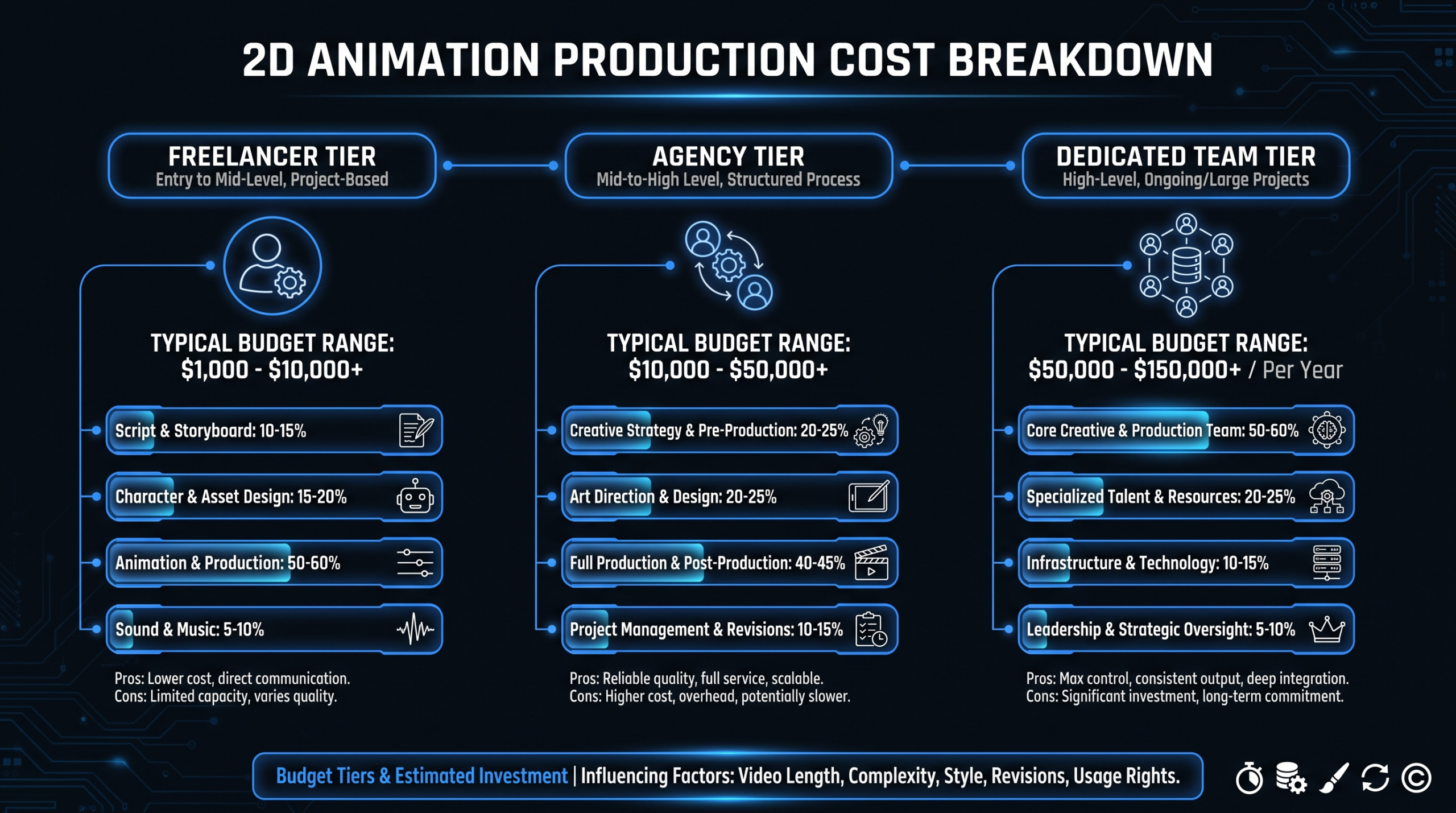
Freelancers (Fiverr, Upwork, Direct Hire)
The freelance market for 2D animation ranges from $15/hour juniors on Upwork to $100+/hour senior animators with major brand portfolios. For a 60-second flat-design explainer, a reliable mid-level freelancer might charge $2,000–$5,000, while a top-tier independent animator could charge $8,000–$15,000 for the same brief. The risk with freelancers isn't the work itself — it's the management overhead: you become the project manager, script reviewer, and QA team.
Boutique Animation Studios
Small studios (2–15 people) typically specialize in a style or two and have an established production pipeline. Quotes for a 90-second B2B explainer commonly run $5,000–$18,000. Studios provide a single point of contact, handle revisions more systematically, and usually have a defined brief-to-delivery process. The tradeoff: availability varies, and at the lower end of boutique pricing you may still be working with freelancers the studio manages.
Dedicated B2B Animation Teams (Agency Retainer)
This tier — where a dedicated team of animators, motion designers, and a project manager works on your account on an ongoing basis — offers the best per-video economics once you're producing regularly. Rather than paying project-rate premiums each time, you're buying consistent capacity. For B2B SaaS teams producing 4–10+ animated assets per month, this model commonly cuts the effective cost per finished minute by 40–60% compared to per-project studio rates.
Video Editing Company's plans are structured for exactly this scenario: the Growth plan at $5K/month covers consistent animated content production, while the Core plan at $9.5K/month and Scale plan at $16K/month support teams with higher volume and more complex animation needs.
How Length and Complexity Drive Price
Animation doesn't scale linearly with length. The first 30 seconds of any animated video are the most expensive — they include all the upfront work: character design, scene building, style guides, voiceover, and the first revision cycle. Each additional 30 seconds after that costs less per unit because the assets already exist.
The First 30-Second Cost Floor
At a professional agency level, expect to spend at minimum $3,000–$8,000 just to establish style and produce the first 30 seconds, regardless of how short the final video is. This is why a 15-second social clip from a studio often costs $2,000–$4,000 — you're paying for setup, not just duration.
Cost Per Additional 30 Seconds
Once the first 30 seconds are done, additional runtime costs roughly 40–60% of the per-30-second setup cost. If the first 30 seconds cost $5,000, the next 30 typically add $2,000–$3,000, and the 30 after that adds a similar amount. This is why a 90-second video rarely costs 3x what a 30-second video costs from the same studio.
Complexity Variables That Add to the Quote
- Number of characters: Each new character requires design and rigging. Each additional character commonly adds $500–$2,500 to the upfront cost.
- Number of unique scenes: New environments need to be designed and built. A video with 8 unique scenes costs more than a 3-scene video of the same length.
- UI/product mockup fidelity: Animating realistic screen recordings or pixel-accurate UI mockups takes additional design time. High-fidelity product animations often add $1,000–$3,000 to a project.
- Voiceover talent: Professional VO artists charge $200–$800 for a 60-second script. Premium VO (SAG, celebrity talent) runs $1,500–$5,000+. Platforms like Voices.com give a useful benchmark for current VO market rates.
- Music licensing: Stock libraries like Artlist range from $100–$500/year for unlimited use; bespoke scoring can add $1,000–$5,000 to a single project.
- Sound design: Custom SFX and audio layering adds $300–$1,500 to a production.
For a line-item breakdown of explainer video costs specifically, our explainer video cost breakdown covers each element in detail.
The 7 Factors That Shift the Quote
Beyond style and length, seven specific factors commonly move a quote materially. Understanding them lets you scope projects more accurately — and pushes back on inflated quotes with data.
1. Script Quality
Handing an animator a polished, final script is one of the easiest ways to reduce cost. If the studio has to iterate through 3 rounds of script feedback before animation begins, that time is billed — explicitly or built into overhead. A tight brief with a final-approved script can reduce total project cost by 10–20%.
2. Revision Rounds
Most studios quote 2 rounds of revisions at each production stage (animatic, rough animation, final). Each additional revision round typically costs $200–$600, depending on scope. Studios that offer "unlimited revisions" are averaging that cost into the base price — it's not free.
3. Turnaround Speed
Standard turnaround for a 90-second animation is 3–5 weeks. Rush delivery (under 2 weeks) typically adds a 25–50% premium. Some studios don't offer rush at all for complex projects — they simply can't compress the production pipeline.
4. File Deliverables
Do you need the final video in one format or six? MP4 in 16:9, 9:16, 1:1, plus source files? Each format variant adds production time. Clarify deliverables in the initial brief to avoid surprise charges.
5. Language / Subtitle Versions
If your audience is multilingual, each language version adds cost: re-recording VO, re-timing animation to new audio (lip-sync and timing adjustments), and re-exporting. Budget $500–$2,000 per additional language version for a professional production.
6. Style Guide Alignment
Animating in a well-documented brand style (established color palette, existing illustration library, icon sets) is faster than building style from scratch. If you have a strong design system, bring it to the briefing — it directly reduces concepting and design time.
7. Geographic Location of the Studio
US-based studios typically charge 2–4x the rates of comparable-quality studios in Eastern Europe, Southeast Asia, or Latin America. The quality gap has narrowed significantly in the past five years; many international studios produce work indistinguishable from US counterparts at the professional tier. For a full view of how location affects rates, see our video editing cost per minute by region.
Project Rate vs. Monthly Retainer: Real Cost Math
Most SaaS marketing teams discover this the hard way: once you're commissioning more than 2 animated videos per month, per-project rates become the most expensive way to buy animation.
Here's the math for a team producing 4 animated assets per month (mix of 60-sec explainers and social clips):
Per-Project vs. Retainer Cost Comparison — 4 Assets/Month
| Approach | Monthly Cost | Effective Cost per Asset | Brand Consistency | Revision Flexibility |
|---|---|---|---|---|
| Per-project (boutique studio) | ~$16,000–$28,000 | $4,000–$7,000 | Low (varies by project) | Limited to contracted rounds |
| Per-project (freelancer pool) | ~$8,000–$16,000 | $2,000–$4,000 | Very low (different animators) | Varies by person |
| Agency retainer (mid-tier) | $5,000–$9,500 | $1,250–$2,375 | High (same team) | Flexible within capacity |
| Dedicated animation team (VEC) | $9,500–$16,000 | $2,375–$4,000 | Very high (dedicated editors) | Daily collaboration |
The retainer model's per-asset cost advantage compounds over time. In the first month, you're also paying for onboarding — the team learning your brand, style guide, and feedback patterns. By month 3, a dedicated animation team typically delivers at full velocity with minimal revision cycles because they've internalized your standards. That efficiency is worth real money: teams commonly report saving 5–10 hours of internal management time per month once a dedicated team is running at full speed.
VEC's Core plan at $9.5K/month is designed specifically for SaaS teams in this range — consistent animated output, dedicated editors who know your product, and a 90-day guarantee to double your video output or month 4 is free.
For a broader look at how different pricing structures compare across all video types, our pricing page and the motion graphics pricing guide provide full context.
How to Reduce 2D Animation Costs Without Sacrificing Quality
There are legitimate ways to compress a 2D animation budget without moving down-market. These are the approaches that work — without compromising the final output.
1. Start With Motion Graphics, Not Character Animation
If your primary goal is explaining a SaaS product's value proposition or workflow, motion graphics (animated UI, text, icons) will do the job at 30–50% of the cost of character-based animation. Characters add cost and production time without necessarily adding clarity. Reserve characters for brand storytelling; use motion graphics for product explanation.
2. Standardize Your Scene Count
Every unique scene in an animated video requires fresh background design and layout work. Reducing a 10-scene 90-second video to 6 scenes (with more dynamic camera moves within each scene) can cut design costs by 15–25% without making the video feel static. Brief your studio on this explicitly.
3. Provide Finalized Assets
If you have an established illustration library, icon set, or UI kit, hand it to the animation team. Animators using existing assets spend time on motion — which is what you're paying for — rather than design from scratch. Studios typically discount 10–20% when assets are provided.
4. Lock the Script Before Animation Begins
The most expensive revision in animation is a script change after storyboarding has started. Every scene that needs to be recut, re-voiced, or re-timed after the animatic stage multiplies rework. Get stakeholder sign-off on the final script before the project enters production — it's the single highest-leverage cost reduction.
5. Plan for Versioning at the Start
If you know you'll need a 30-second cut, a 15-second social version, and a full 90-second video, brief all three at once. Producing versions in a single production cycle costs 20–40% less than commissioning them separately after the master is complete.
6. Consider a Retainer for Recurring Needs
If you're commissioning animation quarterly or more frequently, the per-project model is almost certainly costing you more than a retainer would. Run the math for your actual content volume — for most B2B SaaS teams above 2 animated assets per month, a retainer structure reduces the effective per-video cost while improving brand consistency and turnaround speed.
The cheapest animation is the one you don't have to redo. A $12,000 video that converts prospects is dramatically better value than a $2,000 video that doesn't move the needle.
Frequently Asked Questions
What does a 60-second 2D animation cost in 2026?
A 60-second 2D animation typically costs between $2,000 and $12,000 for professional-quality work, depending on style and studio tier. Simple motion graphics or whiteboard animations from a competent freelancer or small studio run $2,000–$5,000. Flat-design character animation from a professional studio commonly ranges from $5,000–$12,000. Frame-by-frame or premium rigged character work for 60 seconds can reach $15,000–$25,000.
Why do 2D animation quotes vary so much for the same brief?
The same brief can return quotes that differ by 5x or more because studios interpret "2D animation" very differently. One studio may propose template-based whiteboard work; another may plan for fully custom rigged character animation. The number of unique scenes, characters, and revision rounds built into the scope also varies significantly. To get comparable quotes, specify the exact style (flat design, motion graphics, frame-by-frame), number of characters and scenes, and revision rounds included.
Is 2D animation cheaper than 3D animation for SaaS explainers?
Yes, in most cases. For a comparable 60–90 second product explainer, professional 2D animation typically costs 30–60% less than equivalent 3D animation. The exception is highly complex 2D (frame-by-frame, rigged character with full lip-sync) versus simpler 3D render styles. For SaaS product explanation and brand storytelling, 2D flat-design animation usually delivers the best ROI — it's clean, on-brand, and significantly faster and cheaper to produce and update than 3D.
How long does 2D animation take to produce?
Standard turnaround at a professional studio ranges from 2–5 weeks for a 60–90 second piece. The breakdown is roughly: script finalization (1–3 days), storyboard/animatic (3–7 days), design and asset creation (3–7 days), animation (5–10 days), and final review and revisions (3–5 days). Rush delivery under 2 weeks is possible with some studios but typically carries a 25–50% premium. Complex projects with multiple characters or scenes take 6–12 weeks.
When does it make sense to use a monthly retainer for animation instead of per-project rates?
A retainer typically becomes cost-effective when you're producing 2 or more animated videos per month on an ongoing basis. Below that frequency, per-project rates are simpler. Above it, the retainer model reduces your effective cost per video, ensures brand consistency across all assets, and eliminates the ramp-up time that comes with briefing a new studio each time. Teams producing 4+ assets monthly commonly see 40–60% lower per-video costs under a retainer versus commissioning each piece individually. See VEC's pricing page for how the plans are structured.
For a complete breakdown of what animators charge by hiring model â including freelancer, agency, and in-house comparisons â see our guide to how much it costs to hire an animator in 2026.
For a full breakdown of animation pricing across all styles — 2D character animation, whiteboard, and motion graphics — see our animation cost per minute & pricing guide for 2026 benchmarks by hiring model.
Choosing between 2D and 3D for your next project? Our 2D vs 3D animation cost guide compares freelancer, agency, and in-house rates side-by-side across every major deliverable type.
If you are considering mixing live action footage with your 2D animation work, see our guide to hybrid animation examples for business — covering techniques, real brand examples, and cost ranges.
Get a Realistic 2D Animation Budget for Your Team
Not sure whether per-project rates or a monthly animation retainer makes sense for your content volume? Our team works with B2B SaaS companies at every stage — and we'll give you an honest recommendation based on what you're actually producing, not just what sounds good on a sales call.
Book a Free Strategy Call View VEC Pricing PlansNeed to compare 2D animation against motion graphics on cost? See our animation vs motion graphics cost comparison — per-minute pricing by hiring model, with three real-world examples to help you choose the right format for your brief.
For real-world style inspiration before you commission, see our collection of 2D animation examples for business — six watchable videos covering flat design, character animation, isometric, and cutout styles, with cost ranges by hiring model.
Also see: Whiteboard Animation Cost (2026) — pricing by style, freelancer vs. studio, and 3 real B2B examples.