How Long Does Animation Take? (2026)
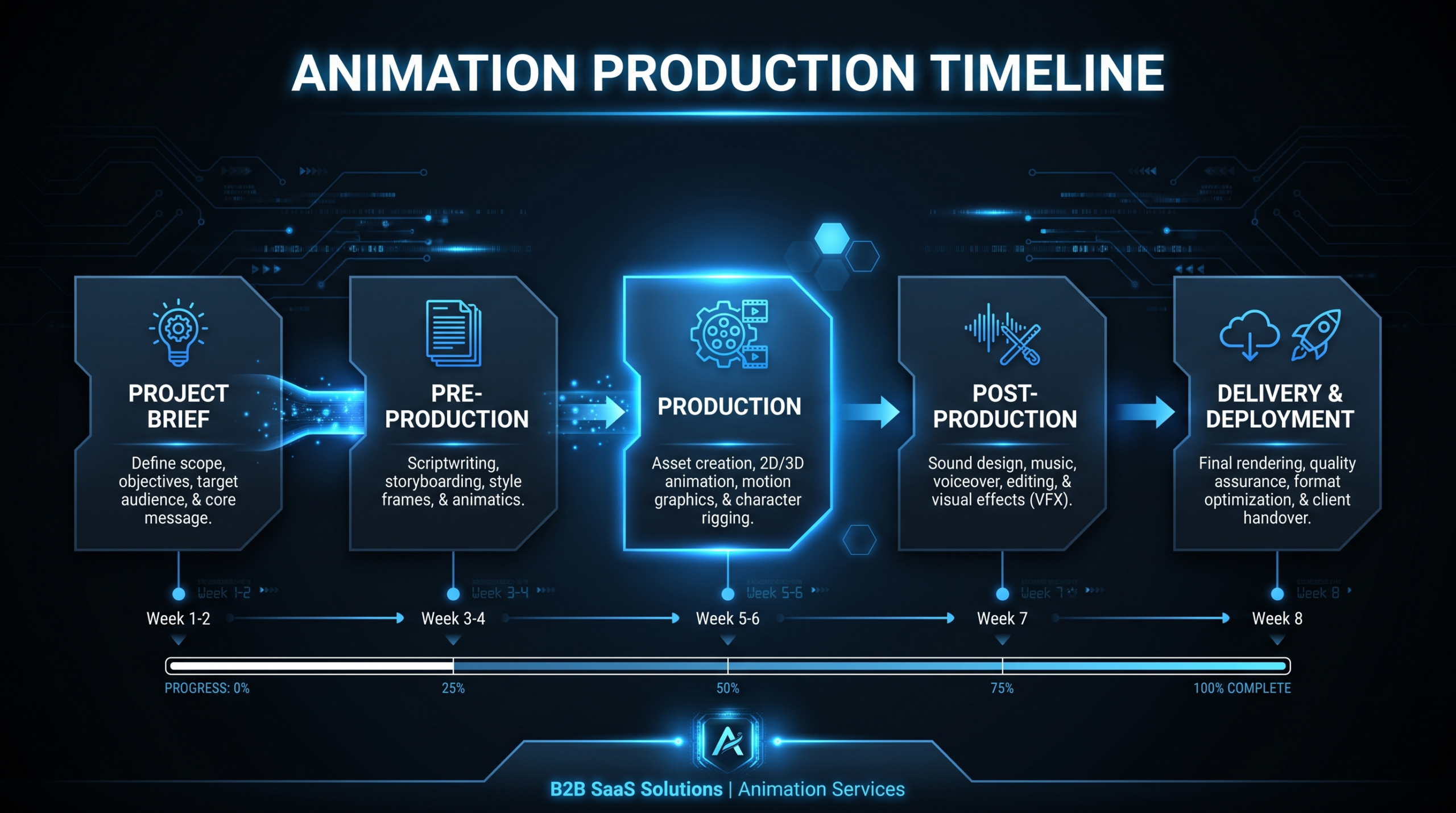
Most animation projects take 4–12 weeks from brief to final delivery. A 60-second 2D explainer with simple characters runs 4–6 weeks; a 2–3 minute corporate animation with complex motion and custom character rigs typically takes 8–14 weeks. The single biggest variable is not your animator's speed — it's how many revision cycles happen in pre-production before a single frame is animated.
This guide breaks down realistic timelines by animation type, gives you a per-minute production estimate, explains the five factors that push projects past their deadline, and shows how B2B SaaS teams structure animation projects to hit launch windows without sacrificing quality.
Key Takeaways
Quick answer
- 60-second 2D explainer: 4–6 weeks (motion graphics style); 6–10 weeks for complex character animation
- 1 finished minute of animation takes 1–3 weeks depending on style — whiteboard is fastest, character animation slowest
- Pre-production is 30–40% of total time — script, storyboard, and style approval determine the rest of the schedule
- Rush fees run 25–50% above standard rates for compressed 2–3 week timelines
- Dedicated animation teams cut total time by 30–50% vs. project-based studios because brand alignment starts at day one
Table of Contents
How Long Does Animation Take? (By Type)
Animation timelines depend on three variables: style complexity, video length, and revision rounds. Below are realistic estimates based on standard agency workflows — not rush jobs, and not infinitely resourced in-house studios.
Animation Production Timeline by Project Type
| Animation Type | Finished Length | Typical Timeline | Rush Possible? |
|---|---|---|---|
| Logo animation / sting | 3–10 sec | 1–2 weeks | Yes (3–5 days) |
| Whiteboard / scribe animation | 60–90 sec | 2–4 weeks | Yes (1.5–2 weeks) |
| Motion graphics explainer | 60–90 sec | 3–5 weeks | Yes (2 weeks +25–50%) |
| 2D explainer (simple) | 60–90 sec | 4–6 weeks | Yes (3 weeks +25–50%) |
| 2D explainer (complex characters) | 60–90 sec | 6–10 weeks | Partial (4 weeks +50%) |
| Product demo animation (SaaS UI) | 1–2 min | 4–8 weeks | Yes (3 weeks +25%) |
| Corporate animation video | 2–3 min | 8–14 weeks | Rarely (6 weeks +50%) |
| Animated ad (15–30 sec) | 15–30 sec | 2–4 weeks | Yes (1–2 weeks) |
See pricing: for animation budget planning, read animation cost per minute and is animation expensive? for a full cost breakdown.
These timelines assume standard 2–3 revision rounds. Every extra round of client-requested changes adds 3–7 business days to the schedule. Teams that lock script and storyboard before animation begins consistently finish 2–3 weeks ahead of those that revise mid-production.
How Long Does It Take to Animate 1 Minute?
1 finished minute of business animation takes 1–3 weeks, depending on style. This is the most useful planning metric for SaaS teams briefing an animation project — it gives you a scalable estimate regardless of video length.
Production Time Per Finished Minute of Animation
| Animation Style | Time Per Finished Minute | What Drives the Range |
|---|---|---|
| Whiteboard / scribe | 1–1.5 weeks/min | Illustration density, hand-drawn vs. digital |
| Motion graphics (text/icons) | 1–2 weeks/min | Design complexity, number of custom assets |
| 2D character animation (simple) | 2–3 weeks/min | Character rig complexity, number of scenes |
| 2D character animation (complex) | 3–5 weeks/min | Facial expressions, fluid movement, multi-character scenes |
| Animated SaaS product demo | 1.5–2.5 weeks/min | UI fidelity, screen recording integration |
| Mixed media (live action + animation) | 2–4 weeks/min | Compositing complexity, rotoscoping needs |
The autocomplete data for "how long does it take to animate 1 minute" reflects a real planning gap: most buyers discover these timelines only after briefing a project. Using the per-minute metric upfront prevents the most common animation project failure — approving a 2-minute character animation two weeks before a product launch.
For context on how animation timing compares to live-action post-production, see our guide on how long video editing takes — the workflows differ significantly.
What Factors Affect Animation Production Time?
Five variables determine whether your project finishes on week 4 or week 12. Understanding them gives you direct control over your delivery date.
1. Pre-Production Thoroughness
Pre-production — script approval, storyboard sign-off, and style frame review — accounts for 30–40% of total project time. Teams that rush this phase create the most expensive outcome: revisions requested after animation has started. Redrawing a scene mid-animation typically costs 3–5× more time than catching the same issue in storyboard. Lock the script before briefing the animator, not after.
2. Animation Style Complexity
The gap between a motion graphics explainer and a fully rigged 2D character animation is significant — roughly 2–3× more time for the same video length. Understanding which animation style fits your brief before committing to a project saves weeks. A SaaS product walkthrough rarely needs complex character rigging; clean motion graphics or an animated screen demo often communicates better and delivers faster.
3. Number of Revision Rounds
Industry-standard animation contracts include 2–3 revision rounds. Each round adds 3–7 business days. Teams regularly underestimate this: a simple "can we change the colors and swap this scene" request triggers a ripple of asset re-exports, timing adjustments, and audio re-syncs. Define revision scope in writing before project start.
4. Team Structure (Agency vs. Freelancer vs. Dedicated)
Freelancers work sequentially — design, then animate, then sound, one person at a time. Full-service animation agencies run parallel workstreams: a designer finalizes scene 3 while an animator completes scene 1. Dedicated teams assigned to your account run even tighter because brand alignment is already established. The difference in throughput is typically 30–50% faster delivery for agency teams vs. solo freelancers on anything over 90 seconds.
5. Feedback Loop Speed
The fastest animation studios in the world still wait for client approval. If your internal review chain requires three stakeholders and takes 5 business days per round, a 3-round project adds 15 days of client-side latency — more than the actual production time for a 30-second motion graphic. Assign a single decision-maker for animation feedback. It is the highest-leverage timeline optimization available.
How Does Each Animation Style Compare?
Different animation styles have fundamentally different production structures. Here is how the major styles used in B2B marketing compare on time, cost, and use-case fit.
Animation Styles: Time, Cost, and Fit Comparison
| Style | Timeline (60 sec) | Relative Cost | Best For |
|---|---|---|---|
| Motion graphics | 3–5 weeks | $$ | SaaS explainers, product demos, stats-heavy content |
| Whiteboard animation | 2–4 weeks | $ | Training videos, process explanation, education |
| 2D character (simple) | 4–6 weeks | $$$ | Brand storytelling, explainer videos, social ads |
| 2D character (complex) | 6–10 weeks | $$$$ | Brand films, series content, high-production campaigns |
| Animated screen demos | 4–8 weeks | $$ | SaaS product walkthroughs, UI feature reveals |
| Corporate animation | 8–14 weeks (2–3 min) | $$$–$$$$ | Company overviews, investor presentations, brand films |
The 2D vs. 3D cost and timeline comparison is worth understanding even if you are focused on 2D — it helps you explain to stakeholders why 3D is rarely justified for SaaS marketing. For most B2B use cases, well-executed motion graphics or 2D animation outperforms 3D on ROI because production time is a fraction of the cost.
For animated ad creative specifically, see our animated ad examples to benchmark style and complexity against your brief before committing to a timeline.
Motion graphics is the most common choice for SaaS because it naturally maps to UI, data visualization, and abstract concept illustration. If you are comparing motion graphics with 2D character work specifically, see motion graphics cost per minute for a detailed breakdown.
How Much Does Animation Cost?
Animation timelines and costs move together — faster timelines cost more, and lower budgets require longer schedules. Understanding both gives you a realistic project brief.
Animation Cost Ranges by Style and Length (2026)
| Animation Type | 60-Second Video | 90-Second Video | 2-Minute Video |
|---|---|---|---|
| Motion graphics (simple) | $2,000–$5,000 | $3,000–$7,500 | $4,500–$12,000 |
| Motion graphics (complex) | $5,000–$12,000 | $7,500–$18,000 | $10,000–$25,000 |
| 2D explainer (simple characters) | $4,000–$10,000 | $6,000–$15,000 | $8,500–$22,000 |
| 2D character (complex rig) | $8,000–$20,000 | $12,000–$30,000 | $16,000–$45,000 |
| Whiteboard animation | $1,500–$4,000 | $2,500–$6,000 | $3,500–$9,000 |
| Animated SaaS product demo | $3,000–$8,000 | $5,000–$12,000 | $7,000–$18,000 |
See pricing: View VEC's animation and video editing plans — Growth $5K/mo, Core $9.5K/mo, Scale $16K/mo — or compare against market rates in our 2D animation production cost guide.
For animation-specific cost drivers and the full breakdown of what pushes a 60-second explainer from $3,000 to $15,000, see is animation expensive? — that post covers the same variables that drive timeline differences: character complexity, asset reuse, voiceover integration, and revision scope.
If you are evaluating whether to hire an animator directly or work through an agency, how much it costs to hire an animator covers the rates, trade-offs, and contract structures. For deeper context on what drives per-minute costs specifically, see animation cost per minute.
According to Wyzowl's annual State of Video Marketing report, animated video continues to be one of the most widely used content formats for B2B marketers explaining complex products — which reflects why animation budgets at SaaS companies have grown even as overall marketing budgets have tightened.
How Can You Speed Up Your Animation Timeline?
The five tactics below consistently compress animation timelines without sacrificing quality — they target the non-production delays that account for 40–60% of actual calendar time.
1. Deliver a Complete, Approved Script Before Briefing
Animation studios treat an approved script as a locked production document. Every change to script post-storyboard triggers cascading rework. Get your script reviewed, approved by all stakeholders, and locked before the first call with your animator. This single step removes 1–3 weeks from most projects.
2. Provide a Reference Reel at Brief
Describing animation style in words is imprecise. A 3-clip reference reel (videos whose style, pacing, and tone match your brief) reduces style frame revision rounds from an average of 2.3 to approximately 1.1, based on agency feedback patterns. Browse 2D animation examples and explainer video examples to build your reference before the kickoff call.
3. Assign a Single Approval Owner
Committee feedback — even on small details — multiplies revision rounds. Projects with a single named approval owner consistently close revisions 40–60% faster than those requiring multi-stakeholder sign-off. The brief should name that person, and they should have authority to approve without escalation for decisions under a defined threshold (color choices, pacing adjustments, minor copy changes).
4. Front-Load the Storyboard Review
Storyboard changes cost 5–10% of the revision effort that the same change costs in final animation. A thorough, focused storyboard review session — ideally a 60-minute synchronous call with screen share — eliminates the back-and-forth that stretches storyboard approval from 1 week to 3. Budget extra time here; it returns double in the animation phase.
5. Work With a Dedicated Team That Knows Your Brand
The onboarding overhead on a new agency project is significant: brand guidelines review, tone calibration, style frame exploration, and the first round of "this isn't quite right" revisions. Teams that already know your brand skip all of it. At Video Editing Company, dedicated teams are pre-briefed on brand identity, previous video output, and preferred feedback patterns — which means the first deliverable on a new project is already in the right zone, not a calibration draft. Read how our model works at how it works.
For SaaS teams producing animation at volume, the right agency pricing model matters as much as the right animator — a per-project model penalizes iteration, while a retainer or dedicated team rewards it. See our full breakdown on how to outsource video editing for structuring the relationship.
The HubSpot video marketing resource hub documents how SaaS companies structure their video production workflows — the pattern of dedicated teams with pre-approved creative briefs consistently produces the fastest, most consistent output. The same principle applies to animation.
For related format decisions, see what video editing services include and our guide on how long a corporate video should be — length decisions directly affect your animation budget and timeline.
Frequently Asked Questions
How long does a 60-second animation take to produce?
A 60-second motion graphics animation typically takes 3–5 weeks from brief to final delivery. A 60-second 2D character animation with custom rigs takes 4–8 weeks. Timeline depends on style complexity, revision rounds, and whether pre-production (script, storyboard) is locked before animation begins. Rush timelines of 2–3 weeks are possible at a 25–50% cost premium.
How long does it take to animate 1 minute of video?
1 finished minute of business animation takes approximately 1–3 weeks depending on style. Whiteboard animation is fastest at around 1–1.5 weeks per minute. Motion graphics runs 1–2 weeks per minute. Complex 2D character animation takes 2–5 weeks per minute. These are production-time estimates assuming pre-production is already approved.
What takes the longest in animation production?
Pre-production revisions — particularly script and storyboard approval — account for 30–40% of total project time and are the most common source of delays. Revision rounds mid-animation are the most expensive delay: a scene change after animation starts costs 3–5× more time than catching the same issue in storyboard review.
Can you rush an animation project?
Yes, most animation studios accept rush projects at a 25–50% premium on standard rates. Realistic rush timelines: a 60-second motion graphic can be delivered in 2 weeks; a 60-second 2D explainer in 3 weeks; a 2-minute corporate animation in 5–6 weeks. Complex character animation with custom rigs is the hardest to rush — frame-by-frame work cannot easily be parallelized.
Is animation faster with a freelancer or an agency?
Full-service agencies are typically 30–50% faster for projects over 60 seconds because they run parallel workstreams: a designer finishes assets while an animator works on early scenes. Freelancers work sequentially. Dedicated agency teams are fastest of all because brand onboarding is already complete — no style calibration, no brand guidelines review, no first-draft misalignment. The trade-off is cost: agencies charge more per project than freelancers, though the per-deliverable cost often equalizes once revisions are counted.
Need Animation Delivered on Deadline?
Video Editing Company provides dedicated animation and motion graphics teams for B2B SaaS — same editors every project, brand-aligned from day one, with a guaranteed 90-day output improvement or month 4 is free.
See Pricing Book a Free Strategy Call