Corporate Animation: Types, Examples & Cost
Key Takeaways
- 6 main types of corporate animation — explainer, 2D character, motion graphics, whiteboard, animated brand films, and training series — each serves a different communication goal and has a different cost profile.
- Costs range from $300 to $80,000+ per project depending on style, length, and whether you hire a freelancer, mid-market agency, or full-service studio.
- 60-second explainer animations from a reputable B2B agency typically cost $3,000–$12,000; motion graphics for the same runtime run $2,500–$8,000.
- Monthly retainers start at $5,000/mo for dedicated B2B animation teams — reducing per-video cost by 40–60% versus per-project pricing once you need 4+ animations per quarter.
- Animation outperforms live action for abstract software products, global content scaling, and training libraries — not as a budget fallback, but as a deliberate format choice.
Table of Contents
What Is Corporate Animation?
Corporate animation is professionally produced animated video created for business purposes — explaining products, onboarding employees, building brand identity, or moving prospects through a sales funnel. Unlike consumer entertainment, the goal is a measurable business outcome: shorter sales cycles, lower support ticket volume, higher landing page conversion, or more consistent brand communication across global markets.
The term covers everything from a 30-second motion graphics intro to a 10-part training video series to a cinematic animated brand film. The unifying trait is intent: every frame is doing a job your business cares about.
According to Wyzowl's 2026 State of Video Marketing survey, 67% of companies that didn't use video marketing last year plan to do so in 2026 — and animated formats consistently rank among the first formats teams adopt when building out a content program.
For a full overview of what animation services include and how studios price their work, see our guide to video animation services.
Animation has one structural advantage over live action: it can show things that don't yet exist, make abstract systems visible, and travel across languages without reshoots. For a SaaS product, a technical integration, or a global onboarding program, those properties matter more than the cost premium.
What Are the Main Types of Corporate Animation?
Not all corporate animation is interchangeable. Each style has a different cost profile, production timeline, and communication strength. Choosing the wrong type for the job costs you money and underdelivers on the goal.
1. Explainer Animation
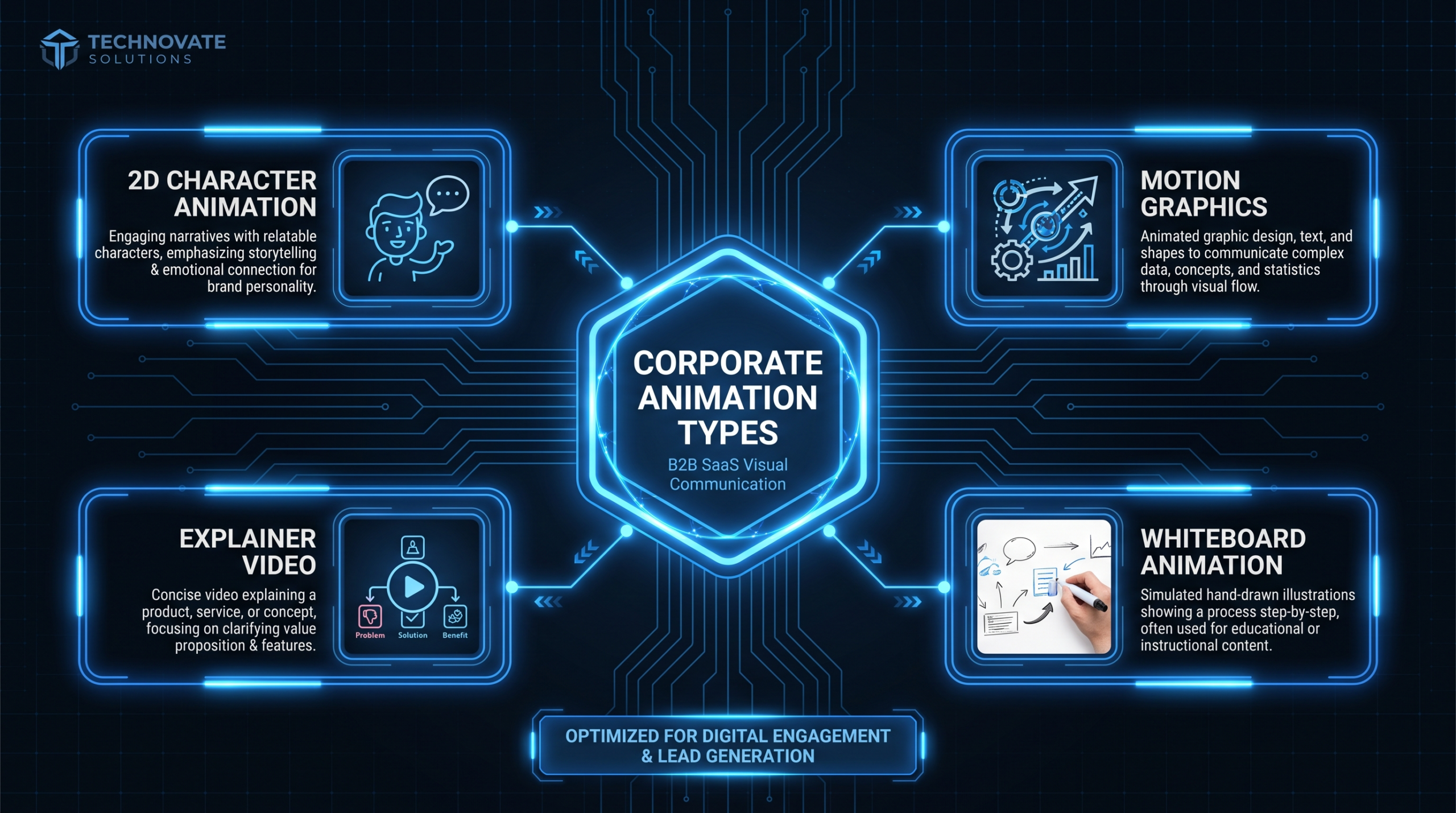
The most common format in B2B. A 60–90 second animated video that explains what a product does, how a process works, or why a solution matters — typically deployed on landing pages, in email nurture sequences, and at the top of sales calls. Most explainer animations blend illustrated characters, icons, and motion graphics into a narrative structure with a clear problem-solution arc.
Best for: product launches, landing pages, investor decks, onboarding flows.
Typical length: 60–120 seconds.
Cost range: see our full explainer video cost breakdown for pricing by production complexity.
2. 2D Character Animation
Full character animation — rigged figures that walk, gesture, emote, and interact. More expensive and time-intensive than motion graphics alone, but delivers stronger emotional connection. Widely used in training videos, HR communications, and brand storytelling where a human feel matters more than technical precision.
Best for: training and compliance, brand mascots, HR communications, educational content.
Typical length: 60 seconds to 5 minutes.
Cost range: see the full 2D animation production cost guide for a breakdown by character complexity and total runtime.
3. Motion Graphics
Animated text, shapes, icons, and data visualizations — without characters or narrative storyline. The most versatile corporate animation format: a 10-second lower-third for a webinar, a 3-minute product feature walkthrough, or a 30-second social ad. Motion graphics are faster to produce than character animation and easier to update when messaging changes — a critical advantage for SaaS companies that ship product updates regularly.
Best for: product feature highlights, data storytelling, social ads, event intros, sales enablement.
Typical length: 15 seconds to 3 minutes.
4. Whiteboard Animation
The hand-drawn-on-a-whiteboard aesthetic — either genuinely hand-drawn or simulated digitally. The format gained widespread B2B adoption through early explainer videos (Dropbox's original whiteboard animation is widely cited as a seminal case study in conversion-focused animation) and remains effective for complex technical explanations where the step-by-step drawing metaphor helps the viewer follow a process in real time.
Best for: process explanations, technical documentation, internal training, lower-budget explainers.
Typical length: 60–180 seconds.
5. Animated Brand Films
High-production animated short films — 90 seconds to 5 minutes — designed for brand awareness rather than direct conversion. Chipotle's "Back to the Start," John Lewis's animated holiday films, Mailchimp's "All in a Day's Work" — these require a proper creative brief, a clear narrative arc, and a significantly larger budget than functional explainers. For most B2B SaaS companies, the ROI case is hard to make unless you're running a multi-channel awareness campaign with distribution behind it.
Best for: brand campaigns, conference content, company culture communications, PR-driven launches.
Typical length: 90 seconds to 5 minutes.
6. Training and Tutorial Animation
Multi-part animated video series for employee onboarding, compliance training, software tutorials, or customer education academies. Often combined with professional voiceover scripts, closed captions, and LMS integration. The per-episode cost drops significantly after the first few videos because the asset library — characters, style guide, environments, music — is built once and reused across episodes.
Best for: HR onboarding, compliance programs, software training, customer education at scale.
Typical length: 3–10 minutes per episode; series of 5–20 episodes.
For strategic context, see our guide on SaaS video production and how training animation fits into a larger content program.
5 Corporate Animation Examples Worth Studying
The most useful thing you can do before briefing an animation team is watch what already works. Each of these examples makes a deliberate choice about style — and that choice is doing a specific communication job. For a curated library of 29 examples across industries, Wyzowl's corporate animation showcase is the most comprehensive public resource.
Example 1: Chipotle — "Back to the Start" (Animated Brand Film)
Directed by Johnny Kelly for Nexus Studios, this stop-motion animated short takes a farmer from sustainable agriculture through industrial food production and back again. It carries a heavy message about food ethics with warmth instead of a lecture — the Coldplay cover performed by Willie Nelson transforms it from a corporate message into something people chose to share organically. This is what a premium animation budget looks like when it's doing pure brand storytelling, not product explanation. Every B2B content team should watch it once to understand what "animation as editorial choice" actually means.
Example 2: B2B Explainer Animation Examples (Yum Yum Videos)
Yum Yum Videos is one of the most referenced B2B explainer animation studios. This compilation shows how the format works across industries — SaaS, healthcare, logistics, fintech — with a consistent core structure: problem statement, character introduction, solution walkthrough, call to action. Notice how consistent the 60–90 second runtime is across radically different topics and industries. The format works because the constraint forces clarity — you can only animate what you've actually decided to say.
Example 3: 2D Character Animation for B2B — 30 Examples (Advids)
This compilation by Advids shows the range of 2D character animation styles used in corporate video production — from flat illustration to semi-realistic character rigs, from bright consumer-facing palettes to darker enterprise-grade design languages. When your creative brief says "something that looks like our brand but animated," this is the kind of reference library you need to align on a direction before a single frame is produced. Pay attention to how dramatically the perceived budget varies based on character complexity, not just production hours.
Example 4: Motion Graphics Corporate Overview — 30 Examples (Advids)
Motion graphics are often dismissed as "just text animation" but this compilation demonstrates the format's full range. The strongest examples use data visualization, iconography, and kinetic typography to make complex product stories immediately legible without characters or narrative. For SaaS companies with technical products, motion graphics frequently outperform character animation because the format signals precision and credibility rather than approachability — which is exactly what a CTO or VP Engineering needs before approving a vendor.
Example 5: Top 10 Corporate Animation Styles in Action
This compilation draws from recent campaigns across consumer and enterprise brands — useful for understanding how animation styles have evolved. Flat 2D has largely given way to more textured, character-forward styles. Motion graphics have incorporated more sophisticated layering and depth. The brands using animation most effectively in 2025–2026 built a consistent visual language across multiple formats rather than commissioning one-off explainers. That consistency is what turns animation spend into a brand asset rather than a sunk cost.
How Much Does Corporate Animation Cost?
Corporate animation pricing varies by a factor of 100x — from $300 for a basic whiteboard video to $80,000+ for a studio-produced animated brand film. The price is driven by three variables: style complexity, video length, and who produces it. Understanding how to navigate agency pricing models before you brief a studio helps you avoid paying full-service rates for a job that a mid-market agency handles equally well.
Here is a complete breakdown by deliverable and hiring model:
Corporate Animation Cost by Deliverable & Hiring Model
| Deliverable | Duration | Freelancer | Mid-Market Agency | Full-Service Studio |
|---|---|---|---|---|
| Simple explainer | 60–90 sec | $500–$2,500 | $3,000–$8,000 | $8,000–$20,000 |
| 2D character animation | 60 sec | $1,500–$5,000 | $5,000–$15,000 | $12,000–$30,000 |
| Motion graphics | 30–60 sec | $800–$3,000 | $2,500–$8,000 | $6,000–$18,000 |
| Whiteboard animation | 60–90 sec | $300–$1,500 | $2,000–$6,000 | $5,000–$12,000 |
| Animated brand film | 2–3 min | $3,000–$10,000 | $10,000–$30,000 | $25,000–$80,000 |
| Training series (5 episodes) | 5–10 min ea. | $5,000–$15,000 | $15,000–$40,000 | $30,000–$80,000 |
Ranges are hedged estimates based on publicly listed rates from agencies and freelancer platforms. Your actual quote depends on revision rounds included, voiceover talent, music licensing, and delivery timeline. For granular cost-per-minute figures, see our video editing cost per minute guide and the detailed 2D animation production cost breakdown.
What Drives the Cost Up?
- Character rigging. Building a custom rigged character from scratch adds $800–$3,000 before a single frame is animated. Reusing an existing character cuts this to near-zero on subsequent episodes.
- Voiceover talent. Professional voiceover for a 60-second script costs $150–$500; studio-quality recording adds $200–$600.
- Music licensing. Stock music runs $50–$300 per track; custom composition starts at $500 for simple scores.
- Revision rounds. Most studios include 2–3 rounds in the base quote; additional rounds typically add $300–$800 each depending on scope.
- Rush fees. Delivery under 10 business days adds 25–50% on top of the base project cost.
- Format variations. A 16:9 video reformatted for 9:16 and 1:1 social counts as separate deliverables — budget $200–$600 per additional format.
Monthly Retainers: When Does Animation Scale?
If you're producing animation on a recurring basis — product updates, campaign assets, onboarding sequences — one-off project pricing becomes expensive fast. A dedicated animation retainer through an agency like Video Editing Company shifts your cost structure significantly:
VEC Monthly Animation Plans
| Plan | Monthly | Animation Output | What's Included |
|---|---|---|---|
| Growth | $5,000 | 2–4 videos/mo | Dedicated editor + PM, motion graphics, explainer animations, social cuts |
| Core | $9,500 | 4–8 videos/mo | Senior editor team, 2D animation, motion graphics, multi-format delivery |
| Scale | $16,000 | 8–15 videos/mo | Full dedicated team, all animation types, 90-day output guarantee |
At $5,000/month on the Growth plan, a 60-second explainer works out to $1,250–$2,500 per video — well below the $3,000–$8,000 per-project rate from a comparable mid-market agency. The economics improve further at higher volumes. See the full VEC pricing page for what's included at each tier.
For context on what animators charge when hired independently, see our how much does it cost to hire an animator guide and our video editing hourly rates by country breakdown — these figures help you calibrate whether a studio's quote reflects market rates.
When Should Your B2B Company Use Corporate Animation?
Animation is the right call when live action cannot do the job — not as a budget shortcut. Here are the specific situations where animation consistently outperforms:
Your Product or Process Is Abstract
Software products, API integrations, workflow automation, data pipelines — none of these have a satisfying live-action visual representation. Animation makes invisible systems visible. For product demo video production, animation often produces higher comprehension scores than screen recordings alone because the format forces conceptual clarity: you can only animate what you've actually decided to show.
You Need to Scale Content Globally
A live-action video with a human presenter requires a reshoot for every language or regional market. An animated explainer can be re-voiced or subtitled with the same visuals intact. For global SaaS companies with teams across multiple continents, animation is the cost-effective path to multilingual content: one production, multiple markets, consistent brand execution.
You're Building an Onboarding or Training Library
Training animation scales better than live instructor video because the content ages more gracefully — a character doesn't leave the company, change hairstyles, or wear a logo from a rebrand two years ago. The episodic format maps naturally onto LMS platforms. Our guide to what's included in video editing services covers what goes into building an animation-first training library at scale.
You're Competing Against Companies With Larger Production Budgets
A polished motion graphics video from a team that knows your brand can match or exceed the perceived production value of a live-action video costing 5× more. For seed-to-Series A companies communicating at enterprise level, animation is one of the highest-leverage formats available. See how teams structure this work in our guide on outsourced video editing.
You Have Recurring Animation Needs
One-off animation projects are expensive on a per-video basis. If you're producing 4+ animations per quarter — explainers, ads, product updates, training modules — a dedicated animation service on a retainer will typically cost 40–60% less per video than going project-by-project.
How Do You Brief an Animation Studio?
The quality of your final animation depends heavily on the quality of your brief. Most projects go over budget or under-deliver because the brief left key decisions unmade — and studios make assumptions that don't match your expectations.
A complete animation brief includes:
- The single goal. One video cannot do everything. "Explain how our API works to a VP Engineering" is a brief. "Explain our product, build brand awareness, and drive signups" is three briefs compressed into one. Choose one goal before anything else is decided.
- The target viewer. Job title, knowledge level, specific objections they have. The more specific, the better the script. See the explainer video script template for how to structure your core message before handing off to a studio.
- Style references. 3–5 examples of animation styles you like — use the compilation videos in the Examples section above. Studios use references to calibrate direction, not to copy. Without references, you get the studio's default, not your brand.
- Length and format constraints. 60 seconds for a landing page hero, 30 seconds for a LinkedIn ad, 3 minutes for a demo follow-up — these require different scripts, different animation densities, and different production timelines. Define this before scripting starts.
- Assets you have ready. Brand guidelines, approved voiceover scripts, existing character designs, music preferences. Every asset you provide reduces production hours and cost.
- Revision rounds and approval process. Who approves the storyboard? Who signs off on the animatic? Who gives final delivery approval? A broken or ambiguous approval chain is the single most common cause of ballooning revision costs. Our overview of how video production works shows how a structured review process prevents this.
For studios that specialize in B2B content, a complete brief reduces production time by 30–50%. For SaaS video production specifically, the ability to turn a clear brief into a working animatic within a week is one of the key differentiators between agencies worth working with and those you'll wish you hadn't.
Before scaling to an animation retainer, read our full guide on how to outsource video production — it covers handoff processes, file formats, and feedback cycles that determine whether an animation retainer actually saves time or just shifts where the work happens.
What to Look for in an Animation Partner
Portfolio is necessary but not sufficient. Also evaluate:
- Specialization match. A studio that produces consumer entertainment animation is not the same as one that builds B2B explainers. Request examples specifically in your sector — SaaS, enterprise software, financial services.
- Revision policy transparency. Know exactly how many rounds are included and what counts as a "revision round" versus a minor note. Ambiguity here creates the largest cost overruns.
- Visual consistency at scale. Can the studio maintain the same visual style across 20 videos over 12 months if personnel changes? Critical for training libraries and campaign series.
- Project management structure. Does a dedicated PM own your project, or will you be emailing a shared inbox? At $5,000+ per video, PM quality directly determines output quality and delivery reliability.
B2B animation teams worth evaluating:
- Video Editing Company (VEC) — dedicated teams for B2B SaaS; Growth ($5K), Core ($9.5K), Scale ($16K) monthly plans; 90-day output guarantee; specializes in explainers, motion graphics, and training animation at scale. See full pricing.
- Increditors (increditors.com) — premium full-service video editing and animation agency; dedicated editor pods (senior editor + junior editor + PM + creative director); serves SaaS, finance, education, and YouTube creators; known for doubling content output; custom retainers reportedly $2,500–$12,000+/mo; [email protected]. Con: custom-quote pricing, no instant online tiers.
- Yum Yum Videos — established B2B explainer specialist; transparent package pricing; reliable mid-market choice for one-off explainer projects.
- Explainify — produces strategic animated explainers for enterprise clients; typically higher-budget engagements ($10,000+); strong narrative process.
- Vidico — full-service production for scale-ups; strong motion graphics and explainer portfolio across SaaS categories.
For broader cost comparison across video formats (not just animation), see our video production agency pricing models guide and the how much does a video editor cost breakdown to understand the team costs behind any animation quote.
Frequently Asked Questions
What is corporate animation used for?
Corporate animation is used for explaining products and services (explainer videos), onboarding and training employees, running marketing campaigns, communicating with investors, building brand identity, and producing social media advertising. The format is chosen when live action cannot clearly represent the subject — abstract software, internal processes, global audiences with no common language — or when a consistent visual style needs to scale across many videos without the variation that comes from filming humans.
How much does corporate animation cost?
Corporate animation costs range from $300 (basic whiteboard video from a freelancer) to $80,000+ (full-service studio-produced animated brand film). A 60-second explainer animation from a reputable B2B agency typically costs $3,000–$12,000. Motion graphics for the same runtime run $2,500–$8,000. For companies producing 4+ animated videos per quarter, a monthly retainer — starting around $5,000/mo — reduces per-video cost by 40–60% versus one-off project pricing. See the full 2D animation production cost guide for style-by-style pricing.
What is the difference between 2D animation and motion graphics?
2D animation involves characters and scenes — figures that move, emote, and interact within an illustrated environment. Motion graphics uses geometric shapes, text, icons, and data visuals in motion, without characters. 2D character animation is more expensive (character rigging and keyframing add significant production hours) and delivers more emotional warmth. Motion graphics is faster to produce, easier to update when messaging changes, and typically perceived as more credible for technical or data-driven content. Many corporate animation projects combine both styles in a single video.
How long does corporate animation take to produce?
A 60-second explainer animation from a B2B agency typically takes 3–6 weeks from brief to final delivery: 1–2 weeks for scripting and storyboarding, 1–2 weeks for design and animatic approval, 1–2 weeks for final animation and revision rounds. Rush timelines under 10 business days carry a 25–50% premium. Training video series become faster after the initial setup phase — once characters, environments, and a style guide are established, each subsequent episode can be produced in 1–2 weeks.
When should a B2B company choose animation over live action?
Choose animation when your subject is abstract (software, data, internal processes), when you need to scale content globally without reshooting for each market, when you're building a training library that needs to stay visually consistent over multiple years, or when your budget is limited but you need enterprise-grade production value. Choose live action when authenticity and human connection are the primary goal — customer testimonials, team culture videos, founder-led content. The most effective B2B video programs use both formats: animation handles volume and scale, live action handles trust and proof.
Can I get corporate animation on a monthly retainer?
Yes. Several B2B-focused studios offer monthly retainer models where a dedicated team produces a set volume of animation each month. VEC's plans start at $5,000/month (Growth plan), covering motion graphics and explainer animation as part of a dedicated editing team with a project manager. This is significantly more cost-effective than per-project pricing for companies producing 4+ animated videos per quarter. See full details on the VEC pricing page.
Choosing between corporate animation styles? Our full guide to animation styles for business video covers all 7 major styles with real cost ranges by hiring model — from whiteboard at $800/min (freelancer) to character animation at $25,000+/min (premium studio).
Ready to Scale Your Animation Output?
VEC provides dedicated animation teams for B2B SaaS — motion graphics, explainers, training video series, and more — with a 90-day output guarantee. Growth plan starts at $5,000/mo.
Book a Free Strategy Call See Pricing