How Long Should a Corporate Video Be?
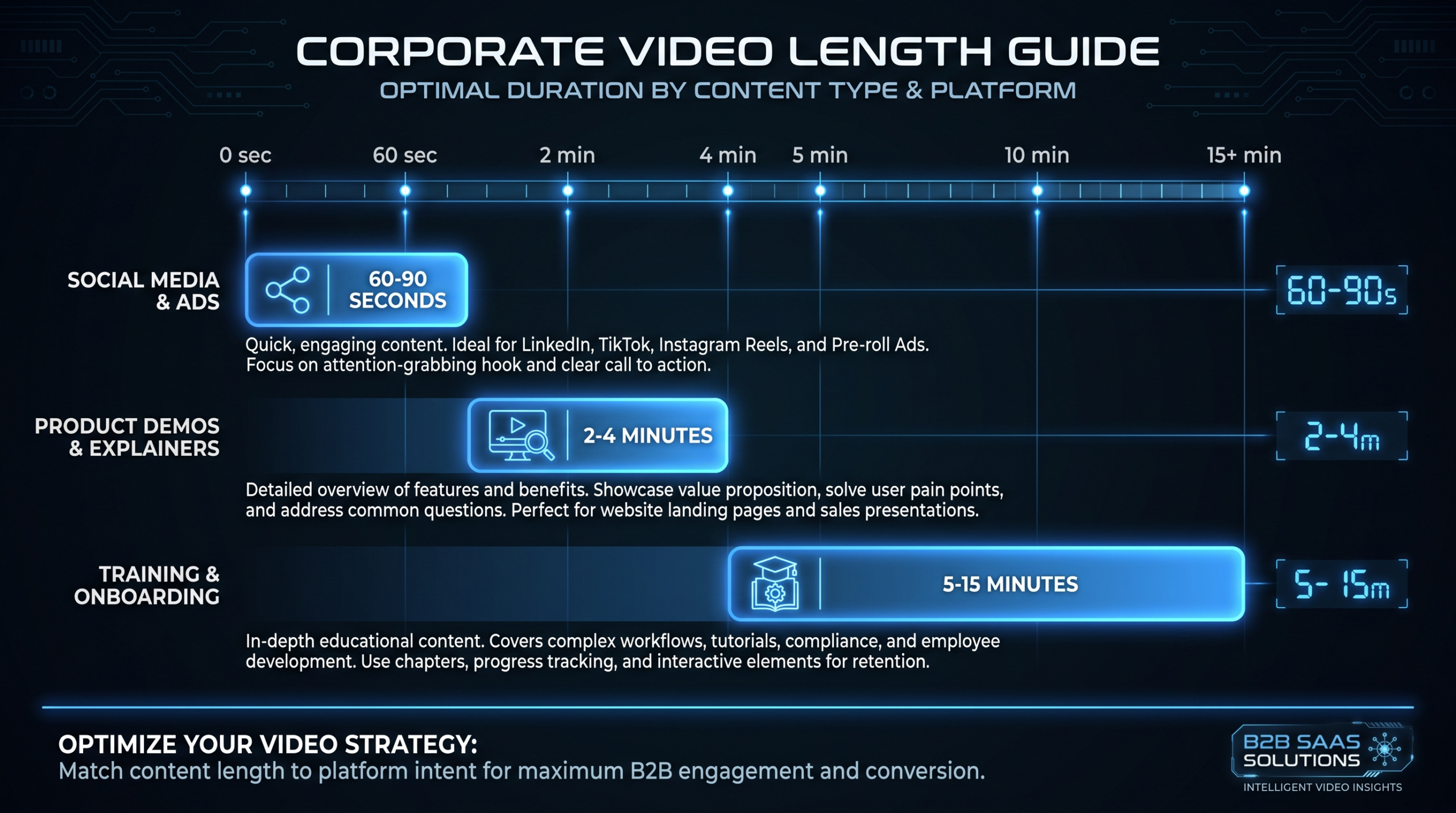
Most corporate videos perform best at 2–4 minutes — long enough to communicate a complete message, short enough to hold a distracted viewer's attention. For sales and social content, 60–90 seconds is the more effective ceiling; for training, onboarding, and detailed product walkthroughs, 4–8 minutes is appropriate and expected.
The "right" length is not a universal number. It depends entirely on the video's purpose, the platform where it lives, and the viewer's relationship with your brand. This guide gives you a clear, practical framework by video type and platform so you can make confident decisions — not guesses.
Key Takeaways
At a Glance
- 60–90 seconds: sweet spot for website hero videos, product teasers, and social ads — viewer attention drops sharply after 2 minutes for cold audiences
- 2–4 minutes: best for product overviews, brand stories, and investor videos where depth matters but time is still scarce
- 4–8 minutes: appropriate for demo walkthroughs, case studies, and webinar content where the viewer opts in to depth
- 8–20 minutes: reserved for internal training, onboarding, and compliance content where completion matters more than conversion
- Video length is a distribution decision first — always decide length based on where the video lives, not just what it says
Table of Contents
- Key Takeaways
- What's the Right Length for Each Corporate Video Type?
- Why Does Video Length Affect Engagement and ROI?
- What Factors Should Determine Your Corporate Video's Length?
- How Long Should a Corporate Video Script Be?
- How Does Video Length Affect Production Cost?
- How to Choose the Right Length for Your Next Video
- Frequently Asked Questions
What's the Right Length for Each Corporate Video Type?
The most useful way to approach this question is to map video type to its distribution context. Purpose and platform are the primary variables — and they differ substantially across the most common corporate formats.
Corporate Video Length by Type — 2026 Benchmarks
| Video Type | Recommended Length | Primary Reason | Primary Platform |
|---|---|---|---|
| Website hero / brand video | 60–90 seconds | Site visitors have no patience for long intros; goal is to hook and convert | Homepage, landing page |
| Product overview / demo | 2–4 minutes | Enough to show key features without requiring a 30-minute calendar invite | Product page, email |
| Explainer video | 90 seconds–2 minutes | Short format forces conceptual clarity; audiences disengage after 2:30 on complex topics | Homepage, LinkedIn |
| Testimonial / customer story | 90 seconds–3 minutes | Emotional payoff needs setup time; anything under 60 seconds loses credibility | Case studies page, sales decks |
| Case study video | 3–5 minutes | Decision-makers need the full arc: problem, solution, and measurable proof | Case studies page, sales |
| Company culture / employer brand | 2–3 minutes | Needs enough time to feel authentic; over-production kills the effect | Careers page, LinkedIn |
| Event recap / highlight reel | 2–4 minutes | Highlight reel format; longer cuts are for internal stakeholder audiences only | LinkedIn, website |
| Internal training / onboarding | 5–15 minutes | Completion is the goal — break into modules at 10 min+ to preserve it | LMS, internal portals |
| Compliance / policy | 5–20 minutes | Coverage is legally required; use chapter markers if over 8 minutes | LMS, HR platforms |
| Social media clip (repurposed) | 15–60 seconds | Platform algorithms and native scrolling behavior demand short, punchy formats | LinkedIn, YouTube Shorts |
For a detailed look at how these length differences translate to production budgets, see our full guide to average corporate video cost by length.
See pricing: VEC's Growth ($5K/mo), Core ($9.5K/mo), and Scale ($16K/mo) plans each cover different monthly video output volumes across short-form and long-form formats — see our pricing page to find the right tier for your content calendar.
Platform-Specific Length Constraints
Platform constraints are hard limits, not suggestions. Key ones to know:
- LinkedIn native video: max 10 minutes; optimal engagement window is 30–90 seconds for feed content, per LinkedIn's own marketing guidance
- YouTube: no practical upload limit; audience retention for non-subscribed viewers typically starts declining around the 3-minute mark
- Instagram Reels: 15–90 seconds effective range; anything longer gets algorithmically deprioritized
- Email embedded CTA thumbnails: link to videos under 2 minutes; anything longer needs its own landing page to convert
- Website above the fold: 60–90 seconds — anyone wanting more depth will scroll to dedicated video sections or a product page
Why Does Video Length Affect Engagement and ROI?
Engagement doesn't decline steadily from the first second. It falls in predictable patterns that vary significantly by content type, placement, and the viewer's intent state — and understanding these patterns is what separates smart content decisions from arbitrary ones.
The Attention Curve in Practice
Video hosting platform engagement data, including benchmarks published by Wistia, consistently shows that completion rates follow a steep curve by video length:
- Videos under 60 seconds typically retain approximately 65–80% of viewers to the end
- Videos at 2 minutes retain around 50–55% to completion
- Videos at 4–5 minutes retain roughly 35–45% — but the viewers who remain are significantly more qualified
- Videos over 10 minutes are completed only by viewers with strong intent: training, deep research, or final-stage buying evaluation
The practical implication: a 90-second brand video with 75% completion delivers more qualified brand impressions than a 4-minute version with 30% completion, even if the longer video is more thorough. This is why B2B SaaS video production teams build tiered content libraries — short-form for awareness and cold audiences, long-form for evaluation and opted-in viewers.
Length and Quality Are Independent Variables
The most common mistake in corporate video planning is equating thoroughness with quality. A 4-minute video is not inherently better than a 90-second one — it's better only if the specific audience you're targeting genuinely needs that depth in that moment. A tight 90-second demo built for an upper-funnel LinkedIn audience will outperform a 4-minute version on the same platform, even if the longer cut is more complete.
This is why professional video teams always start with the distribution context before making editing decisions about length. Understanding what's included in professional video editing makes clear why the edit drives the length — not the other way around.
What Factors Should Determine Your Corporate Video's Length?
Five variables reliably predict the optimal length for any corporate video. Evaluate all five before writing a single word of script.
1. Audience Intent and Relationship
Cold audience scrolling a social feed? Every second above 60 costs you viewers. Warm prospect who clicked from a sales sequence? They'll watch 3–4 minutes of a thorough product demo without issue. Decision-stage executive comparing vendors on a shortlist? A 5-minute case study is both appropriate and expected. The same topic, same brand, different audience state = different optimal length.
2. Platform and Placement
Platform constraints are real. Beyond hard limits, the context in which a video appears shapes viewer expectations. A video embedded above the fold on a product page competes with everything else on that page. A video sent in a personalized sales follow-up has the viewer's near-undivided attention. Design length for the attention context, not the content alone. For a full framework on this, see our B2B video distribution strategy guide.
3. Content Complexity
Simple emotional hook with a single CTA? 30–60 seconds. Technical product walkthrough for a technical buyer evaluating your API? 3–5 minutes may be the honest minimum. The working rule: cut until it hurts, then add 10 seconds back. Every second that doesn't serve a specific viewer need should be removed — ruthlessly.
4. Call to Action
If the video's job is to drive an immediate click or form fill, keep it short and direct — every extra second adds friction. If it's designed to accelerate a buying decision for a complex enterprise product, longer content is justified because the goal is a qualified conversation, not a quick conversion. Different CTAs require fundamentally different length budgets.
5. Production Constraints and Cost
Longer videos cost more to produce and edit across every pricing model. A 5-minute video requires more raw footage, more editing hours, and more revision rounds than a 90-second version. If your content program has a defined monthly budget or output ceiling, factoring length into your calendar is essential. Our guide to video production agency pricing models covers how length interacts with different billing structures.
How Long Should a Corporate Video Script Be?
The standard rule of thumb is 125–150 words of spoken script per minute of finished video. This accounts for natural pausing, on-screen visuals, B-roll, and the breathing room that makes a presentation feel confident rather than rushed. At a comfortable conversational pace:
Script Word Count vs. Finished Video Length
| Target Video Length | Script Word Count (spoken dialogue) | Key Constraint |
|---|---|---|
| 30 seconds | 60–75 words | Tagline-level messaging only — one idea, no branches |
| 60 seconds | 125–150 words | Single-message focus is non-negotiable |
| 90 seconds | 185–225 words | Sweet spot for explainers; allows one problem + one solution + one CTA |
| 2 minutes | 250–300 words | Requires tight visual pacing; every sentence earns its place |
| 3 minutes | 375–450 words | Three clear sections: hook, body, CTA — no tangents |
| 5 minutes | 625–750 words | Multiple subsections required; narrative arc essential to retain viewers |
| 10 minutes | 1,250–1,500 words | Training/deep-dive format only; chapter markers strongly recommended |
A recurring mistake in corporate video production is writing the script first and then hoping it "fits" the intended length in the edit. The professional workflow inverts this: define the target length based on audience and platform, then write to that word count, then cut the script further before you shoot. It is always cheaper to cut 50 words from a script than to cut 30 seconds from an edited video.
If you're scripting for a non-native English speaker or a technical presenter who tends to slow down, reduce the target word count by 10–15%. If the video uses animation-heavy or motion graphics sequences, reduce it by 20–25% — visual storytelling needs breathing room or the narration fights the imagery.
For real-world examples and a reusable framework, see our corporate video script examples guide. For format-specific script guidance, our product demo video production guide and the explainer video cost breakdown each include tailored script-length recommendations.
How Does Video Length Affect Production Cost?
Video length is one of the most direct cost drivers in production. Everything scales with time: more footage to shoot, more material to review, more edit decisions to make, more rounds of feedback to process. Here's a practical breakdown of how length maps to cost across different production models:
Production Cost by Video Length and Model
| Video Length | Freelancer (editing only) | Agency (full production) | Dedicated Team (monthly plan) |
|---|---|---|---|
| 30 seconds | $150–$400 | $1,500–$5,000 | Included in monthly volume |
| 60–90 seconds | $300–$900 | $3,000–$12,000 | Included in monthly volume |
| 2–3 minutes | $600–$1,800 | $5,000–$20,000 | Included in monthly volume |
| 4–5 minutes | $1,000–$3,000 | $8,000–$30,000 | Included in monthly volume |
| 8–10 minutes | $2,000–$6,000 | $15,000–$50,000+ | Counts as 2–3 standard pieces |
These ranges cover post-production editing only — not filming, scripting, or motion graphics. For a granular per-minute view, see our guide to video editing cost per minute. If you're evaluating offshore teams to reduce cost on longer-form content, compare video editing hourly rates by country for a realistic market map.
For B2B teams producing 4+ videos per month, the interaction between video length and pricing model becomes a significant budget variable. Understanding how to outsource video editing efficiently — and which model you're buying — can reduce effective cost-per-minute by 30–60% at meaningful volume.
For the full picture of how video length affects total corporate video production budgets across different scenarios and formats, our dedicated analysis covers the numbers in detail: average corporate video cost by length.
VEC's dedicated editing teams — available from $5K/month on the Growth plan — include mixed-length video library editing with no per-minute surcharges and a guaranteed output increase in the first 90 days. See how the process works or review the full VEC pricing and plan details for output benchmarks by tier.
How to Choose the Right Length for Your Next Video
Apply this five-question framework before writing a word of script or booking a single hour of production time:
- Who is the primary viewer — and what is their intent state? Cold audience, warm prospect, or existing customer/employee? Each has a different attention budget and different depth expectation.
- Where will this video live? Social feed, product page, sales email, LMS, or conference screen? Distribution channel determines attention context and hard length limits.
- What is the ONE job this video needs to do? If you can't state it in a single sentence, the video will likely end up too long.
- What decision needs to happen? A click, a demo request, a behavior change, a purchase approval? Decision complexity correlates strongly with appropriate length.
- What content is genuinely necessary — not just "nice to have"? List every element you want to include, then cut anything that doesn't directly serve the one job and the target decision.
After applying this framework, run a final check: can you say the same thing in half the time? If yes, do it. Every second of video that doesn't serve the viewer's need is a second they're more likely to stop watching — and a second the algorithm uses to penalize distribution.
The best video marketing ROI comes from precision and distribution intelligence, not production volume. This is why programs that work — including the ones our teams support — build around a defined length and intent matrix rather than producing content and then asking where it belongs.
For teams building a full B2B video program rather than a one-off piece, the SaaS vertical video strategy guide covers how to tier your library by length and funnel stage. If you're still evaluating whether to handle production in-house, outsource, or use an agency model, our agency vs. freelancer vs. in-house comparison covers the real cost trade-offs at different output volumes.
For sales-specific use cases, our sales enablement video guide includes length recommendations for every stage of the B2B sales cycle — from cold outreach clips (under 60 seconds) to late-stage technical demos (3–5 minutes).
Frequently Asked Questions
How long should a corporate video be for a website homepage?
Homepage corporate videos should be 60–90 seconds. Website visitors have minimal patience, and engagement data consistently shows significant drop-off after 2 minutes for cold audiences. A homepage video's job is to create interest and drive a next action — not to explain everything. Keep it short, direct, and outcome-focused.
What is the ideal corporate video length for LinkedIn?
For LinkedIn feed content, 30–90 seconds performs best for native video posts. For thought leadership or company page content, up to 3 minutes is acceptable when the topic has genuine professional value. LinkedIn caps native video at 10 minutes, but most organic reach accumulates within the first 60–90 seconds based on platform engagement patterns.
Does a longer corporate video mean higher quality?
No. Length and quality are independent variables. A well-structured 90-second video that accomplishes its goal completely is higher quality than a 5-minute video padded with content the audience does not need. Quality is measured by how efficiently the video serves its defined purpose for its specific audience — not by runtime.
How long should an internal corporate training video be?
Internal training videos can run 5–15 minutes per module — because viewers have task-completion motivation rather than entertainment motivation. For anything over 8–10 minutes, break content into clearly labeled chapters or separate modules. E-learning research consistently shows modules under 10 minutes have meaningfully higher completion rates.
How does corporate video length affect production cost?
Video length is a direct cost multiplier. Every additional minute of finished video requires more footage, more editing time, and more revision rounds. Agency production costs for a 4-minute corporate video are commonly 2–3x higher than for a 90-second version of equivalent quality. Editing-only costs typically range from $150–$600 per finished minute depending on complexity and provider type. See our full average corporate video cost by length breakdown for detailed figures.
Ready to Build a Corporate Video Program That Actually Scales?
VEC's dedicated editing teams work with B2B SaaS companies to plan, edit, and deliver corporate video libraries at scale — with the right length and format for every platform. Growth plans from $5K/month, no per-minute pricing, 90-day output guarantee.
Book a Free Strategy Call See Pricing