
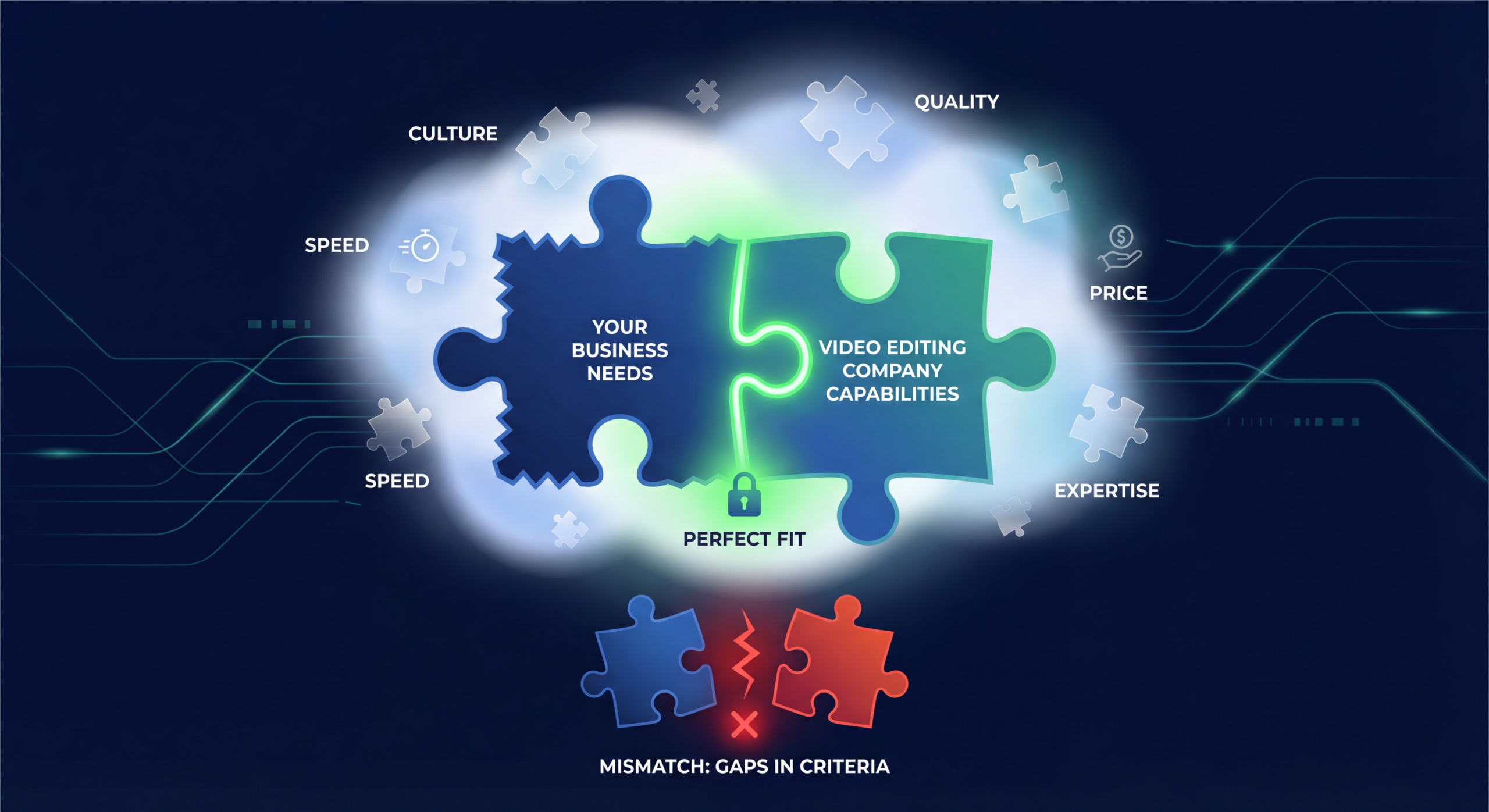
Finding the right video editing company for your business isn't just about finding someone who can cut footage together. It's about finding a partner whose workflow, creative sensibility, communication style, and capacity align with your specific needs - and whose strengths complement your weaknesses. The wrong choice creates months of frustration: missed deadlines, videos that don't match your brand, revision cycles that consume more time than doing it yourself. The right choice gives you a scalable content engine that produces professional video consistently without draining your internal team's bandwidth.
In 2026, the video editing company landscape is more diverse than ever. You can work with subscription-based services offering unlimited edits for a flat fee, boutique post-production studios that specialize in cinematic quality, offshore teams that provide budget-friendly volume, or hybrid partners that combine strategic input with editing execution. Each model has real advantages and real limitations, and the best choice depends entirely on your situation.
This guide provides a systematic framework for evaluating and selecting a video editing partner. We'll cover how to define your requirements, build a weighted scoring system, evaluate candidates objectively, and structure the engagement for long-term success. Whether you're hiring your first editing partner or replacing one that isn't working, this guide will help you make the decision with confidence.
Video editing is where raw content becomes compelling storytelling. The difference between amateur and professional video rarely comes down to camera quality - it comes down to editing. Pacing, transitions, sound design, color grading, motion graphics, text overlays, and music selection all happen in post-production. A skilled editing team can transform smartphone footage into content that looks and feels premium. A poor editing team can make footage shot on a $50,000 camera look amateurish.
For businesses, this matters because video is increasingly the first touchpoint with potential customers. According to recent marketing research, short-form video delivers the highest ROI of any content format in 2025-2026, with over 100% more marketers naming it their most valuable channel compared to the prior year. Your editing quality directly impacts whether those videos generate trust, engagement, and conversions - or get scrolled past.
Many companies settle for a video editing partner that's merely adequate. The videos are watchable, technically correct, but unremarkable. The problem with "good enough" video editing is that it represents a massive opportunity cost. You're investing time in creating content - filming, scripting, planning - and then undermining that investment with editing that fails to maximize the impact of every piece of footage.
Consider the math: if your team spends 10 hours per week on video content creation (filming, planning, reviewing), and your editing partner produces work that gets 30% lower engagement than it could with better editing, you're effectively wasting 3 hours of your team's time every week. Over a year, that's 150+ hours of team capacity diminished by subpar post-production.
Before evaluating any video editing company, you need clarity on your own requirements. This self-assessment prevents the most common mistake in vendor selection: choosing based on the vendor's strengths rather than your actual needs.
List every type of video content you produce or plan to produce. Be specific:
How many videos per month do you need edited? Be honest about both current state and where you want to be in 6-12 months. Common volume profiles:
Not all editing is created equal. A simple cut-and-caption job takes very different skills than a motion-graphics-heavy explainer video. Assess your needs across these dimensions:
Most B2B companies need a partner who's excellent at intermediate editing with the ability to handle advanced work occasionally. If your needs are primarily basic, a subscription service may be perfect. If they're primarily advanced, you need a specialized post-production studio.
Now let's build a systematic evaluation framework. Gut feeling matters, but a structured scoring system prevents you from being swayed by a great sales pitch or beautiful portfolio that doesn't match your needs.
Score each vendor 1-10 per criteria. Multiply by weight. Highest weighted total wins. Adjust weights to match your priorities.
Let's break down each criterion and explain what to look for when scoring.
This isn't about whether their work is impressive - it's about whether it's relevant to what you need. A video editing company that produces stunning music videos may struggle with B2B SaaS content. Evaluate:
Watch their work critically. Here's what separates great editing from adequate editing:
Speed matters, but only in the context of quality. Ask about their standard turnaround times for different content types:
Also ask about rush capabilities: what happens when you need something fast? Do they charge rush fees? How much faster can they go?
The sales process is your best preview of the working relationship. During evaluation, note:
Note: this is "pricing value," not "lowest price." Evaluate the relationship between cost and what you receive. Key metrics:
Can this partner grow with you? If your video needs double in 6 months, can they handle it without quality degradation? Consider:
Some editing companies just execute. Others think with you - suggesting content ideas, noticing what's working, proactively improving. While this isn't essential for a pure editing relationship, it's a valuable bonus that differentiates good partners from great ones.
Once you've scored your top candidates, visualize the comparison. A radar chart (also called a spider chart) makes it immediately obvious where each vendor excels and where they have gaps.
The radar chart immediately reveals trade-offs. Vendor A might score higher on quality and portfolio relevance but lower on pricing value. Vendor B might be more balanced across all dimensions. The visualization helps you and your stakeholders make a nuanced decision rather than defaulting to the cheapest or flashiest option.
Understanding the landscape helps you narrow your search before evaluating individual companies. Here are the five distinct models of video editing company you'll encounter:
The fastest-growing segment. Companies like VEC, MoonB, beCreatives, and Clipmasters offer unlimited or high-volume editing for a flat monthly fee, typically ranging from $1,500 to $8,000 per month. You submit raw footage and a brief; they return edited videos within 24-72 hours.
Best for: Companies that produce high volumes of content and have the ability to film or source raw footage internally. Ideal for podcast-driven businesses, social-media-heavy brands, and content repurposing operations.
Watch out for: Wide quality variation between providers. Some use junior or offshore editors who lack creative judgment. Ask to see work produced for clients similar to you, not just their best portfolio pieces.
Small teams (3-15 people) of experienced editors who focus on quality over volume. They typically work on a per-project basis with higher per-video costs but superior editing craft. Many specialize in specific industries or styles.
Best for: Companies that need occasional high-impact videos - brand films, product launches, investor presentations - where quality is paramount and volume is low.
Watch out for: Capacity constraints. If they take on too many clients, your project may get delayed. Per-project pricing can become expensive at volume.
These companies offer editing as part of a broader service offering that includes strategy, shooting, and distribution. While they provide excellent end-to-end experiences, you often pay for services you don't need if editing is your primary requirement.
Best for: Companies without any internal video capability who need everything from concept to final delivery. For more on this model, see our complete buyer's guide to video production services.
Watch out for: You may be paying for production capabilities you don't use. Ensure you can engage them for editing-only work without subsidizing their full-service overhead.
Individual editors working independently, typically found through Upwork, Fiverr, or industry networks. Costs range from $15/hour for junior editors to $100+/hour for senior professionals with specialized skills.
Best for: One-off projects or supplementing internal editing capacity. Also good for finding specialists in specific areas (e.g., motion graphics, color grading, sound design).
Watch out for: No redundancy. If your freelancer gets sick, takes vacation, or gets a better offer, your content pipeline stops. Managing multiple freelancers for consistent output is a project management burden that many underestimate.
Emerging tools like Descript, Kapwing, and others use AI to automate aspects of editing - auto-captioning, silence removal, rough cuts, clip selection. These aren't editing companies per se, but they're increasingly competing for the same budget.
Best for: Simple editing tasks like adding captions, removing silences, or creating basic clips from longer content. Can supplement a human editing team to reduce costs on high-volume, low-complexity tasks.
Watch out for: AI editing lacks creative judgment. It can't pace a story, choose the right emotional beat, or make the hundred micro-decisions that make video editing an art. For more on AI's role, see our piece on AI video editing for B2B teams.
Now that you understand what you need and what's available, here's the step-by-step process for evaluating candidates:
Start with 8-12 potential partners identified through:
Narrow to 4-5 candidates based on initial portfolio review and website evaluation. Eliminate anyone who doesn't have relevant examples, has an unprofessional web presence, or doesn't clearly explain their services and pricing model.
Schedule 30-minute discovery calls with each candidate. Come prepared with:
During the call, pay attention not just to what they say but how they engage. Do they listen more than they pitch? Do they ask smart questions? Do they push back on anything or just agree with everything? The best partners challenge your thinking.
This is the most important step. Do not skip it. Ask your top 2-3 candidates to complete a paid test project using real footage from your business. Give all candidates the same footage, the same brief, and the same deadline.
The test project should be:
When reviewing test project results, evaluate: Did they follow the brief? Did they add creative value? Was the audio clean? Did the pacing feel right? Did they hit the deadline? How did they handle clarifying questions?
Ask each finalist for 2-3 client references. When calling references, ask:
Use the weighted scoring template to compile your evaluation. Include the scores from portfolio review, test project assessment, reference checks, and your subjective impression of communication quality. Present the results to your decision-making team with a clear recommendation.
Once you've selected your preferred video editing company, it's time to structure the engagement. Here's how to negotiate effectively:
Resist the pressure for long-term commitments upfront. The ideal structure is:
Any reputable editing company that's confident in their quality should be willing to earn your long-term commitment rather than lock you in contractually.
Be specific about what's included in the monthly fee. Critical items to define:
Ensure your contract explicitly states that you own all final deliverables, project files, and custom templates created for your brand. This is non-negotiable. If the relationship ends, you need to be able to continue without starting from zero.
Include provisions for quality standards. This might include:
The first 30 days set the tone for the entire relationship. Invest time in a thorough onboarding process:
Prepare a comprehensive brand package:
Document the entire workflow in writing:
Plan for the first 2-3 projects to require more feedback and revision than usual. This isn't a red flag - it's normal calibration. Use these early projects to establish expectations, clarify preferences, and build a shared understanding of quality standards. The investment you make in detailed feedback during weeks 1-4 pays enormous dividends in reduced feedback cycles from month 2 onward.
Selection is only the beginning. The ongoing management of your video editing partnership determines whether you get maximum value from the investment.
Establish a sustainable rhythm:
Schedule a 30-minute monthly review to discuss:
Every three months, step back and evaluate the partnership at a higher level:
Not every partnership works out. Here are clear signals that it's time to evaluate alternatives:
If you recognize these signs, start your evaluation process for a replacement before terminating the current relationship. Maintain professionalism throughout - the video production community is small, and your reputation matters.
Pricing varies widely by model. Subscription-based editing services range from $1,500 to $8,000 per month for unlimited or high-volume editing. Per-project pricing ranges from $200 for simple social clips to $5,000+ for complex brand videos. The most important metric is cost per deliverable - divide your monthly spend by the number of finished videos to compare value across providers.
A video editing company specializes in post-production: taking raw footage and transforming it into finished content through cutting, color grading, sound mixing, motion graphics, and effects. A video production company handles the full lifecycle from concept through shooting and post-production. If you can capture footage internally, you likely only need an editing company. If you need help with filming and creative direction as well, consider a full-service production partner.
For editing specifically, remote works perfectly. Unlike production (where physical presence for shoots matters), editing is entirely digital. The quality of the work, communication, and process matters far more than geographic proximity. Remote editing companies often provide better value because they can hire talent from broader markets. That said, if you value in-person collaboration for creative direction and feedback, a local partner may be worth the premium.
With a well-calibrated editing partner, most projects should require 1-2 revision rounds. If you're consistently needing 3+ rounds, something is wrong - either the briefs aren't clear enough, the editor doesn't understand your brand, or there's a quality mismatch. During the first month, expect more revisions as you calibrate. After month two, revision rounds should stabilize at 1-2 maximum.
Yes, and many companies do. A common approach is to use a subscription-based service for high-volume, routine content (social clips, podcast editing) and a boutique studio for occasional high-impact projects (brand films, product launches). Just ensure you have documented brand guidelines that both partners follow so the output feels cohesive regardless of who produced it.
Provide the highest quality footage available - typically .MOV or .MP4 files in the original resolution (4K is ideal, 1080p is acceptable). For screen recordings, .MP4 at 1080p minimum. Include separate audio files if you recorded audio independently. Provide brand assets in vector formats (SVG, AI, EPS) for logos and specify exact color codes. Share fonts as installable files. Use cloud storage (Google Drive, Dropbox, or Frame.io) for delivery rather than compressing files.
Expect 2-4 weeks for functional onboarding and 2-3 months for full calibration. The first two weeks involve sharing brand assets, documenting workflows, and completing initial test projects. By week four, they should be producing work that requires minimal revision. By month three, the workflow should be smooth enough that you can submit briefs with minimal detail and receive on-brand content consistently.
Choosing a video editing company is ultimately a decision about trust. You're trusting someone with your brand's visual identity, your audience's attention, and your team's time. The evaluation framework in this guide helps you make that decision systematically rather than emotionally.
Use the weighted scoring template. Run a paid test project. Check references. But also trust your instinct about the working relationship. The best editing partnerships are characterized by mutual respect, clear communication, and a shared commitment to producing great work. When you find that combination of capability and compatibility, commit to the relationship and invest in making it succeed.
The companies winning with video content in 2026 aren't the ones with the biggest budgets or the fanciest equipment. They're the ones with reliable editing partnerships that turn consistent content creation into a sustainable competitive advantage.
Get our complete evaluation framework with scoring templates, reference check scripts, and contract negotiation tips to find the perfect video editing partner.
Download the Checklist See Pricing