What Are the Stages of Corporate Video Production?
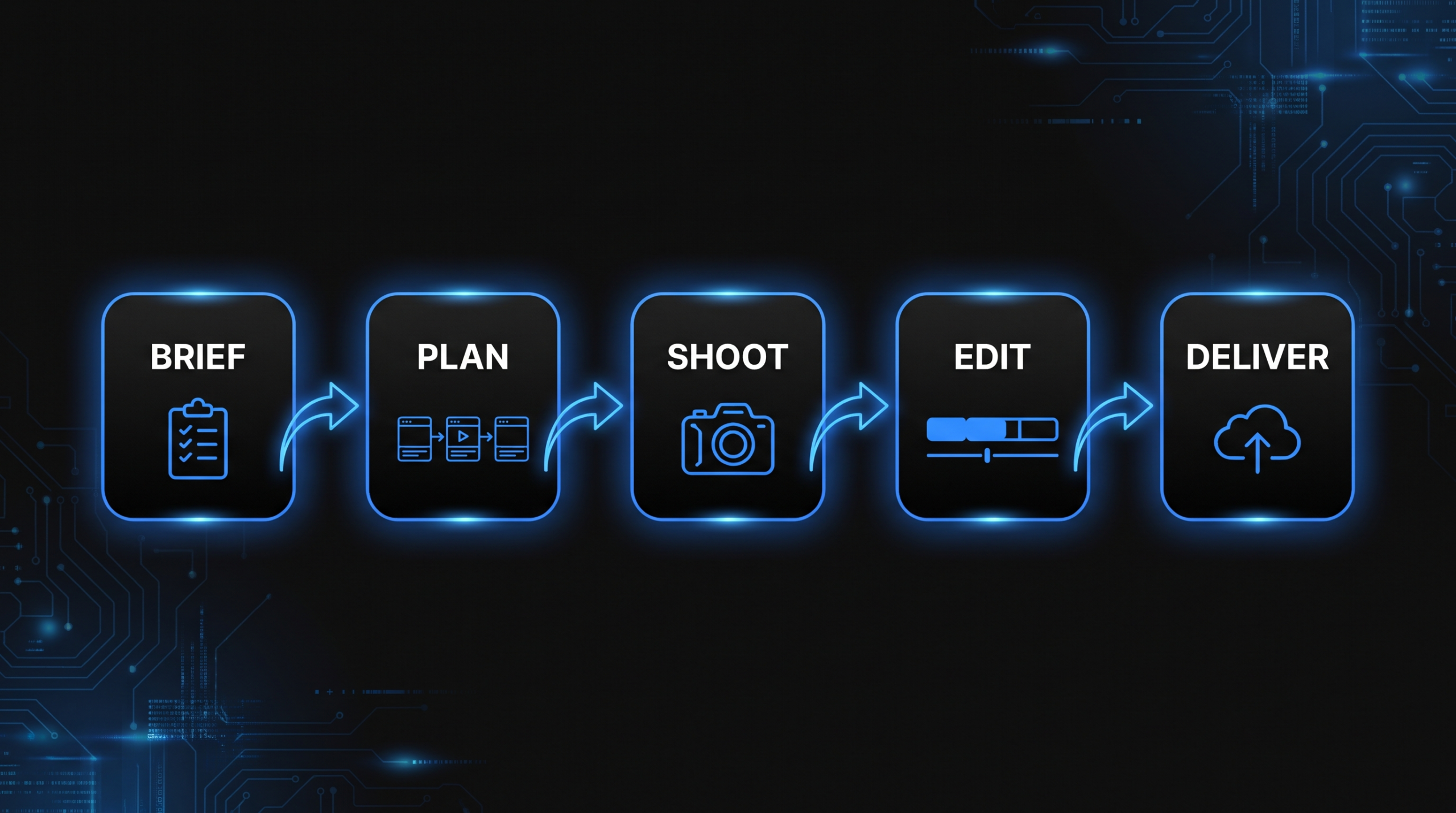
Corporate video production moves through five stages in a fixed order: brief and strategy, pre-production, production, post-production, and delivery and distribution, and each stage ends with a sign-off that unlocks the next.
Key Takeaways
- The five stages are brief and strategy, pre-production, production, post-production, and delivery and distribution.
- Many budget and schedule problems are created in stages 1 and 2 and only discovered in stages 3 and 4.
- A mid-complexity corporate video commonly lands somewhere between four and ten weeks from brief to delivery; the shoot itself is usually the shortest stage.
- Post-production is the stage that is often delayed, usually by review rounds rather than by editing work.
- You can outsource stages 3 to 5 while keeping stages 1 and 2 close to your own team, which is a common split for B2B marketing teams.
Table of Contents
- What are the five stages at a glance?
- Stage 1: What goes into the brief and strategy?
- Stage 2: What happens in pre-production?
- Stage 3: What happens on set during production?
- Stage 4: Why does post-production take the longest?
- Stage 5: How is a corporate video delivered and distributed?
- Who is responsible for what at each stage?
- How long does each stage take, and where does time slip?
- How does cost spread across the stages?
- Which stages should you outsource?
- What mistakes derail corporate video projects?
- FAQ
If you are a marketing lead commissioning your first corporate video, or your fifth one that went over schedule, the stages matter because they tell you what to decide, when, and who has to approve it. This guide walks through each stage in order, names the deliverable that closes it, and flags where projects usually slip. For the wider picture of video types, budgets and trends, start with our pillar guide, Corporate Video Production: Everything You Need to Know in 2026. This post goes deeper on the sequence itself.
What are the five stages at a glance?
The five stages are brief and strategy, pre-production, production, post-production, and delivery and distribution. Other guides label them differently (Wistia's business video production guide, checked October 24, 2026, lists planning, pre-production, production, post-production and publishing), but the underlying sequence is the same. We split planning into a strategy-focused brief stage and a logistics-focused pre-production stage, because they have different owners and different failure modes.
The Five Stages of Corporate Video Production
| Stage | What gets decided or made | Closing deliverable | Typical calendar time* |
|---|---|---|---|
| 1. Brief and strategy | Goal, audience, message, channel, budget band, approvers | Signed one-page brief | 2-5 business days |
| 2. Pre-production | Script, storyboard, shot list, talent, locations, schedule | Locked script and shoot plan | 1-3 weeks |
| 3. Production | Filming, interviews, screen capture, audio, B-roll | Wrapped, backed-up raw footage | 1-3 shoot days (screen-capture-only work can be hours) |
| 4. Post-production | Edit, graphics, color, sound, captions, review rounds | Approved final cut | 2-5 weeks including reviews |
| 5. Delivery and distribution | Exports, versions, captions, hosting, publishing, tracking | Live video plus archived project | 2-5 business days |
*These are VEC editorial planning ranges for a single mid-complexity video, not survey data. Scope, number of stakeholders and shoot logistics move them in either direction.
Stage 1: What goes into the brief and strategy?
A good brief answers six questions on one page: what the video must achieve, who it is for, the single message, where it will run, what success will be measured by, and who approves it. If a brief cannot be written in a page, the project is not ready for a producer.
The six fields of a working brief
- Objective. A business outcome, not a topic. "Explain onboarding to new enterprise admins so fewer of them need a live walkthrough" is a brief. "Make a video about our company" is not.
- Audience. One primary viewer rather than "everyone."
- Single message. The one sentence the viewer should repeat afterwards.
- Distribution. Website, sales emails, LinkedIn, YouTube, an internal LMS or an event screen. This drives aspect ratio, length and captions.
- Success metric. Views are rarely the right answer. Completion rate on a sales page, demo requests assisted, or support tickets deflected are examples of metrics tied to an objective.
- Budget band and approvers. A range, plus the named people who can say yes. Unnamed approvers are the source of most late-stage rework.
The stage 1 sign-off
The gate is a signed brief from the budget owner and the final approver. If a stakeholder appears after this point with a new objective, treat it as a change request, not a note. Our guide to where video production money goes shows why late scope changes are so expensive once a crew is booked.
Stage 2: What happens in pre-production?
Pre-production turns the brief into a plan that a crew can execute in a day or two: a locked script, a visual plan, confirmed people and places, and a schedule. It is the cheapest stage to change your mind in and the most expensive to skip.
Pre-production documents and what each one settles
Pre-Production Deliverables
| Document | What it settles | Who signs off |
|---|---|---|
| Script or interview question list | Exact words, order of ideas, claims that need legal or product review | Marketing lead, subject-matter expert, legal where needed |
| Storyboard or shot list | What each scene looks like, camera setups, on-screen graphics | Marketing lead, director |
| Call sheet and schedule | Who is where, when, with what equipment | Producer |
| Talent and location releases | Permission to film people and places and to use the footage | Producer, legal |
| Edit plan (asset list) | Which logos, screen recordings, music and graphics post-production will need | Editor, marketing lead |
Lock the script before the shoot
The most valuable gate in the whole process is script lock. Changing a sentence in a document costs minutes. Changing it after the interview has been filmed can mean a reshoot, a voiceover, or an awkward cut around the problem. For interview-led videos, send the questions to your speakers ahead of time and agree which claims need a source.
Plan the shoot around the edit
The edit plan is the document most teams skip, and the one editors ask for first. It lists the shots, cutaways and graphics the final video will need, so the crew can capture them while they are on site. Our guide on how to shoot for the edit covers coverage, shooting ratio and the settings that make post-production faster.
Stage 3: What happens on set during production?
Production is the capture stage: interviews, B-roll, product footage and screen recordings, collected against the shot list. For many corporate videos it is the shortest stage, often one to three days, and it succeeds or fails on what was prepared in stage 2.
Who is on a corporate shoot
A typical live-action crew includes a director, one or more camera operators, a sound engineer, and often a lighting technician and a production assistant. Software and SaaS videos frequently replace the crew with screen capture plus a voiceover recorded in a quiet room.
Four habits that protect the footage
- Audio first. Viewers forgive a plain shot sooner than bad sound. Record clean dialogue before anything else, and capture room tone for the editor.
- Prepare the interviewee. Share the questions in advance, tell them to answer in full sentences, and let them redo any answer.
- Back up before leaving. Copy the cards to two locations on site and confirm the files open.
The stage 3 sign-off
Before the crew is released, someone checks the day's footage against the shot list. A missing shot is cheap to pick up at 4 pm on set and expensive to fix three weeks later. If your video is a product walkthrough, the compressed version of this whole process is laid out in our demo video production process, brief to publish in 14 days.
Stage 4: Why does post-production take the longest?
Post-production takes the longest because it holds the most sequential steps and, more importantly, the most waiting: every review round pauses the editor until feedback comes back. The editing itself is a minority of the calendar time on most projects.
Post-Production Steps
| Step | What comes out of it | Review gate |
|---|---|---|
| Ingest and organize | Synced, labelled, backed-up project | Editor internal check |
| Assembly (rough cut) | Content in order, no polish | Marketing lead: story and message |
| Fine cut | Pacing, trims, transitions | Stakeholders: accuracy and tone |
| Graphics and motion | Titles, lower thirds, data visuals, logo animation | Brand owner |
| Color and sound | Consistent look, mixed audio, music | Editor and marketing lead |
| Captions and versions | Caption files, cutdowns, alternate aspect ratios | Final approver |
Cap the review rounds
Agree before editing starts how many consolidated review rounds are included, and who owns consolidation. Two rounds of one merged set of notes is a common structure. Five people sending five separate email threads is how a two-week edit becomes a six-week edit.
Scope differs between providers, so ask what is in and out. Our overview of video post-production services: process, timeline and cost and the checklist in what video editing services include are useful comparison points. If you want to see how VEC structures this stage for a dedicated team, the steps are on our how it works page.
Stage 5: How is a corporate video delivered and distributed?
Delivery means exporting the right files for each destination, attaching captions, publishing, and tracking the metric you set in stage 1. A video that is approved but not delivered correctly is still an unfinished project.
- Master and versions. Keep one high-quality master, then export per channel: widescreen for your site and YouTube, vertical or square cutdowns for social, and a short version for sales emails.
- Follow platform specs. YouTube's help page on recommended upload encoding settings (checked October 24, 2026) recommends an MP4 container, H.264 video, AAC-LC or Opus audio at a 48 kHz sample rate, and uploading at the same frame rate the content was recorded in. Other platforms publish their own specs, so check the destination before you export.
- Captions and transcripts. Captions help viewers who watch on mute and viewers who rely on them for access. The W3C Web Accessibility Initiative maintains a dedicated guidance page on captions and subtitles for web video (checked October 24, 2026). Budget for caption review, not just auto-generation.
- Measure against stage 1. Review the success metric four to six weeks after launch, and note what you would change in the next brief.
Who is responsible for what at each stage?
Your team owns the decisions at the start and the approvals at the end; the production partner owns execution in between. Ambiguity about who approves what is a frequent source of delay, so write it down in stage 1.
Responsibilities by Stage
| Stage | Your team | Production partner | Final sign-off |
|---|---|---|---|
| 1. Brief and strategy | Writes objective, audience, metric | Pressure-tests scope and budget | Budget owner |
| 2. Pre-production | Reviews script, supplies subject experts and brand assets | Writes script, plans shoot, books crew | Marketing lead |
| 3. Production | Provides access, speakers, product environment | Directs, films, records audio | Producer and marketing lead |
| 4. Post-production | Consolidates feedback within the agreed rounds | Edits, animates, mixes, captions | Final approver |
| 5. Delivery | Publishes and tracks | Delivers files and versions | Marketing lead |
How long does each stage take, and where does time slip?
Each stage has one typical cause of delay, and it is rarely the creative work. The delays come from decisions that arrive late.
Where Schedules Slip
| Stage | Common cause of delay | Practical fix |
|---|---|---|
| 1. Brief and strategy | Stakeholders disagree on the goal | One decision-maker; brief signed before any quotes |
| 2. Pre-production | Script stuck in legal or product review | Send claims for review early; set a script-lock date |
| 3. Production | Speaker unavailable, location access problems | Hold a backup date; confirm access in writing |
| 4. Post-production | Unconsolidated or late feedback | Named owner for notes; fixed turnaround for each round |
| 5. Delivery | Missing captions, wrong export, platform approval | Delivery checklist agreed at the rough cut |
How does cost spread across the stages?
Cost follows the type of video: a live-action brand film puts most of its spend into pre-production and production (crew, equipment, locations, talent), while an interview cutdown, motion-graphics or SaaS video puts most of it into post-production. There is no universal percentage split, and we do not quote one.
What Drives Cost at Each Stage
| Stage | Main cost drivers | Where teams save without hurting quality |
|---|---|---|
| 1. Brief and strategy | Producer or strategist time | Arrive with a written objective and metric |
| 2. Pre-production | Scriptwriting, storyboards, casting, location fees, permits | Use your own office and real customers where appropriate |
| 3. Production | Crew days, equipment, travel, talent | Batch several videos into one shoot day |
| 4. Post-production | Editor hours, motion graphics, music licensing, revision rounds | Plan the edit before the shoot; cap review rounds |
| 5. Delivery | Versions, captions, platform setup | Plan cutdowns in the brief, not after approval |
For real ranges, see our corporate video production cost guide and our breakdown of videographer rates, which covers the crew side of stages 2 and 3. If you need a worksheet, the video production cost estimate template maps line items to the same stages. On the post-production side, VEC's dedicated-team plans are published on our pricing page: Growth at $5,000 per month, Core at $9,500 per month and Scale at $16,000 per month.
Which stages should you outsource?
Keep the strategic stages close and outsource the execution-heavy ones. A common B2B split keeps stage 1 in-house, share stage 2 with a producer, hire a local crew for stage 3, and hand stages 4 and 5 to a specialist editing team.
- Stage 1: keep in-house. Nobody else knows your objective or approvers.
- Stage 2: split. Your team owns message and claims; a producer or scriptwriter owns structure and logistics.
- Stage 3: hire a crew or shoot in-house. A shoot day is a poor use of a full-time editor, and a poor use of a marketer's time.
- Stage 4: outsource if volume is steady. If you publish regularly, a dedicated editing team that learns your brand is faster than briefing a new freelancer each time.
To be clear about where VEC fits: we are a post-production company. A VEC dedicated team covers stages 4 and 5, meaning editing, motion graphics, sound, captions and versions. We do not shoot footage and we do not produce 3D. If you need stages 2 and 3 as well, pair a local crew with a post-production partner. Our guide to outsourcing video production without losing creative control covers how to structure that handoff, and our SaaS video production overview shows how the stages compress for software companies.
What mistakes derail corporate video projects?
The mistakes that cost the most are decisions skipped early. Each one below maps to a stage.
- Starting with a format instead of an objective (stage 1). "We need a two-minute brand film" is a format. Start with what the video should change.
- Script changes after filming (stage 2). Lock the words, including legal-sensitive claims, before the camera rolls.
- Unlicensed music and footage (stages 2 and 4). Do not assume "fair use" covers a commercial video. The U.S. Copyright Office's Fair Use Index (checked October 24, 2026) summarizes court decisions and shows that fair use is judged case by case. Licensed or original assets are the safe route; ask your legal team.
- Shooting without an edit plan (stage 3). No cutaways, no clean audio, no room for the editor to tighten.
- Unlimited, unstructured feedback (stage 4). Cap rounds, consolidate notes, and name one person who resolves conflicts.
Frequently Asked Questions
What are the stages of corporate video production, start to finish?
The stages are brief and strategy, pre-production, production, post-production, and delivery and distribution. The brief fixes the goal and approvers, pre-production produces the script and shoot plan, production captures the footage, post-production turns it into the final cut, and delivery publishes and measures it.
How long does corporate video production take?
A mid-complexity corporate video commonly takes about four to ten weeks from signed brief to delivery. Simple screen-capture or interview-cutdown projects can be faster; multi-location shoots with many stakeholders take longer. The biggest swing factors are script approval time and the number of review rounds in post-production.
Which stage of video production is the most important?
Stage 1 and stage 2, the brief and pre-production. Decisions made there set the budget, the shot list and the message, and changing them after filming is an expensive kind of change. A clear brief and a locked script prevent most downstream rework.
Can I outsource only part of the corporate video production process?
Yes. Many teams keep strategy in-house, hire a local crew for the shoot, and outsource editing and delivery. VEC covers post-production only, with dedicated-team plans listed on our pricing page, and does not shoot footage.
Do the stages change for product demo or explainer videos?
The five stages stay the same but compress: the shoot may be a screen recording and a voiceover, and the script carries more of the weight. Our product demo video production guide walks through that compressed version.
Sources checked October 24, 2026
Need a Team for Stages 4 and 5?
Our dedicated editing teams take footage from your crew or your screen recordings to a finished, captioned, multi-format video. Talk to us about how a dedicated team would fit your production process.
Book a Free Strategy Call See Pricing