Corporate Video Production Cost: 2026 Guide
TL;DR
- Corporate video production typically costs $3,000–$50,000+ depending on type, length, and production approach.
- The four biggest cost drivers are production complexity, crew size, post-production scope, and revision rounds.
- Dedicated editing teams cost 40–60% less than per-project quotes at sustained content volumes.
- Most B2B SaaS teams at Series A–C spend $8,000–$20,000/month for a consistent corporate video program.
- Use the video production cost calculator to model your specific scenario.
Table of Contents
You're building a budget for corporate video production and you need real numbers — not a range so wide it's useless. This guide gives you the actual cost landscape for 2026: what different corporate video types typically cost, what drives those numbers up or down, and how to structure a production budget that your finance team will accept.
We've worked with hundreds of B2B SaaS companies on their video programs. The number one budgeting mistake we see is treating "corporate video" as a single line item when it's actually four or five very different production categories, each with its own cost logic.
What Corporate Video Production Costs in 2026
Corporate video production typically starts around $3,000 for a simple internal communication piece and commonly reaches $25,000–$50,000+ for a polished brand film or multi-location shoot. Most B2B SaaS companies producing content consistently — product demos, customer stories, thought leadership — budget between $8,000 and $20,000 per month across their video program.
The wide range reflects real differences in scope, not agency markup variation. A 90-second animated explainer and a 3-minute customer testimonial filmed on-location have almost nothing in common from a production standpoint, even if they end up at similar lengths.
Corporate Video Production Cost — Quick Reference (2026)
| Video Type | Typical Range | Primary Cost Variable |
|---|---|---|
| Internal communication / training | $3,000–$8,000 | Length + revision rounds |
| Product demo / walkthrough | $5,000–$15,000 | Screen capture vs. live shoot + animation |
| Customer testimonial / case study | $5,000–$18,000 | Location, crew size, travel |
| Animated explainer | $8,000–$25,000 | Animation style (2D vs. motion graphics vs. 3D) |
| Brand / culture film | $12,000–$50,000+ | Shoot days, locations, talent, music licensing |
| Executive thought leadership | $4,000–$12,000 | Studio setup, scripting, teleprompter vs. conversational |
| Event recap / conference highlight | $6,000–$20,000 | Crew count, multi-camera, same-day turnaround requirements |
These are market ranges, not exact quotes. Your actual cost will sit somewhere in each band based on the factors covered in §3.
Corporate Video Cost by Type
Understanding what you're actually buying at each price point helps you allocate budget accurately rather than underestimating scope.
Internal Communications and Training Videos
The most produced but often most undercosted category. A training video for 200 employees onboarding quarterly still requires professional scripting, clean audio, and screen recording or talking-head production. Companies commonly start around $3,000–$5,000 for a single episode with a teleprompter setup and professional edit, scaling to $6,000–$8,000 when motion graphics, chapter markers, or interactive overlays are added. If you're producing a training series (8–12 episodes), per-episode costs typically drop 20–35% under a dedicated engagement versus one-off quotes.
Product Demo and Walkthrough Videos
For SaaS companies, this is usually the highest-ROI video type, and cost varies sharply by approach. A screen-recorded walkthrough with professional voiceover and light motion graphics commonly runs $5,000–$8,000 for a 2–3 minute piece. Add a live presenter, studio lighting, and branded lower-thirds and you're typically at $8,000–$12,000. Full-production demo videos with client environment simulations, motion design, and multiple revision rounds regularly reach $12,000–$15,000.
See our full video production cost breakdown for a phase-by-phase view of where each dollar goes in a demo video production.
Customer Testimonial and Case Study Videos
Location is the dominant variable. A remote-filmed testimonial (customer uses their own webcam, you handle the edit with b-roll and motion graphics) typically starts around $5,000–$7,000. On-location filming with a 2–3 person crew, travel, and a half-day shoot commonly runs $10,000–$18,000. Budget for travel separately — it's real cost that agencies don't always surface upfront.
Animated Explainer Videos
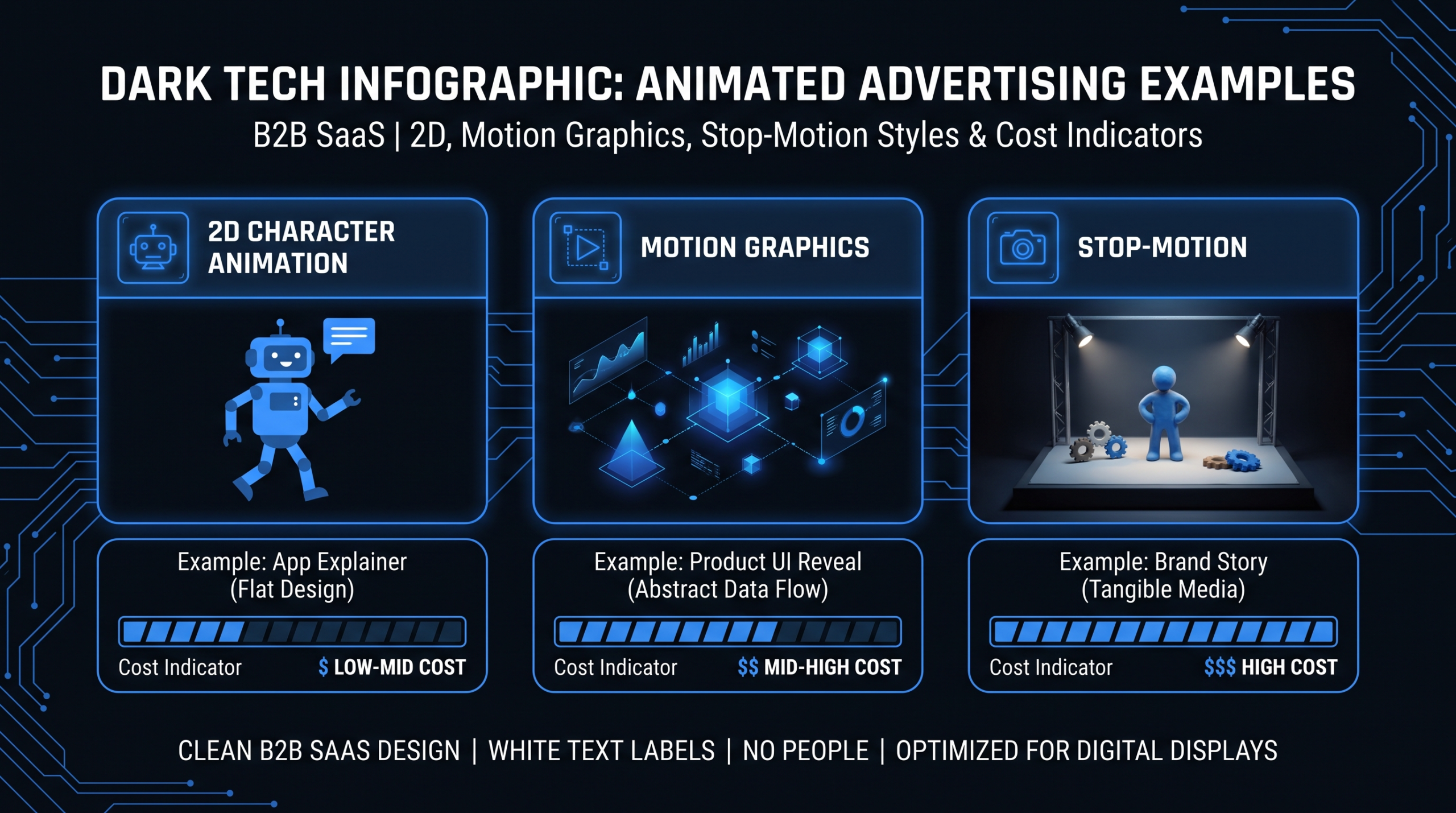
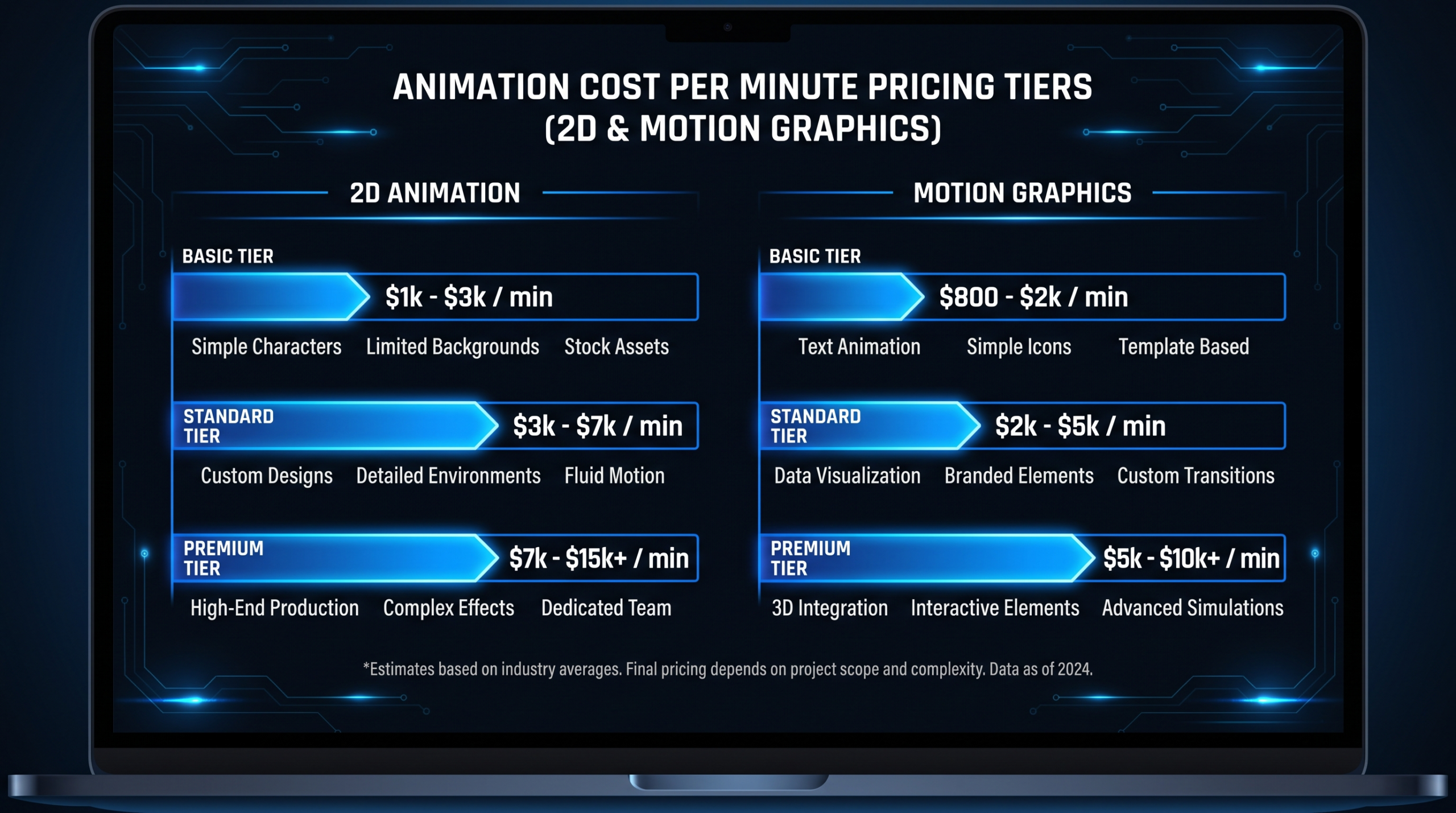
Animation style is everything. Motion graphics with existing brand assets typically start around $8,000–$12,000 for 90 seconds. Custom 2D character animation (true frame-by-frame or puppet animation) commonly reaches $15,000–$22,000. 3D animation for product visualization regularly runs $20,000–$40,000+ at professional quality. The script and voiceover add $1,500–$4,000 on top regardless of style.
Brand Films and Culture Videos
The highest-variable category. A well-produced 2-minute brand film with one location, a 4-person crew, and licensed music typically starts around $15,000–$20,000. Multi-location shoots, aerial footage, professional talent (non-employee), original music composition, and 4K cinema-grade production push costs to $35,000–$50,000+. For a comprehensive look at where these costs land by company size, our corporate video cost guide by company stage covers the startup-to-enterprise spectrum.
What Drives Corporate Video Production Costs
Four variables account for roughly 80% of the cost variance between a $5,000 and a $25,000 corporate video. Understanding them lets you make intelligent trade-offs rather than treating budget discussions as black boxes.
1. Pre-Production Scope
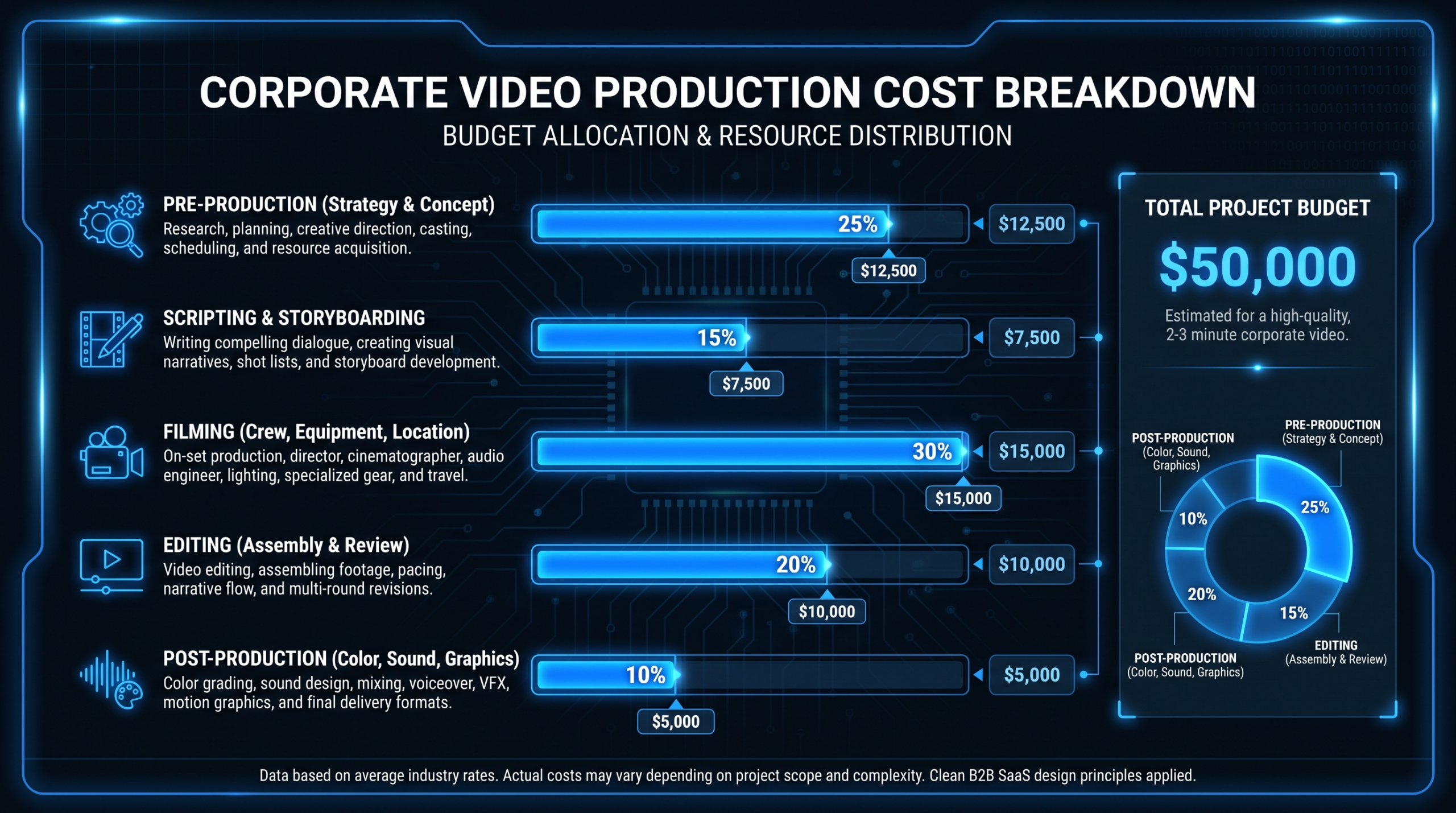
Scripting, storyboarding, and creative concepting are often underweighted in initial quotes and overrun in final invoices. A professionally scripted and storyboarded 90-second video requires 8–15 hours of creative work before a camera turns on. If your agency quotes a flat project fee without separating pre-production, ask for the line item — hidden pre-pro overages are the single most common source of "why did this cost more than quoted?"
Pre-production typically represents 15–25% of total production cost on a well-scoped project.
2. Crew Size and Shoot Days
A professional video shoot commonly involves a director, camera operator, gaffer (lighting), audio technician, and a production assistant at minimum. Day rates for experienced crew members in major US markets typically run $500–$1,500/person/day. A two-day shoot with a five-person crew is $5,000–$15,000 in crew costs alone, before equipment, location fees, and catering.
Every additional shoot day and crew member compounds linearly. The most reliable way to control this cost is tighter scripting and location consolidation before the shoot starts.
3. Post-Production Complexity
Post-production — editing, color grading, audio mix, motion graphics, and delivery — commonly represents 30–50% of total project cost on a complex video. For an animated explainer, post is closer to 60–70% of total cost (there's no "shoot").
The per-minute cost of finished video editing gives a useful benchmark. Our video editing cost per minute guide shows what professional editing actually costs across different production tiers, which helps you reality-check agency quotes against market rates.
4. Revision Rounds
Most corporate video projects include 2–3 rounds of revisions in the base quote. Each round beyond that typically costs $300–$800 depending on the agency and scope of changes. An organization with unclear approval chains — marketing reviews, then legal, then the CEO — routinely adds 3–5 extra revision rounds. On a $15,000 project, that's $1,500–$4,000 in overages that never appear in the original quote.
Locking stakeholder input before the edit begins is free. Changing the messaging after the final cut is not.
5. Music and Licensing
Stock music licensing for a single video commonly runs $50–$500 depending on the library and usage rights. Premium sync licenses (real artists, broadcast rights) run $2,000–$15,000+. Original composition for a brand film starts around $3,000–$8,000. This cost is frequently omitted from initial quotes and shows up as a surprise line item at delivery.
6. Number of Deliverable Formats
A single corporate video delivered in four aspect ratios (16:9 for YouTube, 1:1 for LinkedIn feed, 9:16 for LinkedIn Stories and Instagram Reels, plus a 4:3 broadcast cut) is effectively four videos from a post-production standpoint. Every additional format adds edit time. Budget accordingly, or negotiate a multi-format package upfront at a 30–40% discount versus separate quotes per format.
Agency vs. Freelancer vs. In-House: Cost Comparison
For a sustained corporate video program, the production model you choose matters as much as any individual quote. Here's how the three main options compare across a realistic B2B SaaS scenario: producing 6–10 corporate videos per month (demos, customer stories, thought leadership clips, social cuts).
Production Model Cost Comparison: 8 Corporate Videos per Month
| Model | Typical Monthly Cost | Per-Video Effective Cost | Best For |
|---|---|---|---|
| Per-project agency | $18,000–$32,000 | $2,250–$4,000 | 1–3 videos/quarter, one-off needs |
| Freelancer team (self-managed) | $8,000–$14,000 | $1,000–$1,750 | High tolerance for coordination overhead |
| Monthly retainer (full-service agency) | $10,000–$18,000 | $1,250–$2,250 | Consistent output, managed relationship |
| Dedicated editing team (subscription) | $5,000–$10,000 | $625–$1,250 | High-volume editing, mixed formats |
| In-house team (loaded cost) | $20,000–$35,000 | $2,500–$4,375 | Highest volume, brand control priority |
The in-house cost is loaded — it includes salary, benefits, software licenses, equipment depreciation, and management overhead. Two mid-level video editors in a major US market, fully loaded, commonly cost $180,000–$250,000/year combined. That's $15,000–$21,000/month before a single piece of equipment or a single software seat. HubSpot's video marketing research consistently shows that companies with dedicated video capacity publish content more frequently and report higher marketing ROI than teams relying on on-demand production.
For a detailed breakdown of which pricing model makes financial sense at different production volumes, see our video production agency pricing models guide.
The Hidden Cost of Self-Managed Freelancer Teams
Freelancer teams can look cheap on a cost-per-hour basis but routinely underperform on total cost. The coordination tax — the hours your marketing manager spends briefing, chasing, reviewing, and re-briefing across 3–5 individual freelancers — is real cost. At $80–$120/hour for a marketing director's time, 10 hours of coordination per project across 8 projects is $6,400–$9,600/month in buried management cost that never appears in the production invoice.
How to Budget for Corporate Video Production
A reliable corporate video budget has four components: production cost, revision buffer, licensing, and distribution. Most marketing teams plan for the first and ignore the other three.
Production Cost (60–70% of total budget)
Get itemized quotes, not lump sums. Ask for pre-production, production day rates, and post-production as separate line items. This makes it easier to spot scope assumptions and gives you leverage to negotiate specific phases rather than the whole package.
Revision Buffer (10–15% of production cost)
Even on well-briefed projects, plan for one unplanned revision round. If your organization has multiple stakeholders with approval authority (common in enterprise), plan for two. Building this into the budget upfront prevents awkward conversations at the finish line.
Licensing and Music (5–10% of production cost)
Music, stock footage, and font licensing add up. For a $10,000 video, budget $500–$1,000 separately for licensing. For broadcast or paid media placements, licensing costs increase significantly — verify usage rights before finalizing quotes.
Distribution and Repurposing (15–20% of production cost)
A $15,000 brand film that lives only on your homepage is a poor investment. Budget for derivative content: a 60-second cut for LinkedIn, a 30-second version for paid ads, a static thumbnail series for social. Repurposing from a single source asset typically costs 25–40% of the original production cost and multiplies the content's reach significantly.
Use our video production cost calculator to model a full budget across these four components for your specific video mix.
Annual vs. Per-Project Budgeting
Companies that budget video per-project consistently overpay. Agencies and production companies offer better rates — commonly 15–30% below per-project pricing — to clients who commit to an annual or quarterly engagement. The reason is simple: predictable revenue lets agencies staff consistently and eliminate the expensive feast-or-famine hiring cycle. That savings gets partially passed to you.
If your company produces more than 3 videos per quarter, run the math on an annual retainer. The savings on a $100,000 annual production budget can be substantial — often $15,000–$30,000 per year at market rates.
How to Stretch Your Corporate Video Budget
These tactics genuinely reduce production cost without reducing output quality — they work by eliminating the waste that inflates most corporate video budgets.
Lock the Script Before Production Begins
Changing messaging or direction during or after production is the most expensive thing a marketing team does. A $500 scriptwriting session that eliminates two post-production revision rounds saves $600–$1,600. Always cheaper to fix it on paper.
Batch Your Shoots
Crew day rates are fixed regardless of how many hours you use in a day. Producing three executive videos in a single studio day costs roughly the same in crew as producing one. If you have executive content planned across Q3, batch it into two shoot days rather than three separate half-day sessions.
Provide Organized Footage
Editors spend 15–25% of post-production time organizing, syncing, and selecting raw footage when clients deliver unstructured files. If you're working with an agency or editing team, deliver footage pre-organized with sync points marked and selects identified. This directly reduces billable editing hours.
Commission Multi-Format Packages
Negotiate for a "cut-down package" at the time of the original production brief — not as an afterthought. A single 3-minute brand film produced with a cut-down package to 60-second and 30-second versions typically costs 25–35% more than the base video. The same three deliverables quoted separately after the edit is complete commonly cost 60–90% more than the base.
Choose the Right Production Model for Your Volume
Per-project pricing makes sense for 1–4 videos per year. At 6+ videos per quarter, a retainer or dedicated team engagement dramatically reduces per-unit cost. The video production cost breakdown covers exactly where retainer economics start to outperform project quotes.
Working With a Dedicated Video Team
For B2B SaaS companies running an active content program, the math on dedicated video teams consistently outperforms per-project agency relationships at sustained production volumes.
Video Editing Company's model is built specifically for this scenario: dedicated senior editing teams assigned per client, with a flat monthly rate and no per-project quoting. The Growth plan ($5,000/month) typically handles 6–10 videos per month; the Core plan ($9,500/month) scales to 12–18 videos. Both include motion graphics, thumbnail creation, and social clip derivatives — not as add-ons, but as part of the base scope.
The production outcome guarantee — double your video output in 90 days, or month 4 is free — exists because the model is designed to absorb production volume, not optimize for per-project margin. See our pricing page for current plan details, or explore case studies from companies that have run the transition from per-project agency to dedicated team.
The critical question isn't "which agency is cheapest?" — it's "which production model gives us the best cost-per-published-video at our current and projected volume?" For most Series A–C SaaS teams producing more than 6 videos per month, the answer is a dedicated editing engagement.
What Moves the Needle on Corporate Video ROI
Consistency over quality spikes
12 good videos per year outperforms 2 great ones in almost every B2B content scenario. Build the volume, then optimize quality.
Repurposing multiplies value
One 3-minute customer story can produce a LinkedIn post, a 60-second ad cut, a sales deck slide, and a website hero — for 25–40% of the original production cost.
Distribution is not optional
Wyzowl's annual State of Video Marketing report consistently finds that marketers who actively distribute video see higher ROI than those who produce and wait. Budget for distribution at the time of production, not after.
Frequently Asked Questions
What is the average cost for corporate video production in 2026?
The average cost for corporate video production typically ranges from $5,000 to $25,000 per video depending on type, length, and production complexity. Simple internal training videos commonly start around $3,000–$5,000, while polished brand films and animated explainers regularly reach $15,000–$40,000+. Most B2B companies running a sustained video program budget $8,000–$20,000 per month across their full video output rather than on a per-video basis.
Is it cheaper to hire an in-house video team or outsource to an agency?
For companies producing fewer than 15–20 videos per month, outsourcing to a dedicated agency team is typically 30–50% less expensive than building an equivalent in-house team when you account for fully loaded salary, benefits, software, equipment, and management overhead. In-house teams become cost-competitive only at very high volume (20+ videos/month) or when proprietary brand knowledge and real-time availability are critical operational requirements.
How much should I budget for a corporate explainer video?
A corporate animated explainer video typically costs $8,000–$25,000 for a 60–90 second finished video, depending on animation style. Motion graphics using existing brand assets commonly fall in the $8,000–$12,000 range. Custom 2D character animation typically runs $15,000–$22,000. 3D product visualization regularly starts around $20,000 and can exceed $40,000 for complex scenes. Script and professional voiceover add $1,500–$4,000 regardless of animation style.
Why does corporate video production cost so much?
Corporate video production costs reflect professional crew (typically $500–$1,500/person/day), equipment rental, location costs, and 20–40 hours of post-production work per finished minute of video. Unlike photos or written content, video production is inherently multi-person and multi-phase — pre-production, filming, and post-production each require specialized skills. The high cost of poor-quality corporate video (lost credibility, reshoots) makes professional production the economically rational choice for client-facing content.
How can I reduce corporate video production costs without sacrificing quality?
The highest-leverage tactics are: locking the script before production begins (eliminates the most expensive revision cycles), batching shoot days (a full crew day for three videos costs roughly the same as one), commissioning multi-format packages at the time of original production (not after), and moving from per-project to a monthly retainer or dedicated team arrangement once you're producing 6+ videos per quarter. The dedicated team model commonly reduces per-video cost by 40–60% versus per-project agency rates at comparable production volumes. See our pricing page for how VEC's team model compares on a per-video basis.
Know Your Budget Before You Brief Anyone
Use our free video production cost calculator to model your specific scenario — video types, volume, production approach — before getting on a single call with an agency. Then talk to our team about whether a dedicated editing arrangement makes financial sense for your content program.
Try the Cost Calculator Book a Free Strategy Call