

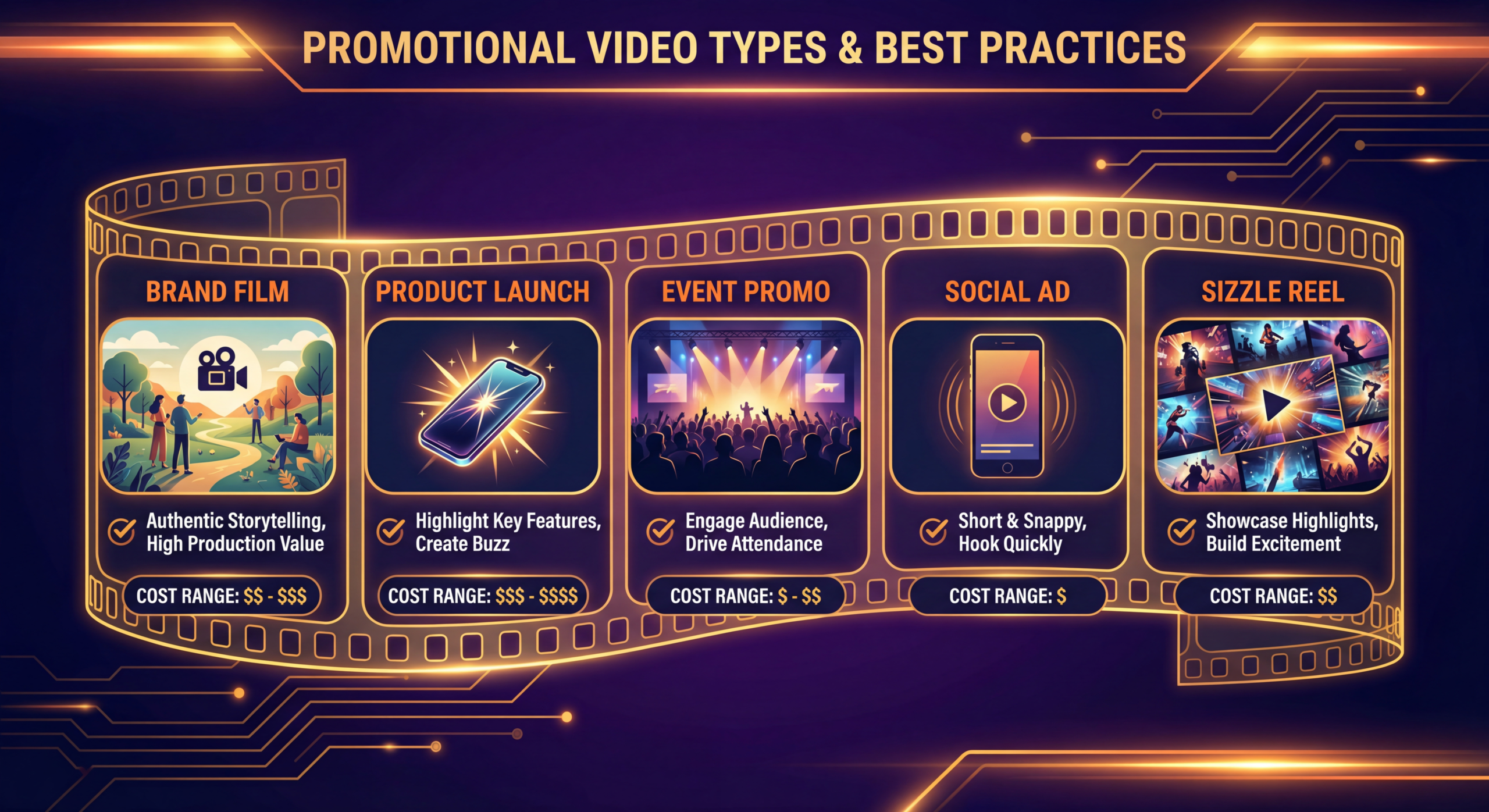
Every business needs to promote itself, and in 2026, promotional video production is the most effective way to do it. Whether you're launching a product, building brand awareness, driving event attendance, or generating leads, promotional videos cut through the noise in ways that static content simply can't. According to HubSpot's marketing report, video is the #1 content format for ROI - and promotional videos are the category that most directly drives revenue.
But "promotional video" is a broad category that encompasses everything from 15-second social ads to 3-minute product launches to full cinematic brand campaigns. The costs range from a few hundred dollars to six figures. The formats span live action, animation, screen capture, and hybrid approaches. The distribution channels multiply the complexity further.
This guide cuts through the confusion. We'll break down every type of promotional video, give you transparent cost ranges based on real production data, and share the best practices that separate videos that generate ROI from videos that waste budget.
Promotional video production is the process of creating video content specifically designed to promote a product, service, event, or brand. Unlike educational or entertainment content, promotional videos have a clear commercial objective - they exist to drive a specific action, whether that's a purchase, a sign-up, a download, or an inquiry.
What distinguishes promotional videos from other marketing videos is their directness. While a thought leadership video builds authority indirectly, and an educational video provides value first, a promotional video makes a clear pitch. The best promotional videos balance that directness with genuine value - they inform, entertain, or inspire while simultaneously promoting.
The first step in planning your promotional video production is understanding the options. Each type serves different objectives, requires different production approaches, and delivers different results.
Product launch videos generate excitement and demand for new products, features, or services. They're the centerpiece of launch campaigns and need to balance demonstration with aspiration - showing what the product does while making viewers feel the possibility of what it means for them.
Key elements:
Length: 60-120 seconds for the hero video. Create 15-30 second cutdowns for ads. Consider a longer 3-5 minute deep-dive for interested audiences.
Brand promos tell your company's story and establish emotional connection with your audience. They're about who you are, not what you sell. The best brand videos create a feeling - aspiration, trust, excitement, belonging - that associates your brand with something meaningful in the viewer's mind.
Key elements:
Explainer videos break down complex products, processes, or concepts into digestible, engaging narratives. They're particularly valuable for B2B companies selling technical solutions, SaaS platforms, or professional services where the value proposition isn't immediately obvious.
Format options:
Social ads are purpose-built for paid distribution on platforms like LinkedIn, Facebook, Instagram, YouTube, and TikTok. They need to grab attention in the first 2 seconds, deliver value fast, and drive a clear action. Every platform has different specs, audience behaviors, and best practices.
Event promos drive registrations and attendance for conferences, webinars, product launches, and company events. They create FOMO (fear of missing out) and excitement by previewing what attendees will experience.
Key elements:
We've covered these extensively in our guides on testimonial video production and customer story videos. When used as promotional assets, the key difference is in the edit: promotional cuts are shorter (30-60 seconds), lead with the most impressive result, and include a clear CTA to your website or booking page.
Animation offers complete creative control - you can visualize anything, from abstract data flows to future-state scenarios. It's also easier to update than live-action (no reshoots needed) and can be localized more easily for international markets.
Animation styles for promotional videos:
Let's talk money. Promotional video production costs are one of the most frequently asked questions we receive, and the answer is always "it depends." But we can give you much more useful guidance than that. Here's a detailed breakdown of what drives cost and what you can expect at different budget levels.
Several factors determine the total cost of a promotional video:
At this level, you can produce effective promotional videos for social media, basic product demos, and simple explainers. Expect:
This tier works well for startups, small businesses, and companies testing video for the first time. The key is to invest wisely: prioritize audio quality, use good natural lighting, and keep the concept simple and focused.
This is the sweet spot for most B2B promotional videos. You get professional production value without enterprise-level pricing. Expect:
Premium promotional videos are your flagship content - the hero video on your homepage, the centerpiece of a major campaign, the presentation at your annual conference. Expect:
Enterprise-level productions include large-scale brand campaigns, multi-day shoots, international productions, and content programs that span multiple videos. These are typically managed as projects with dedicated producers, creative directors, and extended timelines.
With so many options and price points, choosing the right promotional video format can be overwhelming. This decision framework helps you match your budget to the highest-impact format:
Regardless of format or budget, these best practices consistently separate high-performing promotional videos from underperformers.
You have 2-3 seconds to earn the viewer's continued attention. Open with something unexpected, emotionally compelling, or immediately relevant. The worst way to start a promotional video is with your logo animation. The best way is with a bold statement, a striking visual, or a question that makes the viewer think "I need to know more."
"87% of your competitors are already doing this. Are you?" - A strong hook that creates urgency and curiosity.
The most common promotional video mistake is trying to say everything. Resist the urge. Each promotional video should have one clear message and one clear call to action. If you have three messages, make three videos. Focused videos outperform unfocused ones by 2-3x in conversion rate because they don't force the viewer to prioritize between competing messages.
Up to 85% of social media video is watched without sound. Your promotional video must be fully comprehensible with sound off. This means:
Then make the sound-on experience even better with music, voiceover, and sound design that elevate the emotion and engagement.
A single promotional video exported in one format is a missed opportunity. Each distribution channel has different technical requirements, audience behaviors, and content expectations. Your production partner should deliver multiple versions optimized for each platform:
Every promotional video needs to tell the viewer exactly what to do next. Vague CTAs like "Learn more" perform significantly worse than specific ones like "Start your free trial," "Book a demo," or "Download the guide." The CTA should be both spoken and displayed as text on screen, and it should appear for at least 3-4 seconds.
Even within a promotional video, social proof dramatically increases effectiveness. Weave in customer quotes, user numbers, awards, or media mentions. A single line - "Trusted by 5,000+ companies including [logos]" - displayed for a few seconds can meaningfully impact conversion rates.
When planning your marketing video production, design each shoot to produce multiple assets. A 2-minute product launch video should also yield five 15-second social clips, ten quote cards, a GIF set, and a blog post. This content multiplication dramatically improves your cost per asset and ensures consistent messaging across channels.
Here's the step-by-step production process from concept to distribution:
Download our B2B Video Brief template to ensure nothing is missed during the strategy phase.
While the fundamentals apply universally, different industries have unique considerations for promotional video production:
Tech companies face the challenge of making intangible products tangible. Screen capture, UI animation, and data visualization are essential production techniques. Focus on showing workflows and outcomes rather than features and specifications. Customer proof is particularly important because tech buyers are naturally skeptical.
Law firms, consulting firms, and agencies need to promote expertise and trust. Thought leadership interviews, client testimonials, and case study narratives work best. Production should feel polished but not flashy - the emphasis should be on the people and their credibility.
Manufacturing companies benefit from facility tours, process demonstrations, and product-in-action footage. Aerial drone shots of facilities, close-up product photography, and time-lapse production sequences create visual interest. Safety and quality messaging are unique differentiators in this space.
Regulatory compliance adds complexity to healthcare promotional videos. All claims must be substantiated, and certain medical/scientific content requires expert review. Patient testimonials are powerful but require specific consent processes. Animation is particularly valuable for explaining complex medical concepts.
Trust and security are paramount. Promotional videos for financial services should emphasize stability, expertise, and client success. Compliance review is essential - all promotional claims must meet regulatory requirements. Data visualization and infographic-style animation are effective for communicating financial concepts.
Track these metrics to evaluate and optimize your promotional video production investment:
Jumping into production without a clear brief wastes time and money. The brief is your compass - without it, every decision becomes a debate and the final product lacks focus. Invest the time upfront to define objectives, audience, messaging, and distribution before anyone picks up a camera.
A beautifully produced video that doesn't communicate a clear value proposition is just expensive entertainment. Start with the message, then design the production around it. The best promotional videos are those where the creative execution amplifies the message rather than overshadowing it.
Over 70% of video consumption happens on mobile devices. If your promotional video isn't optimized for small screens - vertical format, large text, clear visuals, burned-in captions - you're alienating the majority of your audience.
A promotional video without a clear call to action is a missed opportunity. Every video should end with a specific, actionable next step. "Visit our website" is weak. "Book your free consultation today View Pricing" is strong.
Publishing a video once and expecting results is unrealistic. Promotional videos need sustained distribution - organic posting, paid amplification, email integration, sales team adoption, and ongoing optimization based on performance data.
For most businesses, partnering with a professional production company delivers better results than attempting to produce promotional videos in-house. Here's how to find and work with the right partner:
At VEC, we guide B2B companies through every stage of the promotional video production process - from strategic planning and creative development through filming, post-production, and multi-platform delivery. Book a discovery call to discuss your upcoming project.
Promotional video costs range from $1,000 for simple social media ads to $50,000+ for premium brand campaigns. The most common budget range for B2B promotional videos is $5,000-$15,000, which gets you professional production, multi-camera setup, motion graphics, and multiple platform-optimized deliverables. The right budget depends on your objectives, distribution channels, and how long the video will be in use.
Length depends entirely on context. Social media ads: 15-30 seconds. Website hero videos: 30-60 seconds. Product launch videos: 60-120 seconds. Detailed explainers: 2-3 minutes. The general rule: make it as short as possible while still communicating your core message and CTA effectively. Every second should earn its place.
Standard timeline is 3-5 weeks from brief to delivery. Simple social ads can be turned around in 1-2 weeks. Complex animated or multi-location productions may take 6-10 weeks. Rush timelines are often possible with a premium - discuss your deadline with your production partner early in the planning process.
Live action creates stronger emotional connection and feels more authentic - ideal for brand stories, testimonials, and product demonstrations involving real people. Animation offers complete creative control and is better for abstract concepts, data visualization, and products that are difficult to film. Many effective promotional videos combine both techniques. Your production partner can recommend the best approach based on your message and audience.
ROI varies by industry and use case, but benchmarks are strong. Landing pages with video see 80% higher conversion rates. Email campaigns with video thumbnails see 200-300% higher click rates. Social video ads typically outperform static ads by 20-30% in CTR. When properly distributed and measured, promotional videos consistently deliver the highest ROI of any content format in B2B marketing.
For simpler formats (social clips, screen recordings, talking-head videos), yes - with the right equipment and skills. For higher-production-value content (brand promos, product launches, animated explainers), partnering with a professional production company typically delivers significantly better results and is often more cost-effective when you factor in equipment, software, and the learning curve of professional production techniques.
Start with 2-3 videos that cover your most critical marketing needs: typically an explainer/overview video for your website, a customer testimonial for sales enablement, and a social ad campaign (3-5 ad variations). Then expand based on performance data. A mature video marketing program produces 3-5 promotional videos per quarter, with multiple versions cut from each production.
Start your next promotional video project with a clear plan. Our brief template covers objectives, audience, messaging, production specs, and distribution strategy.
Get the Free Template See PricingPromotional video production is one of the most impactful investments a B2B company can make - when it's done strategically. The key is matching the right video type to the right objective, setting realistic budgets based on your goals, and following production best practices that maximize both quality and efficiency.
Start with a clear brief. Choose the format that best serves your audience and objective. Work with a production partner who understands your business. Distribute aggressively across every relevant channel. Measure relentlessly and optimize based on data.
The companies that get the most from their promotional video investment aren't necessarily the ones spending the most - they're the ones spending the smartest. Every video has a clear purpose, every dollar has a clear rationale, and every asset is distributed and measured to maximize impact.
Ready to plan your next promotional video? Book a call with our team and we'll help you define the right strategy, format, and budget for your goals.
