

If you're a B2B marketing leader reading this, chances are you already know that video is important. You've seen the statistics: 91% of businesses use video as a marketing tool, video content generates 1200% more shares than text and images combined, and buyers spend 19% more time on websites with video. The question isn't whether to invest in marketing video production — it's how to do it effectively with limited resources, tight timelines, and the pressure to prove ROI on every dollar spent.
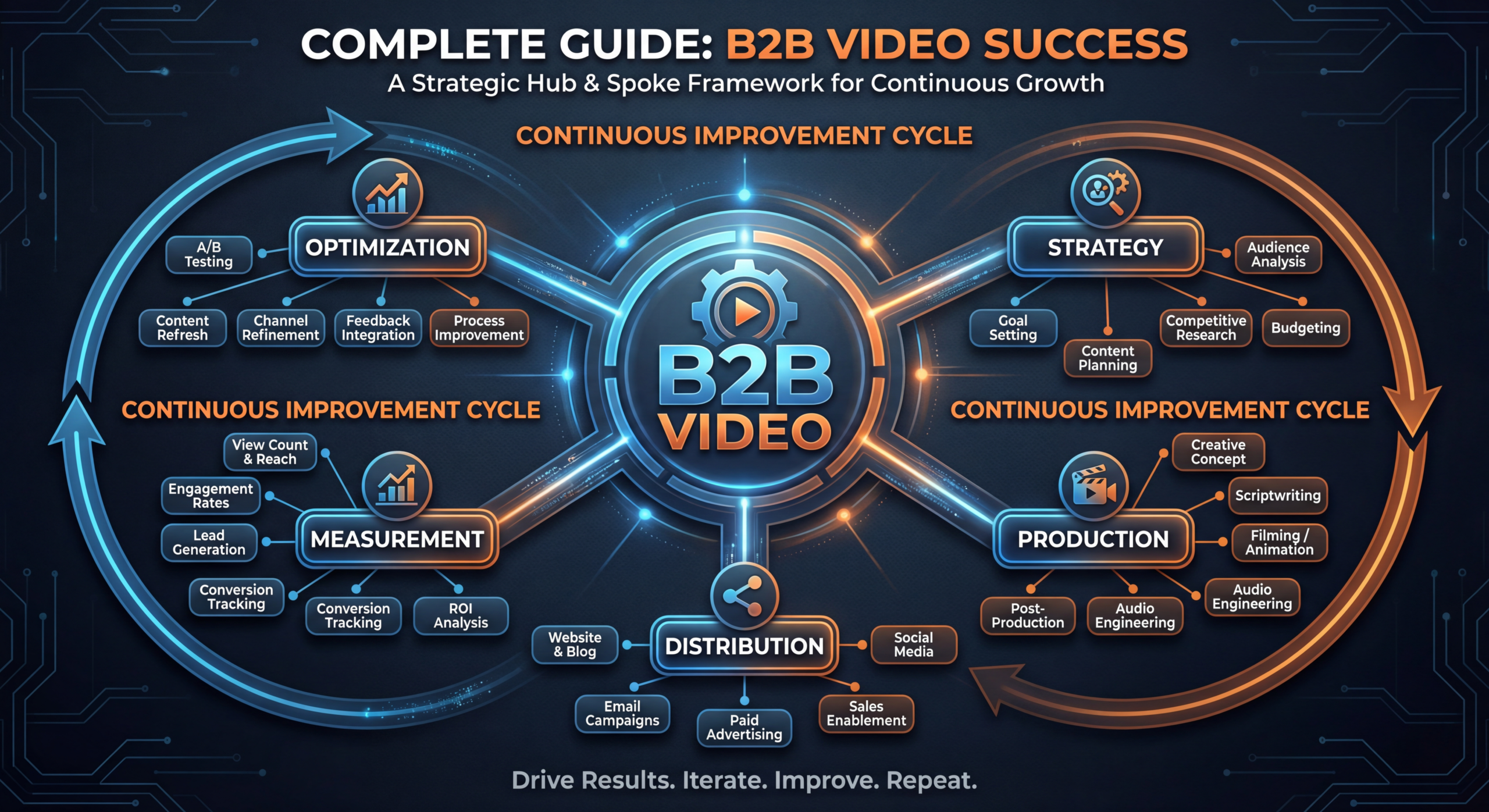
This guide was written specifically for B2B marketing teams navigating the complex reality of video production. We'll cover everything from building a video strategy aligned to your pipeline goals, to managing production workflows, to measuring impact in ways that matter to your leadership team. Whether you're producing your first video or scaling an existing program, this is your playbook.
The B2B buyer has fundamentally changed. They self-educate before engaging sales, consume content on their own terms, and trust peer recommendations over vendor claims. Marketing video production addresses every one of these behavioral shifts.
According to Gartner research, B2B buyers spend only 17% of their buying journey meeting with potential suppliers. The other 83% is spent researching independently, comparing options, and building internal consensus. Video content is the most efficient way to communicate complex value propositions during this self-serve phase.
Consider the difference: a 2-minute explainer video can convey the same information as a 2,000-word whitepaper, but it takes 1/10th of the viewer's time and is 4x more likely to be consumed completely. For busy executives making purchasing decisions, video is the format of choice.
B2B marketing teams are expected to produce more content than ever — for more channels, more segments, and more stages of the buyer journey. Video production can feel daunting in this context because it's traditionally been associated with high costs and long timelines. But modern marketing video production approaches have made it possible to produce high-quality video content efficiently and at scale.
The key is moving from one-off projects to a systematic production program. Instead of treating each video as a custom engagement, successful B2B teams build repeatable frameworks, templatized processes, and batched production schedules that maximize output while controlling costs.
Before you book a camera crew or open an editing timeline, you need a strategy. A well-defined video strategy ensures every production dollar drives measurable business outcomes.
Different video types serve different stages of the buyer's journey. Here's how to map your marketing video production efforts to your funnel:
Don't try to cover every stage at once. Start where your pipeline has the biggest gap. If you're generating plenty of leads but struggling to convert them, invest in decision-stage content like customer story videos and product demos. If awareness is the problem, prioritize brand films and thought leadership content.
Content pillars are the recurring themes that structure your video program. For B2B companies, common pillars include:
Each pillar should have a defined cadence (e.g., 2 customer stories per quarter, 1 brand film per year, 4 educational videos per month). This structure makes planning, production, and budgeting predictable.
Marketing video production budgets vary enormously across B2B companies. Here's a general framework based on company size:
The most cost-effective approach for most B2B teams is partnering with a specialized video production company for complex pieces (customer stories, brand films, product launches) while handling simpler content (social clips, screen recordings, webinar edits) in-house. This hybrid model balances quality and volume.
One of the biggest challenges B2B marketing teams face is maintaining a consistent production cadence. It's easy to produce a burst of videos for a launch, then go dark for months. A monthly production calendar solves this by creating a predictable rhythm.
This calendar produces approximately 5-7 finished videos per month: 1 thought leadership piece, 2-3 educational videos, 1 customer story, and various social cuts from each. Adjust the cadence based on your team's capacity and budget.
Batching is the single most effective technique for reducing per-video production costs and increasing output. Instead of setting up cameras, lighting, and audio for one video at a time, batch similar content types together:
Batching reduces setup/teardown time, allows you to negotiate better rates with production crews, and creates a content buffer that keeps your publishing schedule consistent even when busy periods disrupt production plans.
Unclear ownership is one of the top reasons B2B video programs stall. Use a RACI framework to define who does what:
R = Responsible A = Accountable C = Consulted I = Informed
Notice that the sales team is involved in distribution — this is intentional. Sales-marketing alignment on video content is critical for maximizing ROI. The marketing team produces the videos; the sales team uses them to close deals. Regular syncs between the two teams ensure the right content is being created for the right selling situations.
Let's break down the specific video types that drive results in B2B marketing, along with production considerations for each.
Explainer videos distill complex products, services, or concepts into simple, engaging narratives. They're the workhorses of B2B marketing video production — used on homepages, in email campaigns, at trade shows, and in sales conversations.
Best practices:
Production cost range: $3,000-$15,000 depending on animation complexity
Demo videos show your product in action. They can be recorded screen captures with voiceover, live demonstrations with a presenter, or a hybrid approach. The key is showing value, not features — show how the product solves a specific problem, not a comprehensive walkthrough of every menu item.
Best practices:
Production cost range: $1,000-$5,000 for screen-capture style; $5,000-$20,000 for live presenter format
Position your executives and subject matter experts as industry authorities through interview-style, panel, or presentation videos. Thought leadership content builds brand credibility and trust while providing value to your audience.
Best practices:
Production cost range: $2,000-$8,000 per session (batch 3-4 interviews per session for efficiency)
We've covered these extensively in our guide to customer story videos for SaaS, but they deserve mention here as a core component of any B2B marketing video program. Customer stories are the most persuasive content type in B2B because they combine social proof with concrete results.
Production cost range: $3,000-$15,000 per story (remote to premium on-site)
A brand video tells your company's story — who you are, what you believe, and why you exist. These are typically higher-budget, higher-production-value pieces that serve as anchor content for your website, about page, and major campaigns.
Best practices:
Production cost range: $10,000-$50,000+ depending on scope and production value
Educational videos position your brand as a helpful resource while driving organic traffic through SEO. These can be screen-capture tutorials, whiteboard explanations, or presenter-led lessons on topics your audience cares about.
Best practices:
Production cost range: $500-$3,000 per video (highly efficient when batched)
Whether you're working with an in-house team or a production partner, every marketing video follows the same fundamental process. Here's the complete workflow:
Every video starts with a clear brief that answers these questions:
Download our SaaS Video Calendar template to plan your quarterly production schedule and ensure every video has a clear strategic purpose.
Pre-production is where you do the heavy lifting that makes production day smooth and efficient:
Production day is about execution. With thorough pre-production, the shoot itself should run smoothly. Key principles:
Post-production transforms raw footage into finished content. The typical workflow includes:
A video's work begins at publication. Distribution should be planned during Phase 1 and executed systematically:
Proving video ROI is the difference between a one-time project and an ongoing program. Here's how to measure what matters:
Video attribution can be challenging, but these approaches help connect video views to revenue:
After working with dozens of B2B marketing teams, these are the patterns we see most often:
Creating videos because "we need video" is a recipe for wasted budget. Every video should serve a specific business objective, target a defined audience, and live in a planned distribution strategy. Random acts of video content don't compound — strategic programs do.
Some teams spend months perfecting a single video instead of shipping good-enough content and iterating. In B2B marketing, a published 8/10 video generates infinitely more value than an unpublished 10/10 video. Establish quality standards, then move quickly.
Many teams invest 90% of their budget in production and 10% in distribution. Flip it to 60/40 or even 50/50. A well-distributed video with good production value will always outperform a poorly distributed masterpiece.
Video content should serve the entire go-to-market team — marketing, sales, customer success, and recruiting. When video production sits in a silo, you miss opportunities for cross-functional impact. Include sales and CS leaders in your video planning process.
Every video shoot should produce multiple assets. A 3-minute customer story becomes five 30-second social clips, ten quote graphics, a blog post, and a sales one-pager. If you're producing one asset per shoot, you're leaving value on the table. See our guide on promotional video production for more on maximizing content output.
The build-vs-buy decision depends on your volume, budget, and internal capabilities. Here's a framework:
Most B2B teams benefit from a hybrid approach: in-house capabilities for high-volume, quick-turn content (social clips, screen recordings, webinar edits) combined with a production partner for premium, high-impact pieces (customer stories, brand films, campaign videos). This model gives you the best of both worlds — speed and volume internally, quality and expertise externally.
At VEC, we partner with B2B marketing teams as their external production arm. We handle the complex, high-value productions while you focus on strategy, distribution, and the daily content engine. Book a call View Pricing to explore what this looks like for your team.
The video landscape is evolving rapidly. Here are the trends shaping B2B marketing video production in 2026 and beyond:
AI tools are transforming specific parts of the production workflow — script generation, automated captioning, intelligent editing suggestions, and synthetic voice/video for rapid prototyping. While AI won't replace human storytelling and creative direction, it's dramatically reducing the time and cost of certain production tasks.
The rise of TikTok and Instagram Reels has trained all audiences — including B2B buyers — to expect short-form, vertical video content. B2B companies that adapt their marketing video production for short-form formats are seeing strong engagement, particularly on LinkedIn. The key is maintaining professionalism while embracing the casual, direct style that works in short-form.
Interactive video elements — embedded CTAs, branching narratives, in-video forms — are making video a direct conversion tool rather than just an awareness builder. B2B companies are using interactive video for product tours, qualification surveys, and personalized buying experiences.
Sales teams are using personalized video tools (Vidyard, Loom) to send custom video messages to prospects. The next evolution is automated personalization — dynamically inserting prospect names, company details, and relevant customer stories into templated video content.
A general benchmark is 15-25% of your total content marketing budget should be allocated to video. For most mid-market B2B companies, this translates to $50,000-$150,000 annually. Companies in competitive SaaS verticals often invest more, recognizing that video is their highest-performing content format. Start with your most critical gap — if it's sales enablement, invest in customer stories first. If it's awareness, start with educational content.
Timeline varies by complexity. Simple screen-capture videos can be turned around in 2-3 days. Interview-based content (testimonials, thought leadership) typically takes 2-3 weeks from planning to delivery. Animated explainers require 4-6 weeks. High-end brand films can take 6-10 weeks. Batching multiple videos in a single production session compresses timelines significantly.
A solid starter kit includes: a mirrorless camera (Sony A7 series or Canon R series), 2-3 LED panel lights, a shotgun microphone and lavalier set, a quality tripod, and editing software (Adobe Premiere Pro or DaVinci Resolve). Total investment: $5,000-$10,000. For screen-capture content, you just need a good microphone, screen recording software (Loom, OBS, or Camtasia), and basic editing capability.
Start small and prove ROI. Produce 2-3 videos with modest investment, track their impact on engagement and pipeline metrics, and present the data to leadership. Most executives are convinced when they see concrete numbers: "Our customer story video was shared in 15 active deals totaling $2.4M in pipeline, and deals where it was viewed closed 30% faster." Start with a pilot, measure rigorously, and scale with proof.
Both. YouTube is the world's second-largest search engine and provides significant organic discovery. Your website gives you full control over the viewing experience and keeps traffic on your domain. Use YouTube for awareness-stage content and SEO, and embed videos on your website using a platform like Wistia or Vidyard that provides analytics without sending viewers to YouTube's recommendation algorithm.
Start with 3-5 videos: 1 brand/explainer video for your homepage, 2 customer stories for sales enablement, and 1-2 educational videos for organic traffic. This gives you content across the funnel and multiple data points to measure. Then expand based on what performs best and where your pipeline gaps are.
Plan your entire quarterly video production schedule with our plug-and-play calendar template — includes content pillars, production timelines, and distribution checklists.
Get the Free Calendar See PricingMarketing video production for B2B isn't a project — it's a program. The companies that generate the most value from video are the ones that treat it as an ongoing capability rather than a series of one-off productions. They have a clear strategy, a consistent cadence, defined roles, and rigorous measurement.
Start with strategy. Map your video content to your funnel. Build a monthly production calendar. Define who owns each phase of the process. Measure relentlessly and iterate based on data. Partner with specialists for your most important content, and build internal capabilities for your daily engine.
The B2B companies winning with video aren't the ones spending the most — they're the ones producing the right content, for the right audience, at the right time, with the right distribution. That's what a true marketing video production program looks like.
Ready to build yours? Book a call with our team to discuss your video strategy, production needs, and how we can help you build a program that drives measurable pipeline growth.
