Brand + Business Case Study Videos: Guide
A brand case study video turns a customer win into your most credible sales asset — a 2–4-minute story that shows exactly what you do, proves it works, and moves the next buyer closer to signing. Done right, a single case study video generates more pipeline per dollar than almost any other content format in the B2B stack.
This guide covers every decision you'll make: format, structure, script, cost, and production path — from first call to published video. Whether you're building your first case study video or systematizing a whole library, this is the playbook.
Table of Contents
- Key Takeaways
- What Is a Brand Case Study Video?
- Brand vs. Business Case Study Videos: How Are They Different?
- What Makes a Case Study Video That Actually Converts?
- 5 Case Study Video Formats Proven to Work in 2026
- How Do You Structure a Business Case Study Video?
- How Much Does a Brand Case Study Video Cost?
- In-House vs. Agency: Which Should Produce Your Case Study Videos?
- FAQ
Key Takeaways
- 2–4 minutes is the proven case study video length for B2B buyers — long enough to tell the full story, short enough to watch in a sales meeting.
- 3-act structure wins every time: Problem → Solution → Measurable Result. Buyers remember the outcome number, not the production quality.
- Brand case study videos focus on identity and transformation; business case study videos lead with metrics, ROI, and workflow specifics. Both are useful at different funnel stages.
- Production cost ranges from roughly $2,500 for a lean interview-based edit to $10,000+ for a full cinematic shoot — the format drives the budget more than the length.
- The script is the hardest part. Get the customer on record saying the outcome number, not just describing your product. Read our full case study video script template to nail the interview structure.
What Is a Brand Case Study Video?
A brand case study video is a short-form documentary that tells a customer's transformation story — using their words — to prove your product or service delivers a specific, measurable result. It is the video equivalent of a written case study, but significantly more persuasive because the buyer hears conviction and sees proof rather than reading claims you wrote about yourself.
The "brand" framing matters. A brand case study video doesn't just validate your product; it communicates your company's character — how you work, what kind of partner you are, and whether you're the right fit culturally. This is why two companies with identical feature sets can generate radically different responses from the same case study video: the story reveals values, not just specs.
The Core Elements
Every effective brand case study video contains three things:
- A credible customer voice. Not a polished spokesperson — a real customer, in their own words, visibly at ease.
- A specific before/after transformation. Vague improvement claims ("things got better") are almost useless. Named metrics ("we reduced editing time by 40%") are citable and shareable.
- A clear reason you were the right choice. The customer should articulate why they chose you over alternatives. This is the section that kills competitor objections on sales calls.
For a full library of what excellent execution looks like, see our curated B2B case study video examples with breakdowns of what each one does right.
Brand vs. Business Case Study Videos: How Are They Different?
The terms are often used interchangeably, but they serve different purposes in your funnel and should be scripted differently.
Brand vs. Business Case Study Videos
| Dimension | Brand Case Study Video | Business Case Study Video |
|---|---|---|
| Primary goal | Build trust and identity; show who you are | Prove ROI and remove risk; show what you deliver |
| Funnel stage | Mid-funnel (awareness → consideration) | Bottom-funnel (consideration → decision) |
| Lead with | Customer's story and relationship narrative | Specific metrics and business outcomes |
| Tone | Conversational, emotional, narrative-driven | Direct, results-focused, data-backed |
| Ideal length | 2–3 minutes | 90 seconds–2 minutes (tight ROI summary) or up to 4 minutes (full story) |
| Where it lives | Homepage, brand campaigns, LinkedIn, YouTube | Sales decks, proposal emails, product pages, /case-studies/ page |
| Example outcome line | "They feel like an extension of our team." | "We cut time-to-publish by 60% and doubled monthly video output." |
Strategic note: For most B2B SaaS companies, the highest-ROI move is to produce both versions from a single shoot day — a longer brand narrative version (2–3 min) and a tight business version (90 sec) edited from the same interview footage. This doubles your asset count from one production investment.
Browse top case study video companies to see how professional agencies approach this format split in their own portfolios.
See VEC Pricing Plans →What Makes a Case Study Video That Actually Converts?
Most case study videos underperform because they describe the product instead of documenting the transformation. Buyers don't care about your features — they care whether someone like them achieved a specific result using your product or service. Here's what separates a converting case study video from a polished vanity piece:
1. The Outcome Is Named in the First 20 Seconds
Don't make the viewer wait for the payoff. Open with the result — the metric, the win, the transformation — then tell the story that explains how you got there. This is the single highest-leverage structural change most teams can make to their existing case study video library.
For guidance on opening hooks and story sequencing, see our detailed case study video script template.
2. The Customer Sounds Like a Real Person, Not a Spokesperson
Overproduced, coaching-heavy interviews kill authenticity. The best case study videos capture natural conversational speech — including "ums" and self-corrections — because authenticity builds trust. A buyer watching a perfectly rehearsed testimonial assigns it roughly the same weight as an ad. A buyer watching someone search for the right words to describe a genuine problem is far more persuasive. Wistia's research on video engagement consistently shows that unscripted, authentic testimonial-style videos hold viewer attention longer than polished ad-format videos.
The interview setup determines this. See our guide on case study video interview questions — specifically, the techniques for eliciting specific language rather than general praise.
3. You Show, Not Just Tell
Cut-aways to screen recordings, product footage, team environments, and real work in progress add credibility to claims that would otherwise feel abstract. "We doubled throughput" hits harder when you show the Asana board before and after, or the team actually using the product.
4. There Is a Single, Memorable Outcome Number
Give the viewer one number to remember and share. "60% faster," "2x video output," "$40K saved per quarter." Stacking multiple metrics dilutes recall. Pick the most impressive, most defensible number and build the story around it.
5. It Handles the Objection Without Being Asked
Great case study video scripts have the customer address the main objection — usually around switching risk, quality, or cost — organically. When a prospect hears a customer describe their exact hesitation and then explain how it resolved, the objection loses its power. Work with your customer to surface this during the interview.
5 Case Study Video Formats Proven to Work in 2026
The format you choose shapes budget, production timeline, and where the video performs best. Here are the five formats driving results for B2B companies right now:
Case Study Video Formats Compared
| Format | Description | Best For | Typical Budget |
|---|---|---|---|
| Interview-led | Single or multi-subject talking-head interview, b-roll cutaways, voiceover optional | Most B2B use cases; the proven default | $2,500–$6,000 |
| Remote/async | Customer records Loom/Riverside footage; agency edits and polishes | Geographically dispersed customers; fast turnaround | $800–$2,500 |
| Documentary-style | Multi-day shoot at customer's location; cinematic b-roll; deeper narrative arc | Enterprise accounts; high-value anchor content | $8,000–$25,000+ |
| Animated case study | Motion graphics, data visualization, illustrated story; no on-camera interview | Customers who won't appear on camera; abstract workflows | $3,500–$10,000 |
| Micro-testimonial | 30–60-second highlight cut from a longer interview; repurposed for ads and social | Paid distribution; top-of-funnel awareness | $400–$1,500 (from existing footage) |
The most cost-efficient approach: produce a full interview-led case study video first ($3,000–$5,000), then repurpose the raw footage into 3–5 micro-testimonial cuts and a LinkedIn-optimized vertical version. One shoot day yields 6–8 distributable assets when the editing is planned from the start. This is the approach VEC teams build into every video editing engagement.
For real-world examples of each format in action, see the full library of B2B case study video examples.
How Do You Structure a Business Case Study Video?
The 3-act structure — Problem, Solution, Result — is not a creative limitation; it is the format your buyer's brain is wired to absorb and retain. Every deviation from it should be intentional, not accidental.
The Proven 5-Beat Structure
Business Case Study Video: Beat-by-Beat Structure
| Beat | Content | Duration | What It Accomplishes |
|---|---|---|---|
| 1. Hook | The outcome, in the customer's voice | 0:00–0:20 | Earns the next 90 seconds of attention |
| 2. Context | Who the customer is; what they were trying to do; what wasn't working | 0:20–0:50 | Creates identification for the prospect watching |
| 3. Solution | How they found you, why they chose you, how onboarding/implementation worked | 0:50–1:40 | Addresses switching-cost and implementation objections |
| 4. Result | Named metrics, qualitative improvements, unexpected wins | 1:40–2:20 | Provides the shareable outcome the buyer will relay internally |
| 5. Endorsement | Customer's recommendation; who it's right for; what they'd tell a peer | 2:20–2:40 | Converts viewer credibility into direct word-of-mouth language |
Script and Interview Alignment
The structure above should be built into your interview question sequence — not imposed in the edit. If you ask the right questions in the right order, the customer naturally delivers footage that maps to each beat. See the complete case study video script and template for the exact question sequence that produces usable, on-structure footage at each beat.
Common structural failure modes to avoid:
- Leading with product features. This positions the video as an ad, not a story. The buyer should narrate — you stay in the background.
- Burying the result. Leaving the metric until the final 15 seconds means most viewers never reach it. State the outcome in the first 20 seconds, then explain how you got there.
- No specific objection handling. If your customers frequently worry about X (onboarding time, quality consistency, cost predictability), script a question that gets the customer to address it directly.
- Too many characters. More than two on-camera subjects dilutes the narrative. Pick the most credible voice and build the story around them.
For a full step-by-step walkthrough of production from brief to final cut, read our guide on how to make a case study video.
How Much Does a Brand Case Study Video Cost?
Brand case study video production typically costs between $2,500 and $25,000 depending on format, crew requirements, location, and the number of final assets you need. The biggest cost driver is not length — it's whether you're doing a remote edit of customer-provided footage, a half-day local shoot, or a full documentary-style multi-day production.
Case Study Video Cost by Production Path
| Production Path | Who It Suits | Typical Cost Range | Turnaround |
|---|---|---|---|
| Remote/async (customer records, agency edits) | Startups, distributed teams, fast-cycle content | $800–$2,500 | 5–10 business days |
| Half-day interview shoot (local crew) | Growth-stage B2B SaaS; standard case study format | $2,500–$6,000 | 2–4 weeks post-shoot |
| Full-day shoot with b-roll | Enterprise accounts; anchor content | $5,000–$12,000 | 3–6 weeks post-shoot |
| Multi-day documentary-style | Flagship customer stories; PR and investor use | $12,000–$25,000+ | 6–10 weeks post-shoot |
| Animated case study (no shoot) | Remote customers, sensitive data, abstract workflows | $3,500–$10,000 | 3–5 weeks |
| Repurpose from existing footage | Companies with interview footage already shot | $400–$1,500 | 3–7 business days |
For a full cost breakdown with agency, freelancer, and in-house comparisons, see our dedicated guide to case study video pricing.
See VEC Pricing Plans →Hidden Costs to Budget For
- Travel + accommodation if the customer is not local — add $500–$2,000 for a domestic shoot, $3,000–$8,000+ for international.
- Music licensing — royalty-free tracks cost $50–$300/year per license; premium sync licensing for broadcast adds $500–$5,000+.
- Format variations — a 16:9 master video, a 9:16 LinkedIn/social cut, and a 1:1 square version from the same footage add roughly $300–$800 to editing costs per format.
- Captions and transcript — typically $100–$300, but required for accessibility and algorithm performance across most platforms.
- Revision rounds — most agencies include 2–3 rounds; round 4+ averages $150–$400 per additional round.
According to Wyzowl's State of Video Marketing research, a large majority of marketers report that video has directly helped increase sales — and case study videos rank among the highest-performing formats for bottom-of-funnel conversion specifically. Budget accordingly: case study video production is not a cost center, it's a sales tool with a measurable close-rate impact.
Budget framing for Series A–C SaaS teams: at $5K/month for an ongoing video retainer through an agency like VEC, you can produce one full case study video per month plus 4–6 supporting social clips. That's a programmatic case study library — not a one-off investment. Learn more about how the video production agency pricing models compare for sustained output.
In-House vs. Agency: Which Should Produce Your Case Study Videos?
Most early-stage companies default to in-house to save cost. Most mid-stage companies regret it once they realize the bottleneck is always editor capacity — not intent. Here's how to think through the decision honestly:
In-House vs. Agency Production for Case Study Videos
| Factor | In-House | Agency / Dedicated Team |
|---|---|---|
| Cost per video | Low variable cost (if editor already on payroll); high if hiring | $2,500–$10,000 per video; lower per-unit at retainer volume |
| Speed | Fast if no queue; slow if editor is shared across projects | Predictable turnaround, dedicated capacity |
| Brand consistency | High — same editor knows the brand deeply | High with a dedicated team; variable with project-based agencies |
| Scale | Hard above 3–4 videos/month without additional headcount | Scales to 10–20+ videos/month without hiring |
| Quality ceiling | Capped by the skill of your one editor | Access to senior editors, motion designers, colorists as needed |
| Right for you if… | You produce ≤2 case study videos/quarter | You produce ≥4 case study videos/quarter or have other video needs |
The most common error is building an in-house video team before you've validated the content model. If your case study videos don't perform well, you've hired staff you can't deploy. Outsourcing first — through a partner like VEC or through a freelance outsourced video editing arrangement — lets you iterate on format and script before committing to headcount.
For a deeper cost analysis of each staffing model, see our guide on the full scope of what's included in professional video editing, and SaaS video production models specific to software companies.
Why the Edit Is the Hardest Part
Shooting a case study interview is relatively straightforward. Editing it well — finding the most compelling 90-second arc inside 40 minutes of raw footage, pacing the cuts to maintain tension, layering b-roll to support claims without overselling — is a specialized craft that takes most editors 12–24 months to develop for this specific format.
This is why case study video specialists for consultancies and SaaS companies charge more than generalist video editors: the story-editing skill, not the camera operation, is where the value is created.
If you're evaluating agencies to produce your case study library, our guide to the top case study video companies covers what to look for, how to evaluate portfolios, and the right questions to ask on the discovery call. You can also explore VEC's own client case studies to see the format in action across different B2B verticals.
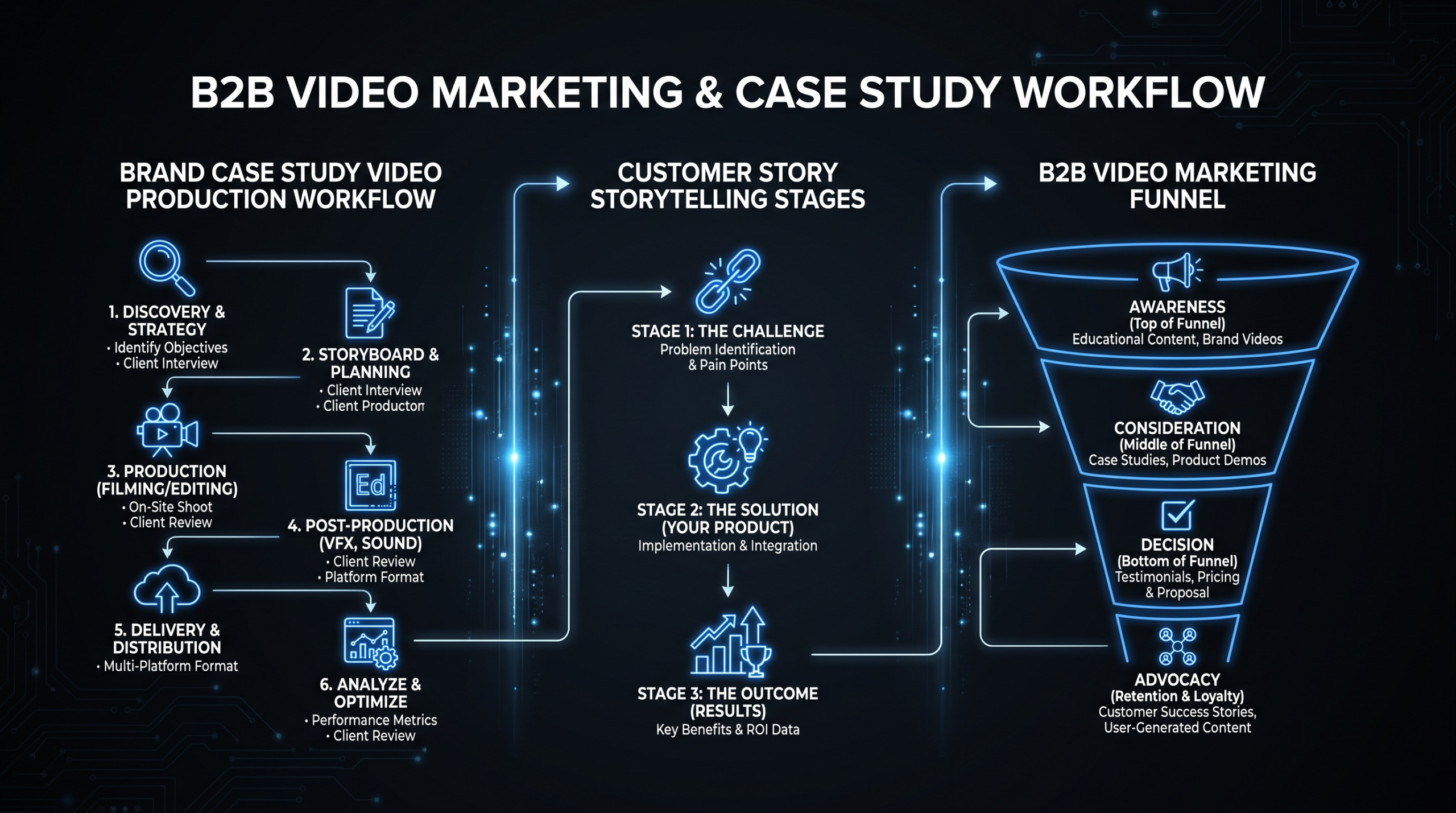
For context on how to build a broader video content engine that case studies feed into, see our guides on product demo video production and SaaS video production strategy. A strong case study video program sits at the bottom of a funnel that demo videos and educational content feed from the top.
"Case study videos are the only content format that does three jobs simultaneously: builds trust, handles objections, and provides social proof — without you having to say a word." — VEC content strategy team
Frequently Asked Questions
What is a brand case study video?
A brand case study video is a short documentary (typically 2–4 minutes) in which a real customer explains a specific problem they faced, how your product or service solved it, and what measurable outcome resulted. The "brand" framing emphasizes not just the result but the working relationship — communicating your company's character and reliability, not just its feature set.
How long should a business case study video be?
2–4 minutes is the proven B2B length. A 90-second version works well for paid distribution and social; a 3–4-minute version is appropriate for your website's case studies page and sales deck use. For most companies, editing both versions from a single shoot day is the most cost-effective approach.
What is the best format for a case study video?
Interview-led with b-roll is the most versatile and credible format for B2B use. The customer speaks on camera; cutaways to product footage, screen recordings, and work environments add context. Animated case study videos work when customers won't appear on camera or the workflow is too abstract to film. Remote/async formats (customer records Loom, agency edits) are fastest and most affordable for growth-stage teams.
How much does a brand case study video cost?
Production typically ranges from $800–$2,500 for a remote edit-only engagement, $2,500–$6,000 for a standard half-day shoot, and $8,000–$25,000+ for a full documentary-style production. At an ongoing video retainer, the per-video cost drops significantly — VEC's Growth plan at $5,000/month includes one case study video per month plus supporting clips. See the full case study video pricing guide for freelancer, agency, and in-house cost comparisons.
What's the difference between a brand video and a case study video?
A brand video communicates your company's identity, mission, and differentiation — typically without a specific customer story. A case study video centers on a customer's transformation and uses their voice to prove a specific outcome. Functionally, a brand case study video combines both: it tells a specific customer story (case study) in a way that reveals your company's character (brand). The best versions do both simultaneously, which is why they outperform pure brand films on sales-assist metrics.
Ready to Build Your Case Study Video Library?
VEC's dedicated video editing teams handle everything from raw interview footage to a polished multi-format case study asset set — one team, consistent quality, no hiring overhead. Our Growth plan starts at $5,000/month.
See Pricing Plans Book a Free Strategy Call