Client Case Study Videos for Consultancies
TL;DR
- Case study videos convert at a fundamentally different level than written case studies in consulting sales — the client's voice on camera delivers credibility that a PDF cannot replicate.
- Use the four-part narrative arc: problem → approach → outcome → transformation. Frame outcomes in the client's own language; protect methodology details in the interview brief.
- Remote production (Zoom, Riverside.fm) handles most budgets well; on-site adds 2–3× the production value for C-suite testimonials and flagship proposals.
- The approval chain involves three parties — client exec, client legal, client comms — and takes 2–6 weeks if not structured from the start. Build sign-off milestones into the SOW.
- Repurpose one 3–5 minute case study video into six assets: short cut, audiogram, quote cards, sales deck slide, email clip, and social crop — without additional filming.
Table of Contents
- Why Case Study Videos Convert Better Than Written Case Studies
- The Four-Part Consulting Narrative: Building a Story That Sells
- Interview Prep: Getting Authentic Answers from Reluctant Clients
- Remote vs. On-Site Production: Which Format Fits Your Budget
- Stakeholder Approvals and Confidentiality: Getting to Yes
- Costs and Timelines: What to Budget
- Repurposing Into Sales Enablement: One Video, Six Assets
- Building a Recurring Case Study Program
- FAQ
Consulting firms close deals on trust. Prospects want proof that you have solved their specific problem, with a client who looks like them, and that you can do it again. A written case study is evidence. A video of a real client — speaking in their own words about the before and after — is something closer to a reference call, available on demand, at scale.
The gap between knowing this and actually producing consulting case study videos is where most professional services firms stall. Client confidentiality concerns, multi-party approval chains, reluctant interviewees on camera, and uncertainty about what production actually costs — these are legitimate obstacles. This guide works through all of them systematically, from story structure through production format, NDA handling, cost planning, and turning one filming session into a six-asset sales toolkit.
Why Case Study Videos Convert Better Than Written Case Studies
Case study videos outperform written versions in consulting sales because they do three things a PDF cannot: they convey emotion, establish credibility through face and voice, and create a surrogate reference experience for prospects who cannot yet speak with your real clients.
The Credibility Problem with Written Case Studies
Every consulting firm's written case study follows the same structure — situation, complication, resolution, results — and reads like the firm wrote it. Because it did. The client's voice is either absent entirely or edited into a sanitized pull quote that sounds nothing like how a real executive talks. Experienced B2B buyers discount this automatically; they know the case study was produced by the same team trying to sell to them.
A video case study is categorically different. The client's body language, hesitations, and phrasing signal authenticity that no marketing copy can fake. When a managing director says "we were genuinely skeptical at first, but what changed our mind was..." on camera, that admission does more for your credibility than a full page of polished agency prose.
Video in B2B Buying Decisions
B2B buyers consistently use video during vendor evaluation — particularly peer testimonials and customer success stories — according to research from Wistia's video marketing insights and B2B buyer behavior analysis published by Vidyard. For consulting and professional services specifically, where the purchase is high-stakes and the deliverable is intangible, peer video testimony carries even more weight than in product categories where prospects can run a free trial.
What Makes It Hard for Consulting Firms
The challenges are real. Consulting engagements often involve sensitive transformations — failed-system replacements, organizational restructurings, turnaround programs — that clients are reluctant to publicize. Approval processes run through legal departments that have never reviewed a marketing video. And filming a C-suite executive requires coordinating schedules across time zones with three weeks' notice, at minimum.
None of these are blockers. They are process problems, and process problems are solvable. The firms that consistently produce compelling consulting case study videos have simply built the systems to manage them.
The Four-Part Consulting Narrative: Building a Story That Sells
The most effective consulting case study video follows a four-part narrative arc. Every element serves a specific sales function, and none of it requires revealing proprietary methodology or client-sensitive financial data.
Part 1: The Problem (Before State)
Open with the client's situation before the engagement began. What was broken, slowing, or failing? Let the client name it in their own words. This section establishes relatability — your next prospect recognizes their own situation in the client's description, which is the trigger for the video doing its job. Avoid the temptation to start with the client praising your firm. Start with the problem; that's the hook.
Part 2: The Approach (Why They Chose You and How It Felt)
Have the client describe what the engagement looked like from their side — the collaboration process, what it was like to work with your team, what made it feel different from previous experiences with consultants. You do not need to reveal your methodology; the client's description of the engagement experience is sufficient and often more compelling. If specific methodology is protected, focus the question on engagement style: responsiveness, how the team challenged assumptions, what made the working relationship work.
Part 3: The Outcome (The Proof)
This is the section most firms handle poorly. Under NDA or without explicit numeric approval from the client's legal team, avoid citing specific figures — even if you remember them. Instead, use the client's own language for the outcome: "their CFO described the efficiency gains as the biggest they'd seen in five years of operation" is more credible and legally safer than a precise percentage your team has approved but the client's communications lead cannot remember authorizing. Specific-and-hedged beats vague-and-corporate, and beats invented-precise by an even wider margin.
Part 4: The Transformation (Future State)
End with what the outcome made possible — new capability built, new markets entered, team confidence restored, strategic ambition unlocked. This section is forward-looking and almost never NDA-sensitive. It is also the most emotionally resonant part of the video and the part that stays with a prospect after they close the tab. Prospects don't just want proof you solved a past problem; they want to see themselves in the transformed-future state your work creates.
Protecting Methodology Details
If your engagement methodology is a genuine competitive differentiator, script the interview questions to have the client speak to outputs and experience rather than your internal process steps. A question framed as "What did working with [firm name] look like from your team's perspective?" elicits the engagement experience without surfacing IP. Your editor can remove any accidental methodology references in post-production — this is a standard editorial step, not an exceptional workaround.
Interview Prep: Getting Authentic Answers from Reluctant Clients
The interview is the hardest part of producing a consulting case study video — not technically, but humanly. Most clients are busy, mildly reluctant, and entirely unused to speaking authentically on camera. Without preparation, the interview falls flat or produces unusable generic praise.
Send Questions in Advance
Share your planned interview questions 5–7 business days before filming. This is not about giving the client time to memorize scripted answers — it is about letting them recall specific anecdotes and moments that made the engagement meaningful. Without advance preparation, clients default to generic praise ("it was a really great experience, very professional team") that cannot be edited into a compelling narrative. With advance preparation, they arrive with a specific story: the meeting where something clicked, the moment the data surprised them, the reaction from their board.
Interview Questions That Generate Quotable Answers
Strong consulting case study interview questions follow a before-after-specific structure. These five questions consistently produce usable footage:
- "Walk me through what the situation looked like in [specific area] before we started working together."
- "What made you decide to bring in external support rather than handle this internally?"
- "Was there a moment during the engagement where you felt things shifting in the right direction? What was that like?"
- "If a peer at a comparable company asked you what it was like to work with [firm name], what would you tell them — honestly?"
- "What's different about how your team operates or thinks about [relevant area] as a result of this work?"
Avoid closed questions: "Were you happy with the results?" produces one-word answers that cannot be edited into a narrative. Open, before-after, specific questions are what generate the footage that makes a video compelling.
Managing Nervous Speakers
Most senior executives are commanding in boardrooms and stiff in front of a camera. Spend the first five minutes of any interview session with the camera rolling but off-record — ask about something they know cold (their background, their company's current market, something in the news in their sector). By the time you move to the substantive questions, the interviewee has found their rhythm and forgotten to be self-conscious. This single technique improves interview quality more reliably than any post-production fix.
Remote vs. On-Site Production: Which Format Fits Your Budget
Remote and on-site production are not different quality tiers — they are different tools suited to different situations. The right choice depends on the client's preference, the video's intended use, and your production budget for that specific case study.
Remote vs. On-Site Production: Side-by-Side
| Factor | Remote (Zoom / Riverside.fm) | On-Site Production |
|---|---|---|
| Cost | Lower — no crew travel, no location logistics | Higher — crew, equipment, travel, prep time |
| Video quality | Good with a shipped camera kit; variable on built-in webcams | Consistently high — controlled lighting, professional camera and audio |
| Client convenience | High — films from their own office or home, no scheduling disruption | Lower — requires physical preparation and coordination |
| B-roll availability | Limited — screen recordings, stock footage, office walkthroughs if client-facilitated | Strong — real office environment, team interactions, tools and spaces in use |
| Approval friction | Lower — less prep required from the client side | Higher — requires scheduling, space, and internal coordination |
| Best for | Geographically dispersed clients, tighter budgets, building an initial case study library | Flagship case studies, C-suite testimonials, premium sales campaigns |
Remote Production Done Right
Remote interviews produce professional footage when approached intentionally. For clients who prefer not to commit to an on-site shoot, consider shipping a simple camera kit two to three weeks before filming: a mirrorless or high-quality webcam, a USB condenser microphone, and a portable ring light. Brief the client on setup over a 15-minute call. Platforms like Riverside.fm record each participant's feed locally at full resolution, eliminating the compression artifacts that make standard Zoom recordings look amateurish. The result is a clean, professionally lit talking-head interview that holds up in a final cut alongside polished agency content.
When On-Site Production Justifies the Investment
On-site production is worth the premium when the case study will anchor a sales campaign — a flagship client win that you will use in proposals, at conferences, and in top-of-funnel content for the next 12–18 months. The difference between a well-lit on-site interview with rich B-roll and a remote recording is visible to experienced B2B buyers evaluating professional services firms. For tier-1 case studies — your most recognizable client, your most replicable engagement, your clearest proof point — the production investment is typically recoverable in a single influenced deal.
Stakeholder Approvals and Confidentiality: Getting to Yes
The single biggest delay in consulting case study video production is not filming or editing — it is approvals. Most firms treat approval as a post-production activity and are surprised when it takes six weeks. Build the approval structure into the project timeline from the first client conversation, not after the rough cut is finished.
The Three-Party Approval Chain
For most consulting clients, approvals involve three parties with distinct concerns and different approval speeds:
- Client executive (your champion): Wants to look credible and forward-thinking. Generally supportive but not always responsive to email. Approves the interview questions and the final cut.
- Client legal: Focused narrowly on what cannot be said — specific metrics, named competitor mentions, internal system details, unreleased strategic decisions. Reviews the script or transcript and sometimes the rough cut.
- Client communications or marketing: Manages brand guidelines, logo usage, and external publication rights. Often the last sign-off before any public release. Can raise objections about messaging, spokesperson positioning, or channel restrictions.
Name all three parties in your first scoping conversation and get direct contact details for each. Routing all approvals through your executive champion creates a bottleneck: they become responsible for chasing their own legal and comms colleagues, which is not how busy executives spend their time.
Building Approval Milestones into Your Agreement
Your statement of work or engagement agreement with the client should include explicit approval milestones with response-time commitments. A practical structure:
- Interview question review: Client legal and comms provide feedback within 5 business days of receiving the question set.
- Rough cut review: Client provides consolidated feedback from all three parties within 7 business days.
- Final cut approval: Client provides written sign-off within 3 business days of the revised cut delivery.
Without these commitments in writing, you are fully dependent on the client's calendar goodwill. Most clients cooperate readily when timelines are agreed upfront; very few create deliberate delays when they have committed to specific response windows in a signed document.
NDA-Sensitive Content: The Practical Approach
Not every detail of a successful consulting engagement can appear on camera — and it does not need to. Common NDA-sensitive elements include specific financial figures or savings amounts, named internal systems that were replaced or failed, organizational structure changes, competitive intelligence data, and acquisition details. None of these need to appear in the video. The four-part narrative arc — problem experienced, engagement approach, outcome as described by the client, transformation — is almost always NDA-compliant because it describes the client's journey, not your methodology or their confidential data.
If the client's legal team wants to review specific statements before approving filming, build a transcript review into the rough-cut stage. Send the transcript alongside the rough video link; legal teams frequently prefer reviewing text over watching video. Changes to interview content are significantly cheaper at the transcript stage than after a final cut has been approved and delivered.
Costs and Timelines: What to Budget
Consulting case study video costs vary based on production format, the complexity of post-production work, and how many deliverables you plan to extract from the original footage. The ranges below represent typical market rates for the three production tiers that professional services firms commonly use.
Consulting Case Study Video: Production Tiers and Cost Ranges
| Tier | Format | Cost Range | Timeline | Best For |
|---|---|---|---|---|
| Foundational | Remote interview, branded graphics, 2–4 min primary cut | $2,500–$7,000 | 3–5 weeks | First-time programs, tighter budgets, building an initial library of case study videos |
| Standard | On-site interview, B-roll capture, motion graphics, 3–5 min primary + 60-sec short cut | $8,000–$18,000 | 6–10 weeks | Key account wins, sector-specific proof points, proposal centerpieces |
| Premium | Multi-location, multiple client speakers, animation, full repurposing suite | $18,000–$35,000+ | 10–16 weeks | Flagship wins, conference keynote support, annual report video content |
For broader context on how these costs sit within the overall video production market, see our video production agency pricing models guide and our breakdown of video editing cost per finished minute.
What Drives Costs Up
- Unplanned revision rounds. Every round outside the agreed scope adds editing time and delays the approval cycle. A transcript review step before the rough cut eliminates most late-stage script changes.
- Travel for on-site production. Crew travel, accommodation, and per diems are real line items that are not always quoted upfront. Budget for them explicitly when planning on-site shoots.
- Animation and custom motion graphics. Branded lower-thirds, animated data callouts, and kinetic text each add production time beyond standard editing. Budget these separately if they are important to your brand standards.
- Rush timelines. A case study video needed for a pitch in three weeks rather than three months carries a meaningful premium. Build case study production into your content calendar in advance — the firms with the best libraries plan case study captures at project close, not when a big pitch lands.
Timeline Realities
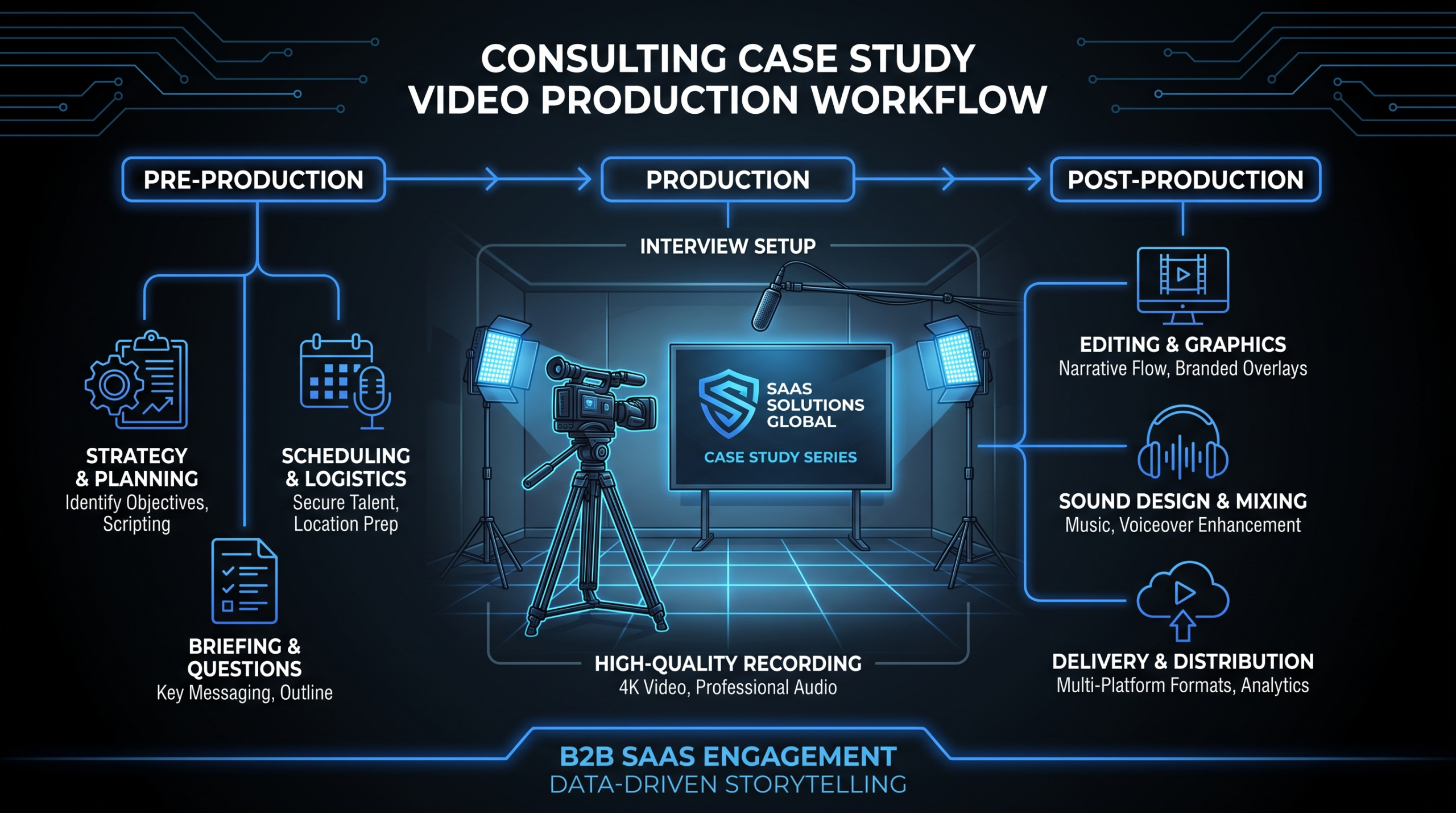
The 6–10 week timeline for a standard consulting case study video breaks down roughly as: one week for scoping and briefing, one to two weeks for scheduling and interview preparation, one day of filming, two to three weeks for editing (rough cut, revision round, final cut), and two to three weeks for client approvals. The approval phase is the most variable element. Consulting firms that have standing relationships with their clients' communications teams — and that have pre-negotiated approval timelines in their agreements — consistently produce case study videos 30–40% faster than firms treating approvals as an afterthought handled post-delivery.
Repurposing Into Sales Enablement: One Video, Six Assets
Repurposing is where consulting case study videos deliver their highest ROI. Most firms film once and publish one video. With a defined editing brief, that same footage becomes six to eight distinct assets serving different stages of the buyer journey across different channels.
For the mechanics of managing a high-volume repurposing workflow with an external editing partner, see our guide on how to outsource video editing.
The Six-Asset Repurposing Stack
- Primary video (3–5 min): The full case study narrative. Used in proposals, on your case studies page, in email nurture sequences, and shared in sales conversations after a discovery call.
- Short cut (60–90 sec): Opens with the outcome, cuts to the key "why us" moment, ends with the transformation. Used on LinkedIn, at trade events, and in email footers.
- Audiogram: A key client quote over a branded waveform graphic and static thumbnail. Used in podcast episode promotions, LinkedIn posts, and Twitter/X content alongside text threads.
- Quote cards: Three to five pull quotes exported as static branded images. Used in LinkedIn carousels, email campaigns, and pitch deck supplemental slides.
- Sales deck slide: A video thumbnail with an embedded play button, dropped into the relevant section of your proposal deck. Links to the hosted video.
- Email clip: A 15–30 second segment — typically the client's summary statement — used as an animated GIF thumbnail or linked play image in a nurture email or deal-stage follow-up.
All six assets originate from the same footage and the same edit session. The marginal cost of assets two through six, once the primary cut is complete, is typically well under $1,000 — often far less within a retainer editing arrangement where additional deliverable formats fall inside the monthly scope.
Channel-Specific Format Optimization
- LinkedIn: Square (1:1) or vertical (4:5) crops of the short cut outperform 16:9 in the feed. Always add closed captions — most LinkedIn video is watched without sound in a professional context.
- Email: Animated GIF thumbnails with a play button overlay are more widely supported than embedded HTML5 video across email clients. Link the thumbnail to the hosted video page; use a platform like Vidyard or Wistia to track whether the prospect actually watched it.
- Proposals: Embed the full-length video or short cut as a play-linked thumbnail image in the PDF. A gated video link that notifies you when the prospect plays the video gives your business development team a warm signal to follow up on.
Building a Recurring Case Study Program
A single consulting case study video is an asset. A quarterly cadence of case study videos is a program — and programs produce compounding returns. Each new video expands your sector coverage, adds another industry-specific proof point, and gives your business development team fresh material for every active relationship and every new prospect conversation.
What a Quarterly Cadence Looks Like
Most professional services firms target two to four case study videos per year at the outset — one every one to three months. With a standardized interview structure and a consistent visual template, each successive video is faster and cheaper to produce than the first: the approval process is familiar to the client's team, the production brief is established, and the editing team already knows your brand's motion style and standards.
Building the Internal SOP
Systematize the case study identification and capture process internally before it becomes someone's ad-hoc task:
- Identify candidates at project close. Add a line to your project completion checklist: "Case study video candidate? If yes, secure verbal client commitment before the engagement formally ends."
- Build consent rights in upfront. Include a video consent clause in your master service agreement or SOW template. Consent secured during contract signing is straightforward; consent requested six months post-engagement is awkward and frequently declined.
- Standardize the brief. Use the same interview questions, production format, and visual template for every case study. Consistency reduces per-video overhead and, more importantly, signals professional maturity to clients asked to participate.
How VEC Supports Recurring Case Study Programs
Consulting firms running a quarterly case study program benefit most from an editing team that already knows their brand — the typefaces, motion style, branded lower-third format, and pacing that makes each video feel coherent with the last. VEC's retainer model provides exactly this: a dedicated senior editor and project manager assigned to your account who build brand familiarity across multiple case study productions rather than re-briefing from scratch each quarter.
For teams producing four or more case study videos per year — plus the repurposing stack each generates — a production retainer typically delivers meaningfully lower per-deliverable cost than commissioning individual projects, alongside tighter brand consistency and faster turnaround on each successive engagement. See how our retainer model works for the full structure.
Frequently Asked Questions
How long should a consulting case study video be?
The primary video should run 2.5–5 minutes. Long enough to tell a complete before-after story with emotional weight; short enough that a prospect can watch it during a discovery call or in a proposal meeting without losing attention. Pair it with a 60–90 second short cut for social and email — that clip handles top-of-funnel work and directs qualified viewers to the full version. Anything over 5 minutes for the primary cut typically requires a compelling reason, such as a complex multi-phase engagement with multiple client speakers.
How do we handle NDA-sensitive information on camera?
Use three layers of protection: send interview questions to the client's legal contact for pre-filming approval; guide the client during the interview to describe their experience and outcomes in their own language rather than citing specific figures or named systems; and build a transcript review milestone into the rough-cut stage, where the client can flag any statements for removal before the final edit. This approach handles the vast majority of NDA concerns without stripping the video of authentic client voice — which is the asset you are trying to capture.
What if our client is reluctant to appear on camera?
Start with a written quote and a headshot before asking for camera time — some clients become comfortable with video participation after seeing a written version approved and published without issue. If on-camera reluctance persists, a narrated case study format works well: voice-over narration using B-roll footage and text-on-screen callouts, with the client reviewing and approving the full script. This format retains the client's explicit sign-off and can convey outcomes and transformation convincingly without requiring them to appear on screen. It is also significantly cheaper to produce at the foundational tier.
How long does it take to produce a consulting case study video?
Remote production typically takes 3–5 weeks from brief to final delivery. On-site production with B-roll runs 6–10 weeks. The approval phase is the most variable: clients with pre-negotiated response windows in the project agreement return approvals within 5–7 business days per milestone; clients without that structure can take 3–6 weeks for a single round. Build explicit approval timelines into your production schedule and hold clients to them from the first scoping conversation — this single change has the biggest impact on total production time.
Can we repurpose one case study video across multiple channels?
Yes — and for most consulting firms, repurposing is where the production budget delivers its clearest return. One primary video generates a short cut, audiogram, quote cards, sales deck slide, and email clip without additional filming. Each format serves a different stage of the buyer journey: the full video in proposals and on the website; the short cut on LinkedIn and at events; quote cards in outreach and nurture campaigns. For teams running a recurring program, this repurposing work fits naturally within a retainer editing scope — the marginal cost per additional format is a fraction of the primary video production cost.
If you would rather hire a specialist than build in-house, see our review of the best case study video production companies for B2B teams.
Ready to Build Your Case Study Video Library?
VEC provides dedicated video editing teams for professional services firms running recurring case study programs — same editor, same brand, every quarter, without the overhead of in-house hiring.
Book a Free Strategy Call See Client Case Studies See Pricing