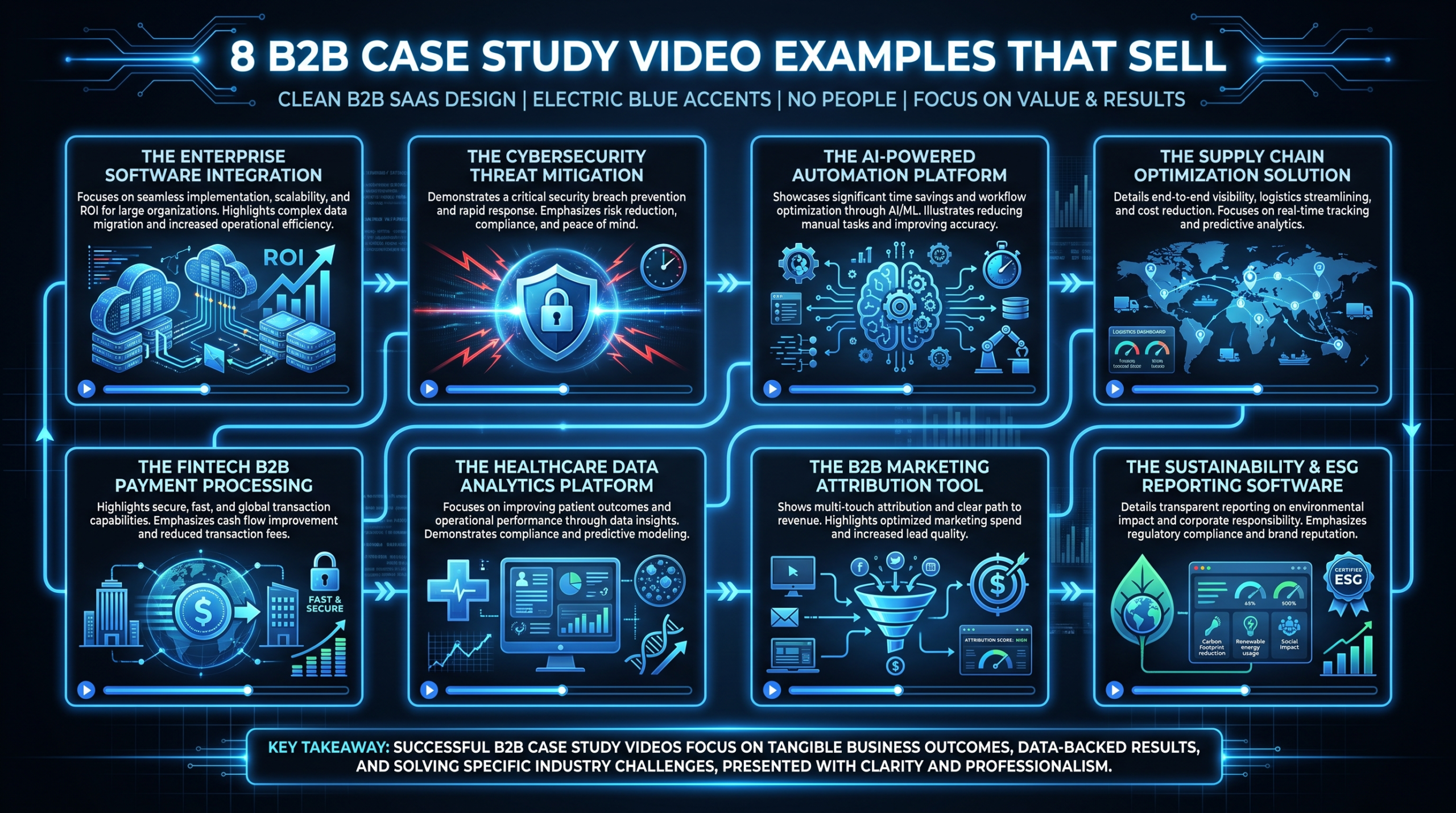
8 B2B Case Study Video Examples That Sell
TL;DR
The best B2B case study videos lead with a measurable outcome in the first 10 seconds, feature a credible customer spokesperson, and run 2–4 minutes. This post breaks down 8 real examples — from Slack to Salesforce to Wistia — and explains exactly what each one does right so you can replicate the structure in your own content program.
Table of Contents
- What Makes a B2B Case Study Video Actually Work
- 8 B2B Case Study Video Examples That Sell
- 1. Slack — IBM
- 2. Salesforce — T-Mobile
- 3. HubSpot — Classpass
- 4. Wistia — Crayon
- 5. Zendesk — Tesco
- 6. Asana — Deloitte
- 7. Drift — Ellie Mae
- 8. DocuSign — LinkedIn
- Anatomy of a High-Converting Case Study Video
- Format Comparison: What Works for Which Buyer
- Production Notes: What Each Example Reveals
- FAQ
Most B2B buyers watch 3–5 videos before requesting a demo. Case study videos — real customers, real results, real context — are consistently the format that closes the gap between "interested" and "convinced."
The problem is that most case study videos are forgettable. Stilted executive talking heads. Metrics that don't mean anything to the buyer. No sense of the actual problem that was solved. They look like marketing and feel like obligation.
These 8 examples are different. Each one does something specific and teachable. Study the structure, not just the surface — the goal is to take these principles back to your own content program. And if you want to see what professional post-production looks like for this type of content, our case studies page shows the editing and motion graphics work behind the scenes.
What Makes a B2B Case Study Video Actually Work
Before the examples: four non-negotiables that separate videos that generate pipeline from videos that sit unused on the website.
1. The outcome comes first
The opening line — not the second paragraph, the first sentence — states the result. "We reduced onboarding time by 60%." "Support tickets dropped by half in the first quarter." Buyers are busy. Give them the headline immediately or they'll click away.
2. The spokesperson is specific and credible
VP of Marketing at a 500-person SaaS company is more credible than "Director of Operations" at an unnamed enterprise. Name, title, company, and company size all matter. The buyer doing due diligence should be able to verify this person is real.
3. The "before" is as important as the "after"
Context creates the emotional arc. If you skip the problem, the solution sounds like a sales claim. The most effective case study videos spend 20–30% of runtime establishing what the world looked like before the product entered it.
4. Length matches buying stage
Top-of-funnel discovery: 60–90 seconds. Mid-funnel evaluation: 2–3 minutes. Late-stage proof for procurement/executive sign-off: 3–5 minutes with more metrics and depth. Matching length to context matters as much as the content itself.
8 B2B Case Study Video Examples That Sell
Example 01
Slack — IBM: "Work the Way You Live"
What they did: Slack's IBM case study video focuses on how one of the world's largest enterprises — over 350,000 employees — adopted Slack at scale. The video features real IBM employees across roles: developers, project managers, communications leads. It doesn't rely on a single C-suite spokesperson. It shows Slack in actual use at IBM workstations, in real meetings, on real phones.
Why it works: Enterprise buyers buying collaboration tools need to see deployment at scale. IBM isn't a startup. The fact that Slack works for 350,000 IBM employees answers the biggest objection enterprise prospects have: "will this work for us?" The video is structured around three moments — the problem (email overload, siloed tools), the adoption (rollout story), and the outcome (faster decision-making, reduced meetings). Visit Slack's website for the full customer stories library.
What to steal: Feature multiple employee levels, not just leadership. A developer's perspective and a VP's perspective are different trust signals to different buyers.
Example 02
Salesforce — T-Mobile: Customer 360
What they did: Salesforce's T-Mobile case study video centers on how T-Mobile used Salesforce Customer 360 to consolidate customer data across multiple legacy systems. The video opens with the business problem — fragmented data, frustrated service reps — before transitioning to the technology solution and then quantifiable outcomes. T-Mobile representatives speak directly to camera with specifics: fewer screens to toggle, faster resolution times, better customer satisfaction scores.
Why it works: Salesforce targets complex enterprise sales. Their buyers are CTOs, RevOps leaders, and CMOs who want proof that Salesforce works in messy, real-world environments — not just greenfield deployments. T-Mobile's size (a Fortune 500 telco) and complexity (decades of legacy infrastructure) makes this a convincing proof point for other large enterprises. The Salesforce customer success library contains hundreds of similar videos organized by industry and use case.
What to steal: Name the before-state problem in concrete operational terms ("service reps toggling between 7 systems per call"), not vague language ("operational inefficiency"). Specificity = credibility.
Example 03
HubSpot — ClassPass: Growth Without Growing Pains
What they did: HubSpot's ClassPass case study video focuses on how the fitness marketplace brand scaled its marketing operations without proportionally scaling headcount. The video leans on a single strong spokesperson — ClassPass's marketing operations lead — and structures around a clear narrative: "We were growing fast but our systems weren't built for that growth." HubSpot then appears as the solution that gave the team visibility and automation without adding hires.
Why it works: The ClassPass case study targets HubSpot's core buyer persona: a lean marketing team at a high-growth company that needs to do more with less. The phrase "scaling without headcount" appears early and anchors the entire video. The HubSpot customer stories page organizes case studies by company size, making it easy for buyers at similar-stage companies to self-select relevant proof.
What to steal: One strong persona-specific hook used early and repeated. Don't try to appeal to everyone in a single case study video — pick the exact buyer and speak only to them.
Example 04
Wistia — Crayon: Using Video for Competitive Intelligence
What they did: Wistia's case study video featuring Crayon (a competitive intelligence platform) is a particularly strong example of a company selling a video platform using video as proof. The video showcases how Crayon's team uses Wistia to host, distribute, and analyze video content — turning video from a passive content type into a measurable demand generation channel. Wistia's Wistia Learn blog contains extensive guidance on the production and distribution strategy behind this type of content.
Why it works: Wistia is selling to marketing and content teams at SaaS companies. Crayon is exactly that buyer. The video demonstrates product value through a use case that mirrors how prospects would use the tool — making it simultaneously a case study and an implicit product demonstration. The production quality is noticeably higher than average, which aligns with Wistia's brand promise around video quality.
What to steal: Choose a customer whose profile closely matches your ideal prospect's profile. The mental "that's exactly us" reaction is what accelerates pipeline.
Example 05
Zendesk — Tesco: Support at Retail Scale
What they did: Zendesk's Tesco case study video positions the brand as capable of handling customer support at genuine retail enterprise scale — millions of customer interactions, thousands of agents, complex multi-channel environments. The video is structured as a day-in-the-life rather than a straight testimonial: it follows Tesco customer service operations, shows the Zendesk interface in context, and closes with measurable improvements in agent efficiency and customer satisfaction. Zendesk's full customer stories library is filterable by industry and company size.
Why it works: Enterprise support software buyers are risk-averse. A Fortune 100 retailer like Tesco using Zendesk is a powerful trust signal. The day-in-the-life format works particularly well for software where the user experience matters as much as the outcomes — seeing agents using it calmly and efficiently is more convincing than a CEO saying "we love the product."
What to steal: Show the product being used in context. Screen time — real, messy, in-use screen time — is more convincing than polished feature demos.
Example 06
Asana — Deloitte: Managing Complexity at Scale
What they did: Asana's Deloitte case study video is one of their longer-form pieces, targeted at enterprise procurement processes where multiple stakeholders need proof before signing off. The video features three Deloitte representatives — a partner, a project lead, and a team member — giving a multi-level view of how Asana fits into Deloitte's service delivery operations. Outcomes are framed in terms relevant to professional services: project visibility, utilization tracking, client deliverable management. The full Asana customer page includes videos, written case studies, and quotes organized by use case.
Why it works: The multi-spokesperson format mirrors Deloitte's own consulting model — structured, credentialed, multi-perspective. It's not a startup's casual talking-head testimonial. The production matches the brand of the customer being featured. This alignment signals to other professional services firms that Asana understands their world.
What to steal: Match production style to your customer's brand, not just your own. A law firm case study should look more structured than a startup case study. This signals that you understand the customer's context.
Example 07
Drift — Ellie Mae: Conversational Marketing for Financial Services
What they did: Drift's Ellie Mae case study video is a tighter, more conversion-focused piece. Ellie Mae (now ICE Mortgage Technology) was using Drift's chatbot and conversational marketing platform to qualify and convert web visitors in the mortgage tech space — a vertical with long B2B sales cycles and high deal values. The video is approximately two minutes, front-loads the ROI, and uses Ellie Mae's VP of Marketing as the sole spokesperson. The full Drift customer story archive has been continued under the Salesloft brand following their 2023 acquisition.
Why it works: Two minutes is the right length when the outcome is quantifiable and the audience is already familiar with the solution category. Drift's buyers at this stage of evaluation don't need concept explanation — they need proof. The video delivers exactly that and nothing more. No padding, no feature tour, no brand story. Just: here's what happened when this company used our product.
What to steal: Know your buyer's stage. Mid-funnel evaluation videos should be tight and outcome-first. Top-of-funnel videos can afford to tell more story. Don't use the same format for both.
Example 08
DocuSign — LinkedIn: Digital Transformation at Scale
What they did: DocuSign's LinkedIn case study video positions DocuSign as central to LinkedIn's digital agreement workflow — covering procurement, sales contracting, and HR agreements at a company with thousands of employees and global operations. The video features LinkedIn's legal and operations leadership speaking to how DocuSign replaced manual paper-based processes and integrated with existing systems (Salesforce, SAP). DocuSign's customer evidence library at docusign.com categorizes customer stories by use case: HR, sales, procurement, and legal.
Why it works: DocuSign has a broad addressable market — virtually every company signs documents. The LinkedIn video works because LinkedIn is a brand that B2B buyers inherently trust and relate to. Seeing LinkedIn as a DocuSign customer implies product-market sophistication. The multi-department coverage (legal, ops, HR) also broadens the internal champion potential — different viewers see different relevance.
What to steal: Feature customers whose brand name alone does persuasive work. A recognizable customer name in the thumbnail or title significantly improves click-through in email nurture sequences and LinkedIn ads.
Anatomy of a High-Converting Case Study Video
Across all eight examples, a consistent structure emerges. This isn't coincidence — it's the architecture that matches how B2B buyers process proof:
Case Study Video Structure Template
| Segment | Duration | Purpose | What to Include |
|---|---|---|---|
| Hook / Outcome First | 0–15 sec | Earn the next 2 minutes | The headline metric or transformation, stated plainly |
| Customer Context | 15–45 sec | Build credibility | Company name, size, industry, spokesperson name + title |
| The Problem (Before) | 45 sec–1:30 | Create emotional relevance | Specific operational pain, not vague "challenges" |
| The Solution in Context | 1:30–2:30 | Show, don't tell | Product in use, workflow demonstration, team reactions |
| The Results (After) | 2:30–3:15 | Close the narrative loop | Measurable outcomes, business impact, stakeholder quote |
| Call to Action | Last 10–15 sec | Convert interest to action | What they want viewers to do next — demo, trial, contact |
This structure works at any production budget. A $2,500 case study video and a $25,000 case study video can both follow this architecture. The difference is production value, not structure. For a closer look at what production quality levels cost, see our video editing services breakdown.
Format Comparison: What Works for Which Buyer
Not all case study video formats serve the same purpose. Here's how to match format to buying context:
Case Study Video Format by Use Case
| Format | Best For | Ideal Length | Key Strengths |
|---|---|---|---|
| Talking Head Testimonial | Mid-funnel social proof | 60–90 sec | Low cost, fast to produce, genuine feel |
| Documentary / Day-in-Life | Enterprise sales, late-stage procurement | 3–5 min | Shows product in real context, builds deep trust |
| Results Spotlight | PPC/paid ads, email nurture | 30–60 sec | Metric-first, designed for attention-scarce environments |
| Multi-Stakeholder Interview | Complex deals with multiple buyers | 3–4 min | Multiple perspectives, addresses different objections |
| Animated Summary | Email follow-up, leave-behinds | 90 sec–2 min | Skimmable, works without audio, easy to distribute |
Most content programs benefit from producing two versions: a longer documentary-style piece (3–5 min) for the website and late-stage distribution, and a 60–90 second cut for top-of-funnel ads and social. If you're working with a dedicated editing team, this dual-format approach adds minimal incremental cost to the production. See how our SaaS video production service handles multi-format deliveries from a single shoot.
Production Notes: What Each Example Reveals
Looking at these eight examples through a production lens, a few patterns appear that aren't immediately obvious from the content alone.
B-roll makes or breaks credibility
The Zendesk and Asana examples work partly because they include genuine workplace footage — real offices, real screens, real people doing real work. Generic stock footage of "people in meetings" undermines the authenticity that case study videos depend on. If you can't get on-site footage, product screen recordings with real data (anonymized if necessary) are more credible than stock.
Audio quality outranks visual quality
A viewer will forgive a slightly soft image. They won't forgive echo, hiss, or muffled audio. The Drift and HubSpot examples in particular use clean, lightly treated audio that sounds professional without sounding over-produced. A $100 lapel microphone and basic acoustic treatment matters more than 4K resolution for this format.
Lower-thirds do real persuasive work
Name, title, company, and company size as a lower-third text overlay takes two seconds of screen time and significantly increases credibility. The Salesforce and DocuSign examples both use clean, branded lower-thirds that establish spokesperson legitimacy before a word is spoken.
Pacing is edited, not filmed
The examples that feel energetic and confident — Slack, Drift — have tight editorial cuts. Dead air is removed. Filler words are cut. The spokesperson sounds decisive because the editing makes them decisive. This is where professional post-production earns its value: the footage captured on location may be full of pauses, restarts, and off-topic tangents. The editor's job is to build a tight, confident narrative from that raw material.
If your team is evaluating whether to handle this in-house or bring in a dedicated editing partner, our product demo and case study video production guide walks through the decision framework. At VEC, we work with B2B SaaS companies producing case study video libraries — typically 4–12 videos per quarter — and our Growth plan ($5K/mo) is built for exactly that volume.
You can also review the agencies specializing in this format in our best case study video production companies roundup, which covers positioning and pricing for the leading providers.
Frequently Asked Questions
How long should a B2B case study video be?
For most mid-funnel use cases, 2–3 minutes is the effective range. Shorter (60–90 sec) works for paid ads and social distribution where attention is scarce. Longer (4–5 min) is appropriate for late-stage enterprise procurement where multiple stakeholders need detailed proof. Produce a long version first, then edit a short cut from it — not the other way around.
Do you need to show ROI numbers in a case study video?
Quantified metrics significantly improve credibility and conversion, but they don't have to be precise. Ranges and hedged framing ("support tickets dropped by roughly half in the first quarter") work as well as exact figures, and they're more honest if your data has natural variation. What to avoid: vague language like "dramatically improved" or "significant results" with no supporting context.
What's the most common mistake in B2B case study videos?
Leading with the company or product story instead of the customer's problem. Buyers don't care about your founding story at the moment they're evaluating a purchase. They care about whether you solved a problem that looks like their problem. Start with the customer's before-state, not your product's features.
How do you get customers to agree to be in a case study video?
The most effective approach is to make the ask easy and frame it as mutual benefit. Offer to give the customer a copy of the video for their own LinkedIn and sales use (which they often want). Keep the time commitment clear upfront — typically 90 minutes on-site or 30 minutes on Zoom. Having a professional crew or a clear remote recording setup reduces friction significantly versus expecting the customer to set things up themselves.
What does it cost to produce a B2B case study video?
Production costs vary widely by format and scope. A remote-recorded talking head case study (Zoom interview + professional editing) typically runs $1,500–4,000. An on-site documentary-style video with b-roll, multi-spokesperson interviews, and motion graphics commonly runs $5,000–15,000. At monthly retainer or dedicated-team volume — 4+ case study videos per quarter — per-video costs can drop 30–50% compared to per-project rates. See our pricing page for VEC's dedicated team plans.
To learn which case study video format suits your use case, how to structure your story, and what production costs to budget for, read the complete brand and business case study video guide.
Ready to Build Your Case Study Video Library?
VEC provides dedicated B2B video editing teams for SaaS companies producing 4–20+ videos per month. Growth plan starts at $5K/mo — includes a dedicated senior editor, project manager, and a 90-day output guarantee.
Book a Free Strategy Call See Our Work