Case Study Video Interview Questions
TL;DR
The questions you ask in a case study video interview determine whether your customer delivers quotable, conversion-driving sound bites — or rambling non-answers. Use open-ended questions structured around the problem → solution → result → recommendation arc. Avoid yes/no questions, leading questions, and anything technical your customer can't answer confidently. This guide gives you a 40+ question bank, a pre-shoot prep framework, and editing-ready structures so your production team can cut a tight 2–3 minute story every time.
Table of Contents
- Why Interview Questions Make or Break Case Study Videos
- Pre-Shoot Prep: Questions to Ask Before You Film
- The Core Interview Question Bank (40+ Questions)
- Questions to Avoid — and Why
- Scripted vs. Open-Ended: Which Question Format Wins
- Follow-Up Probes That Unlock the Best Sound Bites
- How Your Post-Production Team Should Structure Answers
- FAQ
Why Interview Questions Make or Break Case Study Videos
The quality of a B2B case study video is decided before the camera rolls. Specifically, it is decided by the questions in your interview script. A customer who is genuinely enthusiastic about your product can still deliver flat, unusable footage if the interviewer asks closed-ended or leading questions. Conversely, a hesitant interviewee can give you three usable sound bites in 20 minutes if the questions are structured correctly.
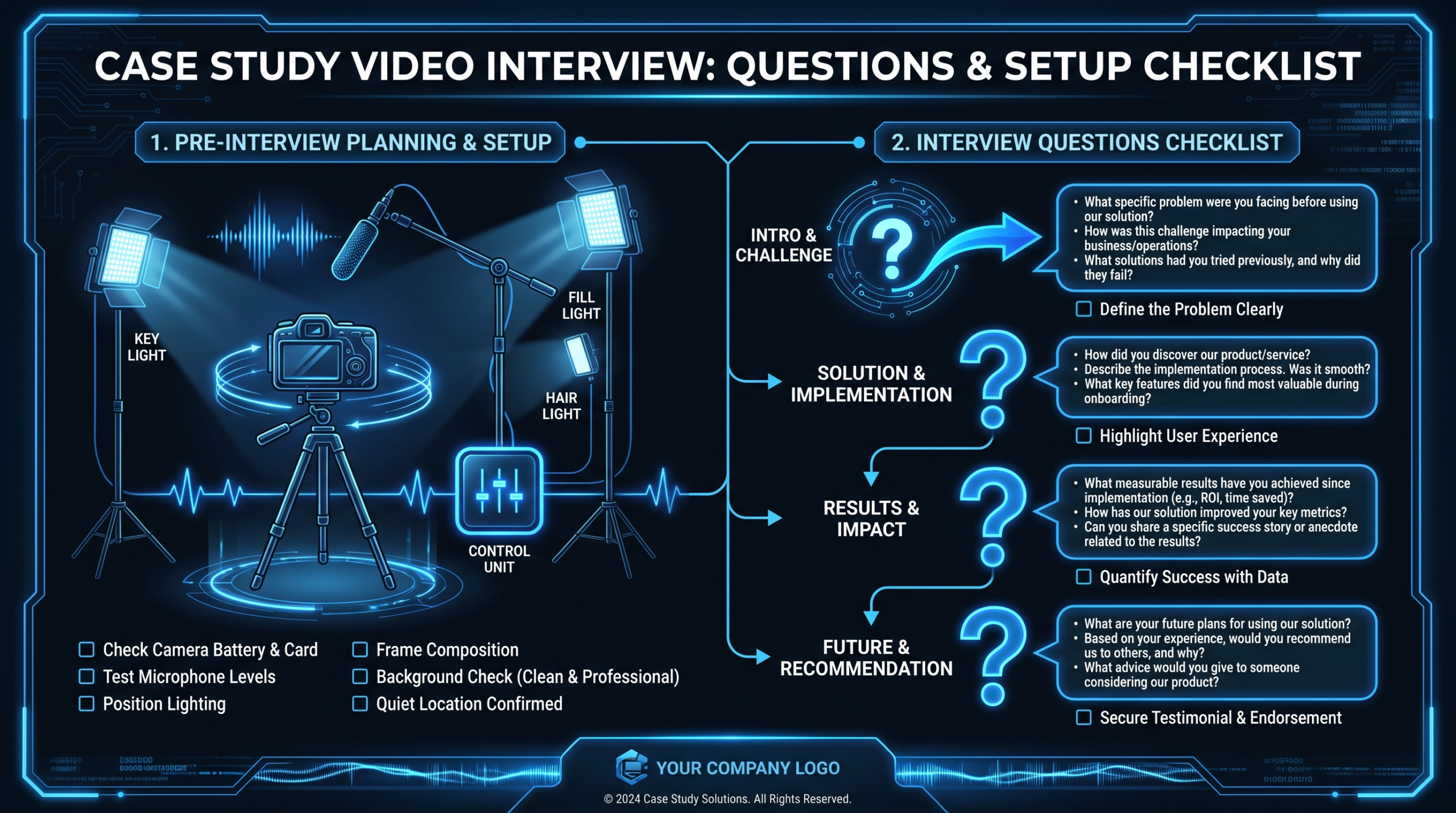
The goal of every case study interview question is to move the customer through a narrative arc — from the pain they felt before your product, through the evaluation and onboarding experience, to the measurable outcome and emotional resolution. When that arc is complete, your post-production team can cut a 90-second to 3-minute video that feels like a story, not a sales pitch. Research from Wistia's video marketing library consistently shows that customer-voice video content outperforms brand-narrated video for B2B buyer trust — and the quality of the interview is the primary driver of that customer voice.
At Video Editing Company, we edit case study videos for B2B SaaS teams producing anywhere from one to twenty customer stories per quarter. The single most predictable predictor of a strong final cut is interview question quality. Teams with a structured question bank consistently deliver raw footage that edits in two to four hours. Teams without one routinely send us 45-minute recordings that yield 40 seconds of usable material.
Before you plan your next customer shoot, review our case study video portfolio to see what well-structured interview footage looks like in a finished edit. For a broader framework on structuring customer stories as written case studies — which often informs what you ask in the video interview — HubSpot's case study question guide is a useful reference. Then use this guide to build the question bank that gets you there.
Pre-Shoot Prep: Questions to Ask Before You Film
The interview prep call — typically 15 to 20 minutes with your customer one to three days before the shoot — is where you set expectations and mine for the specific metrics, moments, and language your customer will use on camera. This call is not the interview. It is reconnaissance.
Customer Success Alignment Call (Pre-Shoot)
Ask your customer success manager or account executive to brief you before this call. You want to know the customer's specific use case, any metrics they have already shared internally, and any sensitive topics to avoid. Then ask the customer:
- What business problem were you trying to solve before you found us?
- What was the moment you knew things needed to change?
- Do you have any specific numbers — time saved, revenue impact, team headcount changes — you are comfortable sharing on camera?
- Who else on your team was involved in the decision or benefited from the outcome?
- Is there any topic, competitor, or internal initiative you would prefer we avoid mentioning?
Capture their exact language. If they say "we were drowning in revision cycles," use that phrase in your interview questions. Mirroring their words puts them at ease and triggers more specific recall during the shoot.
Technical and Logistics Checklist
Also confirm before the shoot:
- Will the interview be on-site or remote?
- Can you approve the final edit before it goes public?
- Are there any logo, brand, or competitor naming restrictions?
- What title and company name should appear in the lower-third?
The Core Interview Question Bank (40+ Questions)
Organize your interview around five acts. Not all questions are asked in every interview — choose eight to twelve that best fit your customer's story. Always ask the most important questions first, in case the session runs short.
Act 1: Opening — Establish the Person and Context
These questions warm up the interviewee and give your editor establishing material. Keep them brief.
- Can you tell me your name, title, and what your company does in one or two sentences?
- How long have you been in this role, and what does your day-to-day look like?
- What is your team responsible for, and how does video fit into that work?
- Before we dive in — how long have you been working with us?
Act 2: The Problem — Before State and Pain
This is the most critical act. Buyers watching your case study video are currently living in this "before state." Every word your customer says here is a mirror. Great answers here create immediate identification.
- What was the specific challenge or pain point you were facing before you started working with us?
- What was the impact of that problem on your team or business — day to day?
- What had you already tried to solve it, and why did those attempts fall short?
- What was the cost — in time, money, or team frustration — of not solving this?
- Was there a specific moment or event that made you realize you needed to find a real solution?
- How were decisions about this problem typically made at your company — who else was involved?
Act 3: The Decision — Evaluation and Why You
This act handles buyer intent. Prospects watching the video are often at the same decision stage your customer was. Their answer to "why us" is more persuasive than anything your marketing team could write.
- How did you first hear about us, and what made you want to learn more?
- What other options did you evaluate, and how did we compare?
- What were the two or three things that made you decide to move forward with us?
- Was there anything about the decision that gave you pause, and how did that get resolved?
- What did the onboarding or kickoff process look like — was it what you expected?
Act 4: The Outcome — Results and Transformation
This is where the case study either converts or loses a prospect. Specific, quantified outcomes in the customer's own words carry far more weight than agency copy. Push for numbers — but never invent them.
- What changed after you started working with us — what did you notice first?
- Can you walk me through what a specific result or win looked like in practice?
- Are there any numbers you can share — time saved, volume increase, cost reduction, team headcount impact?
- How has this affected your team's day-to-day or capacity?
- Has this change had any knock-on effects in other parts of your business?
- If you had to describe the transformation in one or two sentences, what would you say?
- Has working with us changed how you think about this area of your business long-term?
Act 5: The Recommendation — Social Proof Close
These questions produce the sound bites that prospects share internally when building the case for your product. They are the verbal equivalent of a five-star review — but earned through narrative, not a rating scale.
- Who would you recommend us to — what kind of company or team would benefit most?
- What would you say to someone who is on the fence about working with us?
- If a peer at another company asked what it is like to work with us, what would you tell them?
- What is the one thing you would never want to go back to doing before we worked together?
- Is there anything else you want to add — something we did not cover that feels important to you?
Bonus: Industry-Specific and Product-Use Questions
- How has the volume or cadence of your video output changed since we started working together?
- What did your approval and review process look like before, and how does it work now?
- How has your internal team's bandwidth changed — are people spending time differently?
- Did the quality of video production meet, fall short of, or exceed your expectations?
- Has the video content produced together helped you hit any specific business goals?
- What feedback have you received from your own customers or audience about the video content?
- Has your brand or production consistency improved in a way you can point to specifically?
- If you had to recommend us to your VP or CEO, what would you say to build that case?
Questions to Avoid — and Why
Just as important as knowing what to ask is knowing what kills an interview. These question patterns consistently produce unusable footage.
| Question Type | Bad Example | Why It Fails | Better Alternative |
|---|---|---|---|
| Yes/No question | "Did you like working with us?" | One-word answer, no usable footage | "What was your experience working with us like overall?" |
| Leading question | "Would you say we saved you a lot of time?" | Puts words in their mouth; feels scripted | "How has your team's time or bandwidth changed since we started?" |
| Multi-part question | "How did we help you, and what changed, and what would you tell others?" | Interviewee answers the easiest part and forgets the rest | Ask each as a separate question |
| Jargon-heavy question | "How did our SLA compliance affect your DevOps pipeline?" | Interviewee freezes or gives a vague answer | "What did day-to-day workflow look like before vs. after?" |
| Hypothetical question | "What would have happened if you had not found us?" | Speculation, hard to answer authentically | "Looking back, what do you think you would have done without us?" |
| Overly broad question | "Tell me about your experience." | Too open — interviewee does not know where to start | "What changed most noticeably in the first 30 days?" |
Scripted vs. Open-Ended: Which Question Format Wins
Fully scripted interviews — where you hand the customer a list of questions in advance and they rehearse answers — produce polished delivery but often feel stiff on camera. Open-ended conversational interviews produce authentic emotion but can yield rambling footage that is difficult to edit.
The approach that works best for B2B case study videos is a structured conversation with a pre-sent question guide. Send the customer a list of five to seven high-level topics (not word-for-word questions) two days before the shoot. This gives them time to recall specific examples and metrics without over-rehearsing.
| Format | Delivery Quality | Authenticity | Edit Friendliness | Best For |
|---|---|---|---|---|
| Fully scripted | High | Low | High | Executive talking-head intros, short testimonial clips |
| Fully spontaneous | Variable | High | Low | Unscripted "reactions" and behind-the-scenes content |
| Structured conversation (recommended) | Good | High | High | Full B2B case study videos, 90s–3min format |
| Pre-recorded written Q&A then on-camera read | Low | Low | Medium | Not recommended — always feels scripted |
For context on how format choices affect your overall case study video production budget, more complex interview setups generally require more editing time. A structured conversation with a good question bank reduces post-production hours significantly — your editor can follow the narrative arc rather than hunting for it.
Follow-Up Probes That Unlock the Best Sound Bites
Follow-up probes are the difference between a competent interviewer and a great one. After any answer that hints at something specific — an emotion, a number, a moment — stop and probe before moving to the next question. The best case study footage almost always comes from the second or third question in a thread, not the first.
The Five Probe Phrases
- "Can you say more about that?" — the simplest probe; works after any answer that was too brief.
- "Can you give me a specific example?" — forces the interviewee from generality to story. Examples are what editors work with.
- "What did that look like in practice?" — pushes toward concrete, visual description. Great for case study B-roll planning.
- "How did that make you feel?" — emotion is the engine of persuasion; do not skip this.
- "If you had to put a number on it, what would you say?" — use after any answer that suggests but does not state a metric. Never invent the number if they cannot provide one.
The Silence Technique
After a follow-up probe, stay quiet for three to five seconds longer than feels comfortable. Most interviewers rush to fill silence. Your customers will fill it instead — often with their most honest and quotable answer. Experienced interviewers describe silence as "leaving space for the good stuff."
This is also why remote case study interviews often produce slightly weaker footage than on-site: connection delays make silence ambiguous, and interviewees tend to wrap up faster. If you are filming remotely, brief your subject in advance: "I may pause after you answer — that's intentional. Just give me a moment before wrapping up."
How Your Post-Production Team Should Structure Answers
Once you have your raw footage, the question bank structure maps directly to a proven editing arc. Your video editor should look for the following beats across the footage and build the sequence in this order, regardless of the order questions were asked:
- Hook (0:00–0:15): Pull the most compelling sentence from the results section. Start in the middle of the story, not the beginning. A great hook sounds like: "We went from three weeks per video to four days — and we did not add a single person to the team."
- Problem (0:15–0:45): One to two clips from Act 2. Establish the pain. Keep it empathetic — not a complaint, but a context-setter.
- Solution (0:45–1:15): One clip from Act 3 on the decision. Why this vendor, why now. Let the customer explain in their own words — no narrator voice-over needed.
- Results (1:15–1:50): The payoff. Two to three clips with specific outcomes. If there is a number, make it on-screen text.
- Recommendation close (1:50–2:00): End on one strong soundbite from Act 5. The video should close on the customer, not a logo card.
At Video Editing Company, our dedicated editor teams are briefed on this arc before they cut a single clip. Editors with experience in B2B SaaS customer stories know to look for the emotional pivot — the moment the interviewee shifts from describing the problem to describing the relief. That pivot is where the best footage lives.
For teams producing case study videos at scale — quarterly or monthly — consider how consulting firms approach case study video production to see how the format scales across multiple customer stories without feeling repetitive. And if you are evaluating outside help, our video editing services overview covers what a dedicated post-production team handles end to end.
Common Editing Problems Caused by Bad Interview Questions
- No usable sound bite on results: The customer was asked "Did you see results?" (yes/no) instead of "Walk me through a specific result you saw." Fix: re-interview or use a written pull quote.
- Rambling problem section: Caused by "Tell me about your experience before us" without follow-up probes. Editors can cut rambling, but it costs hours.
- Generic recommendation clip: "They're great, definitely recommend" is the most common and least useful closing line. Caused by "Would you recommend us?" Fix: Ask "What would you say to someone who's on the fence about working with us?"
- Missing the emotional pivot: Happens when the interviewer never asks "How did that make you feel?" or "What was that moment like?" B-roll can compensate, but the voiceover will be flat.
"The case study video question bank is a production asset. Treat it with the same care you give to your script or shot list. The questions you ask on day one of filming determine what your editor has to work with in week two." — Video Editing Company production team
Approvals and Final Delivery
Build one approval round into your production timeline for case study videos. The customer (and sometimes their legal team) will want to review the final cut before it goes public. Structure this in your agreement before shooting — it prevents last-minute pull requests that stall your content calendar.
Most B2B SaaS teams can get to final delivery in two to three weeks from shoot date when the interview is well-structured and the brief to the post-production team is clear. For more on what drives timeline and cost, see our roundup of case study video companies and how turnaround time compares across different service models.
To see how strong answers play out on screen, browse these 8 B2B case study video examples, along with guides to scripting, cost and testimonials.
Frequently Asked Questions
How many questions should I ask in a case study video interview?
Plan for eight to twelve questions across the five-act arc, but ask the most important ones first in case the session runs short. A 30-minute interview with ten strong questions and good follow-up probes typically produces enough footage for a 2–3 minute final cut. Avoid padding with more than fifteen questions — longer interviews do not reliably produce more usable material, and they fatigue your subject.
Should I send interview questions to the customer in advance?
Yes — but send topic areas, not word-for-word questions. Sending the exact questions risks over-rehearsed, robotic answers. Send five to seven bullet points covering the areas you'll explore (challenge, decision, outcome, etc.) two to three days before filming. This lets them recall specific examples without scripting their delivery. Brief them that you'll follow up with probes, so they should not try to cram everything into one long answer.
What if the customer does not have specific metrics to share?
Never pressure customers for numbers they cannot verify, and never substitute invented statistics — even approximate ones. Instead, push for qualitative specifics: "Can you describe what a week looked like before versus after?" Time-based descriptions ("we used to spend a full day on this, now it takes an hour") are credible, verifiable, and often more relatable than percentages. Your editor can use on-screen text to frame these in context without fabricating precision.
How long should a finished B2B case study video be?
For most B2B SaaS use cases — website, sales deck, LinkedIn — the sweet spot is 90 seconds to 3 minutes. Under 90 seconds and you rarely have time for the full problem-solution-result arc. Over 3 minutes and completion rates drop significantly for cold or warm audiences. If you have exceptional footage and a strong story, a 4–5 minute "deep cut" can work as a gated asset, but keep the website version short. One shoot can produce a short version and a long version from the same raw footage.
Can the same interview questions work for video testimonials and full case study videos?
Mostly yes, with one difference in emphasis. For a 30-second testimonial clip, you only need the recommendation act (Act 5) and one strong result line from Act 4. For a full case study video, you need all five acts. Use the full question bank for every interview — even if the immediate deliverable is just a short testimonial — because you can always edit a longer cut from the same footage later without scheduling another shoot.
Ready to Produce Case Study Videos That Actually Convert?
Video Editing Company provides dedicated post-production teams for B2B SaaS brands. We handle editing, color, sound, graphics, and delivery — you handle the interview, we handle the rest. Growth plan from $5K/month, with a 90-day output guarantee.
Book a Free Strategy Call See Pricing Plans