Do AI Video Ads Work for B2B Brands?
AI video ads work for B2B brands when the job is volume, variation or speed, such as testing many hooks, localizing a message or producing retargeting creative, and they work less well when the ad has to carry trust, a complex product story or a named human voice. The honest answer is "sometimes, for specific jobs," and the evidence that they beat edited ads outright is thin.
Key Takeaways
- AI ads are a production method, not a strategy. They make versions cheaply; they do not decide the message, the audience or the offer.
- The best public evidence is consumer-side and mixed. An MIT IDE write-up of a 21,000-person experiment found AI-personalized video had higher click-through rates, but the authors question whether novelty drove it, and the ads had heavy human involvement.
- Use AI for variants, retargeting and localization. Use edited ads for flagship product stories, customer proof and anything a buying committee must trust.
- Tool cost is small next to media spend. Entry plans for the main generators listed below start in the tens of dollars a month; the real cost is review time and brand risk.
- Platforms require disclosure for realistic synthetic content. YouTube and LinkedIn both have rules; read them before you publish.
Table of Contents
- What Are AI Video Ads?
- Do AI Video Ads Actually Work for B2B?
- Which AI Video Ad Tools Do B2B Teams Use?
- When Do AI Video Ads Beat Edited Ads?
- When Do Edited Ads Still Win?
- What Does Each Approach Cost?
- What Do Platforms Make You Disclose?
- How Do You Test AI Ads Without Wasting Budget?
- What Does a Hybrid AI-Plus-Editor Workflow Look Like?
- Which Should You Choose?
- FAQ
This guide is for a VP Marketing or Head of Content at a B2B company deciding whether AI-generated video ads deserve a slot in the paid media plan. We are a video editing company, so we see the production side of ad programs rather than your campaign dashboards; every statistic below comes from a named public source, and every external page was checked on October 24, 2026.
What Are AI Video Ads?
AI video ads are video advertisements whose visuals, voiceover, avatar presenter or script are generated or assembled by an AI tool instead of being filmed and edited by hand. The category covers a spectrum, and the differences matter for how much risk you take on.
- Template-and-script generators. You paste a product link, script or ad copy and the tool assembles stock visuals, a voiceover and captions. HeyGen's ad generator page, for example, describes turning product data, ad copy or a script into UGC-style, lifestyle, explainer or product demo ads.
- Avatar presenters. A synthetic spokesperson reads your script. Useful for talking-head explainers; the risk is an uncanny delivery that buyers read as low effort.
- Generative footage. Models create scenes or product motion from prompts. This is the newest and least predictable layer, and the one most likely to trigger platform disclosure rules.
- AI-assisted editing. A human shoots or supplies footage and AI speeds up cuts, captions or resizing. This is closer to a normal edit than to a "generated" ad, and our guide to AI video editing for B2B teams covers where it helps.
This post is about the first three, where the ad itself is largely machine-made. If you are weighing AI tools against hiring editors across all your video, start with our comparison of AI video tools versus human editors; here we stay on paid and promoted ad creative.
Do AI Video Ads Actually Work for B2B?
There is no public, B2B-specific benchmark showing that AI video ads outperform edited ads, so the defensible claim is narrower: AI ads can match or beat conventional creative on click-through in some tests, mostly in consumer contexts, and the gains depend on how much human judgment goes into them.
The strongest public study we found is summarized by the MIT Initiative on the Digital Economy. Researchers ran an online experiment with more than 21,000 consumers, working with a GenAI technology company, an Indian e-commerce retailer and a WhatsApp marketing provider. They compared an AI-generated personalized avatar video against a personalized image ad and a generic video. According to the MIT write-up, click-through rates for the AI personalized videos were 9.4% higher than the personalized image ads and 6.5% higher than the generic videos.
Read that result with its caveats, which the researchers state themselves:
- It was a single-exposure test. The authors ask whether the lift came from personalization or from the novelty of AI video, and whether it fades as such ads become common.
- The ads were not hands-off. The marketing team kept full control of message content and used GenAI as a production tool rather than a creative engine; MIT notes the technology "works best when guided by human judgment."
- It measured clicks from consumers. A click on a retail or messaging ad says little about how a six-person buying committee evaluates a $50,000 software contract.
The same article cites a 2025 Interactive Advertising Bureau report finding that more than 40% of US agency and marketing professionals were already using GenAI to produce multiple versions of video ad creative. Adoption is real; proof of B2B lift is not yet there. Source: MIT IDE, "AI-Generated Video Ads Are Getting Personal. Are Consumers Buying It?", checked October 24, 2026.
For a B2B brand, the practical reading is: treat AI ads as a way to test more creative per dollar, and judge them on your own cost per qualified lead, not on a vendor's case study.
Which AI Video Ad Tools Do B2B Teams Use?
The tools that dominate search results for this topic are HeyGen, Creatify and invideo, and all three are built primarily around short-form social and e-commerce style ads. Their public plans are cheap relative to media spend, but check limits on credits, watermarks and commercial use before you commit.
| Tool | What it does for ads | Entry pricing seen Oct 24, 2026 | B2B fit to check |
|---|---|---|---|
| HeyGen | Turns product data, copy or a script into avatar-led UGC, lifestyle, explainer or demo ads | Creator $29/mo, Pro from $49/mo, Business $149/mo plus $20 per extra seat (pricing page) | Avatar quality on technical scripts; brand controls on team plans |
| Creatify | URL-to-video, avatar and cinematic ad styles, batch variations, built-in testing and launch tools | Standard $15/mo, Pro $55/mo (lower on annual billing) (pricing page) | Product-page inputs suit apps and e-commerce better than complex enterprise software |
| invideo AI | Prompt-to-ad with script, visuals, voiceover and an editable timeline for Instagram, YouTube and TikTok | Starter $20 per seat/mo, or $10 billed annually; Plus $60 monthly or $30 annually (pricing page) | Editable timeline helps a human fix what the model gets wrong |
Prices change often and plans are credit-based, so treat these as a snapshot, not a quote. Vendor pages describe what the tools can do; none of them is evidence of B2B results.
When Do AI Video Ads Beat Edited Ads?
AI ads win when the constraint is the number of creative versions, the speed of turnaround or the cost of each additional variant, and when the claim in the ad is simple enough that nobody needs to trust a person to believe it. In B2B that usually means the lower and middle of the funnel, not the first impression of a complex product.
Hook and headline testing
If you want to learn which opening line, pain point or offer earns the click, AI lets you build ten variants of the same ad in an afternoon. The learning is the value; the winning idea can later be rebuilt by an editor to a higher standard.
Retargeting and nurture creative
Visitors who already know you tolerate lighter production. A short reminder ad about a webinar, a template download or a pricing page does not need cinematic polish, and refreshing it every few weeks fights ad fatigue.
Localization and format resizing
Translating a voiceover, swapping on-screen text or reformatting for 9:16 and 1:1 is mechanical work that AI handles well, as long as a native speaker reviews the output.
Event and webinar promotion
Short-lived campaigns with a hard deadline reward speed over polish. An AI-built countdown ad that ships today often beats a better one that ships after the registration page closes.
When Do Edited Ads Still Win?
Edited ads win when the ad has to carry credibility: a customer's face and words, a product shown working in real software, a founder's point of view or a story with a deliberate emotional arc. These are the assets that move a buying committee, and a synthetic presenter weakens each one.
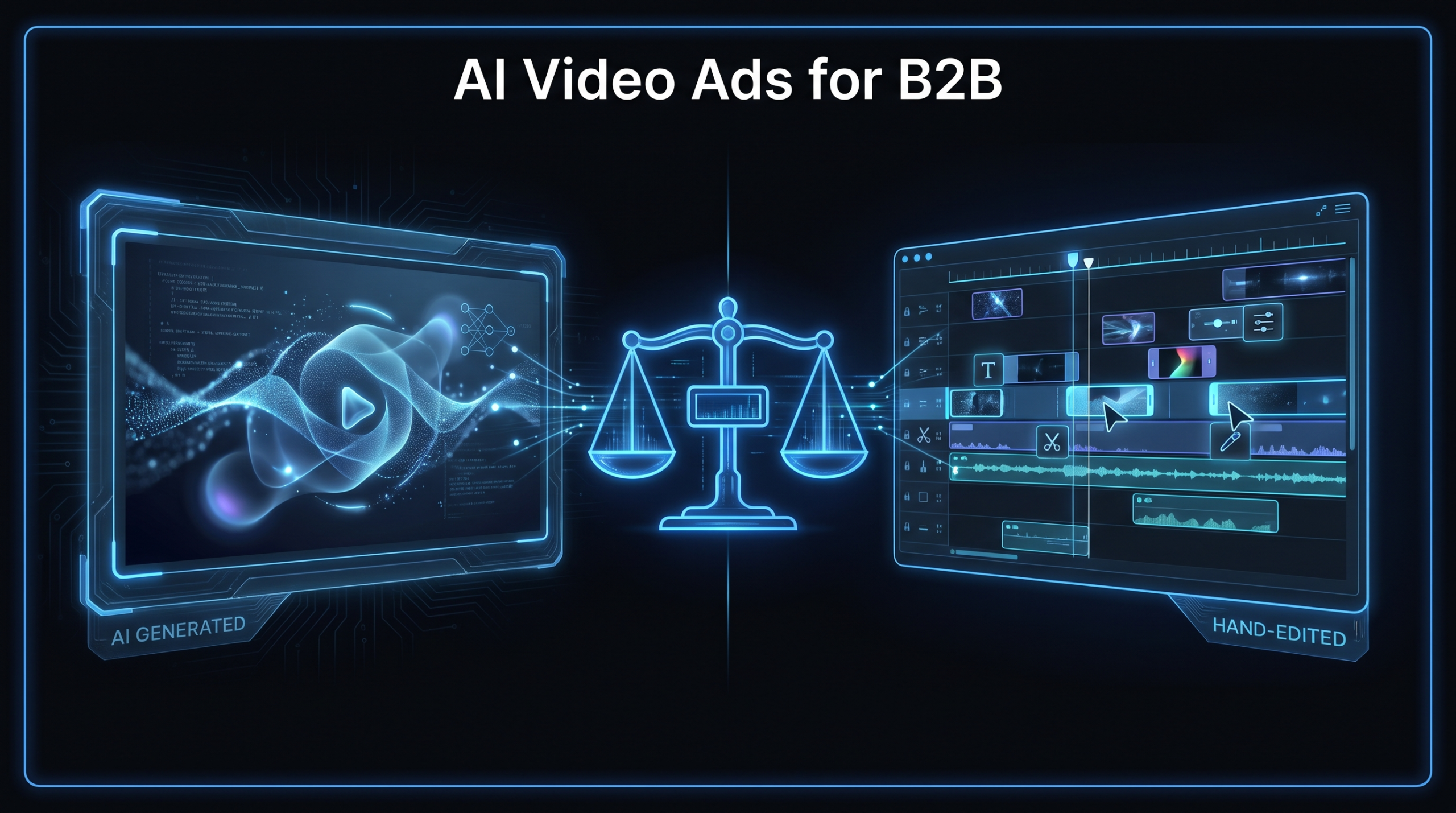
| Ad job | AI-generated | Human-edited | Our read |
|---|---|---|---|
| Test 10 hooks on LinkedIn | Fast, low cost per variant | Slower, higher cost per variant | AI for the test, editor for the winner |
| Retargeting reminder | Good fit | Overkill for most | AI |
| Flagship product story | Generic; weak on real UI | Real screen capture, pacing, sound design | Edited |
| Customer testimonial ad | A synthetic customer is not a testimonial | Real person, real words, cut for the platform | Edited |
| Founder or executive ad | Avatar clone risks trust | Authentic delivery, tightened | Edited |
| Localized variants of a winner | Efficient with native review | Costly at many languages | AI plus review |
| Regulated or technical claims | Hallucination risk | Script control and sign-off | Edited |
Our collection of B2B video ad examples shows the formats where editing craft does the persuading, and our piece on video ad formats that lower SaaS CAC explains how to match format to funnel stage. Product demos are a similar story; see how AI product demo videos compare with an agency.
What Does Each Approach Cost?
AI tools cost tens to low hundreds of dollars a month in subscription fees, a freelancer or agency edit costs per video or per month, and in both cases the larger line item is usually the paid media and the internal review time. Compare them per finished, approved ad, not per subscription.
| Approach | Typical cost structure | Hidden costs |
|---|---|---|
| AI generator, self-serve | Subscription of roughly $10 to $150 a month on the plans listed above, credit-limited | Prompting and revision time, brand review, re-generating failed outputs, extra seats |
| AI generator plus freelance editor | Subscription plus per-video or hourly editing; see video editing cost per minute for benchmarks | Coordinating two workflows, inconsistent style between editors |
| Dedicated editing team | Monthly plan; VEC's plans are $5,000 (Growth), $9,500 (Core) and $16,000 (Scale) per month, with a guarantee to double video output in 90 days or month four free | Onboarding time, a minimum monthly commitment |
| Full production agency | Quoted per project, often well above the options above for filmed work | Long lead times, revision rounds |
A dedicated team does not compete with AI generators on the price of one ad; it competes on the cost of a consistent program. See our pricing page for what each plan includes, and note that we handle post-production only, not shooting.
What Do Platforms Make You Disclose?
YouTube requires creators to disclose realistic AI-generated or altered content, and LinkedIn's community policies prohibit synthetic media that shows a person saying or doing something they did not, unless the altered nature is clearly disclosed. Check each ad platform's current advertising policy before you launch, because rules differ between organic posts and paid ads.
- YouTube. Its help page says creators must disclose GenAI content that makes a real person appear to say or do something they did not, alters footage of a real event or place, or generates a realistic scene that did not occur. Source: YouTube Help, "Disclosing use of GenAI content", checked October 24, 2026.
- LinkedIn. The Professional Community Policies tell members not to share synthetic or manipulated media depicting a person saying something they did not say or doing something they did not do without clearly disclosing the fake or altered nature. Source: LinkedIn Professional Community Policies, checked October 24, 2026.
- Political content. The MIT article notes the FCC has set AI transparency requirements for TV and radio producers of political ads. Most B2B campaigns are not political, but it shows regulators are moving.
AI advertising is not illegal as such, and this is not legal advice. Ordinary advertising rules still apply: claims must be truthful whether a person or a model produced the video, and a synthetic "customer" praising your product is a fast route to a policy problem. Never use an AI avatar to impersonate a real customer or executive without their consent.
How Do You Test AI Ads Without Wasting Budget?
Run AI ads as a controlled test with a fixed budget, one variable at a time and a pre-agreed success metric, then rebuild the winners with more craft. This turns the speed of AI into learning instead of noise.
- Pick one audience and one offer. Do not test creative style and targeting together.
- Build 4 to 6 variants of one idea. Change the hook or the first three seconds, keep the body constant.
- Set a metric beyond clicks. Use cost per qualified lead or demo request, because clicks alone reward curiosity. The MIT researchers' novelty caution applies directly.
- Run a matched edited control. Put one human-edited version of the same message in the test. Without it you are comparing AI ads to nothing.
- Decide before you launch. Write the threshold for scale, iterate or stop. Our video A/B testing guide covers what to test and how to measure it.
- Rebuild the winner. Hand the winning concept to an editor so the scaled version has real pacing, sound and brand polish.
What Does a Hybrid AI-Plus-Editor Workflow Look Like?
A hybrid workflow uses AI for drafts and variants and a human editor for the final cut, brand consistency and quality control. It is the setup that matches the MIT finding that the tested AI ads performed with heavy human involvement.
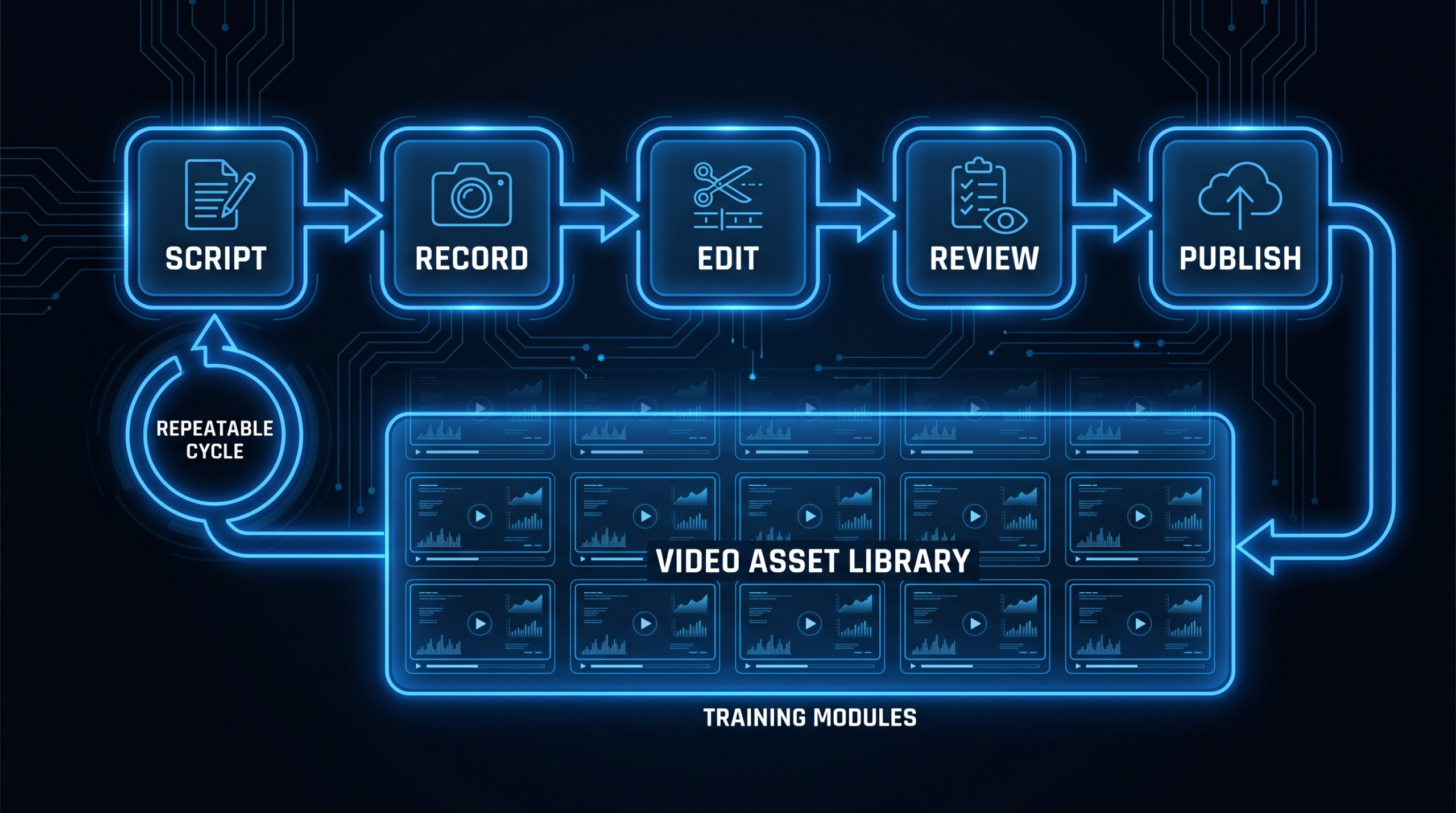
- Strategist writes the brief and script. The message, claim and proof point come from a person who knows the product.
- AI produces first drafts and variants. Visuals, voiceover options and resized cuts.
- Editor repairs and unifies. Fixes timing, swaps weak shots for real footage or screen capture, matches fonts, color and audio to your brand, and checks every on-screen claim.
- Reviewer approves for disclosure. Someone confirms whether the platform's AI disclosure rules apply.
- Performance data feeds the next brief. Winners are rebuilt; losers inform new hooks.
For a sense of what "made with AI" looks like in B2B marketing, the publisher below labels its own videos that way. This one is an AI-assisted explainer on why B2B videos underperform, published on the Increditors YouTube channel; judge the pacing and delivery against what your buyers expect.
If your bottleneck is editing capacity rather than ideas, this is where a dedicated team earns its fee: the editors become the quality layer on top of whatever mix of AI and filmed footage you feed them. See how our dedicated editing teams work, or browse our case studies. If you are still choosing a partner, our guide to the best video marketing agencies for B2B compares the options.
Which Should You Choose?
Choose AI for variants, retargeting and localization, choose edited ads for flagship, proof and trust assets, and choose a hybrid when you have both the volume and the stakes. Use this checklist before you decide.
| Question | If yes | If no |
|---|---|---|
| Does the ad rely on a real person's credibility? | Edited | AI is viable |
| Do you need many versions fast? | AI or hybrid | Edited |
| Does the product need real UI or complex explanation? | Edited, with screen capture | AI is viable |
| Is the audience cold, with no prior contact? | Edited first impression | AI for retargeting |
| Can someone review every ad for claims and disclosure? | Proceed | Do not scale AI ads yet |
| Will you measure cost per qualified lead, not just clicks? | Proceed | Fix measurement first |
Frequently Asked Questions
Do AI video ads work?
They can, for specific jobs. A 21,000-person consumer experiment summarized by MIT IDE found higher click-through for AI-personalized video than for personalized image ads or generic video, but with caveats about novelty and heavy human involvement. There is no public B2B benchmark proving AI ads beat edited ones, so test them against your own control.
Which AI creates video ads?
The tools that rank for this search include HeyGen, Creatify and invideo AI, plus design platforms with video ad templates. They differ in avatar quality, input options (script, product link or prompt) and editing control, so trial two or three with a real script before choosing.
Is AI advertising illegal?
No, AI advertising is not illegal in general, but ordinary advertising truthfulness rules still apply and platforms set their own disclosure requirements. YouTube requires disclosure of realistic AI-generated or altered content, and LinkedIn bars undisclosed synthetic media depicting a person saying or doing something they did not. Confirm specifics with counsel for regulated industries.
Will AI video ads replace video editors for B2B?
Not for the ads that carry trust. AI is taking over variant production, resizing and first drafts, while editors shift toward quality control, brand consistency and the flagship assets a buying committee actually watches. Teams that pair the two usually get more tests per month without losing polish on their best ads.
How much do AI video ad tools cost?
Entry plans seen on October 24, 2026 ranged from about $10 to $20 per seat per month for invideo's starter tier, $15 for Creatify Standard and $29 for HeyGen Creator, with business plans higher. Add review time and any editing support when you compare against a per-video or monthly editing cost.
Want Your Winning Ads Rebuilt by a Dedicated Editing Team?
Test fast with AI, then hand the winners to editors who match your brand, fix the details and keep a steady stream of ad creative flowing. Tell us your monthly volume and we will recommend a plan.
Book a Free Strategy Call See Pricing