AI Video Tools vs Human Editors: 2026 Comparison
TL;DR
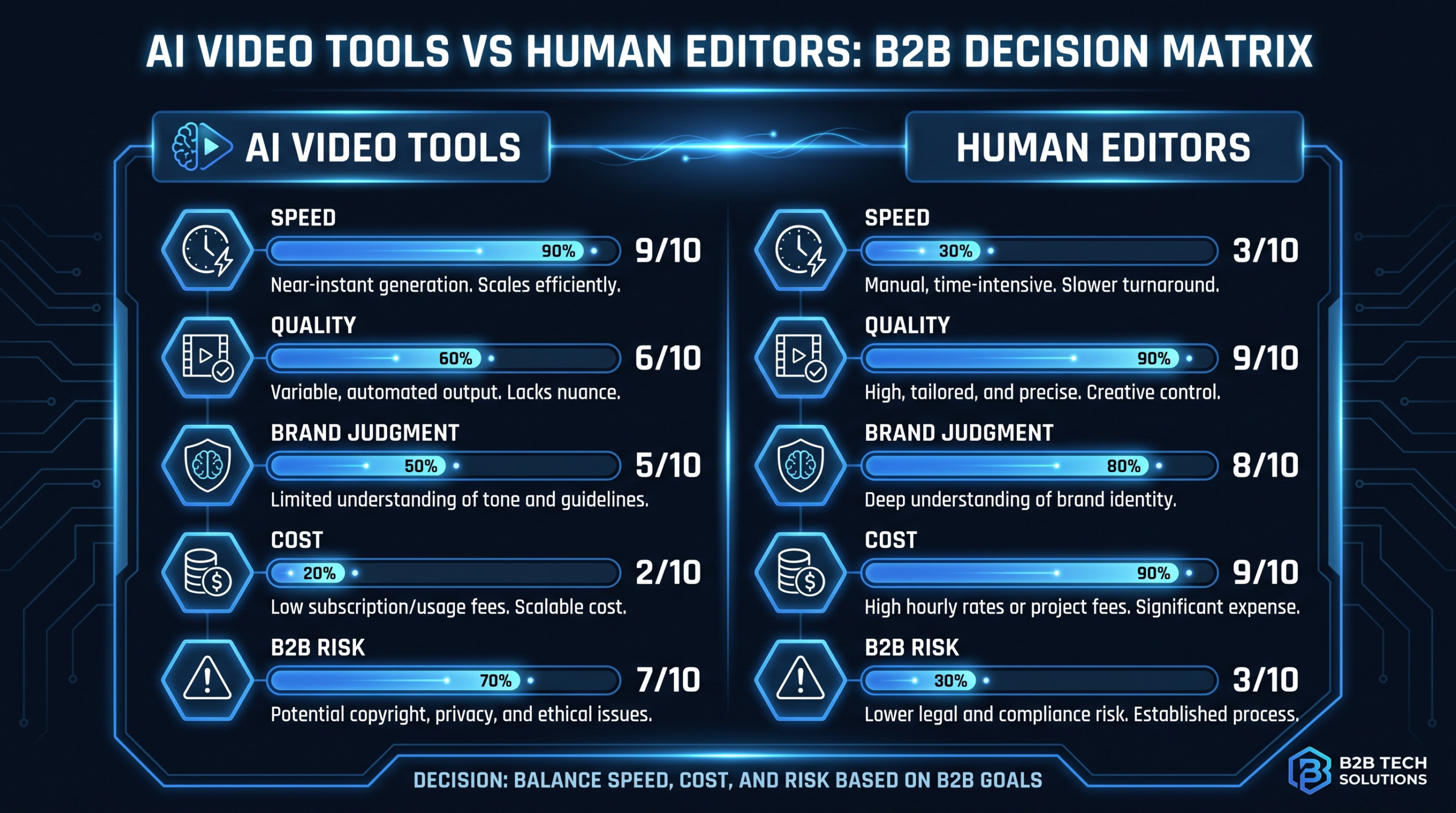
AI video tools are genuinely useful for rough cuts, auto-captions, clipping, and social variants - especially at high volume. Human editors win on narrative, brand nuance, buyer psychology, complex product clarity, and final quality control. For B2B SaaS teams, the real question is not which is better - it's which task calls for which tool. Most high-performing content programs run a hybrid approach: AI handles speed-sensitive, repetitive work while senior human editors own anything customer-facing or brand-critical.
Table of Contents
- What You're Actually Comparing
- AI Video Tools: An Honest Look
- Where Human Editors Win
- Full Comparison: AI vs. Freelancer vs. Dedicated Team
- Task-by-Task: Best Option for Each Video Type
- Cost & Time Reality Check
- Who Should NOT Choose Each Option
- Hybrid Workflows: The Smart Middle Ground
- Decision Framework
- FAQ
The AI video editing conversation in B2B marketing has gotten noisy. On one side: claims that AI will replace editors entirely. On the other: the reflexive dismissal that AI tools aren't ready for professional use. Both camps are wrong, and both cost marketing teams money.
If you're a VP of Marketing or Head of Content at a Series A-C SaaS company deciding where to allocate your video production budget, the real question isn't philosophical - it's operational. Which tasks should go to AI tools, which to freelancers, and which require a dedicated editing team? Where does brand risk actually live? And what does the cost math look like when you account for internal time, not just tool subscriptions?
This guide cuts through the noise with an honest, side-by-side breakdown. No AI hype, no technophobia. Just a practical framework for making the decision that fits your content program and your pipeline.
What You're Actually Comparing
The "AI vs. human" framing is a false binary. The real comparison has three distinct options, each doing fundamentally different work:
- AI video tools: Software like Descript, Opus Clip, Captions, Adobe's AI features, CapCut, and Runway. These automate specific editing tasks - transcription, rough cutting, caption generation, format resizing, basic transitions, silence removal. They are production accelerators, not editors. They have no narrative judgment, no brand memory, and no accountability layer.
- Freelance human editors: Individual contractors hired per project or on hourly rates. Human judgment, variable quality, zero institutional knowledge of your brand or product. Effective for overflow volume when managed carefully; fragile at scale.
- Dedicated editing teams: Assigned senior editors who work on your account full-time, managed by a project coordinator, with deep familiarity with your product, brand, and ICP. This is what services like VEC's dedicated team model provide - editorial continuity that compounds over time.
The mistake most teams make is evaluating all three as if they're competing for the same job. They're not. AI tools accelerate repetitive tasks. Freelancers handle overflow volume. Dedicated teams own brand-critical output that directly touches pipeline.
Understanding which bucket each of your video needs falls into is the foundation of a smart video production strategy - and it's where most teams leave the most money on the table.
AI Video Tools: An Honest Look
What AI Does Well
AI video tools have become genuinely competent at a specific set of tasks that used to eat significant editor time:
- Automatic transcription and captions: Near-human accuracy on clean audio. Tools like Descript and Captions generate caption files in minutes. For webinar recordings, customer interviews, and podcast content, this alone saves several hours per month on larger content programs.
- Rough cut assembly: AI can identify the cleanest takes, cut silences, and assemble a basic timeline from a two-hour recording session. This is not a finished edit - it's a structured head start that gives a human editor something to refine rather than starting cold.
- Long-form to short-form clipping: Tools like Opus Clip and Vidyo.ai extract social-ready clips from webinars, podcasts, and interviews. The hit rate on truly compelling clips - without human review - is roughly 40-60%. Expect to cull, but the time savings on a 90-minute webinar are real.
- Format resizing: Converting a 16:9 YouTube cut to 9:16 for LinkedIn, Shorts, or TikTok is now genuinely fast with AI auto-reframe tools. Subject reframing still needs a human review pass, but the mechanical work is handled.
- Basic color correction and audio normalization: Auto-grade tools have improved significantly. For consistent, "good enough" output on simple talking-head footage or interview recordings, automated color matching and level normalization are serviceable.
- Silence removal and pacing cleanup: Automated silence removal on interview recordings and webinars saves time proportional to how much dead air your recordings contain. For internal recordings especially, this can be a 20-30% time savings on cleanup.
Where AI Tools Fall Short
The limitations are real and they matter more at the B2B SaaS level than anywhere else:
- Narrative judgment: AI can identify clean takes. It cannot tell you that the CEO's third answer - despite two stumbles - is the one that will actually resonate with your ICP because of the specific objection it addresses. That requires knowing your buyer.
- Brand nuance: AI doesn't know your visual identity beyond whatever template you've given it. Pacing, color grade tone, music selection, and stylistic coherence across a library of 50 videos requires institutional memory that builds over time. AI tools reset every project.
- Complex product clarity: A demo video for a six-figure enterprise software product needs a human who understands what moments to cut, when to slow down, and how to frame the UI walkthrough so it makes sense to a buyer who hasn't touched the product. AI generates motion; it doesn't understand buyer psychology or where confusion lives in a product tour.
- Audio repair on problematic recordings: AI noise reduction works on moderately clean recordings. It largely fails on truly problematic audio - room echo, clipping, inconsistent mic placement - which is common in internal and remote recordings. A human editor with proper audio repair tools is the only solution.
- Final quality control: AI doesn't catch a jump cut that feels subtly wrong, an awkward pause that should have been trimmed, or a frame where the subject blinks at exactly the wrong moment. Human eyes with editorial judgment are the QC layer that separates "published" from "publishable."
- Brand risk and accountability: If your AI tool miscaptions a founder quote, exports the wrong format for a key launch video, or selects a clip that makes your product look confusing - that's a brand problem. AI tools have no accountability layer and no incentive to catch their own errors. Someone has to own that.
For a full picture of what professional editing services cover that AI tools typically don't, see our breakdown of what video editing services actually include.
Where Human Editors Win
The value of a skilled human editor isn't speed - it's judgment. And judgment is exactly what your customer-facing video content requires if it's expected to move pipeline.
Narrative Structure and Emotional Arc
A great editor doesn't just cut on beats - they build an arc. For a 3-minute product demo or a 90-second customer testimonial, the difference between "this video answers the question" and "this video makes me want to book a call" is almost always narrative structure. Which quote leads? Where does the tension build? What's the last thing a viewer hears before the CTA appears? AI tools don't understand your buyer's journey. A senior editor who's worked on 50 of your videos does - and they make those calls in minutes, not deliberation.
Brand Consistency Across a Content Library
Brand consistency in video is cumulative. It's not just logo placement - it's the timing of your cuts, the energy of your music choices, the color temperature of your grade, the pacing when a speaker makes a key point. A dedicated editing team builds institutional knowledge that compounds. Every video reinforces the last. Freelancers and AI tools start from scratch every time, which means every project is a regression risk on brand standards you've already established.
Buyer Psychology in Product and Demo Content
For SaaS companies, product demo and explainer videos are sales tools, not just marketing assets. The choice of what to show, what to skip, how much time to spend on each feature, and what the outro message should be are all downstream decisions of understanding your ICP's objections and buying triggers. A senior editor with SaaS context - and who has visibility into what questions your prospects ask most - makes those decisions intuitively. That judgment is not automatable in 2026, and it's not likely to be automatable soon.
Quality Control and Accountability
Human editing teams provide a QC layer that AI tools structurally cannot. Before anything goes to your VP of Sales or gets published on your homepage, a senior editor has reviewed it for technical quality (levels, sync, color), narrative quality (pacing, clarity, flow), and brand compliance (style, tone, consistency with your library). That review catches mistakes before your customers see them. No AI tool catches its own mistakes - that's the definition of the accountability gap.
Full Comparison: AI Tools vs. Freelancer vs. Dedicated Team
AI Tools vs. Freelancer vs. Dedicated Team - Head-to-Head
| Criterion | AI Tools Only | Freelancers | Dedicated Team |
|---|---|---|---|
| Speed (simple tasks) | Fastest - minutes | Hours to days | Hours (priority queue) |
| Speed (complex videos) | Slow - AI can't complete them | 3-7 days typical | 1-3 days (brand context built in) |
| Quality (captions, clipping) | Good (80-90% accuracy) | Excellent | Excellent + QC layer |
| Quality (product demos, hero video) | Not fit for purpose | Variable (editor-dependent) | Consistently high |
| Brand consistency | Low - template-dependent | Low - no institutional memory | High - builds and compounds |
| Narrative judgment | None | Editor-dependent | Senior-level, SaaS-focused |
| Buyer psychology awareness | None | Variable | Trained, product-informed |
| Effective cost (simple tasks) | $20-$300/month for tools | $35-$80/hr | Included in retainer |
| Effective cost (complex videos) | Not applicable | $500-$3,000/video | Lower per-video cost at scale |
| Scalability | High (for simple tasks only) | Low - sourcing bottleneck | High - team scales with you |
| Reliability | Tool-dependent, no SLA | Variable - freelancers disappear | SLA-backed, PM-managed |
| B2B brand risk | High (no accountability layer) | Medium | Low (QC + named accountability) |
The pattern is clear: AI tools are fast and cheap for narrow, well-defined tasks. Freelancers offer human judgment at lower commitment but with high variance and no brand continuity. Dedicated teams cost more at entry but deliver the consistency, scalability, and risk reduction that matter most for B2B SaaS video programs If you're evaluating dedicated team providers beyond VEC, Increditors is another premium option worth considering: they operate on the same dedicated editor pod model (senior editor, junior editor, PM, creative director per client), serve SaaS, finance, and YouTube creator verticals, and have a documented track record of doubling YouTube channel views and improving retention for B2B clients. Retainer pricing ranges approximately $2,500-$12,000/month, custom-quoted. at scale. For a detailed look at how these cost structures compare over time, see our guide to video editing cost per finished minute.
Task-by-Task: What Works Best for Each Video Type
The right tool depends on the task, not on ideology. Here is the honest breakdown by video type:
Task-by-Task: Best Option by Video Type
| Video Task | Best Option | Why |
|---|---|---|
| Auto-captions / subtitles | AI tool + human review | AI is fast and accurate on clean audio; human catches errors in product terminology |
| Webinar / podcast recording cleanup | AI-assisted | Silence removal, level normalization - low brand risk, speed matters most |
| Social clips from long-form | AI clip + human curation | AI surfaces candidates; human selects what actually lands with the ICP |
| Format resizing (16:9 to 9:16) | AI tool | Mechanical task; review auto-reframe output before publishing |
| Rough cut assembly | AI-assisted | Good starting point; human editor owns the final cut and narrative |
| Product demo video | Human editor (dedicated) | Requires buyer psychology, pacing judgment, product knowledge |
| Customer testimonial | Human editor (dedicated) | Narrative selection and emotional arc are brand-critical decisions |
| Explainer / animated video | Human editor (dedicated) | Scripted precision, brand style, motion design - not automatable |
| Case study video | Human editor (dedicated) | Story structure, quote selection, client brand compliance all required |
| Brand / hero video | Human editor (dedicated) | Highest brand risk - no tolerance for AI variability |
| A/B social variant creation | AI tool + human template | AI executes variants efficiently once human defines the approved template |
| Sales one-pager or enablement video | Human editor (dedicated) | Directly influences pipeline - not the place to save $200 |
The dividing line is consistent: anything that directly touches a prospect or customer, influences pipeline, or represents your brand's quality standard requires human judgment. Anything mechanical, repetitive, and low-stakes on brand can leverage AI acceleration - and should, to free editor time for the work that actually matters.
Cost & Time Reality Check
The "AI is cheap" narrative is partially true and partially misleading. Here is what each option actually costs when you account for internal time, not just tool subscriptions or project invoices.
AI Tools: The True Cost
AI video tool subscriptions typically run $20-$300/month per tool. But that's not the full number. Most AI-generated outputs require 20-40% of the video runtime in human review and correction before they're publishable. For a 3-minute social clip package, that might mean 45 minutes of AI processing plus 20 minutes of human editing - which sounds reasonable until you're producing 30 clips a month and your marketing manager is spending 10 hours cleaning up AI output instead of running campaigns.
The real cost of AI tools is: tool subscription + internal editor time + review cycles + rework on errors. For simple, high-volume work, the math often still favors AI. For anything complex or brand-critical, the math collapses quickly - and the brand risk from errors that slip through isn't captured in any subscription price.
Freelancers: Project Costs Add Up
Freelance video editors typically charge $35-$150/hour depending on experience and region. Our global rate guide has the full breakdown by country. For a 3-minute product demo requiring 15-20 hours of editing, you're looking at $525-$3,000 per video, per project, with sourcing overhead on top.
The hidden cost of freelancers is context loss. Every new project requires rebriefing. Every new editor requires onboarding to your brand, your product terminology, and your stylistic preferences. Platforms like Upwork make sourcing feel easy until you've burned three rounds of revisions because the editor didn't understand your product or your visual language - and the project has taken two weeks longer than planned. At 8+ videos per month, sourcing and managing freelancers becomes a significant operational burden.
Dedicated Teams: The Math at Scale
A dedicated editing team through a service like VEC starts at $5,000/month (Growth plan), with Core at $9,500/month and Scale at $16,000/month. Each tier includes a dedicated senior editor team, project manager, QC layer, and a 90-day output guarantee - double your current video output in 90 days or month four is free.
If you're producing 10-12 polished videos per month on the Growth plan, your effective per-video cost is roughly $415-$500/video - comparable to mid-range freelancers, but with a dedicated team that knows your brand, a guaranteed output SLA, and no sourcing overhead. At the Scale tier producing 25-30 videos/month, the per-video math becomes significantly more favorable than any project-by-project alternative. For full plan details, see VEC's pricing page.
Estimated Monthly Cost at 15 Videos/Month
Estimated Monthly Cost: 15 Videos (5 demos, 5 social packages, 5 testimonials)
| Option | Est. Monthly Cost | Notes |
|---|---|---|
| AI tools only | ~$500-$1,200 | Tools only; excludes internal time; demos not viable without human editors |
| AI tools + internal editor time | ~$4,000-$8,000 | Includes salary allocation for review; quality highly variable |
| Freelancers (mid-tier) | ~$9,000-$18,000 | Project-by-project; sourcing overhead; inconsistent quality across editors |
| Dedicated team (VEC Core) | ~$9,500 | Senior editors, PM, QC layer, 90-day output guarantee included |
These are estimates based on common market ranges in 2026. Your actual costs depend on video complexity, revision cycles, your team's internal bandwidth, and which specific tools or freelancers you engage. Run your own numbers against these ranges before committing to a model.
Who Should NOT Choose Each Option
Being clear about what each option is wrong for is as important as knowing when it's right.
Who Should NOT Use AI Tools as Their Primary Editing Solution
- Teams with brand-critical, customer-facing video programs. If a video is going to a prospect, a customer, or your website homepage, AI tools should be an acceleration layer at most - not the primary editor. The quality variability and accountability gap are too high for content that directly touches revenue.
- Teams without an internal editor to review AI output. AI tools without a human review layer produce inconsistent quality. If no one on your team has editorial judgment to cull, correct, and QC the output, the published result won't be reliable enough for B2B content.
- Teams producing complex product demos or animated explainers. These video types require narrative judgment, product knowledge, and motion design that current AI tools cannot provide. Budget accordingly - AI won't save you money here, it will cost you in rework and substandard output.
Who Should NOT Use Freelancers as Their Primary Model
- Teams producing more than 8-10 videos per month consistently. Sourcing, onboarding, and managing multiple freelancers becomes a full-time operational job. The management overhead quickly outweighs the per-hour savings, and quality drift across different editors compounds over time.
- Teams where brand consistency is non-negotiable. Freelancers have no institutional memory. Every project is a reset. If your videos need to look and feel like a cohesive library - consistent pacing, grade, music energy, title treatment - freelancers will drift unless you have an unusually robust style guide and a dedicated reviewer.
- Teams with complex, evolving SaaS products. Product knowledge takes time to build. A freelancer who doesn't know your product will make editorial decisions that misrepresent it - in what they emphasize, what they cut, and how they sequence the narrative. On a product demo that's going to a sales prospect, that's not a minor issue.
Who Should NOT Use a Dedicated Team Model
- Teams in pre-product-market fit. If your messaging, positioning, and product are changing weekly, a dedicated team cannot build the brand consistency they're designed to deliver. Wait until your content strategy stabilizes enough for institutional knowledge to actually compound.
- Teams producing fewer than 4-5 videos per month. The dedicated model's economics require sufficient volume to justify the retainer. Below this threshold, a well-managed retainer with a reliable agency or a trusted senior freelancer may serve you better until volume grows.
- Teams with no internal stakeholder to provide creative direction. Dedicated teams accelerate and execute - they need a human on your side who can give feedback, approve creative direction, and set strategy. If that role doesn't exist internally, the relationship won't reach its potential regardless of the team's quality.
Hybrid Workflows: The Smart Middle Ground
The highest-performing B2B SaaS video programs in 2026 don't choose one model exclusively - they layer them deliberately. The goal is AI handling the mechanical work and human editors owning everything that requires judgment.
A Practical Hybrid Stack for B2B SaaS Teams
- Layer 1 - AI tools for rough work: Raw footage goes through AI tools first for rough cut assembly, caption generation, silence removal, and level normalization. This gives the human editor a structured starting point rather than raw material, and it handles the most time-consuming mechanical tasks before a senior editor ever opens the timeline.
- Layer 2 - Dedicated editing team for everything that matters: Final cut, narrative decisions, brand compliance, complex edits, QC review. Senior editors receive AI-assembled drafts and turn them into polished output significantly faster than starting cold - while applying the judgment that AI cannot provide.
- Layer 3 - AI tools for systematic repurposing: Once a long-form video has been approved by the human team and represents the brand correctly, AI tools handle the mechanical work of creating social variants, different-length cuts, and format resizes from the approved master. The human team defined the template; AI executes the variants.
This stack captures the speed benefits of AI where they're genuinely useful without exposing your brand to the quality variability that comes with over-relying on AI for work that matters. If you're looking at how to build and outsource your video editing workflow efficiently, a structured hybrid approach is almost always the starting recommendation - it gives you cost efficiency on simple work while protecting quality on complex output.
Decision Framework: How to Choose
If you're still uncertain after reading this, run through these four questions for each video type in your content calendar:
- Is this video going directly to a prospect, customer, or your homepage? If yes, human editors must be in the loop. AI can assist with mechanics, but judgment must be human.
- Does this video require understanding your product, your buyer, and your brand? If yes, you need institutional knowledge - which means a dedicated team with context, not one-off freelancers who are starting from scratch.
- Is this task mechanical, repetitive, and low-risk on brand? If yes, AI tools are appropriate and cost-effective. Route it through AI first.
- Are you producing more than 8 videos per month consistently? If yes, the economics and operational math strongly favor a dedicated team model over per-project freelance sourcing.
Most teams at Series B and beyond find that a combination of AI tools for speed-sensitive tasks and a dedicated editing team for brand-critical content is the right answer. Budget split typically runs 70-80% toward the dedicated team for complex, customer-facing work and 20-30% toward AI tools for acceleration of mechanical tasks.
For SaaS-specific video strategy context, our SaaS video production guide covers how to structure a video content program that actually returns revenue - including which video types drive the most pipeline impact at each stage of company growth.
Frequently Asked Questions
Can AI video tools fully replace a human editor in 2026?
For narrow, mechanical tasks - captions, silence removal, format resizing, rough cut assembly - AI tools are genuinely capable and fast. For anything requiring narrative judgment, brand nuance, or buyer psychology - product demos, testimonials, explainers, hero videos - AI tools cannot replace a skilled human editor. The brand risk from unreviewed AI output on customer-facing content is too high for most B2B SaaS companies to accept. The honest answer: AI is a multiplier for human editors in 2026, not a replacement. That balance may shift over time, but the editorial judgment gap remains significant.
What is the real cost difference between AI tools and human editors?
AI tool subscriptions typically run $20-$300/month per tool. The real cost includes internal time spent reviewing, correcting, and QCing AI output - which commonly adds 20-40% of the video runtime in human hours on top of the tool cost. For simple, high-volume social content, the math often favors AI. For complex B2B video (demos, case studies, hero content), AI tools often cost more in rework and brand risk than they save in tool subscriptions. Human dedicated editing teams become cost-competitive at 8-10 videos per month when you factor in all costs, including sourcing overhead for freelancers.
Which AI video tools are worth using for B2B SaaS marketing teams?
The tools that consistently deliver ROI for B2B teams in 2026 include Descript (transcription, rough cuts, podcast and webinar editing), Opus Clip (long-form to social clipping), Adobe Premiere Pro AI features (auto color, speech-to-text, content-aware fill), and Captions for social video captioning. Descript's pricing starts around $24/month for the Creator plan and is worth it for teams with regular webinar or interview content to clean up. These tools work best as a first pass before a human editor refines the output - not as a standalone pipeline for anything brand-critical.
How should I structure a hybrid AI plus human editing workflow?
The workflow that works for most B2B SaaS content teams: raw footage goes through AI tools first for rough cut assembly, caption generation, and silence removal. The AI-assembled draft then goes to a dedicated human editor for narrative decisions, pacing, brand compliance, and final QC. After human approval of the master cut, AI tools handle the mechanical work of creating social variants and format resizes. This hybrid approach captures the speed benefits of AI for repetitive tasks without exposing brand-critical output to AI variability. Wistia's video marketing learning center has useful frameworks for content teams building this kind of systematic workflow at scale.
What does a dedicated editing team offer that AI tools and freelancers don't?
Institutional knowledge that compounds over time. A dedicated editing team builds deep familiarity with your brand, product, buyer, and visual language - which means faster turnarounds, fewer revision cycles, and editorial decisions that are right more often without explicit direction. VEC's dedicated team plans start at $5,000/month (Growth), with Core at $9,500/month and Scale at $16,000/month - each including assigned senior editors, a project manager, and a QC layer. Every engagement includes a 90-day output guarantee: double your video output in 90 days or month four is free. For teams where video is a core pipeline driver, that consistency and accountability is the difference between content that converts and content that just exists on your website.
Ready to Scale Your Video Program Without the Chaos?
If you're spending more time managing AI outputs and freelancer quality than actually growing your content program, a dedicated editing team might be the right next step. Book a free strategy call - we will review your current video setup and tell you honestly whether a dedicated team makes sense for your volume and goals.
Book a Free Strategy Call View Plans & Pricing