What Do Corporate Video Production Services Include?
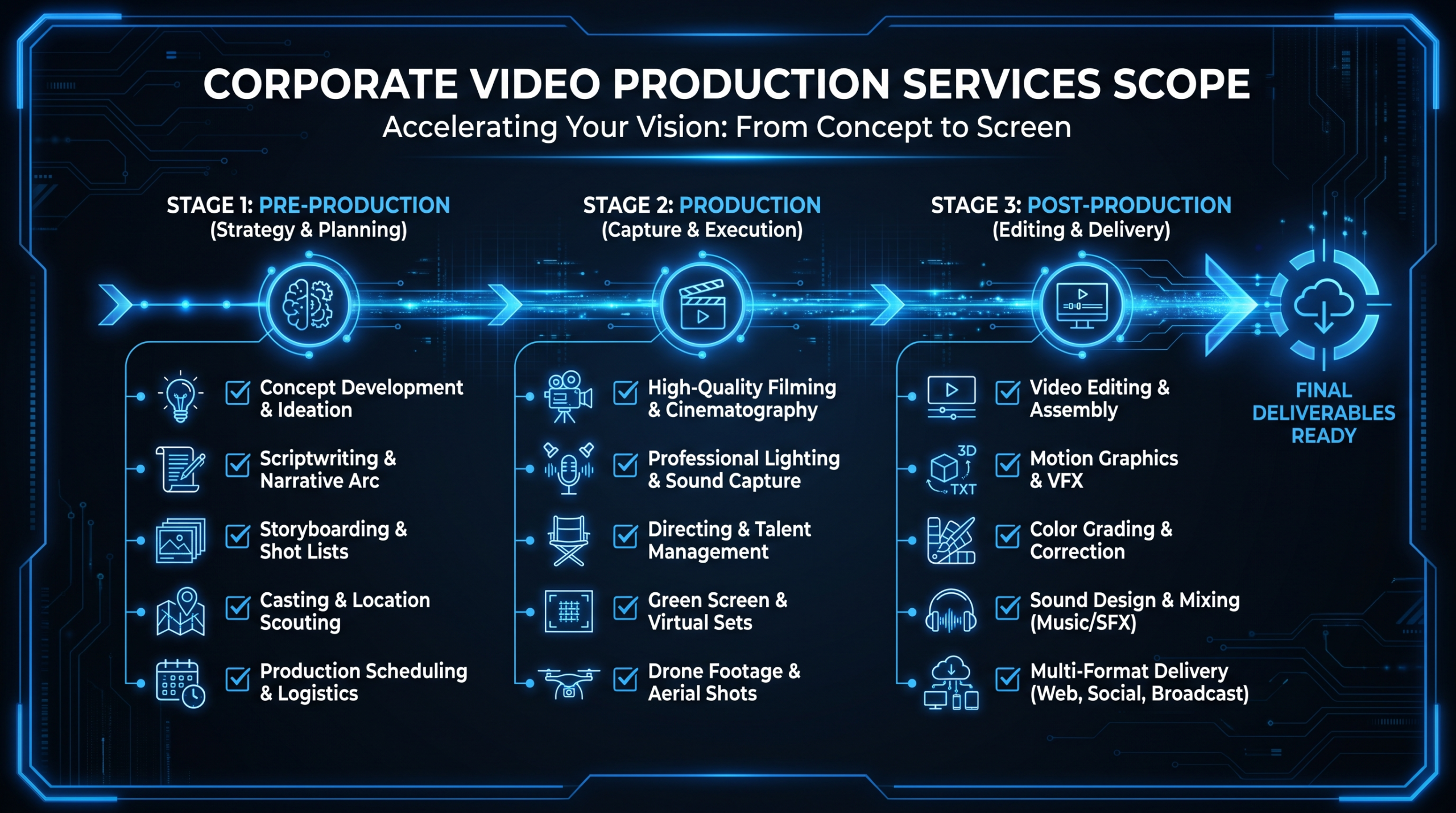
Corporate video production services are the planning, filming and editing work a production company does to turn a business goal into a finished video, normally bundled as pre-production (strategy, script, storyboard), production (crew, shoot, sound) and post-production (editing, motion graphics, color, captions and multi-format delivery).
Key Takeaways
- Three phases, one price. A full-service package covers pre-production, production and post-production. Ask which of the three your quote actually includes.
- Deliverables are more than one file. Expect a master file, platform-specific cuts, captions and a thumbnail, not just a single MP4.
- Typical project ranges: roughly $3,000-$15,000 for demos, explainers and testimonials, $10,000-$50,000 for a brand story, and $25,000-$150,000+ for a campaign. These are planning ranges, not quotes.
- Common exclusions: talent, locations, licensed music, extra revision rounds, usage rights and hosting are the line items most often added on top.
- Ownership comes from the contract. Get usage rights and footage ownership in writing before you sign.
Table of Contents
- Key Takeaways
- What Are Corporate Video Production Services?
- What Do Corporate Video Production Services Include, Phase by Phase?
- What Deliverables Do You Get at Handoff?
- How Much Do Corporate Video Production Services Cost?
- What Is Usually Not Included?
- Who Owns the Finished Video?
- How Long Does a Corporate Video Production Take?
- Full-Service, Editing-Only or Dedicated Team: Which Fits?
- How Do You Compare Quotes From Production Companies?
- Frequently Asked Questions
What Are Corporate Video Production Services?
Corporate video production services are the packaged work a production company, agency or in-house studio performs to make business video: brand films, product demos, explainers, customer testimonials, training, internal communications and executive messages. The word "services" matters because it signals a bundle of roles rather than a single deliverable. A producer manages the schedule and budget, a writer shapes the script, a director and crew capture the footage, and editors, motion designers and sound engineers turn raw material into a finished asset.
If you want the wider strategic picture (video types, trends and how to build a program), start with our pillar guide, Corporate Video Production: Everything You Need to Know in 2026. This article answers a narrower and more practical question: when a provider says "full corporate video production services," what exactly are you buying, and what are you not?
That distinction drives the price more than any other variable. Two quotes of $4,000 and $40,000 can both be honest, because one may cover an editor working on footage you supply while the other covers a crew, a studio day, talent, licensed music and three rounds of revisions. Our buyer's guide to video production services covers how to shortlist providers; this guide covers what should be written on the scope page once you have one.
What Do Corporate Video Production Services Include, Phase by Phase?
A complete engagement runs through three phases, and each phase has its own tasks, owners and typical line items. The table below is the checklist to hold a quote against.
Scope by Production Phase
| Phase | What it usually includes | Who does it | Common quote line |
|---|---|---|---|
| 1. Pre-production | Discovery call, creative brief, script, storyboard, shot list, casting, location scouting, scheduling | Producer, writer, director | Strategy and scripting; production management |
| 2. Production | Camera, lighting, audio capture, direction, makeup, teleprompter, b-roll, drone or green screen if scoped | Director, DP, sound recordist, crew | Day rate for crew and equipment; travel |
| 3. Post-production | Editing, color correction and grading, sound mix, music, motion graphics, captions, revisions, export | Editor, motion designer, colorist, sound engineer | Editing and finishing; revision rounds |
Phase 1: Pre-production
Pre-production is where the project is won or lost. A good provider starts with the business goal (generate demos, shorten sales cycles, onboard customers) and works backwards to format, length and distribution. The tangible outputs are a creative brief, a script, a storyboard or shot list, and a production schedule. If a quote skips this phase, you are either supplying all of it yourself or getting a shoot without a plan, which is the most common source of reshoots.
Phase 2: Production
Production is the shoot itself: the director, camera operator, sound recordist and any lighting or grip support, plus equipment and travel. Day rates, number of shoot days, number of locations and the use of on-camera talent or a teleprompter are what move the price. Specialist capture such as drone footage, studio sets or green screen is normally a separately scoped item rather than a default inclusion.
Phase 3: Post-production
Post-production turns footage into the finished video and is where most review time goes. It covers assembly and editing, color correction, audio cleanup and mixing, music and effects, motion graphics and lower thirds, captions, and exporting. Our guide to corporate video editing costs and what's included breaks this phase down in detail, and our overview of what video editing services include shows how the same checklist applies across formats.
What Deliverables Do You Get at Handoff?
You should receive a defined set of files, not just "the video." A professional handoff lists every file, format and aspect ratio before the project starts, so there is nothing to argue about at delivery. For B2B teams that publish across a website, LinkedIn, YouTube and sales decks, the multi-format cuts are often worth more than the hero film.
Typical Deliverables Checklist
| Deliverable | Typical specification | Why it matters |
|---|---|---|
| Master video | 16:9, 1920x1080 or 3840x2160, MP4 (H.264) | Website, YouTube, sales decks |
| Vertical cut | 9:16, 1080x1920 | Short-form social and mobile feeds |
| Square or 4:5 cut | 1:1 (1080x1080) or 4:5 | LinkedIn and other feed placements |
| Short cut-downs | 15, 30 and 60 second versions | Ads, email, event loops |
| Captions | SRT or VTT file, plus burned-in version for social | Accessibility, silent autoplay |
| Thumbnail or poster frame | 1920x1080 JPG or PNG | Video player and landing page |
| Source files (if agreed) | Project file, raw footage, music licences | Future re-edits without a reshoot |
Captions deserve a specific line item. The W3C Web Accessibility Initiative describes captions as a text alternative for the audio in a video, covering speech and other meaningful sounds, and they also make silent autoplay watchable (W3C WAI, captions guidance, checked October 24, 2026). If a provider treats captions as an add-on, price it before signing.
How Much Do Corporate Video Production Services Cost?
Corporate video production services commonly cost a few thousand dollars for a simple explainer or demo and well into five or six figures for a brand film or campaign, with the gap driven by crew size, shoot days, talent, graphics and revision rounds. The ranges below are the same U.S. planning ranges VEC publishes in its guides; they are directional and will move with market, location and scope.
Corporate Video Cost: Full Production vs Editing Only (2026 planning ranges)
| Video type | Full production (typical) | Editing only, you supply footage |
|---|---|---|
| Social clips (per batch) | $500-$3,000 | $200-$800 per clip |
| Product demo, 2-5 min | $3,000-$15,000 | $800-$3,500 |
| Animated explainer, 60-90 sec | $3,000-$15,000 | $2,500-$8,000 |
| Customer testimonial, 2-4 min | $3,000-$15,000 | $1,000-$4,000 |
| Brand or company story, 1-3 min | $10,000-$50,000 | $2,000-$8,000 |
| Multi-video campaign | $25,000-$150,000+ | Scoped per deliverable |
Two things stand out. First, editing is a fraction of full production for the same video type, which is why many B2B teams film in-house or with a local videographer and outsource only the post-production. Second, the broad ranges are real: the same label ("brand video") can mean a one-day interview shoot or a multi-location production. For the line-by-line cost drivers, read our corporate video production cost guide, and for crew rates specifically see how much a videographer costs in 2026.
If you would rather buy output than individual projects, flat monthly plans change the math. VEC's dedicated-team plans start at $5,000 per month (Growth), with Core at $9,500 and Scale at $16,000; see current details on the VEC pricing page. Packaged one-off options are covered in our guide to video production packages and what's included.
What Is Usually Not Included?
The most useful question to ask any provider is what the price excludes. Exclusions are legitimate, but they should be visible before you sign rather than discovered on the invoice. These are the line items that most often sit outside a base quote:
- On-camera talent and voiceover. Actors, presenters and voice artists are usually billed separately from the crew. Your own executives and customers do not carry talent fees, but they do need scheduling and prep.
- Location and permit fees. Studio hire, venue fees and filming permits are typically pass-through costs.
- Licensed music and stock footage. Music is protected by copyright like any other creative work; the U.S. Copyright Office explains that copyright covers original works including musical and audiovisual works (U.S. Copyright Office, What is copyright?, checked October 24, 2026). A track found online is not automatically cleared for commercial use, so ask who holds the licence and for how long.
- Revision rounds beyond the agreed number. Two or three rounds are common. Additional rounds, or changes to an approved script after filming, are billed as extra scope.
- Translations, subtitles and localization. Extra languages mean extra captions files, text-on-screen versions and sometimes re-recorded audio.
- Hosting and distribution. A finished file is not a published video. Video platforms sell hosting and analytics as their own subscriptions; for example, Vimeo publishes tiered plans on its pricing page (checked October 24, 2026). Paid distribution and ad spend are separate again.
- Rush delivery. Compressed timelines often carry a premium because they displace other work.
Who Owns the Finished Video?
Ownership is decided by your contract and by copyright law, not by the fact that you paid. In the United States, the Copyright Office's guide to works made for hire explains that a work created by an independent contractor is generally a work made for hire only if it falls into certain statutory categories (which include a part of an audiovisual work) and the parties agree in a signed written instrument (U.S. Copyright Office, Circular 30: Works Made for Hire, checked October 24, 2026). In practice, you want the agreement to say it explicitly.
Ask the provider to confirm, in writing:
- Whether you receive ownership or a license of the final video, and whether it is exclusive.
- Who owns the raw footage, project files and any custom graphics, and whether you can have them.
- The term, territory and media covered by any usage license, especially for talent and music.
- Whether the provider may use the finished video in its own portfolio or marketing.
This is general information, not legal advice. For anything high-value or featuring recognizable talent, have your counsel review the agreement.
How Long Does a Corporate Video Production Take?
A single 2-3 minute corporate video commonly takes several weeks from kickoff to delivery, and the longest phases are usually approvals and scheduling rather than filming or editing. Use the ranges below as planning assumptions and confirm them against your provider's calendar.
Typical Timeline for One 2-3 Minute Corporate Video
| Phase | Typical duration | What slows it down |
|---|---|---|
| Pre-production | 1-3 weeks | Script approvals, talent and location availability |
| Production | 1-2 shoot days | Multiple locations, executive schedules |
| Post-production (first cut) | 1-2 weeks | Volume of footage, motion graphics scope |
| Revisions and final delivery | 3-10 business days | Number of stakeholders, late feedback |
On the editing side, a dedicated team working at steady volume can turn a standard corporate cut in a few business days because the editors already know your brand, templates and approval chain. That familiarity is the main reason recurring programs get faster over time, and it is how VEC's onboarding and editing process is structured.
Full-Service, Editing-Only or Dedicated Team: Which Fits?
The right model depends on how much video you need and who captures it. Full-service production suits one-off hero films, editing-only suits teams that already shoot, and a dedicated team suits companies publishing video every month.
Service Models Compared
| Model | Best for | Includes shooting? | Typical commitment |
|---|---|---|---|
| Full-service production company | One-off brand film, event or campaign | Yes | Per project |
| Freelance videographer plus editor | Small budgets, simple shoots | Yes, varies by freelancer | Per project |
| Editing-only agency | Teams with footage, tight deadlines | No | Per project or monthly |
| Dedicated editing team (e.g. VEC) | B2B SaaS publishing 8+ videos a month | No (post-production only) | Monthly plan, from $5K |
To be transparent about where VEC fits: we are a post-production team for B2B SaaS companies. We do not film, direct or build 3D. Our plans (Growth $5K, Core $9.5K, Scale $16K per month) cover editing, motion graphics, captions and multi-format delivery for footage you or a local crew capture, backed by a guarantee to double your video output in 90 days or month 4 is free. For a full-service shoot, a local production company is the right call; for the editing that follows, or a steady monthly program, a dedicated team is usually cheaper per finished video. You can see examples of results on our case studies page, and how the model scales in our SaaS video production guide.
How Do You Compare Quotes From Production Companies?
Normalize every quote to the same scope before you compare prices. A quote is only comparable once you know which phases, deliverables and rights it covers. Use this checklist on each proposal:
- Phases covered. Does the price include pre-production, production and post-production, or only some of them?
- Shoot assumptions. How many days, locations, crew members and talent are included?
- Deliverables list. Master file, aspect ratios, cut-downs, captions, thumbnail, source files.
- Revision policy. Number of rounds, what counts as a revision versus new scope, and the turnaround per round.
- Licences and rights. Music, stock, talent and the usage term and territory.
- Payment schedule. Deposit, milestone payments and what happens if the schedule slips.
- Timeline. Committed delivery dates for first cut and final.
Then divide: price per finished minute, and price per delivered asset (including cut-downs). A provider that looks 30% more expensive per project can be cheaper per asset if it ships six formats and you would otherwise pay for each one separately. For a rate-by-rate comparison on the editing portion, our video editing cost per minute guide is the benchmark we use.
Frequently Asked Questions
What is included in a typical corporate video production package?
A typical package covers pre-production (brief, script, storyboard, shot list), production (crew, camera, lighting, audio, direction on shoot days) and post-production (editing, color, sound mix, motion graphics, captions and export). Talent, location fees, licensed music, extra revision rounds and hosting are the items most often quoted separately, so ask for them line by line.
How much do corporate video production services cost?
Project prices commonly run from roughly $3,000 for a simple explainer or demo to $10,000-$50,000 for a brand story and $25,000-$150,000+ for a multi-video campaign, based on VEC's published 2026 ranges. Editing-only work on footage you already own is much cheaper, often $800-$8,000 per video depending on type. Treat every figure as a planning range, not a quote.
What is the difference between corporate video production and corporate video editing?
Production covers the whole chain from concept to finished file: planning, filming and editing. Editing, also called post-production, starts once footage exists and covers cutting, color, sound, graphics, captions and delivery. Many B2B teams film in-house or with a local videographer and outsource only the editing.
Do corporate video production services include music, captions and revisions?
Usually revisions (commonly two or three rounds) and basic captions are in scope, but this varies by provider. Licensed music, stock footage, voiceover talent and additional revision rounds are frequently add-ons. The contract should state the number of revision rounds and who pays for licences.
Who owns the video after a production company delivers it?
Ownership is set by your contract, not by default. In the US, a contractor's work is generally a work made for hire only if it fits specific statutory categories and both parties sign a written agreement, per the U.S. Copyright Office. Ask for a written assignment or license covering the final video, raw footage and any music, and confirm the territory and duration of usage rights.
Does VEC film corporate videos?
No. VEC is a post-production team: dedicated editors for B2B SaaS companies, with plans from $5K to $16K per month. We do not shoot or produce 3D. If you need a crew, pair a local videographer with an editing team and send us the footage.
Already Have Footage? Skip Straight to the Edit.
VEC's dedicated editing teams turn your footage into finished corporate videos, captions and platform cuts, from $5,000/month, with a guarantee to double your video output in 90 days or month 4 is free.
Book a Free Strategy Call See Pricing