
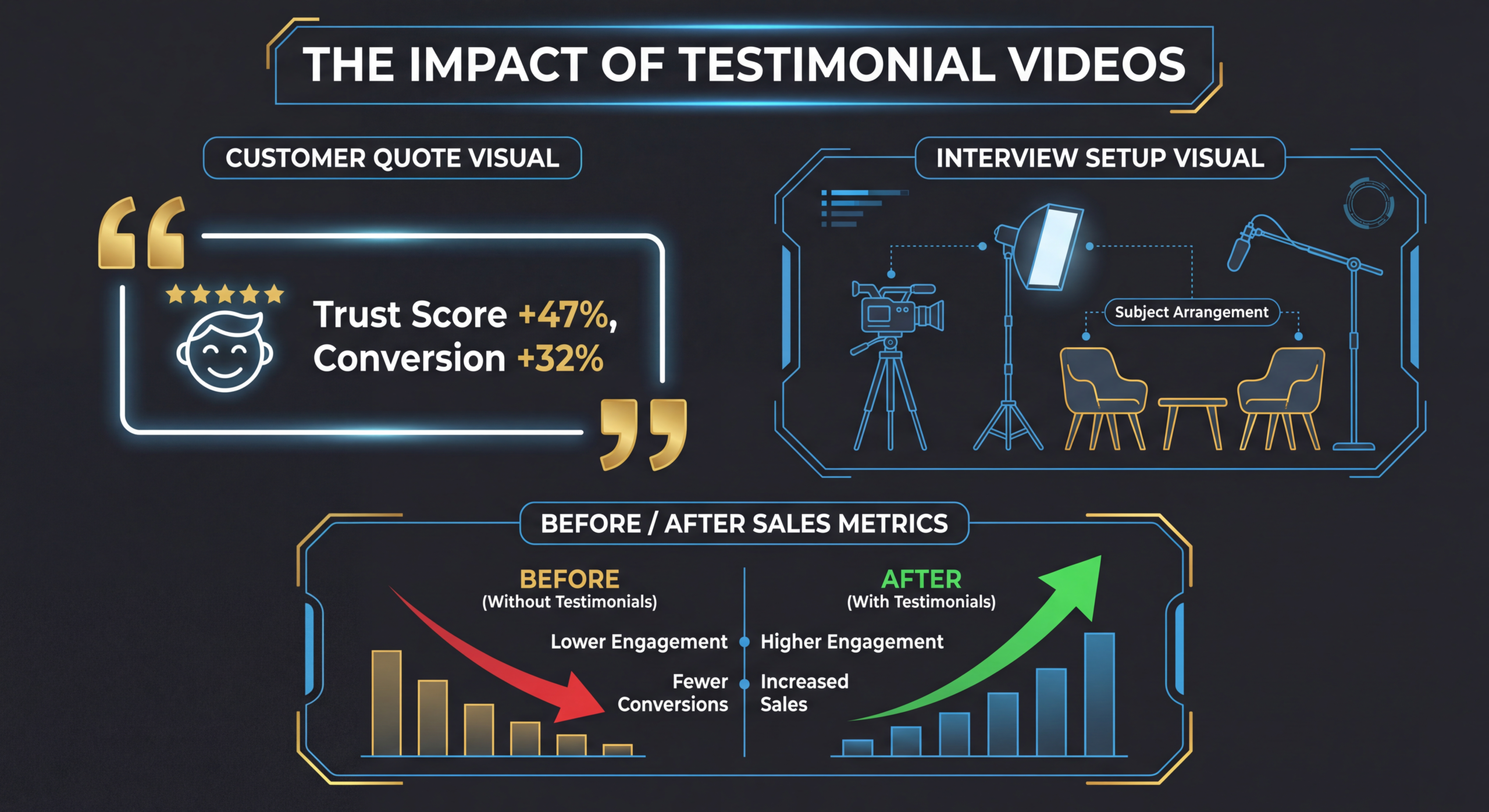
In a world where buyers are increasingly skeptical of marketing messages, testimonial video production stands as one of the most powerful tools in your arsenal. Nothing sells quite like a real person telling a real story about how your product or service changed their business. According to Wyzowl's State of Video Marketing report, 92% of consumers trust recommendations from others - even people they don't know - over branded content. That's why testimonial videos have become a non-negotiable element in every serious B2B marketing strategy.
But here's the challenge: most companies get testimonial video production wrong. They end up with stiff, scripted clips that feel more like hostage videos than genuine endorsements. The customer sits awkwardly in front of a camera, reads from a teleprompter, and delivers lines that no one believes. That's not what sells.
What sells is authenticity - and capturing that authenticity requires a deliberate, structured approach to every stage of the production process. In this comprehensive guide, we'll walk you through everything from selecting the right customers to the final cut, ensuring your testimonial videos actually drive revenue.
Before we dive into the how, let's talk about why testimonial video production deserves a significant slice of your marketing budget. The B2B buying journey has fundamentally changed. Today's buyers complete roughly 70% of their research before ever speaking to a sales rep. During that research phase, they're looking for proof - evidence that your solution works for companies like theirs.
Text-based case studies are useful, but they lack emotional punch. A well-produced testimonial video delivers something a PDF never can: the genuine enthusiasm of a real customer, complete with facial expressions, vocal tone, and body language that signal sincerity. Here's why it works:
Social proof is a psychological principle coined by Robert Cialdini in his landmark book Influence. When we're uncertain about a decision, we look to others to guide our behavior. Video amplifies this effect exponentially because it engages multiple senses simultaneously. Viewers can assess the speaker's authenticity through micro-expressions, eye contact, and vocal inflection - cues that are completely lost in written testimonials.
Research from Nielsen has shown that earned media (recommendations from real people) remains the most trusted form of advertising globally. When you capture a customer's genuine excitement about your product on video, you're essentially creating the most credible form of advertising that exists.
Testimonial videos don't just build awareness - they accelerate deals. Sales teams that use customer video testimonials in their outreach see higher response rates, shorter sales cycles, and better close rates. A testimonial video embedded in a proposal or follow-up email gives prospects the social validation they need to move forward with confidence.
Great testimonial videos don't happen by accident. They're the result of careful planning that starts long before anyone picks up a camera. Here's how to lay the groundwork for testimonial video production that actually delivers results.
Not every happy customer makes a great testimonial subject. You're looking for customers who tick several boxes:
We recommend maintaining a running list of potential testimonial candidates. Flag customers who send positive emails, leave great reviews, or have strong NPS scores. When it's time to produce new testimonial videos, you'll have a ready pipeline of enthusiastic advocates to draw from.
The questions you ask determine the quality of the story you capture. Avoid generic prompts like "Tell us about your experience" - they produce generic answers. Instead, design questions that guide the customer through a narrative arc without putting words in their mouth.
Here's a proven question framework:
Send these questions to the customer a few days before the shoot. You want them to have time to reflect and recall specific details, but not so much time that they over-rehearse and lose their natural delivery.
"We were spending 20+ hours a week on manual reporting..."
"We tried three other tools before we found [Company]..."
"What stood out was how easy onboarding was..."
"Within two months, our team reclaimed 15 hours a week..."
"Revenue increased 40% and we scaled without adding headcount."
Not all testimonial videos are created equal. The format you choose depends on your budget, the customer's location, and how you plan to use the final video. Let's break down your options.
One of the biggest decisions in testimonial video production is whether to shoot remotely or on-site. Both approaches have legitimate use cases, and many companies use a combination of both. Here's a detailed comparison:
Remote testimonial production has come a long way since the early days of the pandemic. With the right coaching and technical setup, you can capture surprisingly high-quality footage without leaving your office. Remote is ideal when:
To maximize remote quality, send customers a simple video brief that includes lighting tips, audio recommendations, and framing guidance. Many companies now ship portable lighting kits and lapel microphones to their top advocates to ensure consistent quality across remote shoots.
On-site production is the gold standard for testimonial videos that will be used in high-stakes situations - website hero sections, sales presentations, trade show displays, and premium ad campaigns. The visual quality difference is undeniable, and there's an intangible benefit to the personal interaction between the production crew and the customer.
On-site shoots also give you the opportunity to capture B-roll footage - the customer using your product in their actual workplace, their team collaborating, their facility in operation. This contextual footage adds enormous credibility and visual variety to the final edit.
Whether you're shooting remotely or on-site, thorough pre-production is what separates amateur testimonial videos from professional ones. Here's your complete pre-production checklist:
For on-site shoots, your production team should scout the location in advance - either physically or via photos and video calls. Look for spaces with good natural light, minimal background noise, and visually interesting backdrops that aren't distracting. Avoid shooting in conference rooms with harsh fluorescent lighting and blank walls.
Key technical considerations include:
Your customer is not a professional actor, and you shouldn't treat them like one. The goal is to make them feel comfortable and confident, not to coach them into a performance. Here's how to prepare them effectively:
The moment of truth. Everything you've planned leads to this - the actual shoot. Here are the techniques that separate compelling testimonial videos from forgettable ones.
The best testimonial videos feel like conversations, not interviews. Here's how to create that feeling:
Position the interviewer just off-camera. The customer should look at the interviewer, not directly at the lens. This creates a natural, documentary-style look that viewers find more trustworthy than a direct-to-camera delivery.
Use follow-up questions liberally. When a customer says something interesting, dig deeper. "Tell me more about that." "What did that feel like?" "How did your team react?" These follow-ups often produce the most genuine, emotionally resonant soundbites.
Let silence work. After a customer finishes an answer, resist the urge to immediately jump to the next question. Pause for 3-5 seconds. Often, the customer will fill the silence with additional thoughts - and these spontaneous additions are frequently the best moments in the entire interview.
B-roll is the visual glue that holds your testimonial video together. Without it, you're stuck with a talking head for the entire duration - and even the most compelling speaker becomes monotonous after 60 seconds of unbroken eye contact with the viewer.
Plan your B-roll shots to reinforce the customer's story:
Shoot more B-roll than you think you'll need. A good rule of thumb is to capture 3x more B-roll footage than interview footage. This gives your editor maximum flexibility to create a polished final product.
Don't be afraid to ask the customer to rephrase or expand on an answer. Most people appreciate the direction, and the second or third take is almost always stronger than the first. Frame it positively: "That was great. Could you say that one more time and include [specific detail]?"
Also consider shooting for multiple formats during the same session:
This is where good footage becomes a great video. The editing process is critical to maintaining authenticity while delivering a polished, professional final product.
Most effective testimonial videos follow a three-act structure that mirrors the story arc we discussed earlier:
Keep the total length between 90 seconds and 3 minutes for most use cases. Shorter versions can be cut from the same footage for social media and ads.
Professional editing techniques that elevate your testimonial video include:
Always add subtitles to your testimonial videos. A staggering 85% of social media video is watched without sound, and captions make your content accessible to deaf and hard-of-hearing viewers. Burned-in captions (as opposed to platform-generated ones) ensure consistent formatting and accuracy across all distribution channels.
A brilliant testimonial video that sits on your hard drive generates exactly zero revenue. Distribution is where the ROI happens. Here's a comprehensive strategy for maximizing the impact of your testimonial video production investment.
Your website is the primary home for testimonial videos. Strategic placement includes:
Each platform has different requirements and audience expectations:
Your sales team is one of the most valuable distribution channels for testimonial videos. Equip them with:
Companies that integrate testimonial videos into their marketing video production strategy see the best results when sales and marketing teams align on which testimonials to prioritize and when to deploy them in the buying journey.
Testimonial videos make excellent ad creative because they carry inherent credibility. They outperform branded ads in many contexts because they don't look like ads - they look like honest recommendations. Test testimonial clips in:
Even experienced teams make these errors. Here's what to avoid:
The moment you hand a customer a script, you kill authenticity. Provide talking points and questions, but never a script. The slightly imperfect, naturally delivered answer is infinitely more convincing than a polished teleprompter read. Viewers can detect scripted content instantly, and it triggers skepticism rather than trust.
You can watch a video with mediocre visuals, but poor audio makes most viewers click away within seconds. Invest in good microphones and record in quiet environments. In post-production, use noise reduction judiciously and ensure consistent audio levels throughout the video.
The testimonial video is the customer's story, not your company's commercial. The customer should be the hero. Your product or service is the tool that helped them succeed. This subtle framing difference has a massive impact on how viewers perceive and respond to the video.
Always - always - get a signed video release form before you publish anything. This protects both you and the customer. Include permissions for specific distribution channels and make it clear how the video will be used. Many companies skip this step and regret it later when a customer changes jobs or a company's legal team raises concerns.
Testimonial video production isn't a one-time project. It's an ongoing program. Your best customers, your product, and your market are constantly evolving. Plan to produce new testimonial videos quarterly or at least twice a year. Fresh testimonials signal to prospects that your company is actively delivering results.
Budget is always a factor, so let's talk numbers. The cost of testimonial video production varies widely based on scope, quality, and format. Here's a general breakdown:
When evaluating cost, consider the ROI. A single high-quality testimonial video can be used across your website, social media, sales enablement, and paid advertising for 12-18 months. When you calculate cost per impression and cost per conversion, premium testimonial production is often the most efficient spend in your video marketing budget.
Need help scoping your testimonial video project? Our team can help you build a production plan that fits your budget and goals - book a call View Pricing to get started.
If you're investing in testimonial video production, you need to track performance. Here are the key metrics to monitor:
Set up proper tracking before you distribute your videos. Use UTM parameters on links, embed tracking pixels on video landing pages, and work with your sales team to tag deals in your CRM where testimonial videos were shared.
Once you have the basics down, here are strategies to take your testimonial program to the next level:
Go beyond the standard 2-minute testimonial and produce a 5-8 minute documentary-style customer story. These deeper pieces work exceptionally well for enterprise sales where the buying committee needs extensive proof before making a decision. Document the customer's entire journey - from the initial problem through implementation and long-term results.
Create a series of testimonials organized by role. A CFO testimonial for the finance team. A CTO testimonial for the technical team. An end-user testimonial for the people who'll use your product daily. This approach ensures every stakeholder in the buying process sees a testimonial from someone who looks like them.
Structure the testimonial explicitly around the transformation. Use split-screen effects, data visualization, and side-by-side comparisons to make the before-and-after contrast visually dramatic. This format is especially effective for products that deliver quantifiable improvements.
For companies with large customer bases, consider launching a user-generated testimonial program. Provide customers with a simple recording platform, clear guidelines, and incentives (swag, discounts, feature access) to submit self-filmed testimonials. While individual production quality will vary, the authenticity and volume can be powerful.
While some companies produce testimonials in-house, partnering with a professional video production company brings expertise, equipment, and efficiency that's hard to replicate internally. Here's what to look for in a production partner:
At VEC, we specialize in B2B testimonial video production that captures authentic customer stories and turns them into revenue-driving assets. Our process handles everything from customer outreach and scheduling through filming, editing, and multi-platform optimization. Schedule a discovery call to learn how we can help.
The ideal length is 90 seconds to 2.5 minutes for a full testimonial. For social media, cut shorter 30-60 second versions. For sales enablement, you can go up to 3-4 minutes if the story is compelling and data-rich. Always lead with the strongest soundbite to hook viewers immediately.
Most satisfied customers are happy to help - they just need to be asked. Make it easy by handling all logistics, offering flexible scheduling, and sharing examples of previous testimonials so they know what to expect. Some companies offer incentives like gift cards, donations to the customer's charity of choice, or co-marketing opportunities.
Absolutely. Remote testimonial production has become increasingly professional with tools like Riverside, Zoom (with proper settings), and dedicated remote production platforms. Send your customer basic setup guidance - ring light, lapel mic, clean background - and you can achieve surprisingly strong results. Download our B2B Video Brief template for guidance.
Start with 3-5 testimonials that cover your core customer segments and use cases. Then build from there, aiming to add 2-4 new testimonials per quarter. A mature testimonial library should have 15-25 videos covering different industries, company sizes, and use cases so sales reps always have a relevant story to share.
A testimonial video is primarily the customer speaking about their experience in their own words. A case study video is more structured, often including narration, data visualization, and a more detailed examination of the problem-solution-result framework. Case studies tend to be longer and more detailed, while testimonials are shorter and more emotionally driven.
For high-stakes testimonials (website, sales presentations, trade shows), yes - professional equipment makes a significant difference. For social media content and internal use, a modern smartphone with good lighting and a quality external microphone can produce excellent results. The most important investment is always audio quality.
Nearly everyone is nervous on camera at first. Start with casual conversation before recording, ask easy warm-up questions, and remind them that editing will remove any stumbles. Position the interviewer just off-camera so the customer can have a natural conversation rather than staring into a lens. Most people relax significantly within the first 5 minutes.
Plan your next testimonial video shoot with our proven brief template - covers objectives, questions, shot lists, and distribution strategy.
Get the Free Template See PricingTestimonial video production isn't about creating a single viral video. It's about building a systematic, repeatable process that continuously generates social proof for your business. The companies that win at testimonial marketing are the ones that treat it as an ongoing program - consistently identifying great customer stories, capturing them authentically, and distributing them strategically across every touchpoint in the buyer's journey.
Start with the fundamentals: select the right customers, ask the right questions, capture authentic stories, and edit with purpose. Then scale by building systems, training your team, and partnering with production professionals who understand the B2B landscape.
The result? A library of authentic, compelling customer stories that build trust, accelerate sales, and differentiate your brand in a crowded market. And in today's buyer-driven world, there's nothing more valuable than that.
Ready to start your testimonial video production program? Book a call with our team to discuss your goals and get a custom production plan.