Video for AI & Machine Learning SaaS Companies
Table of Contents
Why AI/ML SaaS Companies Need Video
AI/ML SaaS is experiencing rapid growth and increasing competition for buyer attention. Companies in this space sell complex solutions to sophisticated buyers who compare multiple vendors before making a commitment. Video is the format that bridges technical complexity and buyer understanding - showing the product in action, building trust through real customer stories, and conveying domain expertise through thought leadership.
The opportunity for AI/ML SaaS companies is significant: most competitors still rely primarily on text-heavy content, generic product screenshots, and static case study PDFs. Companies that invest in strategic video content gain an immediate visual advantage - standing out in crowded inboxes, shortening sales cycles, and building stronger brand recall among target accounts.
Video is particularly powerful for AI/ML SaaS because the products are often invisible or abstract until demonstrated. A 3-minute product demo communicates more about your platform's user experience, data visualization, and workflow efficiency than 10 pages of feature documentation ever could.
Unique Challenges for AI/ML SaaS Video
- Explaining the unexplainable: AI/ML products often work as 'black boxes.' Buyers need to understand what the AI does, how it makes decisions, and why they should trust it - without a PhD in machine learning. Video must demystify without oversimplifying.
- Hype vs. reality management: The AI market is flooded with exaggerated claims. Sophisticated buyers are increasingly skeptical of 'AI-powered' messaging. Video must demonstrate actual capabilities with real data rather than making grand promises about artificial intelligence.
- Demonstrating accuracy and reliability: AI products are judged on accuracy, false positive/negative rates, and edge case handling. Video demos must address these metrics directly and show how the system performs in realistic scenarios - including when it's uncertain or wrong.
- Ethical and bias concerns: Buyers increasingly ask about AI fairness, bias detection, and ethical guidelines. Video content addressing your approach to responsible AI builds trust with enterprise buyers who have governance requirements.
- Rapid capability evolution: AI products improve quickly as models are retrained and updated. Video content can become outdated faster than in other verticals, requiring a production process that supports frequent updates.
Video Types That Work for AI/ML SaaS
| VIDEO TYPE | PURPOSE | LENGTH | FUNNEL STAGE |
|---|---|---|---|
| AI Demo with Real Data | Show the model processing real inputs to outputs | 3-5 min | Mid-funnel |
| Explainer (How the AI Works) | Demystify the technology for non-technical buyers | 90-120 sec | Top-funnel |
| Accuracy & Performance Video | Benchmark results and comparison data | 2-4 min | Mid-funnel |
| Customer Results Video | Real-world outcomes from AI implementation | 2-3 min | Late funnel |
| Responsible AI Overview | Ethics, bias, and governance approach | 3-5 min | Mid-funnel |
| Integration Demo | Show AI within existing tech stack | 3-5 min | Mid-funnel |
Product demonstrations
Product demos are the most-watched video type by B2B buyers (89% watch them during evaluation). For AI/ML SaaS, demos must use realistic but anonymized data and reflect the actual workflows your customers encounter daily. Structure demos around the buyer's pain points: start with the problem, demonstrate the solution in your product, and quantify the outcome.
Use our product demo script template to maintain a consistent problem-solution-outcome structure across all your demo videos.
Customer testimonials
Peer validation from AI/ML SaaS professionals is the most persuasive content format for this vertical. Buyers want to see companies similar to theirs achieving specific, measurable results. Focus testimonials on concrete metrics: time savings, cost reduction, efficiency improvements, and compliance benefits.
Thought leadership
Position your executives and domain experts as industry authorities through video content on trends, best practices, and strategic insights. This builds trust before the sales conversation begins. Thought leadership videos perform especially well on LinkedIn for reaching AI/ML SaaS decision-makers.
Use Cases & Strategy
Natural language processing platforms
Show the AI processing real text inputs in real-time: sentiment analysis, entity extraction, summarization, or translation. Side-by-side comparisons of AI output vs. manual processing dramatically illustrate speed and accuracy. Use diverse example inputs to demonstrate versatility.
Computer vision and image analysis
This is where video shines - show the AI analyzing images or video in real-time. Object detection, classification, or quality inspection demonstrated visually is far more convincing than accuracy statistics in a whitepaper. Demo videos with live processing create genuine 'wow' moments.
Predictive analytics and forecasting
Visualize predictions alongside actual outcomes. Show how your model predicted events that occurred, how accuracy improves over time, and how predictions translate into actionable recommendations. Dashboard visualizations comparing AI forecasts to historical accuracy build confidence.
AI-powered automation
Demonstrate the before (manual process) and after (AI-automated process) workflow. Quantify the time savings, error reduction, and scale improvements. Show edge cases where the AI correctly identifies unusual situations and routes them for human review.
Production Considerations
Technical accuracy
AI/ML SaaS buyers are domain experts who will immediately identify inaccurate terminology, unrealistic scenarios, or oversimplified workflows. Every video script should be reviewed by a subject matter expert. The credibility cost of a single technical error outweighs the production cost of proper review.
Data sensitivity
Product demos must use synthetic or clearly anonymized data. Work with your product and compliance teams to create demonstration environments that look realistic without exposing actual customer or operational data.
Production quality
Professional production quality signals competence. This doesn't require massive budgets - it requires clean audio, proper lighting, thoughtful editing, and consistent branding. For enterprise-focused AI/ML SaaS companies, video quality is interpreted as a proxy for product quality.
Companies leading with video
Jasper
Jasper creates compelling demo videos showing AI content generation in real-time. Their approach: show the actual product interface processing a real prompt and generating real output. No tricks, no cuts - the demo builds trust through transparency.
Hugging Face
Hugging Face produces developer-focused content showing model deployment, fine-tuning, and inference. Their videos succeed because they're genuinely technical and useful, not marketing-wrapped-in-tech-speak.
Scale AI
Scale AI produces sophisticated thought leadership content on data labeling, model training, and AI application across industries. Their videos position them as the infrastructure layer that serious AI companies rely on.
Go-to-Market Video Strategy
Phase 1: Foundation (Month 1-2)
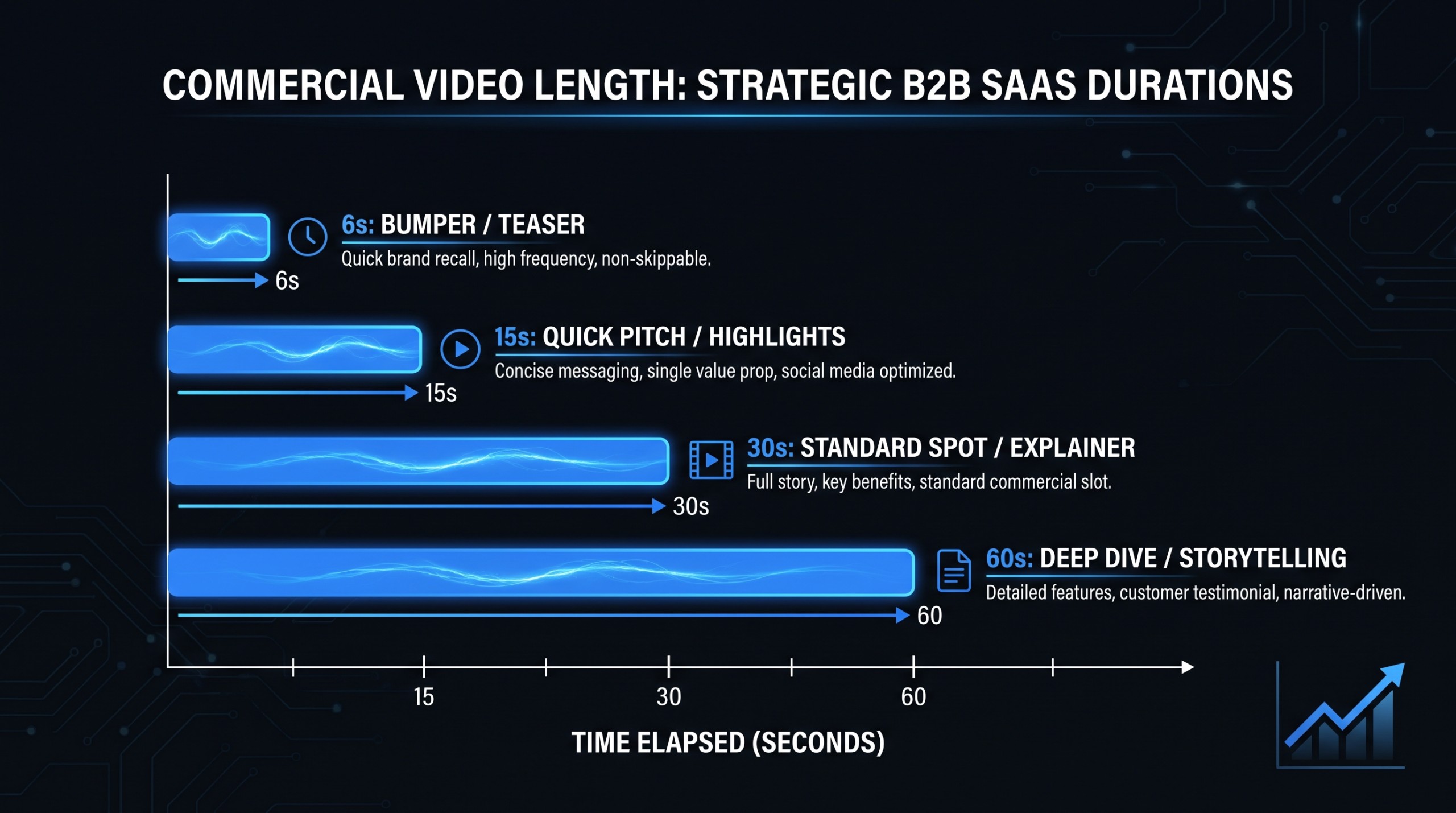
- 1 product overview/explainer video (90-120 seconds)
- 1 detailed product demo (5-8 minutes)
- 2-3 customer testimonials (2-3 minutes each)
- Website integration on key conversion pages
Phase 2: Scale (Month 3-4)
- 3-5 use-case-specific demo variations
- Thought leadership video series for LinkedIn and YouTube
- Sales enablement clips for SDR outreach sequences
- Webinar production and content repurposing
Phase 3: Optimize (Month 5-6)
- Video analytics setup and performance measurement
- A/B testing video placements, thumbnails, and CTAs
- Video retargeting campaigns
- Content refresh based on performance data and product updates
Budget framework
| VIDEO TYPE | COST RANGE | PRIORITY |
|---|---|---|
| Product demo | $3,000-8,000 | Must-have |
| Explainer video | $5,000-15,000 | Must-have |
| Customer testimonial | $2,000-5,000 each | Must-have |
| Thought leadership | $1,000-3,000 each | Recommended |
| Social clips | $500-1,500/batch | Nice-to-have |
Total recommended first-year investment: $25,000-55,000 for a comprehensive video library producing 10-15 core assets that can be repurposed into 50+ content pieces across channels.
Ready to Level Up Your Video Strategy?
Talk to our team about your video production needs. No commitment required.
Book a Free Strategy Call See PricingReady to get started? Explore our case studies.
Frequently Asked Questions
How do we demo AI without revealing proprietary models?
Show the inputs and outputs without exposing model architecture. Use anonymized data for demonstrations. Focus on capability demonstration (what the AI can do) rather than technical implementation (how the model works). Most buyers care about results, not architecture.
Should AI company videos be technical or business-focused?
Create two tracks: technical demos for ML engineers and data scientists (show API calls, model performance, integration), and business-value videos for executives (show ROI, time savings, competitive advantage). The buying committee includes both.
How do we address AI accuracy concerns in video?
Show real performance metrics: precision, recall, F1 scores, and accuracy on benchmark datasets. Include examples of edge cases and how the system handles uncertainty. Honesty about limitations builds more trust than unrealistic accuracy claims.
What's the biggest video mistake AI companies make?
Using animated explainers that show generic 'neural network' visualizations without demonstrating actual product capability. Buyers are tired of abstract AI imagery. Show the real product doing real work with real data.
How often should AI companies update their video content?
More frequently than other SaaS verticals. Model improvements, new capabilities, and accuracy gains happen quickly. Plan for quarterly content reviews and create a rapid production workflow for feature announcement videos.
SaaS Video Swipe File
50+ SaaS video examples including campaigns from leading AI/ML SaaS companies and adjacent verticals.
Download Free