How Do You Test a Video Editor Before Hiring?
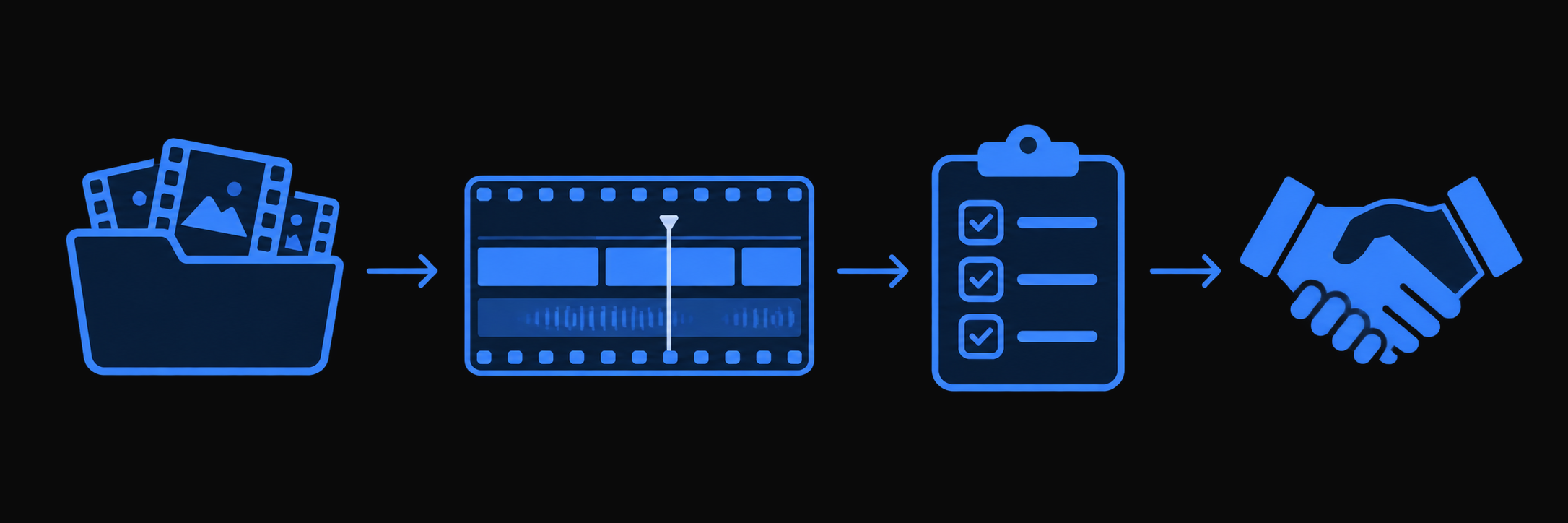
A video editor test is a short, paid assignment in which a candidate edits a small set of footage to a written brief, so you can judge their cut, their questions and how they take feedback before you commit to hiring them. The reliable version has five parts: a real brief, a fixed deadline, a time-boxed scope, a scoring rubric you write before the work arrives, and one round of feedback.
Key Takeaways
- Test the job, not the portfolio. A reel shows the best work an editor has ever shipped. A test edit on your footage shows what they will do on a normal Tuesday.
- Pay for it. A paid test of one to three hours' work filters for professionals, avoids the spec-work problem and gives you a clean paper trail for ownership.
- Write the rubric first. Score the same five things for every candidate: brief fit, story and pacing, polish, communication and the feedback round.
- The feedback round is the real test. How a candidate handles one change request predicts working with them better than the first cut does.
- A test cannot prove consistency. One good edit does not show you can get ten a month, so plan a paid first month as the second stage.
Written by the VEC Editorial Team. Sources last checked October 25, 2026.
Table of Contents
- Why can't you just hire from a portfolio?
- What should a video editor test include?
- Should the test edit be paid?
- How do you write the test brief?
- How do you score a test edit?
- What does the feedback round tell you?
- What red flags show up in a test?
- What can't a test edit tell you?
- Is there a faster way to de-risk the hire?
- FAQ
Why can't you just hire from a portfolio?
You can't, because a portfolio shows selected outcomes, not the process that produced them. You don't know how much direction the editor received, how many people touched the cut or whether the footage was easier than yours. A test puts one variable back in your control: the same footage and brief for everyone.
Testing matters most when the hire is a single person. If you are still deciding between a freelancer, a team or an in-house editor, start with the Hire a Video Editor or Outsource? A Framework post, then come back here once you have chosen to evaluate individuals. If you are comparing models, Video Editors for Hire: Agency vs Freelance (2026) lays out the trade-offs.
A good test answers four questions in one pass:
- Can they cut to your brief, not their own taste?
- Do they ask smart questions before starting, or guess?
- Do they deliver on time in a file you can use?
- Do they respond well to a change request?
What should a video editor test include?
A strong test has a narrow scope, real material and a clear deadline. Keep it small enough that a skilled editor can finish in an hour or two of focused work, and specific enough that two candidates' results can be compared side by side.
Test design checklist
| Element | What to set | Why it matters |
|---|---|---|
| Footage | One to three raw clips, ideally from a recent shoot of yours | Shows how they handle your audio, lighting and messy takes |
| Deliverable | One finished video in the format you actually publish | Tests the real job, not a showpiece |
| Length | A short cut, such as a 30 to 90 second clip or a one-minute section of a longer video | Long enough to show pacing, short enough to be fair |
| Deadline | A fixed date and time, usually 48 to 72 hours out | Reveals reliability and whether they ask for extensions |
| Brief | A one-page written brief with audience, goal, tone and references | Separates editors who follow direction from those who freelance on it |
| Revision | One planned change request after delivery | Shows communication and speed under feedback |
| Rubric | Written before you send the brief | Keeps scoring fair and keeps you from choosing on gut feel |
Use footage you would otherwise edit anyway, but remove anything confidential. If your raw material is sensitive, a stand-in clip that mirrors your format works almost as well. What you are testing is judgment on a representative problem, not the final product.
Which skills should the test actually stress?
Pick three or four. Spreading a test across ten skills makes it long and shallow. For a SaaS marketing team, the ones that usually separate candidates are cutting talking-head footage into a tight narrative, clean audio, readable captions and brand-consistent graphics. If the job is mostly social clips, test a vertical cut and captions instead. If it is a long-form show, test an episode section.
Should the test edit be paid?
Yes, for anything beyond a 20-minute screening task. Paying for the test is the cleanest way to attract working professionals and to avoid the problem that unpaid trial work, used in your published content, can create. It also lets you put ownership in writing, which an unpaid exchange rarely does.
There are two separate issues, and both are about paper, not goodwill.
Who owns the test edit?
Ownership of a creative work does not move to you just because you asked for it. US copyright law says a transfer of copyright ownership is not valid unless it is in writing and signed by the owner of the rights conveyed (17 U.S.C. § 204, checked October 25, 2026). The statute's definition of a "work made for hire" also requires, for a commissioned contribution to an audiovisual work, that the parties expressly agree in a signed written instrument (17 U.S.C. § 101, checked October 25, 2026).
The practical rule: if you plan to publish any part of the test edit, get a short signed agreement that says you own the deliverable on payment. If you do not want that obligation, tell candidates the test is evaluation-only and do not publish it. This is general information, not legal advice, so have counsel review your template.
Contractor or employee?
If you hire the editor as a freelancer, the test should look like a contractor engagement: you specify the result, not the method or the working hours. The IRS says the key question is whether the payer has the right to direct and control how the work is done, and that an employee relationship can exist regardless of what the arrangement is called (IRS: Independent Contractor Defined, checked October 25, 2026). Give the brief, the deadline and the deliverable. Do not prescribe software settings, work hours or a step-by-step method.
What should the test cost?
Pay the editor's quoted rate for the time the test should take. If a candidate quotes $40 an hour and the test should take three hours, budget about $120. That figure is only an example of the arithmetic. For where real quotes tend to land by market, see Video Editor Hourly Rates by Country: 2026.
Paid vs unpaid test edit
| Factor | Paid test | Unpaid test |
|---|---|---|
| Candidate pool | Working professionals will do it | Experienced editors often decline |
| Use of the footage | Can publish with a signed agreement | Risky to use; no clear ownership |
| Your cost | A modest fee per finalist | No fee, but a weaker field |
| Fairness | Time is compensated | Looks like spec work |
| Best for | Final two or three candidates | A 15 to 20 minute screening task only |
How do you write the test brief?
Write a one-page brief that you would give a real editor on day one. It should hold everything a competent editor needs and nothing they could not reasonably find out. Leave one or two details out on purpose, then see whether the candidate asks about them.
For the full list of what an editor needs from you on a real project, use What Does a Video Editor Need From You?. For a test, a short version is enough:
- Goal and audience: who watches, and what should they do next.
- Source files: a shared folder link, with a one-line description of each clip.
- Deliverable: length, aspect ratio, resolution and file format. For web delivery, match a published spec, such as YouTube's recommended upload settings (MP4, H.264, AAC-LC audio, 48 kHz, uploaded at the recorded frame rate; checked October 25, 2026).
- Style references: two or three links to videos you like, plus one you do not.
- Brand notes: fonts, colors, logo placement and caption style.
- Deadline and the contact for questions.
What is the intentional gap?
Leave one real ambiguity, such as a clip with two plausible hero moments or a music direction that is unspecified. Strong editors send a question or state their assumption in the delivery note. Weak ones silently pick and hope. Either way you learn how they work with incomplete direction, which is most real direction.
How do you score a test edit?
Score every candidate on the same rubric, written before the first file arrives, and score without knowing their rate or reputation if you can. The weights below are an illustrative starting point, not an industry standard; change them to match the job.
Illustrative scoring rubric (100 points)
| Criterion | Weight | What a strong result looks like |
|---|---|---|
| Brief fit | 25 | Length, format, tone and message match the brief; assumptions were noted |
| Story and pacing | 25 | The cut has a clear arc, no dead air, and the best moments are kept |
| Technical polish | 20 | Clean audio levels, consistent color, readable captions, no jump-cut glitches |
| Communication | 15 | Questions before starting; clear delivery note; on-time handoff |
| Feedback round | 15 | Changes made accurately, quickly and without defensiveness |
Score the first four criteria on the first delivery, then add the feedback score after round two. Watch each cut once straight through without pausing, the way your audience will, then review it in detail. If two candidates are within a few points, the feedback round and communication scores should break the tie, because those are the traits that persist after the first project.
How many candidates should you test?
Test two or three finalists, not ten. Screen the wider pool with portfolio review, a short call and a few vetting questions first. Testing everyone wastes your time and either burns money or trains the market to ignore your offers.
What does the feedback round tell you?
It tells you whether the person can take direction, which is most of the job. After the first delivery, send a short, specific change list with two or three edits: one easy, one that requires judgment and one that quietly contradicts a choice they made. Then watch what happens.
A strong response applies the changes accurately, explains any change they did not make and returns the new version inside the time you agreed. A weak response ignores items, argues about taste without offering an alternative or makes unrequested changes elsewhere in the cut.
Use the same change list wording for every finalist. Sending different feedback to different candidates makes the scores incomparable.
What red flags show up in a test?
The most useful red flags are behavioral, not aesthetic. Taste is subjective and a good brief can fix it. These are harder to fix:
- No questions at all on a brief that had a deliberate gap.
- Missed deadline without notice. A late delivery with a heads-up is a different signal than silence.
- Wrong specs. Wrong aspect ratio, wrong length or a format you cannot upload.
- Template edits. Stock transitions and effects that ignore your references.
- Unlicensed assets. Music or footage dropped in with no license or source noted.
- Defensiveness in revisions, or a revision that breaks something that was working.
- Resistance to a signed agreement for a paid test.
Treat one slip as information and a pattern as a decision. A candidate who missed a caption style but flagged it and fixed it in a day is usually a better bet than one whose first cut was beautiful and who vanished after feedback.
What can't a test edit tell you?
A test cannot tell you whether the editor will stay fast and consistent across many videos, whether they will still be available in three months or what happens when they are sick or busy. It measures one deliverable. Your actual risk is the next fifty.
That is why the strongest process has two stages. Stage one is the paid test with your top two or three. Stage two is a paid first month, or a defined first batch, with clear exit terms. Treat the first month as the real test of the relationship.
Two-stage hiring test
| Stage | Scope | What it proves | Typical decision |
|---|---|---|---|
| 1. Paid test edit | One short deliverable, one revision round | Skill, brief-following, communication | Pick one or two to continue |
| 2. Paid first month | A small batch of real videos, fixed scope | Consistency, speed, fit with your team | Extend, restructure or exit |
If the stage-two month shows that one person cannot cover your volume, backup and range of formats, the fix may be a different model. When to Replace Your Freelance Editor With a Team covers the signs, and what to do with the work already in flight.
Is there a faster way to de-risk the hire?
Yes, if the real constraint is volume rather than a single skill: buy a team on terms that let you leave. A dedicated editing team replaces the testing problem with a trial structure, because you are evaluating a process with built-in review and backup, not one person's good week.
That is the model we run at VEC. We are a dedicated video editing team for B2B and SaaS marketing, working on post-production only (we do not shoot footage and we do not do 3D). Plans start at $5K per month (Growth), with Core at $9.5K and Scale at $16K, all month-to-month, and we guarantee that you will double your video output in 90 days or month 4 is free. The how VEC onboarding and delivery works page shows the onboarding setup, and VEC pricing shows what each plan includes.
If you are weighing agencies rather than individuals, the checks are different: you are testing a process and a team, not one cut. How to Vet a Video Editing Company: Red Flags is the companion piece.
FAQ
How do you test a video editor before hiring them?
Give two or three finalists the same paid test edit: a one-page brief, one to three raw clips, a short deliverable and a fixed deadline. Score each result against a rubric you wrote in advance, then send one round of specific changes and score how they respond. Hire on the combined score, not on the first cut alone.
How long should a video editor test take?
Plan for one to three hours of focused work from the editor, delivered within 48 to 72 hours. Longer tests lose good candidates and tell you less than a short, well-designed task. If you need more proof than that, move to a paid first month rather than a longer test.
Is it okay to ask for a free test edit?
A 15 to 20 minute screening task is reasonable. A full edit you intend to publish is spec work, and it limits your pool to people with time to spare. Paying also lets you get ownership in a signed agreement, which US copyright law requires for a valid transfer.
Should I use my own footage or sample footage?
Use your own footage when it is not confidential, because it shows how the editor handles your audio, lighting and branding. If it is sensitive, use a stand-in clip in the same format. Give every candidate identical material so the results are comparable.
What if I like the test edit but not the person?
Weigh the communication and feedback scores heavily, since those predict working with them. A great cut from an editor who answers late, argues revisions or skips the brief tends to cost more over a quarter than a good cut from a reliable collaborator.
Rather Not Run Editor Tryouts?
VEC provides dedicated video editing teams for B2B companies, with plans from $5K per month and a guarantee to double your video output in 90 days or month 4 is free. Tell us your volume and formats and we will outline the setup.
Book a Free Strategy Call See Pricing