How to Vet a Video Editing Company: Red Flags
TL;DR
- Most vetting fails because buyers evaluate portfolios instead of processes - and get burned in month two.
- The seven red flags: no SLAs, portfolio mismatches, vague pricing, single-editor dependency, no brand consistency protocol, communication delays in discovery, and lock-in without performance guarantees.
- The fix: score vendors against a consistent rubric before committing - use the framework in this post.
- The safest path: a paid scoping call + one test project before signing any multi-month agreement.
Table of Contents
You've watched the demo, seen the portfolio, and liked the sales rep. Then month two arrives and you're chasing your editor on Slack at 11 PM, the turnaround slipped again, and the video your CMO needs for the product launch looks nothing like your brand guidelines.
Picking the wrong video editing partner doesn't just waste budget - it stalls content programs, burns internal goodwill, and forces a painful mid-quarter swap. The frustrating part? Most of these failures are entirely predictable. The warning signs were there during vetting; the buyer just didn't know what to look for.
This guide gives you the framework to vet video editing companies the way a procurement lead would: with a structured checklist, scored criteria, and hard questions that separate reliable partners from expensive disappointments. According to Wistia's State of Video research, businesses that invest in video consistently outperform those that don't - but only when production quality is maintained at scale. A bad editing partner can erase that advantage fast.
Why Most Vetting Processes Fail
The standard agency evaluation goes like this: request a proposal, review the portfolio, check a reference or two, compare prices, pick the one that "feels right." That process is almost designed to miss the real risks.
Portfolios show best-case work from ideal clients. References are cherry-picked. Proposals are optimistic. And "feels right" is just confirmation bias toward whoever had the best sales process.
The actual failure modes show up later:
- Communication breaks down under real workload pressure - you discover this in week three, not in the pitch.
- The editor who impressed you in the demo is not the editor who ends up on your account.
- The pricing estimate was based on simple edits; your actual footage is messier and more complex.
- Brand consistency degrades because there's no documented style guide process, and every new video requires the same correction cycle.
- SLAs were implied, not written - and the agency interprets "business days" differently than you do.
Proper vetting targets the process behind the portfolio, not the portfolio itself. The questions below are designed to surface process quality, team stability, and risk factors - the things that actually predict whether a partnership succeeds at scale.
For broader context on what a strong outsourcing arrangement looks like, our guide to how to outsource video editing covers the structural decisions before you start comparing vendors.
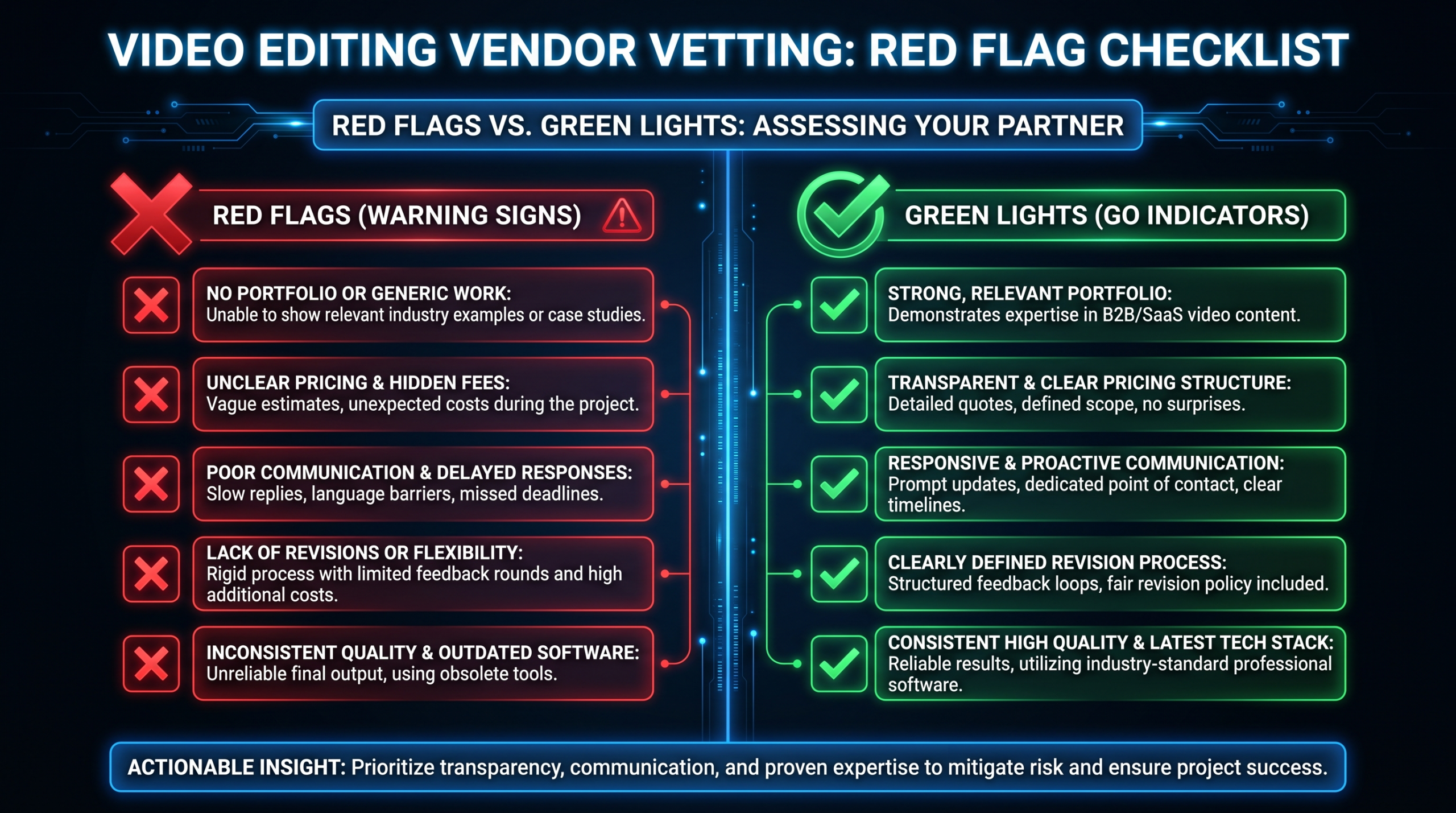
7 Red Flags That Signal a Risky Partner
These aren't hypotheticals - they're patterns that consistently show up in failed agency relationships. If you encounter multiple flags from one vendor, treat it as a disqualifier.
Red Flag 1: No SLAs or Vague Turnaround Guarantees
Any serious editing partner should be able to give you specific, written turnaround commitments: "First draft delivered within X business days of receiving approved footage." If an agency responds to this question with "it depends" or "we do our best," that's the exact answer you'll get when you need to escalate a missed deadline.
Look for: written SLAs that specify turnaround by video type, what happens when they miss (credit? escalation path?), and how rush requests are handled and priced.
Watch out for: vague language like "fast turnaround," "quick edits," or "we always deliver on time" without numbers attached.
Red Flag 2: Portfolio Mismatches With Your Industry or Content Type
A showreel full of wedding films and YouTube vlogs is not evidence of SaaS product video capability. The cognitive and technical demands of editing a product demo, explainer, or customer success story are completely different from lifestyle content. Brand voice, screen recording integration, motion graphics for UI walkthroughs, and pacing for conversion-focused content are specialized skills.
Ask to see: three recent examples of the specific video type you need (product demo, explainer, customer testimonial) for a B2B software company. If they can't provide this, they're asking you to pay for their learning curve.
Red Flag 3: Vague or All-Inclusive Pricing With No Defined Scope
Pricing that sounds too comprehensive - "everything included, unlimited revisions, no extra fees" - is almost always hiding scope ambiguity that benefits the agency in disputes. Conversely, unusually low quotes often mean the proposal is scoped to a simpler version of what you described.
What good pricing looks like: itemized or clearly tiered with defined deliverables per tier, explicit revision policies (rounds included + overage rate), and clear language about what's out of scope. Our breakdown of what video editing services typically include is useful benchmarking here.
Red Flag 4: Single-Editor Dependency
Small shops often run on one or two editors. If your primary editor gets sick, leaves, or takes on a bigger client, your project stalls or gets handed to someone who doesn't know your brand. This is one of the most common sources of quality degradation at month three and beyond.
The right answer to "what happens if my editor is unavailable?" should include: a backup editor who has already reviewed your brand guidelines, a handoff process, and examples of how they've managed transitions for existing clients.
Red Flag 5: No Brand Consistency Protocol
If an agency can't describe a specific process for capturing and applying your brand standards - colors, fonts, motion style, tone of voice for on-screen text, lower-third templates - then every new project will require you to correct the same mistakes. That revision overhead accumulates quickly.
Look for: a documented brand onboarding process, templated style guides they maintain per client, and evidence of consistent output across multiple videos for the same client in their portfolio.
Red Flag 6: Slow or Evasive Communication During Discovery
How an agency communicates before you're a client is the best predictor of how they'll communicate after. If responses are slow during the sales process - when they're trying to win your business - they'll be slower once the contract is signed.
Specific signals: taking more than 24 hours to respond to emails during active evaluation, giving vague answers to direct questions, or getting defensive when you push for specifics. An agency that can't handle straightforward procurement questions won't handle production feedback well either.
Red Flag 7: Lock-In Without Performance Guarantees
A 12-month contract with no performance clause and no exit conditions is a one-sided agreement. If the agency requires long-term commitment but offers no quality benchmarks, output minimums, or exit rights tied to performance, you're assuming all the risk.
Reasonable contract terms: 3-month minimum with month-to-month after that, performance SLAs that trigger a review or credit if missed, and a defined process for raising quality disputes.
12 Questions to Ask on a Discovery Call
These questions are designed to get past the prepared pitch and into operational reality. Use them in your first or second call - ideally with the production lead or account manager, not just the sales rep.
About the Team
- "Who specifically would be editing our videos, and can we meet them before signing?" - A good agency will connect you with the actual editor. Hesitation here means you might be buying a name-brand agency and getting an offshore subcontractor you never vetted.
- "What's your editor retention rate, and how long has your average account editor been with the company?" - High turnover is a quality and consistency risk. Look for multi-year tenure on senior accounts.
- "If our primary editor is unavailable, what's the backup process?" - A non-answer is a red flag (see above). A good answer describes a specific, tested process.
About the Process
- "Walk me through exactly what happens between us handing over footage and receiving the first draft." - This reveals whether they have a real workflow or improvise. You want to hear about intake checklists, project management tools, QA steps, and a named PM.
- "What project management tool do you use for client communication, and how many touchpoints should I expect per project?" - Agencies that operate entirely by email are harder to hold accountable than those using Frame.io, Asana, or a dedicated client portal.
- "What's the longest turnaround you've had on a project like ours, and what caused it?" - Every agency has had delays. How they answer this question - specifically, honestly, with an explanation of what changed - tells you more than "we always deliver on time."
About Brand and Quality
- "How do you capture and apply our brand guidelines? Can you show me the brand guide document you maintain for a current client?" - Not the client's content - the internal style guide they maintain. If they don't have one, they're winging your brand consistency.
- "How many revision rounds are included, and what specifically counts as a new round versus a minor change?" - "Minor change" is where scope disputes happen. The definition should be written, not oral.
- "Can you share three recent examples of videos you've made for B2B SaaS clients, specifically product demos or explainers?" - If you can't get three recent SaaS examples, treat this as a portfolio mismatch.
About Risk and Accountability
- "What happens if you miss an agreed delivery date? Is there a credit or SLA remedy?" - A strong partner will have a defined remedy. "We'll try harder next time" is not a remedy.
- "What's your minimum contract length, and what are the exit conditions?" - You want clarity on what you're committing to and under what circumstances you can leave early without penalty.
- "Do you have any current or past clients we can speak with who are in a similar space to us - B2B SaaS, similar content volume?" - Ask for references you can actually call, not just names to email. Real references answer the phone.
The Vendor Scoring Framework
Once you've completed discovery calls with two or three vendors, use this scoring rubric to compare them objectively. Rate each criterion 1-5. A score below 30 is a disqualifier; 35-40 is acceptable; 40+ is a strong match.
Video Editing Vendor Scoring Rubric
| Criterion | What to Evaluate | Weight | Score (1-5) |
|---|---|---|---|
| Portfolio Relevance | Recent SaaS/B2B examples matching your video type | High | ___ / 5 |
| Team Stability | Named editor assigned, backup plan, retention data | High | ___ / 5 |
| SLA Clarity | Written turnaround commitments with defined remedies | High | ___ / 5 |
| Brand Protocol | Documented brand guide process, template library | Medium | ___ / 5 |
| Communication Quality | Response speed, directness, tool infrastructure | Medium | ___ / 5 |
| Pricing Transparency | Itemized scope, clear revision policy, no hidden fees | Medium | ___ / 5 |
| Contract Fairness | Reasonable commitment length, performance exit clauses | Medium | ___ / 5 |
| Reference Quality | Live references in similar space, not just names | Low | ___ / 5 |
| Scalability | Can handle 2-3x your current volume within 60 days | Low | ___ / 5 |
Use this alongside a concrete cost comparison. For context on what different models should cost at various volumes, our SaaS video production guide covers pricing benchmarks specifically for software companies.
The scoring rubric is intentionally simple. The goal isn't to create a false sense of precision - it's to force the comparison to be about process quality and operational fit, not about who had the most polished proposal deck.
Top Video Editing Companies for SaaS Teams
Most vendor comparison content lists ten companies that were paid to be listed. This section doesn't operate that way. These are the vendors that specifically perform well for B2B SaaS content programs - evaluated against the criteria above, not against SEO keyword lists.
Video Editing Partners for SaaS: At a Glance
| Vendor | Best For | Pricing | SaaS-Specific Strengths | Watch Out For |
|---|---|---|---|---|
| #1 - Video Editing Company | Dedicated teams for Series A-C SaaS | $5K-$16K/mo (Growth, Core, Scale) | Dedicated editor pods, 90-day output guarantee, SaaS-native portfolio | Min. 3-month commitment |
| #2 - Increditors | Premium full-service for SaaS, YouTube, education | Custom retainers ~$2.5K-$12K+/mo | Senior editor + junior editor + PM + creative director pod model; known for doubling YouTube performance | Not SaaS-exclusive; no instant pricing tiers - custom quote required |
| #3 - Vimeo/In-House Hybrid | Companies wanting partial control | Varies widely | Retains brand knowledge internally | Requires in-house PM overhead |
| #4 - Vidico | Explainer and brand films | Project-based, $3K-$25K+ | Strong storytelling, good for one-off hero videos | Not suited for ongoing high-volume editing |
| #5 - Subscription platforms (Vidchops, Video Husky) | High-volume simple content | $500-$2K/mo | Fast turnaround for social clips, podcasts | Sequential queue limits throughput; quality variance on complex edits |
The single most important differentiator for SaaS companies at scale is the dedicated pod model - an assigned senior editor, junior editor, and project manager who deeply know your product, brand, and audience. This is what separates vendors #1 and #2 above from the rest of the market. The cost premium pays for itself in reduced revision cycles and consistent output quality.
For teams evaluating full outsourcing for the first time, our pricing page breaks down exactly what each VEC tier includes and how to match your content volume to the right plan.
According to Wyzowl's annual State of Video Marketing survey, the majority of marketers who use video say it helps them generate leads and understand their product - but only when production quality is high enough to hold attention. Cheap editing that erodes production quality undermines the entire investment.
How to Run a Paid Test Project
Before signing a multi-month agreement with any vendor, run a paid test project. This is the single most reliable signal of how a partnership will actually perform - and any serious agency will accept it.
Structuring the Test
The test project should be representative of your normal workload, not your simplest or most forgiving content. Give them:
- Real footage that reflects your typical quality (not your best-ever footage)
- A brief that matches your standard detail level - not over-specified
- Your actual timeline expectation, not an artificially relaxed one
- Your real brand guidelines, including any tricky elements (complex lower-thirds, specific color grading, branded motion templates)
Pay for the test project at their standard rate. Agencies who agree to "free test edits" to win the contract are often allocating junior resources to make it happen. You want to see what you'll actually get as a paying client, not what they can produce when the deal is on the line.
What to Evaluate
After receiving the first draft, assess four things:
- Brand accuracy: Did they hit your color palette, font usage, logo placement, and motion style without you correcting them first?
- Brief adherence: Does the edit reflect what you asked for, or did they interpret creatively in ways you didn't request?
- Communication quality: How did they handle questions during production? Did they flag potential issues proactively or wait for you to discover them?
- Revision process: When you provided feedback, how did they respond - defensively or constructively? How quickly did the revision arrive?
Green Lights vs. Stop Signs
Test Project Evaluation Matrix
| Observation | Signal | What It Predicts |
|---|---|---|
| First draft nails brand guidelines without correction | Green light | Strong onboarding process, experienced B2B team |
| First draft has multiple brand errors, acknowledged proactively | Yellow light | Learning curve; watch closely in month one |
| First draft has brand errors that are defended or minimized | Stop sign | Quality disputes will be a recurring pattern |
| Delivered on time or early | Green light | SLAs are real, not aspirational |
| Delivered late with proactive communication and an explanation | Yellow light | Processes exist but may need monitoring |
| Delivered late without proactive communication | Stop sign | Communication will be reactive under pressure |
| Feedback incorporated accurately in one revision round | Green light | Good brief-to-output translation; low future revision cost |
| Same feedback needed in three or more revision rounds | Stop sign | Systemic quality control gap - won't self-correct |
If you see two or more stop signs in a test project, move on. The problems that appear on a test - when everyone is trying to make a good impression - are reliably worse on the fifth project of month three.
Contract Must-Haves Before You Sign
Once you've run the test and identified a preferred vendor, review the contract against this checklist before committing. A well-structured agreement protects both sides and prevents the ambiguities that create disputes.
Deliverable Definition
Every deliverable should be defined with specificity: video type, approximate length, included formats (16:9, 9:16, 1:1), and included elements (captions, motion graphics, color grade, sound mix). "Monthly editing package" is not a deliverable definition - it's an opening for a dispute.
Turnaround SLAs in Writing
The contract should specify: business days from footage delivery to first draft delivery, by video type. It should also specify what "business days" means (time zone, excluded holidays) and what constitutes the clock starting (your footage upload, their acknowledgment, or something else).
Revision Policy
Written definition of: how many rounds are included, what constitutes a "round" versus a minor correction, the turnaround time for revision delivery, and the overage rate for additional rounds. "Unlimited revisions" in a contract should be read as an early warning sign - find the actual definition elsewhere in the document or ask for one in writing.
Intellectual Property and Asset Ownership
You should own all final deliverables and source project files. The contract should state this explicitly. Some agencies retain source files as leverage - if you ever want to switch vendors and need to make edits, you're stuck. Insist on source file delivery, or at minimum a right to purchase them.
Performance Exit Clause
If the agency consistently misses SLAs or delivers below agreed quality standards, you should have a defined right to exit without full contract penalty. This doesn't need to be aggressive - something like "three consecutive missed SLAs within 60 days" triggering a 30-day notice period is reasonable and signals a mature agency.
Data Security
For SaaS companies handling unreleased product footage, customer testimonials, or proprietary screen recordings, the contract should include NDAs, a defined list of who has access to your materials, and data handling procedures. This is a genuine business risk, not a formality.
For context on what a comprehensive outsourced editing arrangement should include end-to-end, our video editing services guide walks through the full scope of what should be included in a professional engagement versus what's typically treated as out-of-scope.
The contract review conversation itself is a useful final vetting signal. A partner who engages constructively with your legal questions, proposes reasonable amendments, and treats the process as alignment-building - not adversarial - is demonstrating the collaborative posture you'll need through the relationship. Resistance to reasonable contract terms is a red flag in its own right.
Frequently Asked Questions
How long should a vendor evaluation take before signing?
Plan for two to three weeks from first contact to contract signature. That includes an initial discovery call (week one), review of proposal and portfolio (early week two), a reference call or two (mid week two), and a paid test project turnaround (week two to three). Rushing this process is one of the most common causes of regret - a vendor who pushes you to decide faster than this is prioritizing their close rate over your fit.
What's a reasonable turnaround SLA for a standard product demo video?
For a 2-4 minute product demo with screen recording, voiceover, and basic motion graphics, a first draft within 3-5 business days of receiving organized footage is a reasonable baseline. Some teams targeting faster cadence offer 48-hour turnarounds, but this often comes at a cost to quality review. Anything quoted under 48 hours for a polished demo edit warrants scrutiny - ask to see examples of that speed at your quality bar.
Is it a red flag if a video editing company won't show me the editor who will work on my account?
Yes. Reputable agencies that operate on a dedicated or semi-dedicated model will connect you with the editor before you sign. If an agency is evasive about who specifically will work on your content, that often means they're running a pooled team model where assignments are based on availability rather than brand familiarity. That structure isn't necessarily bad for simple editing, but it creates real consistency problems for complex B2B content programs.
How many reference calls should I do before hiring a video editing company?
At minimum one, ideally two - and specifically with clients who are similar to you in company stage and content type. Ask references: how do they handle missed deadlines, how has quality held up over six-plus months, what's the weakest part of the relationship, and would they re-sign. A reference who answers that last question with "yes, obviously" is worth ten written testimonials.
What's the most overlooked red flag when vetting a video editing partner?
Single-editor dependency. Most SaaS marketing leads evaluate portfolio quality and pricing but don't ask what happens when their editor is unavailable. At agencies built around individual freelancers or small teams, editor departure or unavailability creates a multi-week gap in output - right when you typically need reliability most. Dedicated team structures like those offered by Video Editing Company explicitly solve this by assigning multiple team members to each account, so no single person's absence disrupts your content calendar.
Ready to Vet the Right Partner?
Video Editing Company works exclusively with B2B SaaS teams - dedicated editor pods, written SLAs, and a guarantee to double your video output in 90 days or month four is free. See exactly what each plan includes before your first call.
Book a Free Strategy Call View Pricing Plans