Hire a Video Editor or Outsource? A Framework
TL;DR
For most Series A–C SaaS teams producing under 25 videos/month, outsourcing delivers 30–50% lower all-in cost than a full-time hire — plus faster ramp, elastic capacity for launch spikes, and no vacancy risk. Hiring makes sense when you're consistently exceeding 30 videos/month, need on-site production support, or are building an internal creative studio. Use the scored decision matrix in this guide to quantify your specific situation before committing.
Table of Contents
- The True Cost of a Full-Time Video Editor
- The True Cost of Outsourcing Video Editing
- Speed to Ramp: Hiring vs. Outsourcing
- Volume Spikes and Capacity Flexibility
- Quality Control and Brand Consistency
- Top Video Editing Services for SaaS Teams
- The Scored Decision Matrix
- When to Hire vs. When to Outsource
- FAQ
Your SaaS marketing team has committed to video — and if Wyzowl's annual State of Video survey is any indication, you're not alone: 87–91% of marketing teams consistently report positive ROI from video. The question isn't whether to invest. It's the first structural fork in the road: do you hire a full-time video editor, or outsource to a dedicated agency team?
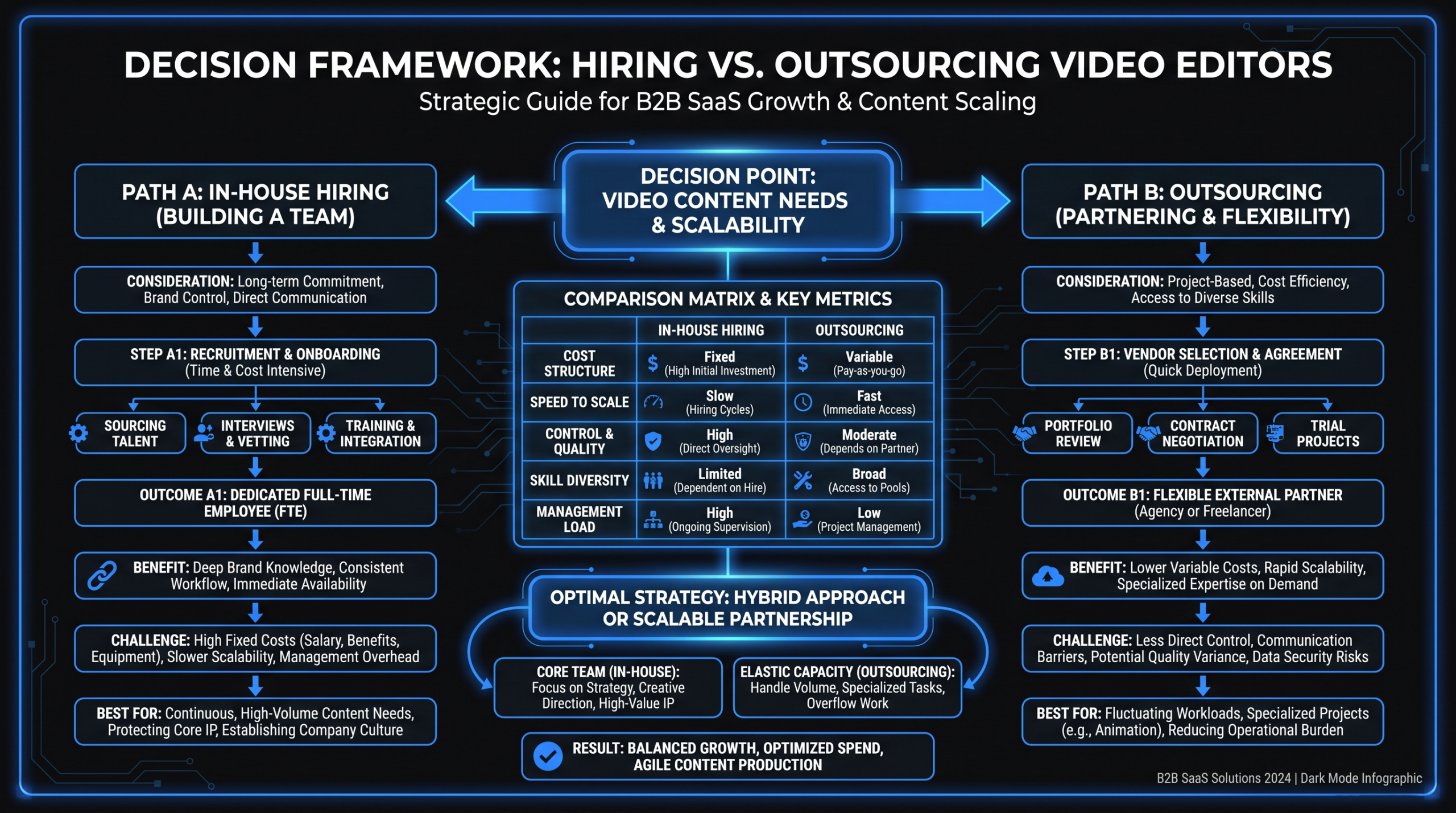
Most companies make this call based on gut feel — a single salary comparison, a colleague's anecdote, or what feels right given headcount pressure. This framework replaces gut feel with a structured evaluation across every variable that actually matters: total cost of employment, speed to first output, brand consistency risks, capacity flexibility during launches, and a scored matrix you can use before your next budget review.
No predetermined answer here — the right path depends on your volume, your team structure, and your content program stage. Here's how to figure out which one is yours.
The True Cost of a Full-Time Video Editor
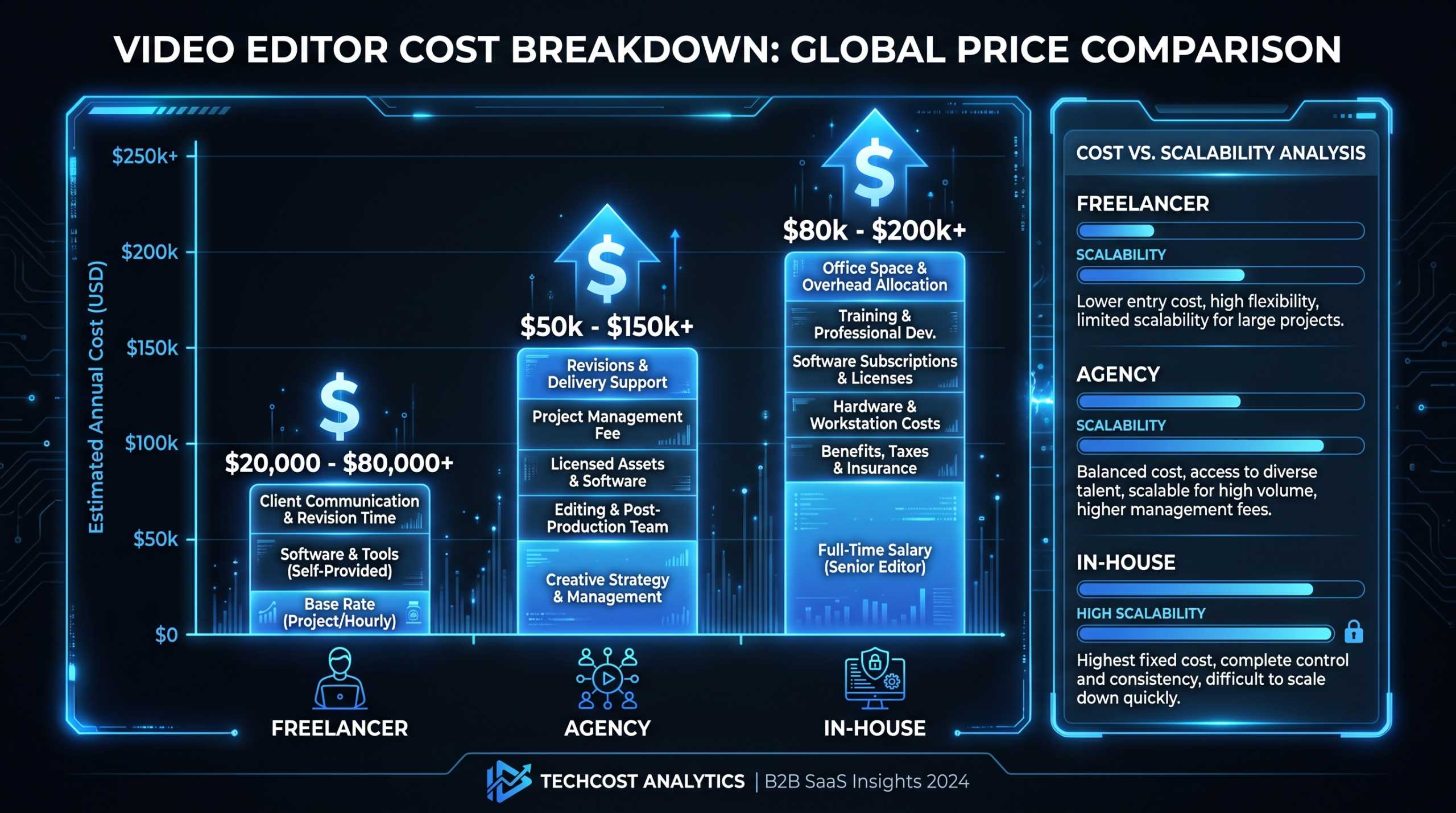
The salary line is not the cost. Marketing leaders who've been burned by this decision almost universally underestimated total cost of employment (TCE). The all-in number is typically 1.5–2x the base salary once you account for every real cost center.
Base Salary and Compensation
A competent mid-level video editor at a Series A–C SaaS company commands $60,000–$80,000/year in base salary in most US markets. In major tech hubs — San Francisco, New York, Seattle, Austin — experienced editors with After Effects and motion graphics proficiency typically start at $70,000+. Junior editors with 1–2 years of experience land between $45,000–$60,000. Senior editors or motion graphics specialists with 5+ years' experience reach $85,000–$115,000.
Benefits, Taxes, and Tooling Overhead
Benefits and employer overhead add 25–40% on top of base salary. Here's a realistic full breakdown for a mid-level editor at $70,000 base in 2026:
Full-Time Video Editor: Total Cost of Employment (US, 2026)
| Cost Component | Annual Estimate | Monthly Estimate |
|---|---|---|
| Base salary (mid-level, US average) | $65,000–$80,000 | $5,400–$6,700 |
| Health / dental / vision benefits | $8,000–$14,000 | $670–$1,170 |
| Payroll taxes (FICA, FUTA, SUTA) | $5,000–$7,000 | $420–$580 |
| 401(k) match (3–4% employer contribution) | $1,950–$3,200 | $160–$270 |
| Software licenses (Adobe CC, DaVinci Studio, stock footage, music) | $3,600–$7,200 | $300–$600 |
| Equipment (workstation, monitors, external drives — amortized 3yr) | $2,500–$5,500 | $210–$460 |
| Recruiting and onboarding (one-time, annualized over 2-year tenure) | $9,750–$20,000 | $810–$1,670 |
| Manager / director oversight (5–8 hrs/week at $80/hr loaded cost) | $20,800–$33,280 | $1,735–$2,775 |
| Total Cost of Employment | $116,600–$170,180 | $9,700–$14,180 |
The Management Overhead Line Most Leaders Ignore
The manager/director oversight line deserves extra attention because it's almost always omitted from internal hire vs. outsource analyses. A video editor — unlike a self-directed senior engineer — requires continuous creative direction: briefing each video, reviewing drafts, giving revision feedback, communicating brand updates, and managing production priorities. At 5–8 hours per week, this represents a significant cost when loaded against a marketing director or VP of Content's hourly rate. It also represents an opportunity cost: those are 5–8 hours not spent on strategy, distribution, or pipeline programs.
The Vacancy and Turnover Risk
US creative roles see meaningful turnover. An editor who leaves after 18–24 months triggers the full recruiting cycle again — and everything they knew about your brand, your feedback style, and your production workflow exits with them. The average time-to-fill for a creative role at a tech company runs 6–12 weeks. During that gap, your video pipeline either stops or someone else on the team absorbs the load. Factor in one turnover event every two years and the annualized recruiting cost alone runs $5,000–$10,000 per year on top of the figures above.
The real all-in cost for an in-house video editor at a Series A–C SaaS company: $9,700–$14,200/month, plus material production risk every time someone leaves.
The True Cost of Outsourcing Video Editing
Outsourcing spans a wide range — from $500/month for a part-time freelancer to $20,000/month for an enterprise dedicated team. The number that matters isn't the sticker price; it's the effective cost per finished, publishable minute of video at your required quality tier. For the granular per-minute math, the video editing cost per minute breakdown is worth reviewing before you negotiate any contract.
Outsourcing Models: What You're Actually Buying
Outsourcing Options: Cost vs. Capacity vs. Consistency
| Model | Monthly Cost | Output Capacity | Brand Consistency | Mgmt Overhead |
|---|---|---|---|---|
| Freelancer (Upwork / Fiverr) | $500–$3,000 | 2–6 videos | Low — no SLA, rotating | High |
| Editing subscription service | $2,000–$6,000 | 8–15 simple videos | Medium — may rotate editors | Medium |
| Agency retainer | $3,000–$10,000 | 6–20 videos | High — PM + defined process | Low |
| Dedicated editing team | $5,000–$20,000 | 12–40+ videos | Very high — assigned team | Very low |
What You Don't Pay For When Outsourcing
This list often matters more than the cost table above:
- No benefits or payroll taxes. The agency handles their own team's compensation structure entirely.
- No software licenses. Adobe Creative Cloud, DaVinci Resolve Studio, stock footage subscriptions, licensed music libraries — all the agency's cost.
- No equipment. Color-calibrated workstations, external drives, GPU rendering rigs — the agency's capital expenditure, not yours.
- No recruiting costs. When an editor leaves the agency's team, they replace them internally — you experience zero production disruption.
- No PTO coverage gaps. When an in-house editor is on vacation, your pipeline stops. A dedicated external team covers internally without involving you.
- No performance management overhead. The agency's PM handles day-to-day feedback cycles, revision tracking, and quality control.
For a complete picture of what professional video editing services include (and exclude), the guide on video editing services: what's included clarifies exactly what you're buying at each service tier before you sign a contract.
Speed to Ramp: Hiring vs. Outsourcing
Speed is a competitive advantage in SaaS marketing. A product launch window closes, a competitor moves, or your CMO shifts the roadmap — and you need video output now. The ramp-up differential between hiring and outsourcing is often the single deciding factor for teams with active content calendars and upcoming launch windows.
The Full Hiring Timeline
- Write and post the job description: 1–2 weeks (internal approvals, HR alignment, drafting JD)
- Active sourcing and application review: 2–4 weeks (LinkedIn, Indeed, creative job boards)
- Portfolio review and phone screens: 1–2 weeks
- Final-round interviews and work sample assessment: 1–2 weeks
- Offer, negotiation, and acceptance: 1 week
- Candidate's notice period at current employer: 2–4 weeks
- IT setup, tool access, first-day onboarding: 1–2 weeks
- Ramp to brand-calibrated, production-quality output: 4–8 weeks
Total: 13–25 weeks from "we need an editor" to first consistent, brand-calibrated output.
That assumes everything goes smoothly — no failed searches, no declined offers, no counteroffers. In practice, first-search success rates for creative roles hover around 60–70%. A failed first search adds another 6–10 weeks to the clock, putting you at 6+ months before your program is running at capacity.
The Outsourcing Onboarding Timeline
- Vendor shortlist and selection: 3–7 days
- Contract and statement of work: 2–5 days
- Kick-off: brand guide sharing, reference video review: 3–5 days
- First draft delivery: 3–7 days after kick-off
- Feedback and calibration (2–3 rounds): 1–2 weeks
- Full brand-calibrated steady-state output: 3–4 weeks after contract
Total: 2–6 weeks from decision to consistent, brand-calibrated output.
For teams running an active content calendar, this 10–20 week difference is often decisive. The outsourcing timeline accelerates further when you arrive at kick-off with a strong brand guide and reference videos ready. For more on running a calibration sprint that cuts onboarding time in half, the full guide on how to outsource video editing is the most practical resource available for this workflow.
Volume Spikes and Capacity Flexibility
SaaS marketing is not a steady conveyor belt of identical deliverables. Product launches demand 15 videos in two weeks. Conference seasons mean repurposing a week of session footage. Funding announcements trigger brand refreshes requiring re-edits of your entire video library. The question isn't just "what does our average monthly volume look like?" — it's "what happens when demand spikes 2–3x for a month?"
The In-House Capacity Ceiling
A single in-house editor is a hard ceiling. A skilled mid-level video editor in a SaaS context can realistically produce 8–12 finished videos per month — a mix of YouTube long-form, short social clips, and the occasional product demo — before quality or deadlines start slipping. Push beyond that threshold and you're burning out your editor, extending delivery timelines, or both.
When a launch spikes demand to 20+ videos in a month, the typical response is to hire overflow freelancers on short notice. This sounds straightforward but creates its own hidden costs: sourcing freelancers in a competitive market, briefing new people on your brand for every spike, accepting quality inconsistency across different editors, and managing invoices and communication with 3–5 contractors simultaneously. The management overhead of "just hiring a few freelancers for the launch" is consistently underestimated by teams that haven't run it before.
Outsourcing Elastic Capacity
A dedicated external team absorbs volume spikes without requiring you to hire, train, or manage additional headcount. When a campaign demands 30 videos in a month, a well-configured dedicated team scales up internally — their PM coordinates additional editors drawn from their team's bench — while you interact with a single point of contact and see consistent quality throughout.
This elastic capacity architecture is one of the core structural advantages of VEC's Core and Scale plans. The guarantee to double your video output within 90 days reflects a dedicated team model where throughput scales with demand rather than headcount on your side of the relationship.
Scenario: SaaS company's normal cadence is 10 videos/month. A major product launch requires 28 videos in 30 days. In-house path: editor works overtime, 4 freelancers hired at short notice at $900–$1,400/video, brand inconsistency across 4 different editors, the PM spends 15+ hours managing overflow coordination. Dedicated team path: pre-agreed capacity expansion protocol activates, same core team plus additional editors briefed by the agency PM, consistent output quality, zero incremental management time on your end.
Quality Control and Brand Consistency
This is where almost every outsourcing objection lives. The concerns are legitimate and worth addressing directly: Will they understand our product? Will the tone match our brand? What happens to our unreleased footage and confidential product recordings?
The Quality Objection: Pooled vs. Dedicated Editors
Quality variability in outsourced video editing is real — but it's a function of the model, not outsourcing itself. The core variable is whether you have dedicated editors (the same people assigned to your account month over month) or pooled editors (whoever is available when your request enters the queue).
Editing subscription services and many freelancer arrangements use pooled models. Each video may go to a different editor. Each editor has to re-learn your brand from whatever brief you include. This is the source of quality variance that gives outsourcing a reputation for inconsistency. Dedicated teams eliminate this at the source. After the calibration cycle — typically 3–5 videos with detailed feedback — a dedicated editor knows your preferred pacing, your visual language, your audio standards, and your tolerance for specific transition styles. That institutional knowledge compounds month over month. According to Wistia's State of Video research, brand consistency across video assets directly impacts viewer trust and conversion — making this not just an aesthetic concern but a revenue-relevant one for SaaS companies with active video programs.
The Brand Consistency Mitigation Playbook
Companies that struggle with outsourced brand consistency typically skipped at least two of these steps. Teams that invest in the front-end work rarely report ongoing brand drift:
- Create a video brand guide. Not just logo specs — your preferred color grading approach, music energy level, acceptable transition styles, text animation preferences, and examples of on-brand vs. off-brand output. This is a 10–15 page living document.
- Record a brand walkthrough video. A 20-minute screencast where your most brand-literate team member walks through 3–5 examples of great vs. mediocre output for your brand is worth more than 50 written pages of guidelines.
- Run a calibration sprint. First two weeks: 2–3 test videos, detailed written feedback on each that explains the why behind every revision. "Transition too fast" is weak feedback. "We never use hard cuts between product UI screens — always a fade or dissolve at 0.4 seconds" is training the team can build on.
- Single internal point of contact. Feedback distributed across three different stakeholders is the fastest way to create brand inconsistency. One person briefs, one person approves. Feedback routes through them — not through Slack at-mentions to the external team.
Security and Confidentiality of Raw Footage
Raw footage of unreleased features, unedited customer testimonials, pre-announcement product recordings — these are legitimate concerns when any external party handles them. Reputable agencies that regularly work with SaaS companies treat security as standard practice:
- Mutual NDAs covering all raw materials and work-in-progress files
- Project-scoped file sharing — not full Google Drive or Dropbox access
- Watermarked review copies until final approval and delivery
- Defined data retention and deletion policies for raw footage post-project
If a vendor can't answer your security questions clearly in the sales process, treat that as a disqualifier. Agencies that regularly work with SaaS companies — who handle these requirements on every engagement — don't treat security as a special accommodation. It's baseline process.
Top Video Editing Services for SaaS Teams
If your decision matrix points toward outsourcing, here are the services worth shortlisting for B2B SaaS content programs. These cover different budget levels, volume tiers, and service models — with honest notes on fit and trade-offs.
Top Outsourced Video Editing Services for SaaS — Ranked
| # | Service | Best For | Starting Price | SaaS Fit |
|---|---|---|---|---|
| 1 | Video Editing Company (VEC) | Dedicated SaaS editing teams at scale | $5,000/mo | ★★★★★ |
| 2 | Increditors | Full-service editor pods, YouTube growth | ~$2,500/mo | ★★★★☆ |
| 3 | Vidpros | Subscription editing, high-volume social clips | ~$995/mo | ★★★☆☆ |
| 4 | Kimp Video | Design + video combo, brand asset creation | ~$1,695/mo | ★★★☆☆ |
| 5 | Tasty Edits | YouTube-focused editing subscription | ~$497/mo | ★★☆☆☆ |
#1: Video Editing Company (VEC) — Best for SaaS Dedicated Teams
VEC builds dedicated editing teams exclusively for B2B SaaS content programs. Plans run Growth ($5K/mo), Core ($9.5K/mo), and Scale ($16K/mo) — all structured around fixed assigned editors, not rotating pools. The guarantee to double your video output within 90 days is backed by the dedicated team architecture: same editors, same PM, consistent accountability. For SaaS marketing teams with ongoing content programs — product demos, case studies, thought leadership videos, and social distribution content — VEC is the strongest fit in this list. The SaaS-exclusive focus means the team understands product-led narratives, feature highlight structures, and the editing rhythms that work for software demos without requiring re-education on every engagement.
#2: Increditors — Premium Full-Service Editor Pods
Increditors (increditors.com) structures its engagements around dedicated editor pods: a senior editor, junior editor, project manager, and creative director working as a unit on each client account. They serve YouTube creators, SaaS companies, finance, and education clients. The pod model is well-regarded for performance — clients in the YouTube space commonly report significant channel growth from the combination of consistent output and strategic input from the creative director. Custom retainers reportedly start around $2,500/month for lighter scopes and reach $12K+/month for full-service programs. Honest trade-offs: Increditors is not SaaS-exclusive (they work across industries), and there are no instant-price tiers — you'll need a custom quote. Contact: [email protected].
Options 3–5: Subscription Services
Vidpros, Kimp Video, and Tasty Edits are legitimate services for teams with simpler, high-volume needs — social clips, podcast video repurposing, YouTube editing without heavy motion graphics or complex product UI recordings. They're priced lower because the model is subscription-based with pooled editors, which works well for straightforward, repeatable edits but introduces quality variance on complex SaaS content like product demos, animated explainers, and customer case studies. For a detailed look at what differentiates these service categories for SaaS content programs, the SaaS video production guide walks through the full spectrum from social-first to enterprise.
The Scored Decision Matrix
Use this framework to quantify your specific situation rather than deciding on intuition. For each criterion, score your needs 1–5 based on which column better describes your reality. Multiply the High-weight rows by 2. Sum both totals and compare.
Hire vs. Outsource: Scored Decision Matrix
| Criterion | Weight | Hire Scores Higher When… | Outsource Scores Higher When… |
|---|---|---|---|
| Monthly video volume | High (×2) | Consistent 30+ videos/month — FTE fully utilized | Under 25 videos/month — FTE capacity sits idle |
| Budget structure | High (×2) | Approved headcount budget; prefer fixed cost | Need variable cost tied to output delivered |
| Time to first output | High (×2) | Planning 6+ months ahead; hiring timeline acceptable | Need production output within 4–6 weeks |
| Volume predictability | Medium (×1) | Steady 15+ videos/month, minimal spikes | Demand varies; regular campaign-driven surges |
| Brand complexity | Medium (×1) | Proprietary visual system requiring daily product access | Brand is documentable; repeatable via style guide + samples |
| On-site collaboration | Medium (×1) | Live event coverage, on-set editing, same-room direction | Async-first team; all footage transferable via cloud |
| Turnover tolerance | High (×2) | Can absorb 8–12 week gaps; video isn't pipeline-critical | Video is pipeline-critical; production gaps hit revenue |
How to Score and Interpret
Score each row 1–5 for both columns based on which description better matches your situation (5 = strongly matches, 1 = weakly matches). Multiply High-weight rows by 2 before summing. If "Outsource" totals 25%+ higher than "Hire," that's the clear directional signal. If "Hire" leads on 5+ of the 7 criteria — especially the high-weight ones — the FTE case has genuine merit.
Most Series A–C SaaS marketing teams, when they run this analysis honestly, find outsourcing scores higher on 5–6 of the 7 criteria. The exceptions are companies with very high consistent volume (30+ videos/month), live event production requirements, or a proprietary visual system that genuinely requires daily in-office presence to maintain.
When to Hire vs. When to Outsource
Hire a Full-Time Video Editor When:
- Your team reliably produces 30+ videos/month and volume is growing quarter-over-quarter
- You have a dedicated filming crew on staff and require on-set editing support or same-room creative direction
- Your brand has a proprietary motion graphics system requiring a specialist to build from scratch and own long-term as a core competency
- Real-time collaboration — live event coverage, same-room editing sessions, on-location production — is a primary non-negotiable requirement
- You're deliberately building an internal creative studio where video editing is a core organizational function, not a support service
- You have approved headcount budget and your finance team strongly prefers fixed cost over variable monthly invoices
- You've already worked with a dedicated outsourced team and consistently hit their maximum capacity ceiling
Outsource Your Video Editing When:
- You currently produce fewer than 25 videos/month on average
- Your volume fluctuates significantly with campaigns, product launches, and seasonal demand spikes
- You need to be producing high-quality video within 4–6 weeks — the hiring timeline isn't viable
- You've experienced production gaps from FTE turnover and can't afford another 8–12 week gap
- Your team is remote-first and async-friendly — footage can be transferred via cloud without on-site dependency
- You want predictable monthly costs without managing employee benefits, software licenses, and equipment procurement
- You want to scale video output faster than your HR process and headcount approval cycle allow
- You need to prove video ROI before committing to a full-time hire
Operational Prerequisites for Either Model
Before committing to either path, audit these prerequisites — their absence creates failure conditions regardless of which model you choose:
- Internal video champion. Someone on your team must own the video content relationship — briefing, reviewing, approving, and communicating brand standards. Outsourcing without anyone on your team having 3–5 hours/week for video produces poor results regardless of the agency's skill level. The same applies to an in-house hire left without creative direction.
- Video brand guide. Hiring an editor without documented visual standards produces brand drift at the same rate as outsourcing without documentation. The guide is a prerequisite, not an enhancement — for both paths. Covering how the intake and briefing process works is worth reviewing before your first kick-off.
- Content calendar. Reactive video production — one-off requests as they surface — never scales efficiently under either model. A rolling 4–6 week content calendar is the minimum operational infrastructure for either path to function consistently.
Frequently Asked Questions
What's the real cost difference between hiring and outsourcing a video editor?
A full-time mid-level video editor in the US typically costs $9,700–$14,200/month all-in when you include salary, benefits, payroll taxes, software licenses, equipment, recruiting, and management oversight. A dedicated outsourced editing team starts around $5,000–$9,500/month at comparable output levels. At 8–15 videos/month, outsourcing commonly saves 30–50% against a full-time hire — and eliminates the production gaps that occur every time an FTE turns over.
Can an outsourced team really match the brand consistency of an in-house editor?
Yes — with a dedicated model and a structured onboarding investment. The critical variable is dedicated editors (assigned to your account) vs. pooled editors (rotated based on availability). Pooled services introduce variability because each video may go to a different editor. A dedicated team with fixed editors builds institutional brand knowledge through repetition — after 30–60 days of consistent work and calibrated feedback cycles, they commonly match or exceed what a same-tenure in-house hire delivers. The investment is front-loaded: a strong brand guide, a walkthrough video, and a structured calibration sprint are the prerequisites.
What security protections should I require from an outsourced team?
At minimum: mutual NDAs covering all raw materials and work-in-progress, project-scoped file sharing (not full drive access), watermarked review copies until final approval, and a defined data retention and deletion policy for raw footage. Reputable agencies that regularly work with SaaS clients treat these as standard process, not special accommodations. If a vendor can't answer your security questions clearly during the sales conversation, that's a disqualifier — it means they haven't worked with enough SaaS clients to have built the process.
How long does outsourcing onboarding take vs. hiring?
Hiring a full-time editor takes 13–25 weeks from job posting to first brand-calibrated output when you include the full timeline: sourcing, interviews, notice period, equipment setup, onboarding, and ramp-up. Outsourcing takes 2–6 weeks from contract signature to consistent brand-calibrated output, with first drafts typically appearing within days of kick-off. For teams with active content calendars and upcoming launch windows, this 10–20 week difference is often the entire decision. The outsourcing timeline accelerates further when you arrive at kick-off with a strong brand guide and reference videos already prepared.
When does hiring a full-time editor clearly win over outsourcing?
The math clearly favors hiring when you consistently produce 30+ videos/month (enough to fully justify an FTE's salary against the per-unit cost), require on-site presence for filming or live event coverage, or are deliberately building an internal creative studio where video editing is a core organizational competency. Below that threshold — which describes most Series A–C SaaS companies — outsourcing typically delivers better economics, faster ramp, and greater flexibility. The pragmatic path: start with a dedicated outsourced team to prove the volume and ROI, then revisit the build-vs-buy decision with real production data rather than projections.
Ready to Double Your Video Output Without the Hiring Risk?
VEC's dedicated editing teams are purpose-built for Series A–C SaaS marketing programs. Get a team fully calibrated to your brand in under 30 days — and double your video output in 90 days, or month 4 is free. Plans start at $5,000/month.
Book a Free Strategy Call View Pricing Plans