
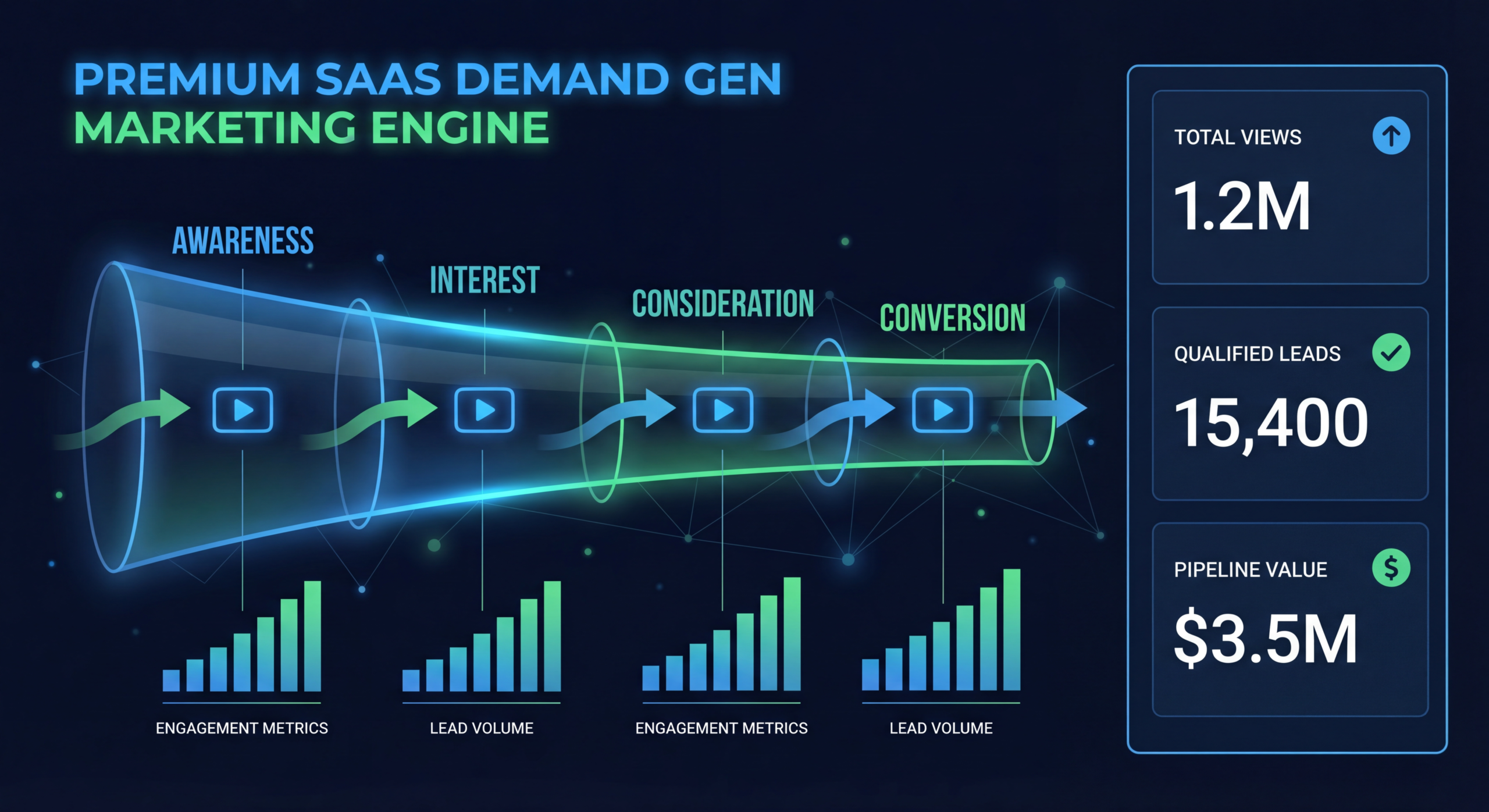
Video for Demand Generation: A B2B Playbook
Demand generation isn't lead generation. Lead gen captures existing demand - someone searching for a solution. Demand gen creates demand - making people aware they have a problem and that solutions exist. Video is the most powerful medium for creating demand because it combines storytelling, education, and emotion in ways that text and static images can't match.
This playbook covers how to build a video-powered demand generation engine for B2B SaaS: what content to create, where to distribute it, how to measure it, and how to scale production without burning your budget.
Table of Contents
The Video Demand Gen Framework
Effective B2B demand generation operates across three layers simultaneously:
Layer 1: Category Creation
Educational content that makes prospects aware of the problem and the category of solutions. Not about your product - about the problem space.
Layer 2: Brand Association
Content that positions your brand as the authority in the category. Thought leadership, expert insights, industry analysis.
Layer 3: Solution Activation
Content that connects the problem to your specific solution. Demos, case studies, comparison content.
Most companies skip straight to Layer 3 - promoting their product to people who don't know they need it. The companies that dominate their category invest heavily in Layers 1 and 2 first.
Why video is the demand gen weapon of choice
- Attention capture: Video stops the scroll better than any other format on LinkedIn, YouTube, and social platforms
- Education at scale: A 5-minute video can explain concepts that would take a 3,000-word blog post
- Emotional resonance: Tone, body language, and music create emotional connections that text can't replicate
- Shareability: B2B buyers share video content with colleagues 3x more than written content
Content Strategy by Funnel Stage
| STAGE | VIDEO TYPE | GOAL | LENGTH |
|---|---|---|---|
| Awareness (TOFU) | Educational videos, industry insights, trend analysis | Reach new audiences, establish expertise | 3-8 min |
| Interest (MOFU) | How-to tutorials, webinar clips, expert interviews | Build trust, nurture interest | 5-15 min |
| Consideration | Case studies, comparisons, product walkthroughs | Demonstrate value, address objections | 2-5 min |
| Decision (BOFU) | Demos, testimonials, ROI calculators | Convert to pipeline | 2-10 min |
| Post-Sale | Onboarding, training, success stories | Expand and retain | 2-10 min |
TOFU: Earning attention
Top-of-funnel video content should be ungated, educational, and generous. The goal isn't to collect emails - it's to make thousands of prospects think, "This company really understands my challenges."
Best TOFU video formats:
- Industry trend breakdowns ("5 changes in [industry] that affect your strategy")
- Expert opinion pieces (founder or team lead sharing a perspective)
- Data-driven insights ("We analyzed 500 companies and found...")
- Problem education ("Why [common process] is costing you more than you think")
MOFU: Building trust
Middle-funnel video nurtures people who are aware of the problem but not ready to evaluate solutions. The goal is to be the most helpful brand in their feed.
Best MOFU formats:
- How-to tutorials related to your problem space
- Webinar recordings and clips
- Expert interviews with customers or industry leaders
- Behind-the-scenes content showing how your team works
BOFU: Converting to pipeline
Bottom-funnel video should make the buying decision feel safe and obvious. Reduce risk, prove outcomes, address specific objections.
Best BOFU formats:
- Customer testimonial videos with specific metrics
- Comparison videos against alternatives
- Personalized demo recordings
- ROI analysis videos
Distribution Channels That Drive Pipeline
Organic channels
| CHANNEL | BEST CONTENT | EXPECTED IMPACT |
|---|---|---|
| LinkedIn (organic) | Thought leadership, insights, clips | Brand awareness + inbound inquiries |
| YouTube | Educational series, tutorials | SEO traffic + long-term discovery |
| Website/Blog | Embedded video on blog posts | 2.6x longer page sessions |
| Email sequences | Video thumbnails in nurture flows | 3x higher CTR vs. text-only emails |
| Podcast (video) | Long-form interviews, panel discussions | Thought leadership + relationship building |
Paid channels
- LinkedIn Sponsored Video: Best for TOFU/MOFU. Target by title, company size, industry.
- YouTube Pre-Roll: Best for awareness at scale. Target by intent (search terms) and affinity.
- Retargeting: Serve BOFU video (testimonials, demos) to people who visited your site or engaged with TOFU content.
Production Playbook
The content engine approach
Instead of producing individual videos, build a content engine that produces multiple assets from each production session:
One production session produces:
- 1 long-form video (8-15 min) ? YouTube, website
- 3-5 short clips (30-90 sec) ? LinkedIn, social
- 1 blog post (transcript + expansion) ? SEO
- 5-10 quote cards/images ? social media
- 1 email with video thumbnail ? nurture sequence
- 1 podcast episode (audio extract) ? podcast platforms
Monthly production cadence
- 2 production sessions/month ? 20+ individual content pieces
- Content types: Alternate between educational (TOFU) and proof-based (BOFU)
- Batch similar content: Record all interviews in one day, all screen demos in another
Ready to Build a Video Demand Gen Engine?
Our team helps SaaS companies build video content systems that generate pipeline month after month.
Book a Free Strategy Call See PricingMeasurement Framework
Leading indicators (weekly)
- Video views and watch time across platforms
- Engagement rate (likes, comments, shares)
- Website traffic from video sources
- New contacts/followers from video content
Pipeline indicators (monthly)
- Leads that engaged with video before converting
- Pipeline influenced by video touchpoints
- Sales cycle length for video-engaged vs. non-engaged leads
- Content-attributed MQLs
Revenue indicators (quarterly)
- Closed-won revenue influenced by video content
- Customer acquisition cost for video-sourced pipeline
- Video content ROI (production cost vs. revenue influenced)
Attribution tip: Perfect attribution is impossible in demand gen. Use a combination of first-touch, multi-touch, and self-reported attribution ("How did you hear about us?"). Don't let attribution paralysis stop you from investing in video.
Scaling Video Demand Gen
Phase 1: Foundation (months 1-3)
- Produce 2 videos/month (1 TOFU, 1 BOFU)
- Distribute organically on LinkedIn and YouTube
- Establish baseline metrics
Phase 2: Expansion (months 4-6)
- Increase to 4 videos/month with repurposed clips
- Add paid distribution (LinkedIn Sponsored Video)
- Launch email nurture sequences with video
Phase 3: Scale (months 7-12)
- 8+ content pieces/month from batched production
- Multi-platform paid distribution
- Personalized video for sales enablement
- Full measurement and optimization loop
Free: 90-Day SaaS Video Calendar
Plan your entire demand gen video strategy with our 90-day calendar template. Pre-mapped to funnel stages and distribution channels.
Download the CalendarReady to get started? Book a free strategy call View Pricing.
Frequently Asked Questions
How much should we budget for video demand generation?
Start with 10-15% of your marketing budget for video production and distribution. For a SaaS company spending $50K/month on marketing, that's $5K-$7.5K/month on video content and paid distribution.
How long before we see results from video demand gen?
Leading indicators (views, engagement) improve within weeks. Pipeline impact typically appears at 3-6 months. Revenue attribution at 6-12 months. Video demand gen is a long game.
Should we gate our video content?
Gate BOFU content (detailed demos, ROI tools) but keep TOFU and MOFU ungated. Gating top-of-funnel videos kills reach and brand building.
Do we need a full production team?
Not initially. Start with a founder or expert on camera + a video editing partner for post-production. Scale the team as you prove ROI. Our clients typically start with 2 videos/month.
How do we get buy-in from leadership for video investment?
Start small with one high-quality video, measure its impact, and present the data. A single customer testimonial video that influences a $50K deal justifies months of video production.

