
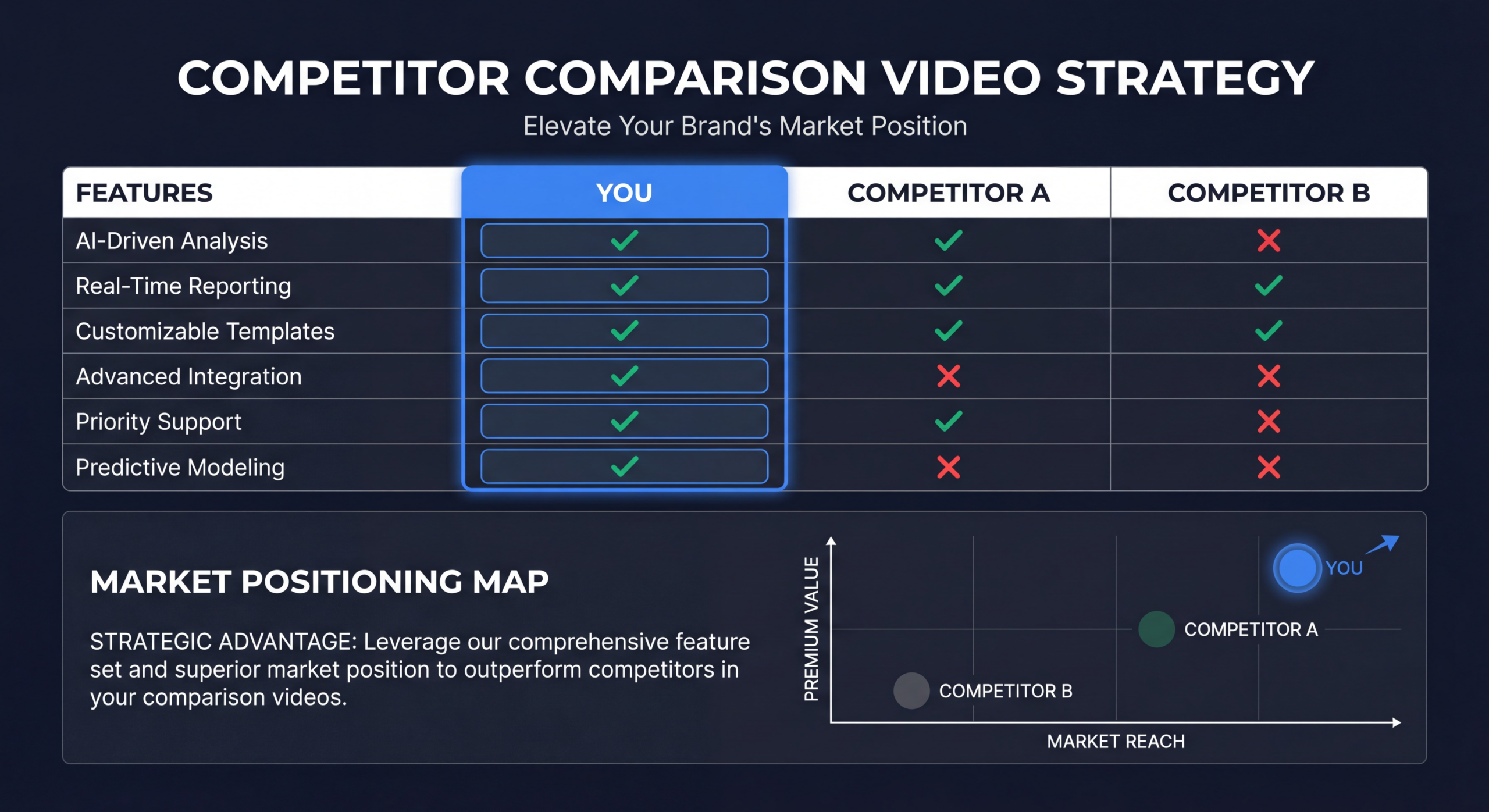
Comparison Video: How to Position Against Competitors
Your prospect has you and two competitors in a spreadsheet right now. They're comparing features, prices, and reviews - trying to figure out which product actually solves their problem. If you're not helping them make that comparison, your competitors are controlling the narrative.
Comparison videos let you own the conversation. They address objections proactively, position your strengths honestly, and - when done right - make prospects trust you more, even when you acknowledge areas where competitors have an edge.
Table of Contents
Why Comparison Videos Win Deals
B2B buying cycles are long, complex, and involve multiple stakeholders. By the time a prospect reaches the comparison stage, they've already identified their problem and shortlisted solutions. They're in decision mode.
At this stage, the vendor who provides the most helpful comparison content wins. Not the vendor who claims to be the best - the one who helps the buyer make a confident decision.
The psychology behind comparison content
- Transparency bias: When a brand acknowledges weaknesses, everything else they say becomes more credible. A company that admits "we're not the best choice for X" gets believed when they say "we're the best choice for Y."
- Effort heuristic: Creating a detailed comparison signals confidence. Prospects unconsciously associate effort with product quality.
- Ownership of narrative: By choosing which factors to compare, you subtly guide the evaluation framework your prospect uses.
Comparison videos vs. comparison pages
| FACTOR | WRITTEN PAGE | VIDEO |
|---|---|---|
| Demonstration | Screenshots only | Live walkthrough of real differences |
| Emotional connection | Limited | Presenter confidence conveys trust |
| Info retention | 10% after 72 hours | 65% after 72 hours |
| Shareability | Forwarded as links | Played in meetings and Slack |
| SEO impact | Strong for keywords | Boosts page dwell time by 2.6x |
5 Types of Comparison Videos
1. Head-to-Head Feature Comparison
Side-by-side walkthrough of specific features. Split screen showing both products completing the same task.
When to use: You win on functionality, speed, or ease of use in specific workflows.
2. Category Comparison
Compare your approach to a category of solutions (e.g., "dedicated team vs. freelancers"). Best when your methodology is the differentiator rather than individual features.
When to use: You're creating a new category or your approach is fundamentally different.
3. Migration Story
Feature a customer who switched from a competitor. They explain why they switched and what changed. This is the most powerful format - comparison plus social proof.
When to use: You have happy customers who previously used your top competitors.
4. Evaluation Framework Video
Teach prospects how to evaluate vendors in your category without comparing yourself to anyone specifically. Positions you as the expert without being adversarial.
When to use: Entering a crowded market and want to establish thought leadership.
5. Use-Case Fit Video
"If you need X, choose us. If you need Y, choose [competitor]." Wins enormous trust because you're explicitly helping prospects make the right decision.
When to use: You serve a specific segment well and want to attract ideal customers while deflecting poor fits.
The Ethical Comparison Framework
The FAIR Framework
F - Facts Only
Every claim must be verifiable. Use publicly available information, product documentation, and customer reviews. Never speculate about competitor weaknesses.
A - Acknowledge Strengths
Credit competitors where they excel. "They have an excellent mobile app" or "Their free tier is more generous." This makes your advantages more believable.
I - Ideal Customer Clarity
Be specific about who each product is best for. "If you're a 10-person startup, [competitor] might be great. At 200+ employees, here's why we're built for you."
R - Results Focus
Compare outcomes, not just features. "Their product does X, ours does X + Y, and here's what that means for your [metric]."
Golden rule: Would you be comfortable if your competitor watched this video? If not, rework it. The best comparison videos earn respect from competitors and trust from prospects.
Scripting Your Comparison Video
A comparison video needs tighter scripting than most content because inaccuracies have real legal and reputational consequences.
Opening (30 seconds)
State the comparison clearly: "We're comparing [Product A] and [Product B] so you can figure out which fits your team." No hype - just clarity.
Criteria Setup (1 minute)
Establish 4-6 evaluation criteria. Choose criteria where you're genuinely strong, but make sure they're things prospects actually care about:
- Ease of setup and time to value
- Pricing structure and total cost of ownership
- Integration ecosystem
- Customer support responsiveness
- Scalability for growing teams
- Reporting and analytics depth
Per-Criteria Comparison (4-6 minutes)
For each criterion: show, don't just tell. If comparing UI, show both products. If comparing pricing, display both pricing pages. If comparing support, show response time data.
Summary + Recommendation (1-2 minutes)
"Choose [Competitor] if [specific scenario]. Choose us if [specific scenario]." Counterintuitive but incredibly effective.
CTA (15 seconds)
"Want to see how [Product] works for your use case? Book a personalized demo."
Production Best Practices
Screen recording quality
- Resolution: Record at 4K, export at 1080p for crisp text
- Mouse movement: Slow, deliberate cursor movement - erratic clicking makes viewers dizzy
- Zoom: Use post-production zoom to highlight specific UI elements
- Demo data: Use realistic data, not "John Doe" and "[email protected]"
Presenter presence
Include a presenter on camera - talking head intercut with screen recordings or picture-in-picture overlay. Adds personality and credibility that pure screen recordings lack.
Visual neutrality
When showing competitor products, maintain visual fairness. Don't color-grade their product darker or choose unflattering screenshots. Let features speak for themselves.
Legal safeguards
- Use publicly available product information only
- Don't modify competitor screenshots or pricing
- Include date stamps ("pricing as of March 2026")
- Have legal review before publishing
Distribution Strategy
| CHANNEL | IMPACT | FORMAT |
|---|---|---|
| Comparison landing pages | Highest - captures high-intent search traffic | Full-length (5-8 min) |
| Sales follow-up emails | High - addresses competitive objections | 2-3 min targeted clip |
| YouTube | High - "[X] vs [Y]" queries have strong volume | Full-length with chapters |
| Paid retargeting | Medium - prospects who visited competitor pages | 30-60 sec highlight |
| Sales decks | Medium - helps SDRs handle objections | 2-min embed |
Need Help Creating Comparison Videos?
We produce competitive comparison videos that win deals without burning bridges. Let's discuss your competitive landscape.
Book a Free Strategy Call See PricingMistakes to Avoid
1. Being negative about competitors
Instead of "Competitor X has a terrible UI," say "Competitor X has a more complex interface for power users. We prioritize simplicity." Same message, completely different perception.
2. Comparing outdated versions
Competitors update products constantly. If your comparison references a feature they've since improved, you lose all credibility. Date your comparisons and update quarterly.
3. Ignoring your weaknesses
If you only highlight categories where you win, prospects see through it. Address 1-2 areas where competitors genuinely excel. Your honesty amplifies everything else.
4. Making it too long
5-8 minutes for a full comparison, 2-3 minutes for focused feature comparison. Anything longer loses the prospect evaluating 5 vendors.
5. Forgetting the viewer's real question
They're not asking "which has more features?" They're asking "which makes my job easier?" Connect every feature to an outcome.
Free: SaaS Video Swipe File
50+ examples of high-performing SaaS videos - including comparison videos that drove real pipeline. Steal the frameworks.
Download the Swipe FileFrequently Asked Questions
Is it legal to make comparison videos about competitors?
Yes, as long as claims are factual and verifiable. Use publicly available information, don't modify competitor materials, include date stamps, and have legal review before publishing.
Should we name competitors directly?
For head-to-head comparisons, yes - prospects already search '[your product] vs [competitor].' For general positioning, category comparison without names can be equally effective.
How often should comparison videos be updated?
Review quarterly, update when competitors make significant product changes, pricing adjustments, or feature launches that affect the comparison.
What if our competitor makes a comparison video about us?
Take it as a compliment - it means you're a real competitor. Respond by creating your own that's more thorough, honest, and helpful.
Can comparison videos hurt partner relationships?
Only if you compare against integration partners. Stick to direct competitors. If a company is both competitor and partner, discuss internally first.

