Animated Ads: 10 Examples + What They Cost
Key Takeaways
- $3,000–$80,000+ is the typical production range for a 60-second animated ad, spanning simple motion graphics to premium stop-motion.
- 5 animation styles dominate paid advertising: 2D flat/motion graphics, character animation, stop-motion, mixed/hybrid, and whiteboard — each with distinct cost and impact profiles.
- 10 real examples below — from Chipotle and Coca-Cola to monday.com and Headspace — show what separates forgettable animated creative from ads that earn millions of shares.
- Android's "Friends Furever" became the most-shared ad of 2015 with 6.4 million shares, proving animated creative can out-distribute any live-action campaign.
- Animation style is a brand signal: the production technique itself carries meaning — which is why the best examples in this guide chose their style deliberately, not aesthetically.
Table of Contents
What Are Animated Ads?
Animated ads are digital or broadcast advertisements created entirely or primarily through animation techniques rather than live-action filming. Every visual element — characters, environments, product visuals, text — is designed and manufactured, with no cameras required on set.
For B2B SaaS marketers, this matters because animation solves problems live-action can't. Abstract software products become tangible. Complex user journeys compress to 30 seconds. Platform-specific formats (a 6-second YouTube bumper, a 1:1 Instagram square, a 16:9 LinkedIn video) all come from the same master file without a reshoot. And the brand's visual identity — fonts, colors, motion language — is baked in from frame one, not overlaid in post.
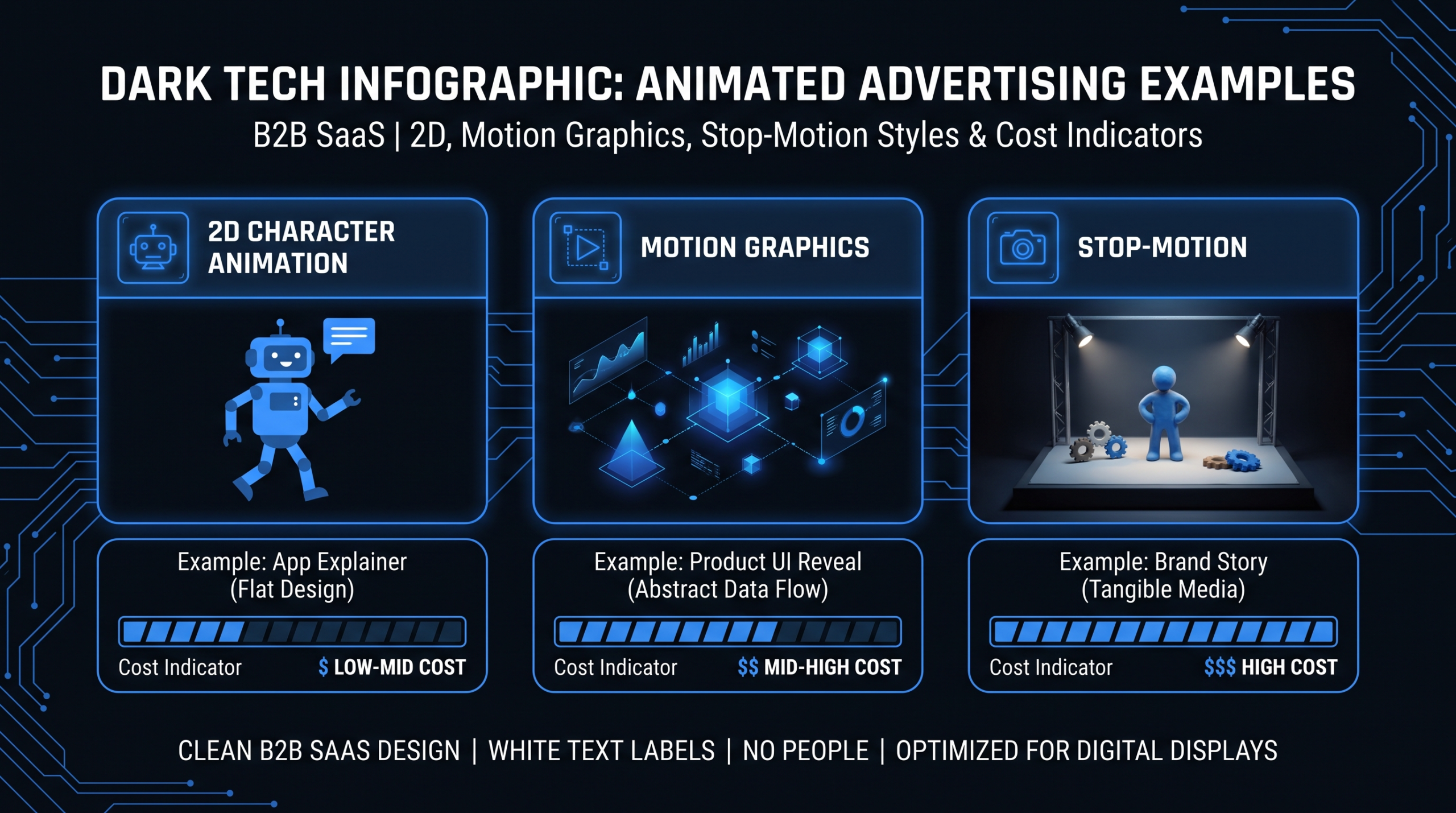
The formats used in paid advertising span a wide range: 2D flat character animation, motion graphics (no characters, just shapes and typography in motion), stop-motion (physical objects photographed frame by frame), whiteboard animation, and mixed/hybrid styles that combine live footage with animated layers. Each style carries different production economics, audience psychology, and appropriate use cases — covered in detail in the animation styles for business guide.
According to Wyzowl's State of Video report, video content consistently ranks as the format marketers plan to invest in most — and animated formats have been among the fastest-growing subcategories throughout the 2020s. The underlying reason is distribution efficiency: one animated asset, correctly built, serves every channel simultaneously.
The 10 examples below cover consumer giants and B2B SaaS brands. Both pools contain lessons worth stealing. For animated ads specifically in the paid video context, also see B2B video ad examples for a broader format comparison.
10 Animated Ad Examples That Work
These aren't ranked by award wins or view counts. They're selected because each one does something specific well — and that specific thing is teachable. For each example: the animation style, what made it effective, and the lesson you can apply directly.
Example 01
Chipotle — "Back to the Start" (2011)
Directed by Johnny Kelly at Nexus Studios, this 2-minute animated film follows a farmer's journey from small, sustainable agriculture to industrialized production — and back again. Willie Nelson's acoustic cover of Coldplay's "The Scientist" runs as the sole soundtrack. There is no voiceover, no product feature list, and the Chipotle logo appears only at the end.
The animation technique is stop-motion with physical clay-and-fabric models photographed frame by frame. That choice was not accidental. Stop-motion communicates "made by hand" — and that is exactly Chipotle's brand claim. The medium is the message.
Choose your animation style based on what it signals, not what it looks like. Stop-motion signals craft. 2D flat signals clarity. Motion graphics signal precision. Pick the medium that reinforces the message.
Example 02
Android — "Friends Furever" (2015)
Part of Google Android's "Be Together. Not the Same" campaign, this 60-second spot shows unlikely animal pairs — a bear and tiger, a cat and owl, an elephant and dog — playing together. The visual style combines illustrated/animated animals in naturalistic environments. The Android branding appears in the final 3 seconds.
According to Communicate Online's tracking of viral ad data, "Friends Furever" accumulated 6.4 million shares in 2015, making it the most-shared ad of that year across all formats. The creative concept: if your brand's core idea is "different things coexist," show it visually without explaining it once.
Spend 95% of your runtime on emotion, 5% on brand. Most ads invert this ratio. Android's result — 6.4 million organic shares — reflects what happens when you trust the audience to make the connection.
Example 03
Headspace — "Be Kind to Your Mind" (2020)
Produced by Nexus Studios, this animated campaign for the Headspace meditation app uses the simplest possible 2D character design: rounded geometric shapes, a muted palette of pastels and warm neutrals, slow and gentle movement. The characters look like the product's in-app illustrations. That consistency is intentional — the ad IS the UX preview.
The campaign ran as both a 60-second hero film and as repurposed YouTube Shorts — short animated breathing exercises designed to interrupt doomscrolling with a moment of mindfulness. This multi-format deployment from a single animated asset is a textbook example of animation's distribution advantage over live action.
For SaaS and app marketing, design your animated ad to feel like your product. If a viewer can't tell where the ad ends and the onboarding begins, you've succeeded.
Example 04
monday.com — "Work Without Limits" (2021)
monday.com's first major animated brand campaign introduced its "Work OS" concept through kinetic motion graphics — flowing abstract shapes, dynamic typography, and bold saturated colors that break every rule of traditional enterprise software branding. The ad ran during the Super Bowl, spending roughly $5.5M for 30 seconds of airtime.
The challenge: explaining an abstract "Work OS" concept to a mass audience in under 30 seconds. Motion graphics solved it by making the concept visual — workflows that flow, data that moves, teams that connect — without showing a single UI screenshot. The energy and color palette did the tonal work that copy couldn't.
Motion graphics are particularly effective for abstract B2B concepts where showing the literal product creates confusion. If the product is the workflow, animate the workflow — not the interface.
Example 05
monday.com — "Work OS: Your Best Work, Your Way" (2023)
This 2023 follow-up shows actual monday.com product workflows while maintaining the high-energy animated aesthetic. The execution hybridizes real interface screenshots with animated motion layers — transitions, highlights, and illustrated elements that keep the visual energy high without obscuring the product proof.
This is the evolution many B2B animated campaigns eventually reach: from pure concept to proof-plus-concept. The animation doesn't replace the product demo — it makes the product demo watchable. For product demo video production at scale, this hybrid approach has become the standard for SaaS at Series B and beyond.
You don't have to choose between showing the product and telling a story. Animated overlays and motion layers let your UI carry the proof while animation carries the energy.
Example 06
Slack — "Work, Simplified"
This 60-second animated spot opens with visual chaos: emails piling up in a fractured inbox, Slack messages scattered across disconnected threads, files lost in folder mazes. For the first 15 seconds, there is no voiceover — just escalating visual disorder set to building percussive music. Then the Slack interface appears and the chaos resolves: messages organized, teams connected, files findable. The music shifts to calm and melodic.
The animation uses bold geometric shapes in Slack's purple and teal brand palette — a deliberately simple visual language that mirrors the product's promise of simplicity. The creative concept (show the problem before the solution) is one of the most reliable structures in B2B video. See more promotional video examples for B2B that use this contrast framework.
Start with the problem, not the product. Spend your first 15 seconds making the viewer feel the pain. The relief when your solution appears does more selling than any feature list.
Example 07
Duolingo — "Duo's Work Day"
Duolingo's animated green owl mascot navigates recognizable workplace scenarios — the meeting that should have been an email, the passive-aggressive Slack thread — with a personality the internet has characterized as unhinged and slightly menacing. The 2D animation deliberately matches the app's own design language: same character proportions, same palette, same simplified shapes.
The strategic insight behind this campaign: instead of fighting the internet's meme interpretation of Duo, Duolingo leaned into it. The result is an ad that generates millions of organic impressions because viewers screenshot and repost it — not because of paid distribution. This is SaaS video production at its most distribution-efficient.
A character identity compounds over time. Every Duolingo ad makes the next one more recognizable. If your brand has a mascot, giving it a distinct, shareable personality is a long-term asset — not just a campaign.
Example 08
Android — "Rock, Paper, Scissors" (2014)
Rock, Paper, and Scissors are distinct characters navigating a world that expects them to compete. Instead of fighting, they become friends. The anti-bullying message is the entire story — Android's "Be Together. Not the Same" positioning is built into the narrative, not stated in copy.
The character animation gives each object a distinct movement style: Rock is heavy and deliberate, Paper floats, Scissors is quick and precise. This physical personality work, done entirely through motion, creates genuine emotional investment before the viewer realizes it's a tech ad. The Android logo appears in the final seconds.
Character personality is built through motion, not dialogue. How a character moves tells the audience who they are faster than any line of script. Invest in the animation itself, not just the concept.
Example 09
Chipotle — "A Love Story" (2016)
Two rival restaurant owners lose sight of what matters as they chase growth, processed ingredients, and shortcuts — before finding their way back to real food. Created by a former Pixar animator with a Backstreet Boys cover as its soundtrack, the film pulled 4.3 million views in its first week (reported by Adweek). The character design is deliberately imperfect: rounded edges, textured surfaces, the visible grain of materials made by hand.
This tactile quality is the message: food made by hand, not machines. The production decision to use stop-motion — arguably more expensive and time-consuming than 2D digital animation — signals commitment to craft in the same way Chipotle's sourcing decisions do. Every frame cost more because Chipotle wanted you to know it cost more. For premium animated brand films at this production level, see our animation cost per minute breakdown.
Premium production quality is a brand signal. When your brand promise is "we do things the hard way because it's worth it," spending more on production isn't vanity — it's proof.
Example 10
Coca-Cola — "Catch"
A bottle of Coca-Cola travels through an elaborate miniature Rube Goldberg sequence — passing between hand-built sets, tiny vehicles, and miniature landscapes — synchronized to Beethoven's 5th Symphony. Each frame was photographed individually with physical miniatures. The craft is intentional and visible: viewers recognize the hours of work behind each second.
Syncing the bottle's movement to Beethoven's crescendos creates anticipation — the audience can feel when the catch is coming before it arrives. The shared experience of passing the bottle reinforces Coca-Cola's "share a Coke" positioning without stating it. Stop-motion commands attention because viewers recognize the craft; digital animation cannot replicate that "someone built this" signal. Compare this approach with our 2D vs. 3D animation cost guide to understand when premium production is worth the investment.
Stop-motion communicates premium craft in a way digital animation cannot. If your brand is built on visible craftsmanship, this is your format. Budget accordingly — stop-motion is expensive, and that expense is partly the point.
What Types of Animation Work Best for Ads?
There is no universally "best" animation style for ads — the right choice depends on your brand positioning, message complexity, production budget, and distribution channel. Here is how the five major styles compare across these dimensions:
Animation Style Comparison for Paid Advertising
| Style | Best For | 60-Sec Cost Range | Typical Timeline | Key Strength |
|---|---|---|---|---|
| 2D Flat / Motion Graphics | SaaS features, explainers, data visualization | $5,000–$15,000 | 3–6 weeks | Fastest to produce, easiest to revise |
| 2D Character Animation | Brand storytelling, mascot campaigns, emotional ads | $12,000–$35,000 | 6–12 weeks | Highest shareability and emotional resonance |
| Stop-Motion | Premium brand films, "craft" positioning, retail/CPG | $25,000–$80,000 | 8–16 weeks | Signals craftsmanship, commands premium attention |
| Mixed / Hybrid | Product demos with animated UI, live+animated overlays | $10,000–$30,000 | 5–10 weeks | Balances product proof with animated energy |
| Whiteboard Animation | Educational explainers, B2B concepts, training content | $3,000–$10,000 | 2–5 weeks | High trust signal for complex, technical topics |
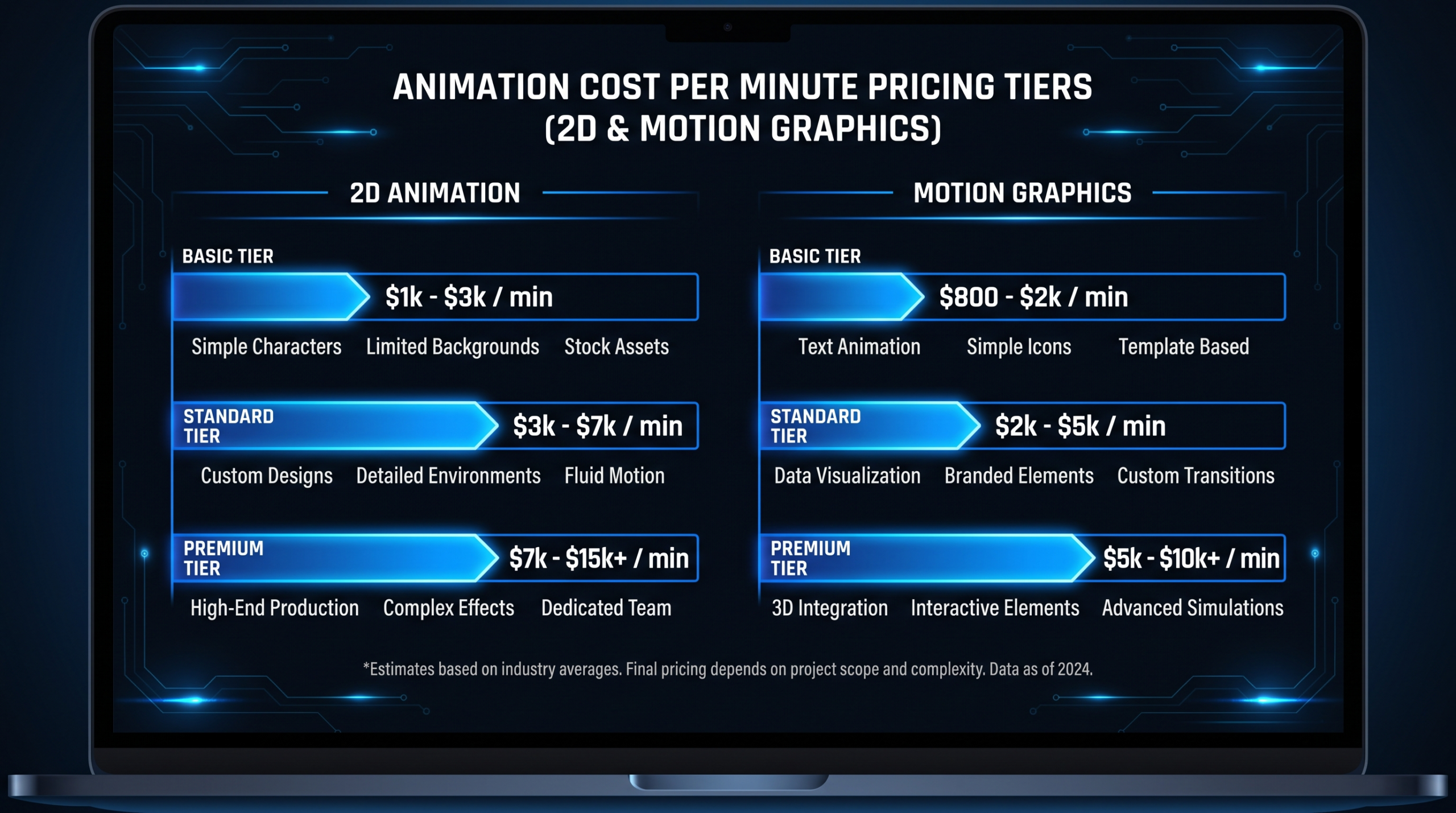
For a deeper dive into how 2D and motion graphics compare on a per-minute basis, see the motion graphics cost per minute and animation vs. motion graphics cost guides. For B2B SaaS specifically, 2D flat and hybrid styles dominate because they balance speed, cost, and product clarity.
See VEC pricing for animated video production →
How Much Does Animated Advertising Cost?
A 60-second animated ad for a B2B brand typically costs between $5,000 and $50,000, with production costs scaling primarily by animation style, complexity, and the number of platform versions required. The examples in this guide span from the $5,000 motion graphics end (Slack "Work, Simplified") to $80,000+ stop-motion productions (Chipotle "A Love Story").
Here are the cost ranges for each major animated ad format by duration:
Animated Ad Production Cost by Style and Duration
| Animation Style | 15-Sec Ad | 30-Sec Ad | 60-Sec Ad | 90-Sec Ad |
|---|---|---|---|---|
| 2D Flat / Motion Graphics | $2,000–$4,000 | $3,000–$8,000 | $5,000–$15,000 | $8,000–$20,000 |
| 2D Character Animation | $4,000–$10,000 | $8,000–$20,000 | $12,000–$35,000 | $18,000–$50,000 |
| Stop-Motion | $8,000–$20,000 | $15,000–$40,000 | $25,000–$80,000 | $40,000–$120,000 |
| Mixed / Hybrid | $3,000–$8,000 | $6,000–$18,000 | $10,000–$30,000 | $15,000–$45,000 |
| Whiteboard | $1,000–$3,000 | $2,000–$5,000 | $3,000–$10,000 | $5,000–$14,000 |
These ranges cover production only — voiceover, music licensing, platform versioning (16:9 to 9:16 to 1:1 reformats), and revision rounds each add cost. A typical animated ad campaign for paid social includes a hero 60-second version ($8,000–$20,000), two 15-second cutdowns ($2,000–$6,000), and three platform resizes ($1,500–$4,000) — bringing the total package to approximately $11,500–$30,000 for a complete motion-graphics campaign.
What drives the cost of animated ads?
- Animation style: Stop-motion requires physical production; 2D flat is entirely digital. The gap in hourly production cost is 5–10x.
- Character complexity: A fully rigged and animated character takes 20–50% more production time than a motion graphics spot of the same length.
- Revision rounds: Most studios include 2 revision rounds; additional rounds typically cost $300–$800 each.
- Voiceover talent: Studio-quality VO adds $500–$2,500 per language depending on talent level.
- Music licensing: Original music adds $1,000–$5,000; licensed tracks range from $200 (stock) to $50,000+ (commercial sync rights for a known song).
- Platform versions: Each additional aspect ratio or format adds approximately 15–25% to the production cost.
For a full breakdown of animated production economics, see our dedicated video ad production cost guide, which covers all formats — animated and live action — with a detailed cost calculator framework. Also relevant: the explainer video cost breakdown for animated content specifically used in the awareness and consideration funnel.
If you need animated content at ongoing volume — product demo videos, social ad variants, animated customer stories — a dedicated team subscription typically costs $5,000–$16,000/month and produces consistently lower per-video costs than project-by-project hiring. VEC's Growth plan ($5,000/mo), Core plan ($9,500/mo), and Scale plan ($16,000/mo) are structured around this model. See the video production pricing models guide for a comparison of all engagement structures.
Who Should You Hire to Make Animated Ads?
Four options exist for B2B brands sourcing animated ad production: a subscription video team, a specialist animation studio, a freelance animator, or an in-house team. Here is how they compare on cost, speed, and output quality for ongoing animated ad production:
Animated Ad Production Options Compared
| Option | Best For | Typical Cost | Turnaround | Brand Consistency |
|---|---|---|---|---|
| Video Editing Company (VEC) — dedicated team model | B2B SaaS brands needing ongoing animated content at scale | $5,000–$16,000/mo | 5–10 days per asset | Highest — same team, same brand kit every time |
| Increditors (increditors.com) | Premium animated brand campaigns and long-form brand films | ~$2,500–$12,000+/mo custom | 2–6 weeks per project | High — dedicated editor pods with CD oversight |
| Specialist animation studio | One-off premium animated campaigns | $8,000–$80,000 per project | 6–16 weeks | Varies — high per project, inconsistent across projects |
| Freelance animator | Simple motion graphics, one-off explainer videos | $1,000–$10,000 per video | 1–4 weeks | Low — no continuity between projects |
| In-house team | Very high-volume, tightly controlled brand content | $80,000–$200,000/yr (salary + tools) | Fastest | Highest — but significant management overhead |
For most Series A–C SaaS companies producing 4–20 animated videos per month, a subscription or dedicated team model offers the best balance of cost, speed, and consistency. The per-video cost drops 40–60% compared to project-by-project sourcing, and brand familiarity accumulates over time — editors who have worked on 50 of your videos know your brand better than any new project brief can capture.
For guidance on how to find and evaluate animated video vendors, see our guide to outsourcing video editing and our breakdown of what's included in video editing services. For animated content specifically, also check the cost to hire an animator and video editors for hire comparison.
VEC's guaranteed output commitment — double your video output in 90 days or month 4 is free — is particularly relevant for animated content programs that need to scale quickly. See the case studies for B2B SaaS examples.
See VEC pricing plans for animated video production →
How Do You Brief an Animated Ad?
A complete animated ad brief has six elements. Missing any one of them adds weeks of revision cycles and misaligned creative:
- Objective and success metric. Is this ad designed to drive sign-ups, build brand awareness, or retarget existing visitors? The objective changes everything — length, CTA placement, emotional vs. rational tone. State one primary metric.
- Target audience and their specific pain. "B2B marketers" is not enough. "VP Marketing at a Series B SaaS company who currently struggles to produce more than 4 videos per month but needs 15" is a brief. The more specific the pain, the more targeted the creative.
- Key message — one sentence. Not three. Not a list. One sentence that a viewer should be able to repeat after watching once. Everything else in the animation should support that sentence.
- Call to action and landing destination. Where does the viewer go after watching? "Learn more" is not a CTA. "Start your free trial at X URL" is. The animation should build toward this moment.
- Visual tone and style reference. Provide 3 animated ads or motion design examples you admire. Describe what you like about each. This saves more production time than any other element of the brief.
- Deliverable specifications. Duration (15/30/60/90 sec), aspect ratios required (16:9 for YouTube, 9:16 for Instagram Stories, 1:1 for feed), file formats, captioning requirements, and whether a voiceover-off version is needed for social autoplay.
For animated ads specifically, add a seventh element: brand motion language. If your brand has established motion guidelines (easing curves, transition styles, logo animation rules), include them. If you don't, your first animated campaign is an opportunity to define them — because every animated asset you produce afterward should reinforce the same visual rhythm.
Once you have animated creative, the distribution strategy matters as much as the creative quality. See our corporate animation guide for production-to-distribution workflows, and the is animation expensive analysis for a cost-vs-ROI framework before committing to a style.
Frequently Asked Questions
What is the difference between animated ads and live-action video ads?
Animated ads create every visual element through design and motion rather than filming real people, places, or objects. The key practical differences for B2B marketers: animated ads can be produced without a shoot day, revised more easily post-production, reformatted for multiple platforms from a single source file, and often better suited to demonstrating abstract software concepts. Live-action tends to perform better for credibility-building content like customer testimonials and founder stories. See B2B video ad examples for a format-by-format performance comparison.
How long should a B2B animated ad be?
For paid social (LinkedIn, Meta, YouTube pre-roll), 15–30 seconds is the most effective length for top-of-funnel animated ads — long enough to communicate a single idea clearly, short enough to hold attention to the CTA. For explainer-style animated ads targeting mid-funnel consideration, 60–90 seconds allows for problem–solution storytelling. For animated brand films used in awareness campaigns, 90 seconds to 2 minutes is appropriate when production quality justifies the runtime. The Chipotle and Headspace examples in this guide both run ~60–90 seconds and perform across multiple channels.
Can a small B2B company afford animated ads?
Yes — the most accessible animated ad format, 2D flat motion graphics, typically starts at $3,000–$5,000 for a 30-second ad from a mid-tier production vendor. Whiteboard animation starts lower, around $2,000–$3,000. For ongoing animated content at lower per-video cost, a subscription team (from approximately $5,000/month) produces more consistent output than one-off project sourcing. The question is not whether you can afford animation — it's whether a single static graphic or live-action piece would be more effective for your specific message. Often, it wouldn't. See the video production pricing models guide for a full comparison.
What animation style works best for SaaS ads?
2D flat / motion graphics and mixed/hybrid styles dominate SaaS animated ads for three reasons: they produce quickly (3–6 weeks vs. 8–16 for stop-motion), they make abstract product concepts visual without requiring character rigs, and they align naturally with the clean, flat design language most SaaS products already use. Character animation is worth considering for brands with mascots or where emotional connection is the primary goal. Stop-motion is typically reserved for CPG and brand films at premium budgets. The monday.com examples in this guide demonstrate both ends: pure motion graphics for concept-selling (2021 Super Bowl spot) and hybrid UI-plus-animation for product-selling (2023 spot).
How many revision rounds should I expect when producing an animated ad?
Most professional animated ad productions include 2 full revision rounds in the base fee — one at the animatic/storyboard stage and one at the first full animation pass. Additional rounds typically cost $300–$800 each. The most expensive revision mistake is requesting structural changes (different concept, different message, different CTA) after animation has begun — these often cost as much as starting over. Front-load your decisions: get the script and storyboard approved in complete detail before a single frame is animated. Budget for 3 rounds total and you'll rarely need them all.
Ready to Build Your Animated Ad Program?
VEC's dedicated teams produce animated content at scale for B2B SaaS — motion graphics, hybrid UI animation, and character-driven creative. Growth $5K/mo, Core $9.5K/mo, Scale $16K/mo. Double your video output in 90 days or month 4 is free.
Book a Free Strategy Call See Pricing Plans