Video Ad Production Cost: 2026 Benchmarks
TL;DR
Video ad production costs in 2026 range from roughly $500 for a simple social ad to $50,000+ for a premium OTT campaign asset. The biggest cost drivers are production complexity (live action vs. animation), runtime, revision scope, and whether you need ongoing ad volume or a one-off. B2B SaaS teams producing ads at scale — 4 to 20+ ads per month — consistently find that a dedicated production retainer delivers the lowest effective cost per asset by a significant margin.
Table of Contents
- What Drives Video Ad Production Cost?
- Video Ad Cost by Format (2026 Benchmarks)
- Breaking Down the Production Stack
- In-House vs. Freelancer vs. Agency: Real Cost Math
- The Volume Equation: Why Scale Changes Everything
- VEC Plans for B2B SaaS Ad Production
- How to Reduce Video Ad Costs Without Sacrificing Quality
- What You Get at Every Budget Level
- FAQ
You're about to brief your team on a video ad campaign — or you've just received a production quote that made you flinch. Either way, you need a clear picture of what video ads actually cost to produce in 2026, and why the numbers vary so dramatically.
This isn't a generic "it depends" article. Below are real market benchmarks, sourced from public agency rate cards and production industry data, with the cost factors that explain every major variation. No fabricated statistics. No "studies show 73%" without context. Just the pricing data you need to budget confidently, negotiate effectively, and decide whether to produce in-house, with freelancers, or via a dedicated agency.
For the broader context of what drives video spend, our video production cost breakdown covers every line item in a typical production budget. This post focuses specifically on video advertising — short-form assets built for paid channels (social, YouTube, OTT, programmatic).
What Drives Video Ad Production Cost?
Video ad production costs aren't random. Every quote you receive is a product of the same five variables:
1. Live Action vs. Animation
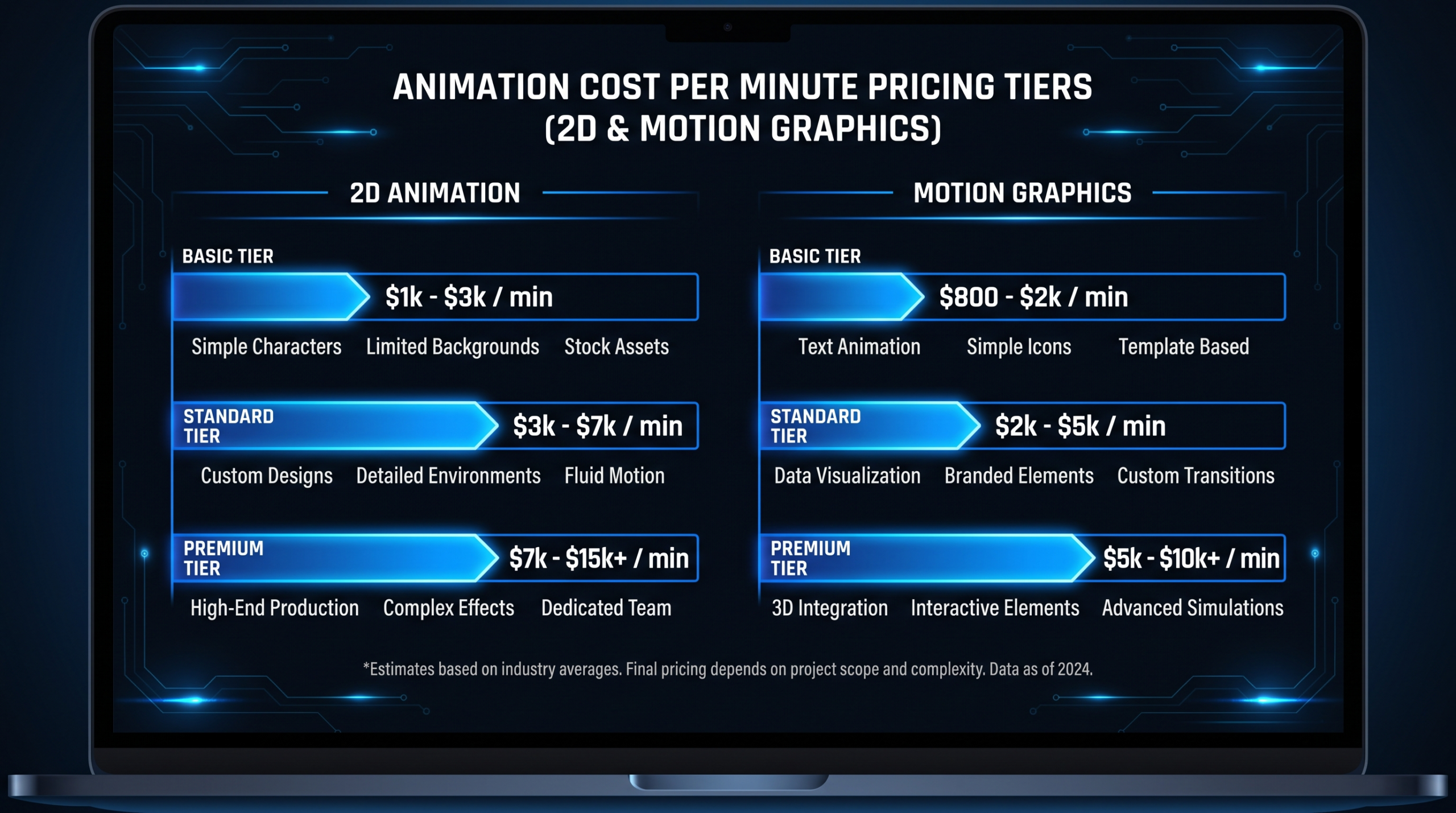
Live action requires physical production — crew, camera, location, talent. Animation requires design time and render time. For ads under 60 seconds, motion graphics and animation often cost more than basic live action because skilled animators command premium rates and execution is slower. The exception: when live action requires expensive locations, multiple shooting days, or on-screen talent.
2. Ad Duration
A 6-second bumper ad and a 90-second brand film are not proportionally priced. Short ads require more creative economy — every second must earn its place — which concentrates skilled editorial and design work. Longer ads add production days and editing hours. Agencies commonly price non-linearly: a 30-second ad isn't twice the cost of a 15-second one; it's often 1.5x to 1.8x.
3. Pre-Production Scope
Script development, creative strategy, storyboarding, and casting add 20–35% to project budgets when done properly. Many low-end quotes exclude this, creating scope creep the moment production begins. Always confirm whether pre-production is included before comparing quotes.
4. Revision Rounds
Most production quotes include two to three revision rounds. Each additional round at a mid-tier agency typically costs $150–$500 per round for simple cuts, substantially more for motion graphics changes. Budget for this upfront or negotiate more rounds into the base price.
5. Distribution Format Variants
A single ad delivered in one format — 16:9 for YouTube — is one deliverable. The same ad adapted for Stories (9:16), LinkedIn (1:1), and display (various) multiplies your deliverable count. Most agencies charge 30–60% of the original edit cost per format variant. If you're running multi-channel campaigns, budget for variants explicitly.
Video Ad Cost by Format (2026 Benchmarks)
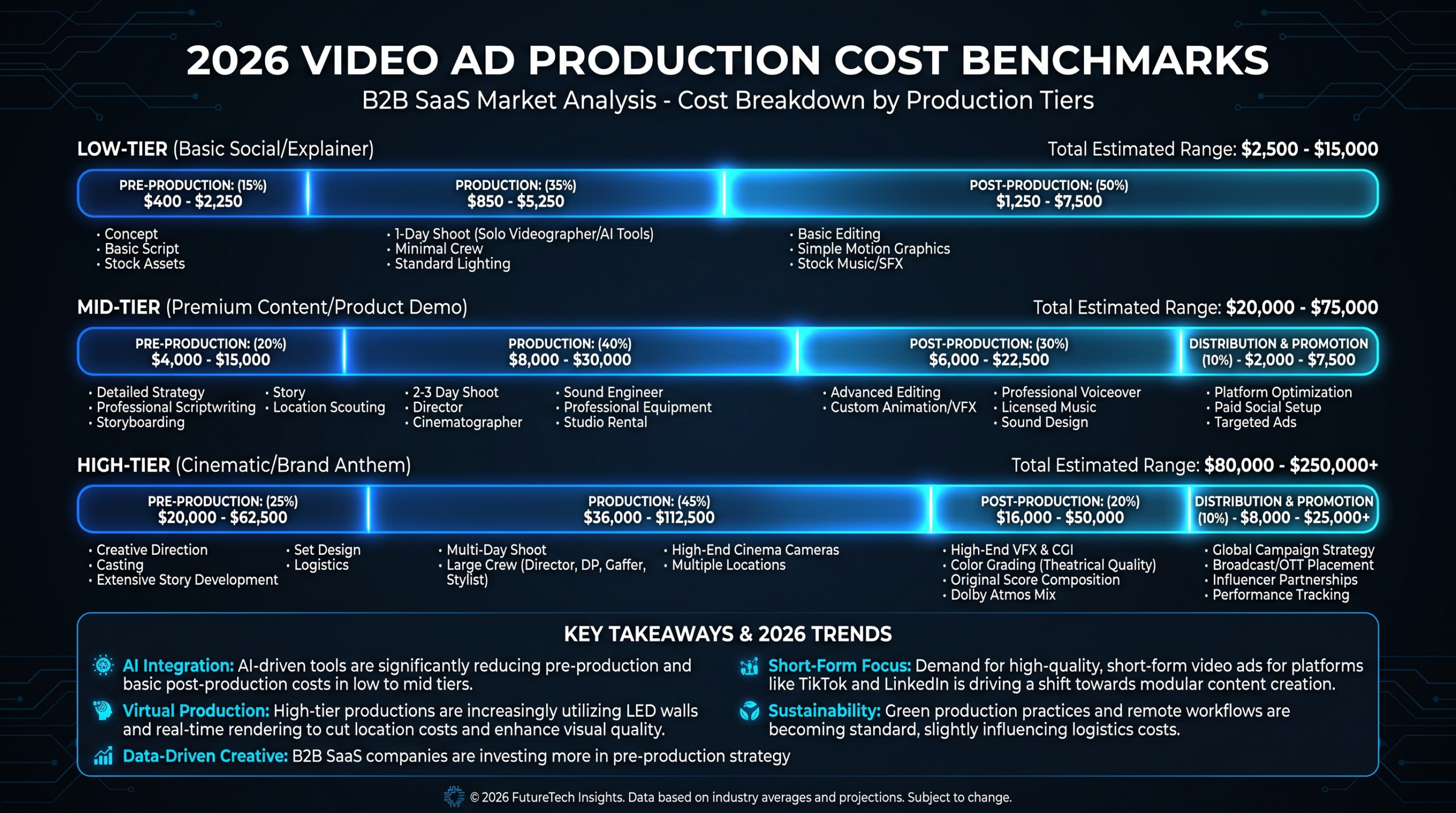
The table below reflects typical market ranges across three production tiers: freelancer (platforms like Upwork/Contra), mid-market agency, and premium production house. Ranges are hedged because geography, complexity, and revision scope move numbers significantly — use these as planning benchmarks, not guaranteed quotes.
Video Ad Production Cost by Format and Tier
| Ad Format | Duration | Freelancer | Mid-Market Agency | Premium Production |
|---|---|---|---|---|
| Social media ad (simple footage edit) | 15–30 sec | $300–$1,500 | $1,500–$5,000 | $5,000–$15,000 |
| Social story / reel ad | 15–60 sec | $500–$2,500 | $2,000–$7,500 | $6,000–$20,000 |
| YouTube pre-roll or skippable ad | 15–30 sec | $800–$4,000 | $3,000–$12,000 | $10,000–$40,000 |
| Animated explainer ad | 30–90 sec | $1,500–$6,000 | $5,000–$20,000 | $15,000–$50,000+ |
| LinkedIn video ad | 15–120 sec | $500–$3,500 | $2,500–$10,000 | $8,000–$25,000 |
| OTT / streaming pre-roll | 15–30 sec | $2,000–$8,000 | $8,000–$25,000 | $25,000–$75,000+ |
| Product demo ad (screen + voiceover) | 60–120 sec | $600–$3,000 | $2,500–$8,000 | $7,500–$20,000 |
What these ranges assume: single format delivery, one round of revisions included, no original footage shooting (using existing assets or stock). Add 30–60% if you need original live-action shoot days; add 20–40% per additional format variant. OTT costs reflect higher quality bar imposed by broadcast-adjacent environments.
For animated ads specifically, see our explainer video cost breakdown — the same motion design economics apply to short ad formats.
Breaking Down the Production Stack
Every video ad — regardless of format or budget — passes through the same three production stages. Understanding how cost distributes across those stages helps you identify where to optimize and where cutting corners creates expensive problems downstream.
Stage 1: Pre-Production (20–30% of total budget)
This is where strategy, script, and creative brief translate into a production plan. For video ads, pre-production includes: creative concept development, script and messaging architecture, storyboarding or animatic, talent casting (if needed), location scouting, and production scheduling. Skipping pre-production is the leading cause of re-shoots and expensive post-production pivots.
Stage 2: Production (30–50% of total budget)
For live-action ads: filming day(s), crew, camera and lighting equipment, sound recording, and on-camera talent. For animation and motion graphics: design, illustration, and base asset creation before any movement. Screen-capture or SaaS demo ads fall closer to the lower end — a skilled editor can produce a polished product demo ad at much lower cost than live-action equivalents.
Stage 3: Post-Production (25–40% of total budget)
Editing, color grading, motion graphics, sound design, music licensing, voiceover integration, and subtitles. For ads targeting paid platforms, this stage also includes platform-specific optimization: safe zones for captions, silence-aware editing for autoplay, and format variants. High-quality post-production is where brand recognition gets built — cheap editing is often visible immediately to savvy audiences.
Production Budget Distribution by Ad Type
| Ad Type | Pre-Production | Production | Post-Production |
|---|---|---|---|
| Simple social clip (existing footage) | 10–15% | 5–15% | 70–80% |
| Live-action product ad (single shoot day) | 20–30% | 35–45% | 25–35% |
| Animated / motion graphics ad | 25–35% | 30–40% | 25–35% |
| Multi-day brand campaign | 25–35% | 40–50% | 20–30% |
The takeaway: if you already have well-shot footage, the post-production stage represents the majority of your cost and opportunity. That's exactly where dedicated editing teams add disproportionate value — they can turn the same raw footage into more polished, on-brand assets faster than a generalist freelancer or in-house team with other responsibilities.
In-House vs. Freelancer vs. Agency: Real Cost Math
The buy-vs-build question comes down to utilization. Let's model the real cost for a SaaS marketing team producing six video ads per month — a mix of social ads, a YouTube pre-roll, and a product demo ad.
Option A: In-House Editor
A mid-level video editor with ad production experience in a US market typically earns $65,000–$95,000 annually in salary. Add benefits, software subscriptions (Adobe Creative Cloud, stock footage, music licensing), equipment amortization, and management overhead, and the true cost lands around $90,000–$130,000 per year — or roughly $7,500–$11,000 per month for full-time capacity. That capacity is only fully utilized if you consistently have 4+ weeks of editing work per month. Most Series A–B SaaS teams don't hit that threshold reliably.
Option B: Freelancer Pool
Skilled freelancers for B2B video ads — people who understand SaaS positioning, can interpret a performance brief, and produce clean motion graphics — typically quote $75–$150/hour or $1,500–$6,000 per ad on a project basis. For six ads per month at mid-range quality, plan for $6,000–$15,000/month. The hidden costs: project management time (your team's hours spent briefing, reviewing, and coordinating), inconsistent style across different freelancers, and no brand familiarity accumulation.
Option C: Dedicated Agency Retainer
A dedicated video production partner handling your ongoing ad output — with a team that learns your brand, SaaS product, and target audience — typically costs $5,000–$16,000/month depending on volume and complexity. The cost-per-ad drops significantly as volume increases, and brand familiarity built over months accelerates production cycles. For teams producing ad content continuously, this model routinely beats per-project freelancer costs after month two or three.
For a deeper look at how pricing models compare across the full spectrum, our guide on video production agency pricing models covers every structure in detail.
The Volume Equation: Why Scale Changes Everything
Video ad performance data from platforms like Meta and YouTube consistently points toward the same finding: creative fatigue is the primary reason ad performance declines over time, not audience exhaustion. The implication is significant: teams that can rotate fresh creative consistently outperform teams that run the same ad until it stops working and scramble to replace it.
According to Wyzowl's annual video marketing research, the share of companies using video as a marketing tool has grown substantially over the past decade, and marketers consistently report that video delivers strong ROI across paid channels. The competitive pressure to produce ad creative at volume is real.
What this means practically: the teams that win on paid video aren't necessarily spending the most per ad — they're producing more ads at sustainable per-unit cost. The economics favor production scale:
- One-off ad production: $5,000–$15,000 per asset at mid-market agency rates
- Four ads per month (retainer): Effective cost typically $1,500–$4,000 per asset
- Ten+ ads per month (dedicated team): Effective cost typically $600–$2,000 per asset
The break-even point varies by vendor, but most B2B SaaS marketing teams find that once they're producing four or more ads per month consistently, the economics of a dedicated retainer or team arrangement become compelling. Use our video production cost calculator to model your specific volume against different production options.
"We went from spending $12,000 per quarter on three freelancer-produced ads to producing eight ads per month through a retainer. The per-ad cost dropped by more than half, and the creative quality improved because the team already knew our product." — Head of Demand Gen, Series B SaaS
VEC Plans for B2B SaaS Ad Production
Video Editing Company structures its services around dedicated teams — a senior editor, junior editor, project manager, and creative direction access — matched to your SaaS brand and ad production needs. The three plan tiers cover the range from growing marketing teams to full-scale content operations:
VEC Video Ad Production Plans
| Plan | Monthly Investment | Ad Output Capacity | Best For |
|---|---|---|---|
| Growth | $5,000/mo | 4–8 ads/month (social, demo, LinkedIn) | Teams building their first ongoing ad program |
| Core | $9,500/mo | 10–16 ads/month (multi-format, YouTube, OTT-ready) | Scaling demand gen teams running paid across channels |
| Scale | $16,000/mo | 20+ ads/month (full multi-format campaign production) | High-volume paid teams treating video as a core growth lever |
Each plan includes VEC's "double your video output in 90 days or month 4 is free" guarantee — a commitment that directly addresses the volume-and-creative-freshness challenge outlined above. See the VEC pricing page for current deliverable specifics per plan.
For teams producing SaaS-specific content — product demos, feature announcements, onboarding sequences — our SaaS video production guide covers the content formats that perform best across the funnel.
How to Reduce Video Ad Costs Without Sacrificing Quality
Budget constraints are real. These approaches consistently deliver cost savings without the quality penalties that often follow generic cost-cutting:
1. Invest in a Modular Script Architecture
Design scripts so that the core message (hook + value prop) and the format-specific close (CTA, offer) are interchangeable modules. One shoot day can produce a 30-second LinkedIn ad, a 15-second YouTube bumper, and a 60-second website video from the same footage. Proper modular scripting adds a few hours of pre-production time but eliminates multiple shoot days.
2. Leverage Existing Footage as a Primary Asset
Most SaaS companies have product recordings, webinar recordings, customer testimonials, and event footage sitting unused. A skilled editor can often produce high-performing social ads and YouTube pre-rolls from existing footage at a fraction of the cost of new production. Before commissioning a shoot, audit what you have.
3. Negotiate Format Variants Into the Base Contract
If you know you'll need a 16:9 cut, a 9:16 vertical, and a 1:1 square of every ad, negotiate this into the base project price rather than ordering variants as add-ons. Agencies offer significant discounts — typically 40–60% off per variant — when variants are scoped upfront rather than added post-completion.
4. Commit to Longer-Term Production Relationships
Agencies and dedicated teams charge less when they know your brand. The first month of any production relationship involves an invisible onboarding tax — time spent learning your positioning, visual style, and review preferences. By month three, that cost is gone. Longer commitments (6–12 months) typically come with 10–20% rate reductions vs. project-by-project work.
5. Use Motion Graphics for Scale, Live Action for Emotion
Motion graphics and screen recordings scale efficiently — once templates and style systems are established, new ads can be produced in hours rather than days. Live action is expensive to shoot but powerful for emotional storytelling. Use each format deliberately: motion graphics for product explanation and retargeting, live action for top-of-funnel brand moments.
What You Get at Every Budget Level
Here's a grounded view of what different monthly video ad budgets realistically deliver in 2026:
Under $2,000/month
Feasible for: 1–2 simple social ads per month using existing footage, edited by a junior freelancer. Expect basic cuts, no motion graphics, limited revision rounds, and high variability across engagements. Suitable for early-stage teams testing paid video for the first time.
$2,000–$5,000/month
Feasible for: 3–6 social and LinkedIn ads per month with a reliable mid-level freelancer or entry-level agency package. Some motion graphics capability, consistent style if you work with the same editor, basic format variants. Good fit for teams that have validated video ad performance and are ready to increase volume.
$5,000–$10,000/month
Feasible for: 6–12 ads per month with dedicated production capacity, including YouTube pre-rolls, multi-format delivery, and motion graphics. This is where dedicated team models start to outperform per-project freelancer arrangements on cost-per-asset. VEC's Growth and Core plans cover this range.
$10,000–$16,000/month
Feasible for: 12–20+ ads per month at professional quality, including OTT-ready assets, animated sequences, and full multi-channel campaign production. Teams at this budget level are treating video production as infrastructure, not a project cost. Brand familiarity from a dedicated team means assets get better and faster over time, not worse.
$16,000+/month
Feasible for: high-volume paid programs, multiple simultaneous campaign tracks, and complex animation or brand films layered into ongoing social output. At this level, the cost-per-asset economics are most compelling — a dedicated Scale-tier team producing 20+ assets per month delivers effective per-unit costs that no per-project model can approach.
For a complete walkthrough of how to structure your video production budget across campaign types, see our video production cost breakdown guide. And if you're still in the planning stage, the production cost calculator can model your specific scenario in under five minutes.
Frequently Asked Questions
How much does it cost to produce a 30-second video ad in 2026?
A 30-second video ad typically costs $1,500–$5,000 via a mid-market freelancer or small agency for a social-platform quality cut using existing footage. For original live-action production with professional post-processing, the same runtime runs $5,000–$15,000 at a production agency. OTT-quality 30-second ads with broadcast-level finishing commonly run $15,000–$40,000. The range reflects creative complexity, production tier, and revision scope — always clarify what's included before comparing quotes.
What's the cheapest way to produce video ads at scale?
The lowest effective cost-per-asset comes from a dedicated production retainer with a team that has learned your brand. Once onboarded, a dedicated team can produce motion graphics ads, screen-based product ads, and social clips far faster than a project-based freelancer who has never seen your brand guide. Teams producing 8+ ads per month typically find retainer economics beat per-project freelancer costs by 40–60% on a per-asset basis. Modular scripting and using existing footage as raw material compounds the savings further.
Does video ad production cost include the media buy?
No — production cost and media spend are entirely separate line items. Production covers creating the ad asset. Media spend covers placing the ad on platforms (Facebook Ads, Google Ads, LinkedIn Campaign Manager, programmatic networks). Most agencies and production companies quote production only. Some full-service agencies bundle both, but they typically earn a margin on the media buy as well. Budget for both separately and track each independently for accurate performance measurement.
How long does video ad production take?
Turnaround depends heavily on pre-production completeness. A social ad using existing footage, with a clear brief, can turn around in 3–7 business days with a dedicated team. Animated explainer ads typically require 3–6 weeks for a first draft. Original live-action production adds shoot scheduling (1–3 weeks) before post-production begins. The fastest path: pre-approved scripts, existing footage, and a team that already knows your brand — all three together can reduce turnaround to 48–72 hours for straightforward social formats.
Are animated video ads more expensive than live action?
For short-form ads (under 60 seconds), high-quality animation is typically more expensive than equivalent live action when you account for design time, illustration, and the skilled labor required for smooth motion graphics. However, animation scales more efficiently: once style guides and motion templates are established, subsequent ads can be produced at significantly lower cost. Live action costs remain relatively flat per shoot day regardless of how many subsequent ads you produce. For teams running ongoing ad programs, animation has a steeper initial investment but better long-term economics. For examples of what these formats look like from top B2B brands — with production cost context — see our B2B promotional video examples guide. Wistia's video research consistently shows that engagement patterns for animated and live-action ads differ by platform and audience — worth factoring into your format decisions.
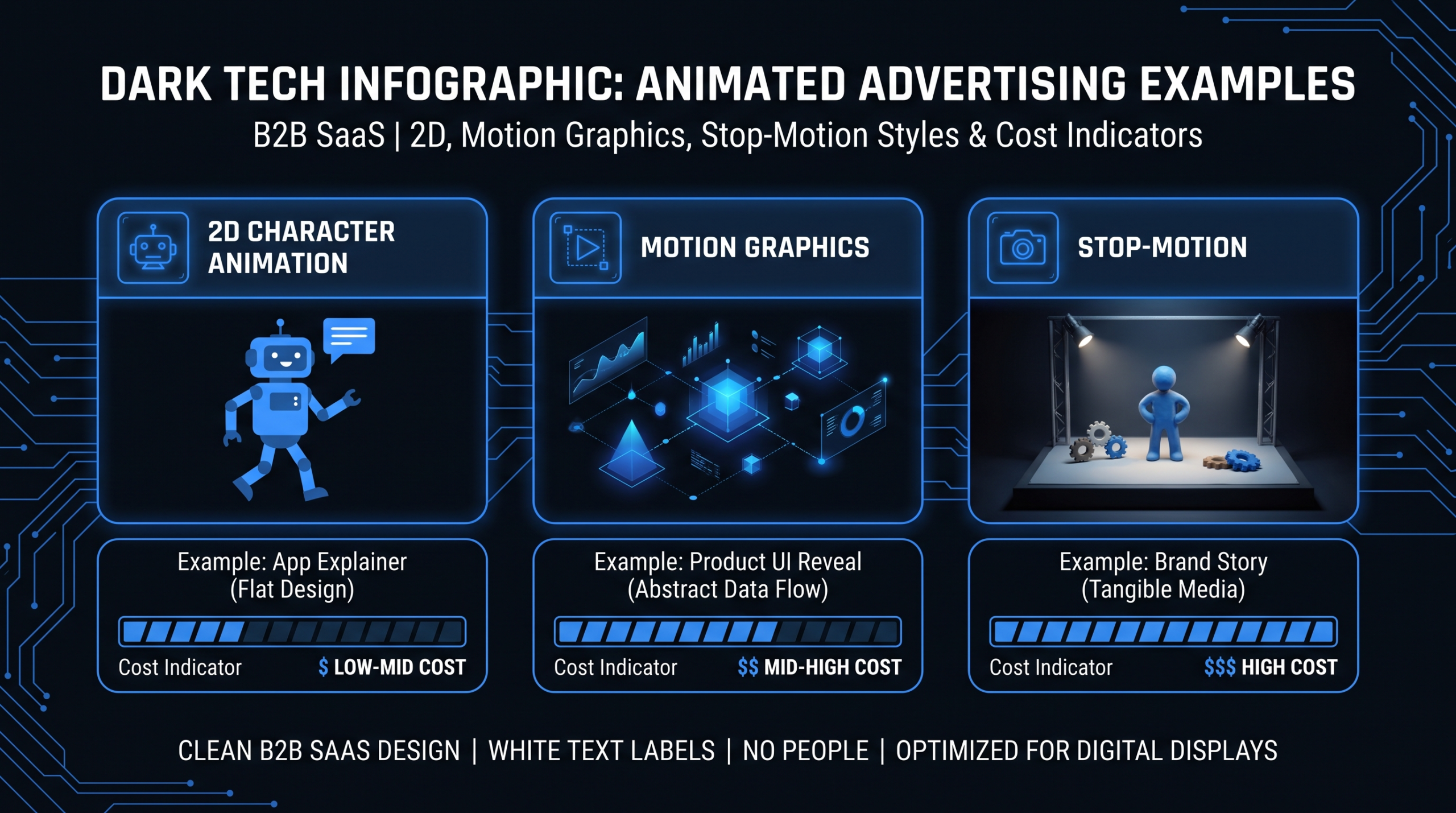
For real-world animated ad examples at each cost tier — from $3,000 motion graphics to $80,000+ stop-motion — see the animated ads examples guide with style-by-style production cost comparisons and lessons from Chipotle, monday.com, and Headspace.
Ready to Scale Your Video Ad Output?
VEC's dedicated teams are built for B2B SaaS companies that need consistent, high-quality ad production — without the overhead of building in-house. Book a call to see which plan matches your volume and budget.
Book a Free Strategy Call See Pricing PlansFor B2B brands that use sizzle reels as paid ad creative — a common format for LinkedIn and YouTube pre-roll — see our sizzle reel examples and cost breakdown to understand how this format is produced and what budgets apply across different production tiers.