2D Animation vs Motion Graphics: Cost
Key Takeaways
- $500–$3,000 per minute is the typical freelancer-to-mid-agency range for motion graphics; full 2D character animation runs $2,000–$15,000+ per minute — a 3–5× cost premium for character work.
- Motion graphics is 2–4× faster to produce than 2D animation, making it the default choice when you need volume, consistent branding, or a quick-turn content calendar.
- A 60-second motion graphics explainer from a mid-tier agency typically costs $3,000–$8,000; the same 60 seconds of 2D character animation costs $8,000–$20,000+.
- Freelancers can cut both costs by 40–60%, but quality control and turnaround consistency are your responsibility.
- In-house animation teams save money at scale — but only if you're producing 10+ minutes of finished animation per month to justify software, licenses, and senior talent costs.
TL;DR
Motion graphics costs $500–$8,000 per 60-second video depending on complexity and who you hire. Full 2D character animation costs $3,000–$20,000+ for the same 60 seconds. Motion graphics wins on speed and budget; 2D animation wins on emotional storytelling and character-driven brand content. For most B2B SaaS teams producing explainers, product demos, and social ads, motion graphics delivers the better ROI — unless your brand specifically needs a character or mascot.
Table of Contents
- Key Takeaways
- What Does 2D Animation vs Motion Graphics Actually Cost?
- How Much Does 2D Animation Cost Per Minute?
- How Much Does Motion Graphics Cost Per Minute?
- What Drives the Cost Difference?
- Freelancer, Agency, or In-House: Who Charges More?
- 3 Real-World Examples: Animation vs Motion Graphics
- How Do You Cut Animation Costs Without Sacrificing Quality?
- FAQ
Motion graphics is cheaper. That's the short answer — but how much cheaper, and when does spending more on 2D animation actually pay off?
This guide gives you real market ranges by hiring model (freelancer, agency, in-house), explains exactly what drives the price gap, and shows three real-world examples of when each format is the right call. No vague estimates — just the decision framework a VP of Marketing actually needs.
What Does 2D Animation vs Motion Graphics Actually Cost?
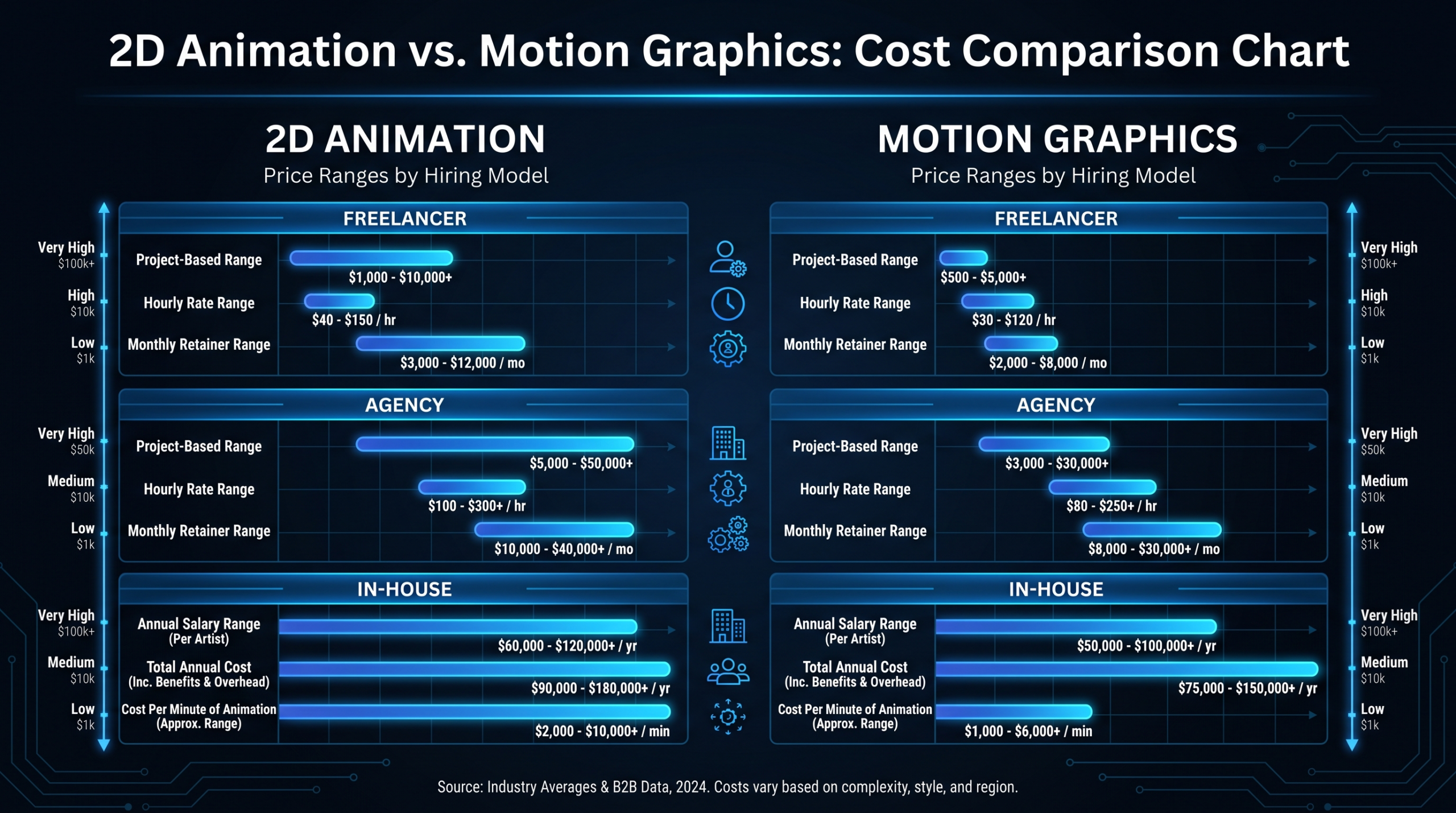
The fastest way to get a clear picture is a direct cost comparison by hiring model. Here's what the market looks like for a 60-second finished video in 2026:
60-Second Video Cost: 2D Animation vs Motion Graphics
| Hiring Model | Motion Graphics (60 sec) | 2D Character Animation (60 sec) | Cost Premium |
|---|---|---|---|
| Freelancer (Upwork/Fiverr, mid-tier) | $500–$1,500 | $1,500–$5,000 | 2–3× |
| Boutique / mid-tier agency | $3,000–$8,000 | $8,000–$18,000 | 2–3× |
| Full-service / premium agency | $6,000–$15,000 | $15,000–$40,000+ | 2–3× |
| In-house team (amortized, 10 min/mo) | $800–$2,000 | $2,500–$6,000 | 2–3× |
Ranges represent typical market rates for B2B-grade work. Style complexity, revision rounds, voiceover, and licensing affect final cost. See our pricing page for current VEC plan rates.
See Pricing → View VEC's Growth ($5K), Core ($9.5K), and Scale ($16K) plans — all include both motion graphics and 2D animation depending on your content mix.
The 2–3× cost gap holds consistent across all hiring tiers. What changes is the absolute dollar spread: a freelancer premium is $1,000–$3,500 per video; a premium agency premium is $9,000–$25,000+. At scale, that math determines your entire content budget.
For a deeper breakdown of what drives per-minute animation pricing, see our guide to animation cost per minute and our overview of motion graphics cost per minute.
How Much Does 2D Animation Cost Per Minute?
2D character animation encompasses a wide range of styles — flat design, cut-out, frame-by-frame, and rigged character animation — and the style choice is the single biggest cost variable. Here's the breakdown by deliverable type:
2D Animation Cost Per Minute by Style
| Style | Freelancer | Mid-Tier Agency | Premium Agency |
|---|---|---|---|
| Simple flat / icon animation | $800–$2,000 | $3,000–$6,000 | $6,000–$12,000 |
| Cut-out / rigged character | $1,500–$4,000 | $6,000–$12,000 | $12,000–$25,000 |
| Frame-by-frame (hand-drawn) | $3,000–$8,000 | $10,000–$20,000 | $20,000–$50,000+ |
| Whiteboard-style animation | $500–$1,500 | $2,500–$5,000 | $5,000–$10,000 |
Frame-by-frame animation is the most expensive because every frame is drawn individually — typically 12–24 frames per second, meaning a 60-second video requires 720–1,440 individual drawings. At a professional animator's rate of $50–$150/hr, a single minute of high-quality frame-by-frame animation can run 40–120 hours of work.
For most B2B SaaS brands, rigged character animation at $6,000–$12,000/minute from a mid-tier agency offers the best balance of quality and cost. Frame-by-frame is reserved for brand mascots or hero content where emotional impact justifies the budget.
See our full guide to 2D animation production costs for a complete style-by-style breakdown, including what affects revision cycles and timeline. Also worth reading: is animation expensive? for an honest assessment of when the premium pays off.
How Much Does Motion Graphics Cost Per Minute?
Motion graphics — animated text, shapes, icons, UI elements, and branded design assets — moves faster and costs less because it doesn't require character design or scene-by-scene illustration. The main cost variables are complexity, brand system depth, and voiceover.
Motion Graphics Cost Per Minute by Deliverable
| Deliverable Type | Freelancer | Mid-Tier Agency | Premium Agency |
|---|---|---|---|
| Simple product explainer (slides → animation) | $300–$800 | $1,500–$4,000 | $4,000–$8,000 |
| Branded motion graphics explainer | $600–$1,800 | $3,000–$7,000 | $7,000–$14,000 |
| Data visualization / infographic animation | $500–$1,500 | $2,500–$6,000 | $6,000–$12,000 |
| Social media ads (15–30 sec) | $150–$500 | $800–$2,500 | $2,000–$5,000 |
| Lower thirds, titles, intros (video package) | $200–$600 | $1,000–$3,000 | $2,500–$6,000 |
The standout value case for motion graphics is social content and product demos. A 15-second social ad at $150–$500 from a freelancer, or $800–$2,500 from an agency, is 5–10× cheaper than commissioning 2D character work for the same length. For SaaS teams running always-on paid social, that multiplier compounds across every campaign.
Animated video continues to rank among the highest-performing B2B content formats — Wyzowl's annual State of Video Marketing report consistently shows animated explainers outperforming text-based content on engagement and recall metrics, making per-minute cost a central budgeting question for marketing teams.
For more detail on per-second and per-minute rates for motion graphics work specifically, see our guide to motion graphics cost per minute.What Drives the Cost Difference?
The cost gap between 2D animation and motion graphics isn't arbitrary — it maps directly to production labor hours. Understanding the drivers helps you negotiate intelligently and scope projects accurately.
Asset Creation Time
Motion graphics reuse and remix design assets — icons, brand colors, shape libraries, UI screenshots. A competent motion designer working from a solid brand kit can animate a 90-second explainer in 20–40 hours. 2D character animation requires original character design, rigging, lip sync, and scene-by-scene staging. The same 90 seconds can take 60–200 hours depending on style complexity.
For context on how these hours translate to team models, see our guide to how much it costs to hire an animator.
Revision Depth
Revisions to motion graphics are typically contained: change the text, adjust a color, reorder a sequence. Revisions to character animation are expensive: reanimate the mouth sync, redraw a gesture, rerender a scene. One round of character animation revisions can add $500–$3,000+ to a project that's already $10,000+.
Style Complexity and Frame Rate
Higher frame rates (24fps vs. 12fps) roughly double the labor in frame-by-frame work. Motion graphics typically run at standard 30fps with no meaningful cost increase. Explore the full range of animation styles for business video to understand which style tier matches your brief before committing a budget.
Software and Pipeline
Motion graphics lives primarily in After Effects, which has a deep freelancer talent pool. 2D animation requires Toon Boom, TVPaint, or similar specialized tools — a narrower talent pool that commands higher rates. The 2D vs 3D animation cost comparison shows how pipeline complexity drives price across the full spectrum.
Freelancer, Agency, or In-House: Who Charges More?
Your hiring model matters as much as the format you choose. Here's how total cost per 60-second video breaks down when you factor in management overhead and quality risk:
True Cost by Hiring Model (60-Second Video, All-In)
| Model | Motion Graphics | 2D Animation | Key Trade-Off |
|---|---|---|---|
| Freelancer (platform) | $500–$2,000 | $1,500–$6,000 | Cheapest; high management overhead; quality variance |
| Freelancer (vetted) | $1,200–$3,500 | $3,500–$10,000 | Better quality; still fragile (sick days, dropout risk) |
| Boutique agency (retainer) | $2,500–$6,000 | $7,000–$15,000 | Consistent; dedicated PM; 3–6 month minimum |
| Full-service agency (project) | $5,000–$15,000 | $15,000–$40,000 | High quality; expensive; slow ramp on new projects |
| In-house team (amortized) | $600–$2,000 | $2,000–$5,500 | Cheapest at scale; $120K–$200K/yr loaded cost for a 2-person team |
| Dedicated video team (VEC model) | $600–$1,800 | $2,000–$6,000 | In-house economics, agency reliability; from $5K/mo |
In-house teams amortize well once you're producing more than 10 minutes of finished video per month — but only if you can keep senior animators busy. Idle senior talent is expensive. For teams producing 3–10 minutes per month, a dedicated team model like VEC's Growth plan ($5K/mo) typically delivers better per-minute economics than maintaining full-time staff.
For more on the economics of outsourcing animation work, see our guide to how to outsource video editing and what's covered in video editing services. For global rate context, the video editing hourly rate by country guide breaks down offshore vs. onshore pricing in detail.
3 Real-World Examples: Animation vs Motion Graphics
Abstract pricing tables only go so far. Here's how the choice plays out in practice for three common B2B SaaS content briefs:
Example 1: SaaS Product Explainer (90 seconds)
A Series B fintech platform needs a 90-second explainer for their homepage and paid social campaigns. Motion graphics wins easily here. The brief calls for UI walkthroughs, feature callouts, and data visualization — all motion graphics native territory. A mid-tier agency produces this in 3–4 weeks for $5,000–$10,000. The same brief produced as 2D character animation would cost $12,000–$25,000 and add 3–6 weeks to the timeline without adding meaningful conversion lift for a UI-heavy product story.
Example 2: Brand Mascot Launch (60 seconds)
A developer tools company wants to launch an animated mascot — a robot character — that appears in tutorials, onboarding flows, and social content. 2D character animation is the only real option. Character consistency across formats requires a designed, rigged character — and that's core 2D animation work. Budget: $15,000–$30,000 for character design plus the initial 60-second launch video. The same brief executed in motion graphics produces a logo-and-icon animation that doesn't deliver the character recognition value the team is paying for.
Example 3: Always-On Social Ad Program (15-second ads, monthly)
A marketing team at a SaaS company needs 8–12 new 15-second animated ads per month for LinkedIn and YouTube campaigns. Motion graphics is the only economically viable choice at this volume. At $300–$800 per 15-second ad from a specialized team, a monthly budget of $3,000–$6,000 keeps the program running. 2D animation at $1,500–$5,000 per 15-second spot would consume the entire paid media budget before a single ad ran.
For the full framework on when to use motion graphics versus live-action versus animation depending on your brief and audience, see our detailed guide to motion graphics vs live action video. And for the cost comparison between animation and live-action production, see animation vs live action cost.
How Do You Cut Animation Costs Without Sacrificing Quality?
Whether you're budgeting for motion graphics or 2D animation, these six approaches consistently reduce cost without compromising output quality:
- Start with a locked script. Every revision to an animation script after production starts costs 3–5× what it would cost on paper. Lock the script, approve it, then animate. Animation teams typically charge $500–$2,000 for revision rounds that start mid-production.
- Provide a complete brand kit. Motion designers working from a solid brand system (colors, typefaces, icon libraries, logo files) spend 20–40% less time on asset creation. Supply everything before the brief lands.
- Use a hybrid approach. Combine 2D animation for your hero/mascot with motion graphics for supporting content. Your character animation budget goes to the high-impact moments; motion graphics handles everything else at lower cost. Corporate animation production guides break this down by use case.
- Reduce complexity, not quality. A simpler character rig with limited facial expressions costs 30–50% less than a fully articulated rig and is often indistinguishable to a viewer watching a 90-second explainer. Work with your animation team to identify where simplification has zero visible impact.
- Repurpose at the asset level. A well-built motion graphics system — character rigs, template layouts, icon libraries — should be reusable across multiple videos. Agencies that charge separately for every asset build are not optimizing your budget. Negotiate to own the source files.
- Use a dedicated team model at volume. If you're producing 5+ animated videos per month, a retainer or dedicated team model reduces your per-video cost by 30–50% compared to project-by-project pricing. See the video production agency pricing models guide for the full economics comparison, and the explainer video cost breakdown for line-item detail on animation projects.
For SaaS-specific guidance on building a scalable video content operation, see our guide to SaaS video production and the video editing cost per minute framework for budgeting ongoing production.
Related Reading
- 2D Animation Production Cost: Full 2026 Breakdown
- Motion Graphics Cost Per Minute (2026)
- Animation Cost Per Minute & Pricing Guide (2026)
- Animation Styles for Business Video (+ Cost)
- Is Animation Expensive? What Drives the Cost
- 2D vs 3D Animation: Cost & When to Use Each
- Product Demo Video Production: Full Guide
- VEC Client Case Studies
Frequently Asked Questions
Is motion graphics cheaper than 2D animation?
Yes — consistently 2–3× cheaper per minute of finished video. Motion graphics typically costs $500–$8,000 per 60-second video (depending on hiring model and complexity), while 2D character animation for the same length runs $3,000–$20,000+. The gap exists because character animation requires original asset creation, rigging, and frame-level labor that motion graphics avoids by working from reusable design elements.
When is 2D animation worth the higher cost?
2D animation earns its premium in three scenarios: (1) your brand needs a recurring character or mascot that builds recognition across touchpoints; (2) the brief calls for emotional storytelling that motion graphics can't deliver — complex narratives, character relationships, humor; (3) you're producing hero content (homepage video, conference launch) where premium production quality has a direct conversion impact. For product demos, social ads, and UI explainers, motion graphics almost always delivers better ROI.
How much does a 60-second animated explainer video cost?
For motion graphics: $3,000–$8,000 from a mid-tier agency, or $500–$2,000 from a freelancer. For 2D character animation: $8,000–$18,000 from a mid-tier agency, or $1,500–$5,000 from a freelancer. Premium agencies charge $15,000–$40,000+ for 2D character work. These ranges assume a complete deliverable including script, voiceover direction, revisions (2–3 rounds), and source files. Additional rounds, stock music licensing, and rush delivery fees are typically extra. See our explainer video cost breakdown for a full line-item view.
Can I mix motion graphics and 2D animation in the same video?
Yes, and it's often the smartest budget decision. A hybrid approach uses 2D animation for the character moments that need emotional impact, and motion graphics for UI walkthroughs, data visualization, and supporting content. This keeps your hero content visually consistent while reducing per-minute costs by 30–50% on the motion-graphics portions. Most full-service agencies and dedicated video teams handle hybrid productions natively — just confirm that the team has both skill sets in-house rather than subcontracting one style.
What's the cheapest way to produce motion graphics or animation at volume?
For consistent monthly volume (5+ videos), a dedicated team model offers the best economics — typically $600–$1,800 per 60-second motion graphics video amortized over a monthly retainer, compared to $3,000–$8,000 per-project. VEC's Growth plan ($5K/mo) is built for exactly this use case: a dedicated team that knows your brand, available daily, without the $120K–$200K loaded cost of an in-house hire. For a full agency-vs-freelance-vs-in-house comparison, see our guide to video production agency pricing models.
For broader benchmarks on video content ROI and production investment, HubSpot's video marketing research hub provides a useful framework for connecting animation budget decisions to measurable outcomes.
Ready to Budget Your Next Animation Project?
VEC's dedicated animation and motion graphics teams work exclusively with B2B SaaS brands. Growth plan from $5K/mo — includes both motion graphics and 2D animation depending on your content mix, with a dedicated senior editor, PM, and 90-day output guarantee.
See Pricing Book a Free Strategy Call