Is Animation Expensive? What Drives the Cost
Animation is not cheap by default — but it is not a single price. Costs range from $200 for a 30-second motion graphics clip produced on Upwork to $30,000+ for a studio-crafted character explainer, and where your budget lands depends almost entirely on style, duration, and who you hire.
Table of Contents
- Key Takeaways
- Animation Cost at a Glance
- What Makes Animation Expensive?
- How Much Does Animation Cost by Type?
- Freelancer, Agency, or In-House — Which Is Cheaper?
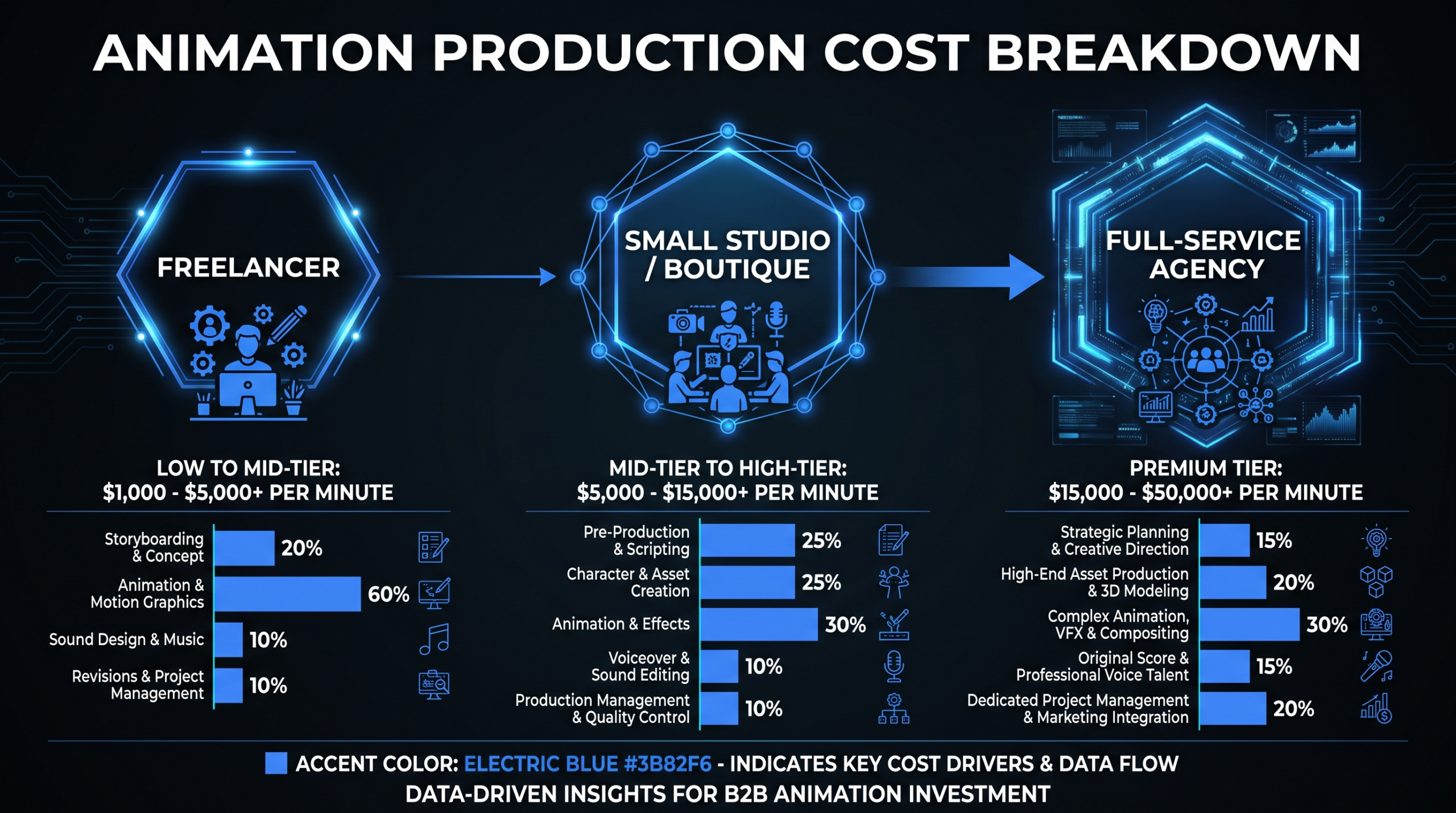
- How Much Does Animation Cost Per Minute?
- 3 Real Animation Projects — What Did They Cost?
- When Is Animation Worth the Price?
- How to Reduce Animation Costs Without Losing Quality
- FAQ
Key Takeaways
- Motion graphics start around $200–$800 from freelancers; agency quotes for the same 30-second asset typically run $1,500–$4,000.
- 2D explainer videos (60–90 seconds) cost $500–$3,000 via freelancers and $3,000–$12,000 from full-service agencies — a 4–6x gap driven by project management, QA, and overhead.
- Animation style is the single biggest cost driver — whiteboard and flat 2D cost a fraction of character animation or frame-by-frame work at the same duration.
- Teams producing 4+ animated assets per month rarely justify per-project rates. A retainer or dedicated team arrangement typically cuts per-asset cost by 40–60% at that volume.
- A dedicated in-house animator costs $91,000–$160,000/year in total employment cost (salary, benefits, equipment, and software), making outsourcing the default for teams producing fewer than 20–25 assets per month.
Animation Cost at a Glance
The table below covers the full cost matrix by deliverable type and hiring model. These are market ranges based on current freelancer platform rates and publicly available agency pricing — actual quotes vary by provider, revision scope, and delivery timeline.
Animation Cost by Deliverable & Hiring Model
| Deliverable | Freelancer | Agency | In-House (amortized/mo) |
|---|---|---|---|
| 30-sec motion graphics | $200–$800 | $1,500–$4,000 | $350–$600 |
| 60-sec flat 2D explainer | $500–$2,000 | $3,000–$8,000 | $550–$900 |
| 90-sec 2D explainer | $1,000–$3,000 | $5,000–$12,000 | $700–$1,200 |
| 2-min character animation | $2,500–$8,000 | $10,000–$20,000 | $1,100–$1,800 |
| 3-min animated product demo | $4,000–$15,000 | $15,000–$30,000 | $1,600–$2,600 |
| Per finished minute of animation | $500–$5,000 | $3,000–$10,000 | $350–$875 |
In-house amortized cost assumes a $75,000–$95,000 annual salary plus 30–40% overhead (benefits, equipment, and software). See our animation cost per minute breakdown for detailed per-minute math.
For teams comparing agency retainer plans, VEC's plans start at $5,000/month and include dedicated editors and motion designers for B2B SaaS. See pricing →
What Makes Animation Expensive?
Animation costs more than live-action editing because every frame must be created, not just cut. A live-action video editor assembles footage that already exists. An animator creates movement, depth, lighting, and expression from scratch — or builds and rigs assets before a single frame of motion is possible.
The five factors that most directly drive animation cost are:
1. Animation Style
Style determines labor more than any other variable. A whiteboard animation (black lines on white) takes far less time than the same script rendered in flat 2D motion design, which takes less than character animation with lip sync. The gap between whiteboard and character animation for a 90-second video can be $800 vs. $12,000 — the same script, the same length, completely different labor hours. For a deeper look at style-by-style cost comparisons, see our 2D animation production cost guide.
2. Duration
Animation is priced on labor-per-minute, and finished minutes of animation require many hours of work. A polished 60-second explainer typically requires 40–80 hours of production time across storyboard, illustration, animation, and sound. Double the duration and you nearly double the cost — with some non-linear overhead for more complex transitions and scene variety. Our per-minute cost breakdown covers the math in detail.
3. Complexity and Assets
A video with five scene types and a recurring character costs more than a video with three simple transitions and no character work. Every unique asset — background, character, UI element, icon — adds illustration and rigging time before animation begins. Projects with extensive asset libraries can spend 30–50% of total budget on illustration alone.
4. Revisions
Animation revisions are expensive because changes in one scene can cascade through downstream scenes. Changing a character's design mid-project can mean redoing all existing frames featuring that character. Most professional studios allow 2–3 revision rounds; rounds beyond that are billed separately, often at $500–$2,000 per round depending on the scope of changes.
5. Timeline
Rush delivery adds 25–50% to standard animation quotes. Standard delivery for a 90-second explainer runs 3–6 weeks; under-two-week delivery requires overtime or diverting capacity from other projects — and that premium is built into the quote. Planning your animation needs 6–8 weeks ahead consistently produces better work at standard rates. For teams needing regular animated content, outsourcing to a dedicated animation team removes the rush-fee cycle entirely.
How Much Does Animation Cost by Type?
Not all animation is the same. Here is how the major styles break down on price, so you can match your brief to the right budget before getting a single quote.
Whiteboard Animation
The most affordable style. Simple line drawings and a hand effect create a classroom feel that works well for explainers and training content. Freelancer rates: $300–$1,500 for 60 seconds. Agency rates: $1,500–$5,000. Whiteboard tools (Vyond, VideoScribe) allow some DIY, but professional execution still requires illustration skill and timing work. For B2B SaaS, whiteboard animation often underperforms on brand recall — worth knowing before you optimize purely for cost.
Flat 2D / Motion Graphics
The dominant style for SaaS product demos, onboarding videos, and social content. Clean icons, UI screen recordings overlaid with motion graphics, and smooth transitions. This is the style you see on most B2B SaaS explainers. Freelancer rates: $500–$3,000 for 60–90 seconds. Agency rates: $3,000–$10,000. VEC's dedicated teams handle this style as part of their core post-production workflow. See VEC's SaaS video production approach for how motion graphics fit into a broader content program.
2D Character Animation
Custom characters, rigged and animated with personality and movement. High recall, high production value — and significantly higher cost. Freelancer rates for a 60-second piece: $1,500–$5,000. Agency rates: $6,000–$15,000. Character animation is often the right call for brand mascots, awareness campaigns, and content designed for multi-year use. For comparison of 2D vs. other approaches, see our 2D vs. 3D animation cost guide.
Corporate / Brand Animation
Hybrid styles combining motion graphics, live-action overlays, and branded visual systems. Common for investor presentations, product launches, and brand films. Typically priced as a project scope rather than per-minute. Ranges from $5,000 for a simple brand opener to $30,000+ for a full brand campaign. See examples of corporate animation for B2B.
Freelancer, Agency, or In-House — Which Is Cheaper?
The honest answer: cheapest upfront is freelancer, cheapest at scale is in-house or dedicated team, and agency is worth it when you need brand-quality output without the management overhead.
Hiring Model Comparison — Total Monthly Cost at Different Volumes
| Hiring Model | Cost Structure | 2 Assets/Mo | 6 Assets/Mo | 12+ Assets/Mo |
|---|---|---|---|---|
| Freelancer (per project) | Pay per video | $1,000–$4,000 | $3,000–$12,000 | $6,000–$24,000 |
| Boutique agency (retainer) | Monthly commitment | $3,000–$6,000 | $5,000–$10,000 | $8,000–$18,000 |
| Dedicated team (VEC-style) | Plan from $5,000/mo | $5,000–$9,500 | $5,000–$9,500 | $9,500–$16,000 |
| In-house animator (hired) | $91K–$160K/yr total | $7,600–$13,300 | $7,600–$13,300 | $7,600–$13,300 |
The pattern: freelancers win for low volume, dedicated teams win for consistent volume. The in-house option becomes cost-competitive only when you're using the animator at near-full capacity every month — otherwise you're paying for idle time. The agency retainer sits between freelancer and dedicated team: reliable quality with less management overhead than managing freelancers, but more expensive per-asset than a dedicated team at high volume.
For a comprehensive comparison of all pricing structures across video production, see video production agency pricing models. For context on what video editors (non-animators) charge separately, see our video editing hourly rates by country.
How Much Does Animation Cost Per Minute?
Per-minute pricing is the most useful normalizer when comparing quotes across different providers and styles. It accounts for duration differences and gives you a single number to benchmark.
Animation Cost Per Finished Minute by Style
| Animation Style | Freelancer ($/min) | Agency ($/min) |
|---|---|---|
| Whiteboard / line animation | $300–$1,500 | $1,500–$4,000 |
| Flat 2D / motion graphics | $500–$2,500 | $2,000–$6,000 |
| 2D character animation | $800–$5,000 | $4,000–$12,000 |
| Frame-by-frame / advanced 2D | $2,000–$8,000 | $8,000–$20,000 |
Note that per-minute cost is not linear with duration — shorter animations often cost more per minute because setup, rigging, and style-frame work is largely fixed regardless of length. A 30-second piece frequently costs 70–80% of a 60-second piece with the same style and asset library. For the full per-minute breakdown including motion graphics vs. character work, see our animation cost per minute guide.
3 Real Animation Projects — What Did They Cost?
Abstract ranges only go so far. Here are three realistic project profiles — not specific named clients, but representative of what B2B SaaS teams actually commission — with typical all-in costs. For more finished examples across styles, browse our corporate animation examples.
Example 1: Series A SaaS — 90-Second Flat 2D Explainer
Brief: Onboarding explainer for a project management tool. 90 seconds, flat 2D motion graphics, UI screen recordings integrated with custom icon animation, 2 revision rounds.
Vendor: Mid-level Upwork freelancer with 50+ reviews.
All-in cost: Approximately $1,800–$2,500, delivered in 4–5 weeks. Script and storyboard separately handled by the internal marketing team.
Key risk: Quality variance. A mid-level freelancer at this price range will produce serviceable motion graphics but may not hit brand-quality standards for investor or high-visibility contexts.
Example 2: Series B Fintech SaaS — 2-Minute Animated Product Demo
Brief: Product demo for a compliance automation platform. 2 minutes, character-adjacent style (branded mascot, no full character rigging), motion graphics overlay of UI screens, voiceover included.
Vendor: Boutique animation agency with B2B SaaS portfolio.
All-in cost: Approximately $7,000–$10,000, delivered in 5–7 weeks. Included script support, style frame approval, and 3 revision rounds. For how this fits into a broader demo strategy, see our product demo video production guide.
Key risk: Scope creep. Mid-project character design changes in this price range typically trigger overage fees of $500–$1,500 per round of revisions.
Example 3: Scale-Up SaaS — Ongoing Motion Graphics (Monthly Retainer)
Brief: Continuous stream of animated content: 4 social clips, 2 product update explainers, and 1 onboarding module per month. Flat 2D, consistent brand system, same dedicated team every month.
Vendor: Dedicated video production team on a monthly retainer.
All-in cost: Approximately $5,000–$9,500/month depending on asset complexity. Annualized, this is $60,000–$114,000 — similar to one mid-senior in-house hire, but with 2–3 people producing and zero HR overhead. Teams at this volume consistently find the retainer model cuts per-asset cost by 40–60% vs. per-project freelancer rates.
Key risk: Volume variability. In months with fewer assets needed, you're still committed to the monthly minimum. Negotiate rollover provisions upfront.
When Is Animation Worth the Price?
Animation justifies its premium when one of three conditions is true: the concept cannot be shown through live-action footage, the content will be used across multiple formats and a long lifespan, or the audience is in a buying stage where visual clarity significantly impacts conversion.
Video marketing research — including annual surveys by Wyzowl — consistently ranks animated explainers among the highest-performing formats for B2B buyer education, particularly for abstract software products where the "product" cannot be shown physically. For SaaS companies, this is a structural advantage: showing a workflow through clean flat-2D animation often communicates faster than a screen recording. The conversion lift on product pages with animated demos is well-documented across the SaaS industry, though exact numbers vary by product and audience.
Where animation typically does not justify the cost: one-off social clips where a well-edited video performs equally well, content with a 30-day shelf life, and teams not yet producing enough video for animation to be a repeatable asset system. In those cases, standard video editing with motion graphics elements often delivers 80% of the visual impact at 30–40% of the cost.
For a business case framework across different video types, see our SaaS video production strategy guide and our client case studies.
How to Reduce Animation Costs Without Losing Quality
These are the five highest-leverage adjustments that consistently reduce animation budgets without degrading output quality:
- Choose style for function, not aspiration. Flat 2D motion graphics are genuinely better than whiteboard for most SaaS contexts — more brand-aligned, higher recall, more versatile for repurposing. But character animation is only worth the cost if the character will recur. A one-off character project at $8,000 is often better served by a well-designed icon system at $2,000 that can be reused across 12 months of content.
- Script before you quote. Animation quotes balloon when script changes happen mid-production. A finalized, approved script before work starts removes the largest source of scope creep and revision fees. The cost of a professional script review ($200–$500) routinely saves $1,000–$3,000 in downstream revision charges.
- Repurpose assets across projects. A custom icon library or character system produced for a 60-second explainer can be reused across multiple videos, amortizing the upfront asset cost. Negotiate asset ownership explicitly — some agencies retain asset rights; you want full ownership to reuse across future productions. See our explainer video cost breakdown for how asset reuse affects per-video pricing.
- Move to volume pricing for ongoing needs. The per-project freelancer model is the most expensive way to produce animation at any consistent volume. Teams producing 4+ animated assets per month should compare the freelancer per-project total against a retainer or outsourced team model — the math almost always favors the retainer above that threshold. See how VEC's team model works for a concrete example of what this looks like operationally.
- Trim first, animate second. For product demos that combine screen recording with animation overlays, invest in tight post-production editing first to cut the raw footage to its essential 90 seconds before adding motion graphics. Animating 3 minutes of loosely cut footage costs significantly more than animating 90 seconds of tightly edited video. A disciplined editing pass reduces the animation scope and total budget. For how this integrates into a full video editing and animation workflow, see our services overview.
For how to structure the hiring decision across all video types — not just animation — see our guide to hiring an animator with full rate comparisons and vetting criteria. For a holistic look at outsourcing video production, including animation, see our agency pricing model comparison.
Finally, if you're evaluating HubSpot's guidance on video marketing ROI alongside your animation budget decisions, the consistent takeaway across B2B marketers is that durability matters more than upfront cost — a $7,000 explainer used for two years is cheaper than a $1,500 explainer replaced every quarter.
Frequently Asked Questions
Is animation more expensive than live-action video?
For comparable durations and production quality, yes — animation typically costs more than live-action editing because every visual element must be created rather than captured. A polished 90-second animated explainer from a professional agency commonly runs $5,000–$12,000; a comparable live-action interview-and-B-roll video might cost $2,000–$5,000 in post-production. The gap narrows for complex live-action shoots (travel, crew, gear) vs. simple motion graphics. For most B2B SaaS teams without filming infrastructure, animation is actually the more accessible option since it requires no camera crew or location management.
Why do agencies charge so much more than freelancers for animation?
Agency rates include overheads that aren't visible on a freelancer quote: project management, quality assurance reviews, dedicated account management, asset storage and handoff, and liability coverage. A $3,000 agency 60-second explainer and a $800 freelancer equivalent may use the same animation software, but the agency quote includes 2–3 people checking the work, defined revision rounds, and a delivery process designed to avoid costly miscommunications. Whether that overhead is worth it depends on how much of your own management time the freelancer relationship consumes.
Can I get good animation for under $1,000?
Yes, for motion graphics and simple flat 2D. On Upwork and Fiverr, experienced freelancers regularly produce 30–60 second motion graphics pieces for $300–$900. The ceiling at this price range: limited asset variety, basic transitions, and standard After Effects presets rather than custom illustration. For brand-defining work or content you expect to run for 12+ months, the $300–$900 range is risky. For internal communications, quick social clips, or testing an animation format before investing in polished production, it works well.
How long does it take to produce an animated video?
Standard timelines run 3–6 weeks for a 60–90 second 2D explainer. The breakdown is roughly: 1 week for script and storyboard approval, 1–2 weeks for style frames and illustration, 1–3 weeks for animation, sound design, and revision rounds. Rush delivery (under 7 business days) is possible but adds 25–50% to the quoted price. Teams on ongoing retainers typically see faster turnarounds after the first two months once the animation team has built the asset library and understands the brand system.
Does VEC handle animation alongside video editing?
Yes. VEC's dedicated team plans include motion graphics and 2D animation as part of the core service for B2B SaaS companies. The Growth plan ($5,000/mo), Core plan ($9,500/mo), and Scale plan ($16,000/mo) each cover a mix of video editing, motion graphics, and animated asset production — matched to your monthly content volume. Teams producing 4–12 animated assets per month alongside regular video editing consistently find the dedicated team model more cost-effective than separate freelancer and editing arrangements. See how it works or browse case studies for examples.
Weighing animation against a shoot on price alone? Our animation vs live action cost comparison sets cost ranges side by side by video type, so you can see where each format is cheaper.
Ready to Scale Your Animation Output?
VEC gives B2B SaaS teams a dedicated motion design and video editing team — with a 90-day output guarantee. Plans from $5,000/month.
Book a Free Strategy Call See Pricing Plans