Video Production Quotes: How to Read Them
TL;DR
- A video production quote covers three phases: pre-production, production, and post-production — and post is where most of the cost hides.
- Line items matter more than totals. Vague scope language ("professional editing included") is where budget overruns are born.
- Real market ranges for a 2-minute corporate video: $4,000–20,000+ depending on crew, complexity, and agency tier.
- The biggest red flags: no revision cap, no format deliverables specified, licensing costs excluded.
- Best comparison metric: cost per minute of finished video — normalizes across different billing structures.
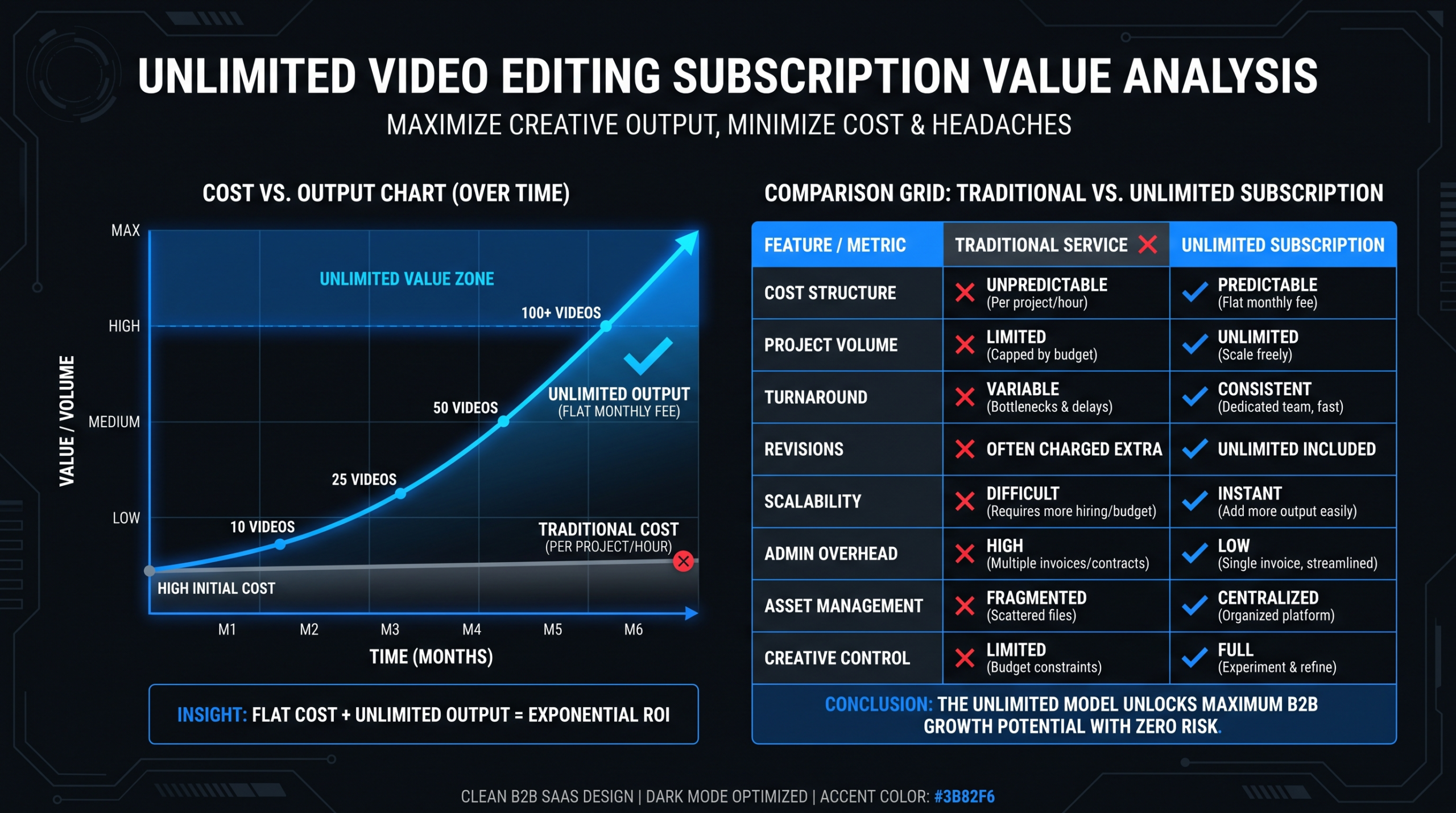
- If you're producing video consistently, a monthly retainer or dedicated editing team often beats per-project quoting by 30–50% at volume.
Table of Contents
- What a Video Production Quote Actually Contains
- The Anatomy of a Quote: Line by Line
- Realistic Price Ranges by Project Type
- Red Flags in Any Video Production Quote
- How to Compare Quotes From Different Vendors
- Questions to Ask Before You Sign
- When a Quote-Based Model Isn't the Right Fit
- Frequently Asked Questions
What a Video Production Quote Actually Contains
Most marketing teams scan a video production quote the same way they scan a restaurant bill — straight to the total. That's an expensive habit. A production quote is more than a price tag. It's a contract preview, a scope boundary, and a risk register rolled into one document. What's in it determines what you get. What's missing determines what will cost extra.
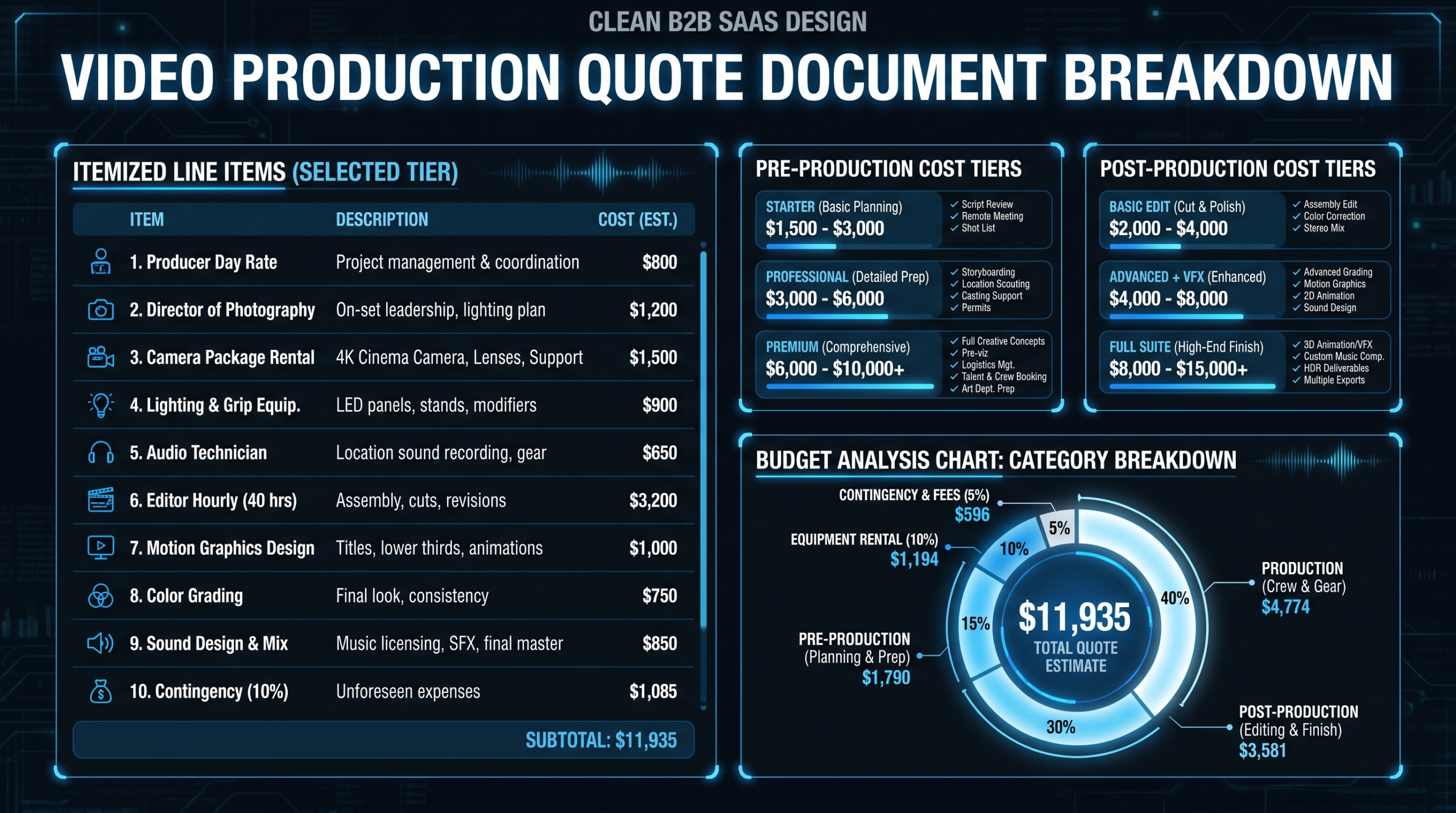
A complete video production quote covers three phases: pre-production (planning, scripting, logistics), production (the shoot or animation build), and post-production (editing, color grading, audio, graphics, delivery formats). What most buyers don't realize is that 40–60% of a typical project's cost lives in pre-production and post-production — the stages that are easiest to under-specify in a quote and most likely to inflate mid-project.
Understanding each phase — and each line item within it — lets you do three things well: evaluate vendors on equal terms, catch scope traps before you're locked in, and negotiate from knowledge rather than instinct. This guide walks you through all of it.
For a broader look at where video budget goes across different content types, our video production cost breakdown covers the full spending picture.
The Anatomy of a Quote: Line by Line
A well-structured video production quote separates costs by phase and names each deliverable explicitly. Here's what to expect — and what each line item actually means.
Pre-Production Line Items
Creative brief / discovery session: Some agencies charge $0 (it's a sales activity and they absorb the cost to win the project). Others bill $500–1,500 for a structured strategy workshop, particularly for larger campaigns. If it's charged, ask whether the fee applies toward the project total — many do.
Scriptwriting: A polished 90-second script from an experienced copywriter runs $500–2,500. Script complexity matters here — a talking-head interview needs minimal scripting; an animated explainer may require two rounds of creative development. If the quote expects you to provide a camera-ready script, remove this line and check whether the project budget reflects that saving.
Storyboarding: Typically $300–1,500, charged separately from scripting. Most live-action interview or testimonial shoots skip formal storyboarding. Animation and complex narrative work almost always needs it — if you're not seeing it in the quote for animated work, ask why.
Location scouting: $200–800. If you're providing your own location, this line should not appear. If it does, negotiate it out or ask what the scouting delivers (a list of options? Photography? A site survey for permits?).
Casting / talent coordination: $500–2,500+ depending on the number of roles, speaking vs. non-speaking, and whether a casting director is involved. Talent day rates are usually a separate line. On-camera talent from a reputable agency commands a premium; internal spokespeople your team provides eliminate this cost entirely.
Production Line Items
Crew day rate: This is where video production quotes diverge most dramatically. A standard crew — director of photography, camera operator, sound engineer, lighting technician — runs $1,500–5,000 per day depending on experience level and market. Half-day rates typically land at 60–70% of the full day rate, not 50%. A single-person "run-and-gun" setup costs far less; a cinema-level crew on a brand film costs far more.
Equipment rental: $500–2,000 per day for a standard kit (cinema camera, prime lenses, lighting package, audio). Specialized gear — drones, gimbals, teleprompters, large lighting rigs — adds to this. Agencies that own their equipment may bundle this differently; always confirm what "camera and lighting" means in the scope.
Location fees and permits: $0 for an office shoot with owner permission. $500–2,000+ for permitted public spaces, commercial locations, or rented studios. If the quote says "locations included" without specifying, ask exactly which locations are assumed.
Talent / on-camera fees: Separate from casting coordination costs. Professional talent booked through agencies ranges widely — budget $300–2,500 per person per day for spokesperson roles. Voice-over talent for animation or narration typically runs $200–800 for a 90-second script, depending on the voice artist's tier.
Post-Production Line Items
Editing (rough cut through final cut): The largest single line item in post-production. A 2-minute corporate video typically requires $1,000–3,000 in editing time alone. Longer, multi-interview documentaries or product demos with complex B-roll run higher. "Editing" should include rough assembly, structured feedback rounds, and delivery — make sure the quote specifies all three.
Color grading: $200–1,500 depending on complexity and length. Professional color grading — matching footage across different shooting conditions, creating a specific look, and exporting for multiple delivery formats — is a distinct skill from basic color correction. Ask which one you're actually getting.
Motion graphics / lower thirds / animation: $500–5,000+ per minute of finished animation for full explainer-style work; simpler motion graphics packages (logo reveals, kinetic text, lower thirds) typically run $300–1,200 total. If the quote says "motion graphics included," find out whether that means three lower thirds or a fully animated segment.
Sound design and music licensing: $200–800 for sound design (sound effects, audio sweetening). Music licensing via stock libraries (Musicbed, Epidemic Sound, Artlist) typically adds $50–300 per track for perpetual project use. Sync licensing for commercial artists is a separate budget category entirely and not appropriate for most corporate video work.
Revisions: Most quotes include 2–3 rounds of structured feedback. Additional rounds are commonly billed at $150–400 per round. "Unlimited revisions" in a quote is marketing language — it always means reasonable revisions within agreed scope. Confirm what a revision "round" means: one consolidated set of notes from your whole team, or individual comments staggered over two weeks.
Table 1: Common Line Items and Typical Market Ranges
| Phase | Line Item | Typical Range | Notes |
|---|---|---|---|
| Pre-production | Discovery / creative brief | $0 – $1,500 | Often waived; sometimes credits toward project |
| Pre-production | Scriptwriting | $500 – $2,500 | Per 90-sec script; scales with complexity |
| Pre-production | Storyboarding | $300 – $1,500 | Required for animation; optional for live interview |
| Pre-production | Location scouting | $200 – $800 | Remove if you provide your own location |
| Pre-production | Casting / talent coordination | $500 – $2,500 | Separate from talent day rates |
| Production | Crew day rate (full) | $1,500 – $5,000/day | DP, camera op, sound, lighting |
| Production | Equipment rental | $500 – $2,000/day | Standard kit; specialized gear adds cost |
| Production | Location fees / permits | $0 – $2,000 | Varies by location type |
| Production | On-camera talent | $300 – $2,500/person | Professional; voice-over is separate |
| Post-production | Editing (rough through final) | $1,000 – $5,000+ | Per 2-min video; scales with footage volume |
| Post-production | Color grading | $200 – $1,500 | Ask: grading vs. correction |
| Post-production | Motion graphics | $300 – $5,000+ | Simple lower thirds vs. full animation |
| Post-production | Sound design + music licensing | $200 – $800 | Stock music license often not included |
| Post-production | Additional revision rounds | $150 – $400/round | Beyond included rounds in scope |
| Extras | Format variations (9:16, 1:1) | $100 – $400 each | Not auto-included; ask explicitly |
| Extras | Rush delivery | +25% – +50% | Of total project cost |
Realistic Price Ranges by Project Type
With individual line items understood, the next question is: what should a complete video production quote actually total? The answer depends on video type, length, and production tier. Here are realistic market ranges — hedged as broad benchmarks, not guarantees, since scope variation within each category is enormous.
These ranges reflect agency production in North American and Western European markets. Offshore production or in-market freelance work will typically land 30–60% lower; premium US-based brand agencies command the upper end or above it. For a detailed breakdown by video type, use our video production cost calculator to model your specific scenario.
Table 2: Realistic Cost Ranges by Video Type
| Video Type | Duration | Low End | Mid Range | High End | Key Cost Driver |
|---|---|---|---|---|---|
| Social media clip (repurposed) | 15–60 sec | $150 | $500 | $1,200 | Source footage quality |
| Talking-head interview | 2–5 min | $800 | $2,500 | $6,000 | Crew size, location |
| Corporate / brand video | 1–3 min | $3,000 | $10,000 | $30,000+ | Production days, talent |
| Product demo video | 2–4 min | $2,500 | $7,500 | $20,000 | Screen recording vs. live shoot |
| Animated explainer | 60–90 sec | $3,000 | $8,000 | $25,000+ | Animation style, script complexity |
| Testimonial / case study video | 2–4 min | $2,000 | $6,000 | $15,000 | Travel, number of interview subjects |
| Event recap video | 2–5 min | $1,500 | $5,000 | $12,000 | Multi-camera setup, days on-site |
| Full content campaign (5+ videos) | Various | $10,000 | $30,000 | $80,000+ | Number of production days, formats |
One benchmark worth knowing: the per-minute cost of professional editing across different production tiers. Our analysis of editing cost per minute shows how post-production cost scales with footage complexity — useful context when a quote's editing line looks unusually high or suspiciously low.
Red Flags in Any Video Production Quote
A quote that raises no questions is a quote you haven't read closely enough. These are the specific patterns that consistently lead to budget overruns, delivery delays, or quality disappointment.
1. Vague Scope Language
"Professional editing included" means nothing on its own. Editing could mean a rough assembly with basic cuts, or it could mean a fully graded, sound-designed final cut with animated lower thirds. Every deliverable should be named and quantified. If the quote says "video editing" without specifying the output (2-minute final cut, delivered in H.264 and ProRes, including three revision rounds), it's ambiguous by design.
Watch especially for phrases like "as needed," "standard package," and "professional quality" — none of these are scope statements. They're marketing copy in a legal document.
2. No Revision Terms
A quote without explicit revision terms is a setup for either unlimited free revision requests (from your side) or an invoice surprise when you ask for your fourth feedback round. Best-practice quotes specify: number of revision rounds included, what constitutes a "round" (consolidated notes from the entire team, within a set window), and the cost per additional round if you exceed the included number.
3. Format Deliverables Not Listed
The final video in 16:9 at 1080p is the standard deliverable. If you need the same content in 9:16 for Instagram Reels, 1:1 for LinkedIn, and a subtitled version for LinkedIn's auto-play environment — that's three additional deliverables, each requiring editor time. Most agencies charge $100–400 per format variation. If your quote doesn't list output formats explicitly, you'll be paying for them later.
4. Music and Stock Licensing Not Addressed
Stock music licensing is among the most commonly excluded line items in video production quotes. A track from a professional library (Musicbed, Artlist, Epidemic Sound) runs $50–300 for perpetual project use. If the quote is silent on music, either the agency has a library subscription that covers it (confirm this in writing) or you'll receive an invoice for licensing after delivery.
5. No Shooting Ratio or Coverage Plan
More applicable to interview and multi-subject projects: a quote should indicate how many shoot days are included and roughly how much footage the team expects to capture. A "one-day shoot" could mean a single two-hour interview, or it could mean eight hours with three interview subjects across two locations. The difference in post-production cost is significant. If the quote doesn't clarify what a shoot day covers, ask for the run-of-show or shot list before signing.
6. Payment Terms That Don't Protect You
Standard payment terms in video production: 50% deposit on signing, 50% on final delivery. Some agencies request 100% upfront for project work — this is unusual and weakens your negotiating position if the project goes wrong. On the other end, any agency willing to do 100% on delivery hasn't priced in their cash flow risk, which often means corners get cut when the project runs long. The 50/50 structure is industry-standard for good reason.
7. Rush Fees Hidden in Fine Print
Rush delivery typically adds 25–50% to total project cost. This fee should be disclosed clearly in a quote's terms, not buried in page-three conditions. If your timeline is in any way tight — production must be complete within two weeks, for instance — confirm whether the quoted price assumes standard delivery or the accelerated timeline your brief described.
How to Compare Quotes From Different Vendors
When three agencies send you three differently structured quotes, comparing them by total is nearly meaningless. A $12,000 quote might include everything; an $8,000 quote might exclude music licensing, format variations, and half the revision rounds. The correct comparison method normalizes across billing structures.
Build a Normalized Scope View
Create a simple grid with your required deliverables as rows and each vendor as a column. For each deliverable (final 2-min video, 9:16 variant, three revision rounds, music license, two-week turnaround), note whether each quote includes or excludes it. Then add the cost to bring each quote to the same scope. This makes apples-to-apples comparison possible and often reveals that the "cheaper" quote becomes the most expensive once you add the missing items.
Normalize to Cost Per Minute of Finished Video
Divide each quote's total by the total minutes of finished video it produces. A $15,000 quote producing 3 minutes of finished content costs $5,000/minute. A $10,000 quote producing 1.5 minutes costs $6,667/minute. The second is more expensive per unit of output despite the lower headline number.
This metric is particularly useful when comparing per-project quoting against subscription or retainer arrangements. For a detailed comparison of those models, our video production agency pricing models guide shows the full cost math across structures.
Evaluate What's Not In the Quote
Every experienced video buyer has a short story about the cost that wasn't in the quote. Ask each vendor directly: "What are the three most common things clients end up paying for that weren't in the original quote?" A vendor who answers honestly is telling you they've thought about this. A vendor who says "nothing, our quotes are all-inclusive" is either running a genuinely tight process or hasn't been asked this before.
The right video production vendor isn't the one with the lowest initial quote — it's the one whose final invoice most consistently matches the original scope.
Questions to Ask Before You Sign
Before countersigning any video production quote, run through this checklist with your prospective vendor. These questions protect your budget and surface assumptions before they become disputes.
- What exactly constitutes a "revision round"? Is it one consolidated set of notes from our team submitted within a set window, or does each email with feedback count as a round? What happens if our stakeholders give conflicting notes — is that one round or two?
- What format deliverables are included? If we need this in 16:9, 9:16, and 1:1 — are all three in scope? What's the per-format cost if we add a new format after production?
- Who specifically will edit this project? Not just the agency — which editor, at what experience level? Will we have the same editor throughout the project? If that person leaves or becomes unavailable, what's the transition process?
- Is music licensing included? Which library? Is the license perpetual for the project or does it expire? Will we receive documentation of the license in case we need to prove clearance later?
- What are the rush fee terms? Our brief says delivery in three weeks. Is the quoted price based on that timeline or a standard four-to-six-week window? If we ever need to expedite feedback, what does that cost?
- What's the process if we need to expand scope mid-project? Do you issue a change order? What's the typical lead time to add a new deliverable? Is there a minimum added cost?
- What are your payment terms, and what happens if we're late on the milestone payment? Most agencies pause production on overdue accounts — understanding this upfront prevents timeline surprises if your procurement process runs slow.
These questions also function as a vendor quality filter. Agencies that answer quickly and specifically have clear processes. Agencies that hedge or say "we're flexible" often don't. According to Wyzowl's annual video marketing research, production quality and clear communication remain the top two factors buyers cite when assessing long-term vendor relationships — both are revealed by how a vendor handles pre-contract questions.
When a Quote-Based Model Isn't the Right Fit
Per-project quoting works well for infrequent, one-off video needs. It becomes inefficient — and expensive — the moment your video production becomes an ongoing program rather than a sporadic campaign.
The math shifts at roughly four or more videos per quarter. At that volume, the quote cycle itself has a cost: briefing time, multiple rounds of vendor communication, scope negotiation, contract sign-off. Each project starts from scratch. There's no accumulated brand knowledge with the editor, no reserved capacity, and no volume pricing. You pay full retail on every engagement.
Monthly retainers and dedicated editing teams solve all of this. A retainer locks in guaranteed capacity at a negotiated monthly rate, typically 20–40% below comparable per-project pricing for the same output volume. A dedicated editing team — where the same senior editor and project manager work exclusively on your content — adds brand consistency on top of the cost advantage. Teams in this model develop deep familiarity with your product, your voice, and your feedback patterns. The first feedback round becomes shorter. The fourth revision cycle rarely happens.
At Video Editing Company, this is the core of how we work with B2B SaaS marketing teams. Our Growth plan at $5K/month, Core at $9.5K/month, and Scale at $16K/month each come with a dedicated senior editor, project manager, and our 90-day output guarantee: double your video output in 90 days or month four is free. For teams that have outgrown the per-project quoting cycle, it's a fundamentally different model. See our pricing page for what each tier covers, or read how other teams have structured their agency pricing arrangements before making the switch.
Wistia's research on video production workflows consistently shows that teams with a defined production process — steady vendor relationships, clear feedback loops, agreed-upon formats — produce more content at lower per-unit cost than teams that re-quote every project. The quote process itself is often the bottleneck, not the production itself.
Frequently Asked Questions
What should a video production quote include at minimum?
A complete video production quote should itemize pre-production costs (scripting, storyboarding, any casting or location work), production costs (crew day rates, equipment, location fees, talent), and post-production costs (editing, color grading, motion graphics, sound design, and music licensing). It should also specify the number of included revision rounds, output formats, turnaround timeline, and payment terms. Any quote missing these elements is incomplete — which is a negotiating position, not a reason to walk away. Use the gaps to ask questions before you sign.
How do I know if a video production quote is overpriced?
Normalize it to cost per minute of finished video and compare against the ranges in Table 2 above. For a 2-minute corporate talking-head video produced domestically, a quote in the $4,000–10,000 range is typical. Significantly above that range suggests high-tier talent, premium crew, or unnecessary scope; significantly below it suggests either a junior team, compressed post-production, or scope that's too narrow to deliver what you actually need. Also ask about team experience and reel quality — a $15,000 quote from a team whose portfolio matches your production level may be better value than an $8,000 quote from a team whose work doesn't.
What does "unlimited revisions" really mean in a video production quote?
"Unlimited revisions" in a production quote always has practical limits — throughput, project timeline, and the agency's interpretation of what constitutes a revision vs. a scope change. In practice, it usually means the agency will address feedback until you're satisfied, but large changes (rewriting the script after filming, adding a new section, changing the music for the fifth time) may trigger a scope-change conversation. Treat "unlimited revisions" as a relationship promise, not a contractual guarantee. Confirm whether it covers structural changes or only cosmetic refinements.
Should I get multiple video production quotes before deciding?
Yes — three quotes is the useful benchmark. One quote gives you a number. Two quotes give you a comparison but no tiebreaker. Three quotes reveal the market spread and help you identify whether your brief is interpreted consistently across vendors. When gathering multiple quotes, send the same brief to each vendor (don't customize it per vendor) and ask each to use the same deliverables list. Use the normalized scope comparison method from the "How to Compare Quotes" section above to evaluate them on equal terms. The goal isn't the lowest number — it's the vendor whose scope interpretation and portfolio best match what you actually need.
What's a fair deposit for a video production project?
The industry standard for video production deposits is 50% on project sign-off, with the remaining 50% due on final delivery. Some agencies for larger projects split it into thirds: one-third on signing, one-third at the end of production, one-third on final delivery. Deposits under 25% signal a vendor who hasn't structured their cash flow properly — they may cut corners when the project runs long. Deposits of 100% upfront remove your main point of leverage if deliverables don't meet expectations. If a vendor asks for more than 50% upfront on a project over $5,000, ask why — a legitimate reason exists (specialized equipment purchase, unusual talent booking), but it should be explained.
Ready to Stop Negotiating Quotes Every Quarter?
If you're producing video consistently, the per-project quoting cycle is costing you time and money. Our dedicated editing teams work as an extension of your marketing team — same editors, predictable monthly cost, guaranteed output. Book a free strategy call and we'll show you the math on your specific content volume.
Book a Free Strategy Call See Our Plans