Is Unlimited Video Editing Worth It?
Unlimited video editing is worth it only if your content is high-volume, repetitive, and simple — think social clips, podcast repurposing, and short-form recuts. For SaaS companies needing complex demo videos, brand films, or consistent motion graphics, a dedicated editing team almost always delivers more value per dollar than any "unlimited" subscription plan.
That's the honest answer. The rest of this guide gives you the numbers, the edge cases, and the framework to decide which side of that line you're on.
TL;DR — Is Unlimited Video Editing Worth It?
- For high-volume simple content: Yes — subscriptions deliver 8–20 simple edits/month at a flat, predictable price.
- For complex SaaS video (demos, explainers, brand films): Rarely — throughput is too low and quality too inconsistent for production-grade work.
- The "unlimited" label is marketing: You're limited by queue throughput, not requests. One active task at a time on most plans.
- Real cost per finished video: $150–$600 on a basic subscription plan. Often comparable to a retainer at volume.
- Better alternative for SaaS teams: Dedicated editing team with a flat monthly retainer — predictable cost, brand consistency, senior editors who know your product.
Table of Contents
- What "Unlimited" Video Editing Actually Means
- What You Get for the Money: Subscription Plans Compared
- When Unlimited Video Editing IS Worth It
- When Unlimited Video Editing Is NOT Worth It
- Unlimited vs. Dedicated Team: Real Cost Comparison
- The Quality Gap Most Buyers Don't Expect
- How to Evaluate Any Unlimited Plan Before You Buy
- FAQ
What "Unlimited" Video Editing Actually Means
"Unlimited" is the most misleading word in the subscription editing market. Requests are unlimited — your production throughput is not. Understanding the actual mechanics before you buy is the single most important thing you can do.
The Queue Model
Most unlimited video editing services work on a sequential queue: you submit a request, an editor picks it up, completes it, then your next request enters production. The constraint is not how many requests you submit — it's how many the team can complete per month at their turnaround speed.
For a detailed breakdown of exactly how this model works under the hood, read our unlimited video editing explainer — it walks through queue mechanics, active request limits, and realistic monthly output by plan tier.
Active Requests vs. Total Requests
Most basic plans allow one active request at a time. Premium plans typically allow two to four. This is the number that actually determines your throughput, not the word "unlimited."
What "Unlimited" Looks Like in Practice
| Plan Tier | Active Requests | Avg. Turnaround | Realistic Monthly Output |
|---|---|---|---|
| Basic (~$1,500–$2,500/mo) | 1 | 48–72 hours | 8–12 simple edits |
| Standard (~$3,000–$5,000/mo) | 2 | 36–48 hours | 15–22 simple edits |
| Premium (~$5,500–$9,000/mo) | 3–4 | 24–48 hours | 25–40 simple edits |
These estimates assume short-form content (under 5 minutes, minimal motion graphics). Complex requests — animated explainers, polished demo videos, multi-track audio — take significantly longer and reduce monthly output proportionally.
What "Unlimited" Usually Covers
- Short-form social clips (Reels, TikTok, LinkedIn)
- Podcast video recording edits
- Webinar and recording clips
- YouTube video editing (basic cuts, captions, thumbnails)
- Repurposing long-form content into short clips
What's Usually Excluded or Upcharged
- Custom motion graphics and animation
- 2D/3D explainer video production
- Color grading beyond basic correction
- Multilingual subtitling at scale
- Brand film and documentary-style productions
- Same-day turnaround (rush fees common)
What You Get for the Money: Subscription Plans Compared
The subscription video editing market has matured enough that pricing has become relatively transparent. Here's how major plan tiers stack up on real deliverable value — not marketing language.
Unlimited Video Editing Plan Value Breakdown
| Plan Type | Typical Monthly Cost | Max Monthly Videos | Cost per Video | Best Use Case |
|---|---|---|---|---|
| Basic subscription | $1,500–$2,500 | 8–12 | ~$150–$300 | Social clips, podcast clips |
| Standard subscription | $3,000–$5,000 | 15–22 | ~$140–$300 | YouTube + social mix |
| Premium subscription | $5,500–$9,000 | 25–40 | ~$140–$360 | High-volume content teams |
| VEC Growth plan | $5,000/mo | Dedicated team output | Varies by complexity | B2B SaaS, 10–20 videos/mo |
For a deeper look at how these costs compare across different service models, our guide on video editor monthly subscription costs breaks down what's actually driving price differences between providers.
The key takeaway: when you calculate cost-per-video, subscriptions and dedicated teams often land in the same range at moderate volumes. The difference is what kind of video you're getting for that number.
When Unlimited Video Editing IS Worth It
There are genuine use cases where unlimited subscriptions outperform every alternative. Here's where they clearly win.
You Produce High Volume of Short, Simple Content
If your content engine runs on social clips, LinkedIn videos, podcast highlight reels, or webinar repurposing — and you need 15–30 of them per month — subscriptions are hard to beat on price. At a premium tier ($6,000–$8,000/month), you're getting 30–40 deliverables for $150–$200 each. Per-project pricing for the same content would typically run $300–$600 per clip.
Your Content Doesn't Require Brand Continuity
If each video stands alone and doesn't need to look and feel exactly like your other content, you can absorb the inconsistency that comes with different editors across requests. Social content teams often work in this mode — speed and quantity matter more than pixel-perfect brand adherence.
Month-to-Month Flexibility Is a Priority
Most subscription services offer month-to-month terms. If your video production needs are unpredictable — you might need 30 videos in January and 5 in February — this flexibility is genuinely valuable. Dedicated team retainers and agency retainers typically require 3–6 month minimums.
You're a Creator, Not a B2B Brand
YouTube creators, course creators, and individual content producers often get excellent ROI from unlimited editing subscriptions. The content type (talking head, screen recording, vlog) is exactly what these services are optimized for. Turnaround speed matters more than creative sophistication.
When Unlimited Video Editing Is NOT Worth It
For B2B SaaS companies, the calculus usually tips the other way. Here's why.
Your Videos Are Complex and High-Stakes
Product demo videos, explainer animations, customer testimonial productions, and brand films require experienced editors who understand your product, your ICP, and your brand voice. Subscription services rotate editors across accounts — your complex SaaS demo video will go to whoever is available in the queue that day. Inconsistency in quality and brand understanding is structural, not a service failure.
Throughput Doesn't Match Your Actual Needs
A Series B SaaS content team producing 6 high-quality videos per month — 2 product demos, 2 customer stories, 2 thought leadership pieces — doesn't benefit from unlimited throughput. They need quality and depth on a manageable volume. At that production pace, a standard subscription's throughput ceiling is irrelevant, but its quality ceiling is the real problem.
Your Brand Consistency Matters Downstream
If your videos live on a polished website, run as paid ads, or represent your brand in sales cycles, brand consistency is non-negotiable. Subscription editing tends to produce "good enough" output — clean, fast, functional. It rarely produces "on-brand" output that reflects months of editor knowledge about your visual language, motion style, and messaging cadence.
The Math Doesn't Work at Lower Volumes
At 6–8 videos per month, a premium subscription ($6,000–$9,000/month) prices out at $750–$1,500 per video. That's per-project agency pricing territory — without the quality guarantee and with rotating editors. A dedicated team or retainer arrangement at the same budget delivers more senior talent on your account full-time.
"The danger with 'unlimited' is paying for throughput capacity you'll never use, while the throughput you do use gets lower-quality output than you'd expect at that price point." — common feedback from SaaS content teams that have tried both models
Unlimited vs. Dedicated Team: Real Cost Comparison
The fairest comparison puts the two most popular models side by side at the same monthly budget and volume — then asks which delivers more value for a B2B SaaS team.
Side-by-Side: Unlimited Subscription vs. Dedicated Team at $5,000–$9,000/month
| Factor | Unlimited Subscription | Dedicated Team (e.g., VEC Growth) |
|---|---|---|
| Monthly cost | $5,000–$9,000 | $5,000–$9,500 |
| Output volume | 25–40 simple edits | 10–20 mixed-complexity videos |
| Editor assignment | Rotates (whoever is available) | Fixed dedicated editor(s) |
| Brand consistency | Low — varies by editor | High — same team learns your brand |
| Complex content (demos, explainers) | Limited or excluded | Core deliverable |
| Motion graphics | Extra cost or excluded | Included in retainer scope |
| Project management | Queue-based (you submit, they process) | Dedicated PM, daily communication |
| Contract flexibility | Month-to-month (most plans) | Typically 3–6 month minimum |
| Ramp-up time | None — start immediately | 2–4 weeks for brand onboarding |
| Best for | High-volume social content | B2B SaaS growth-stage teams |
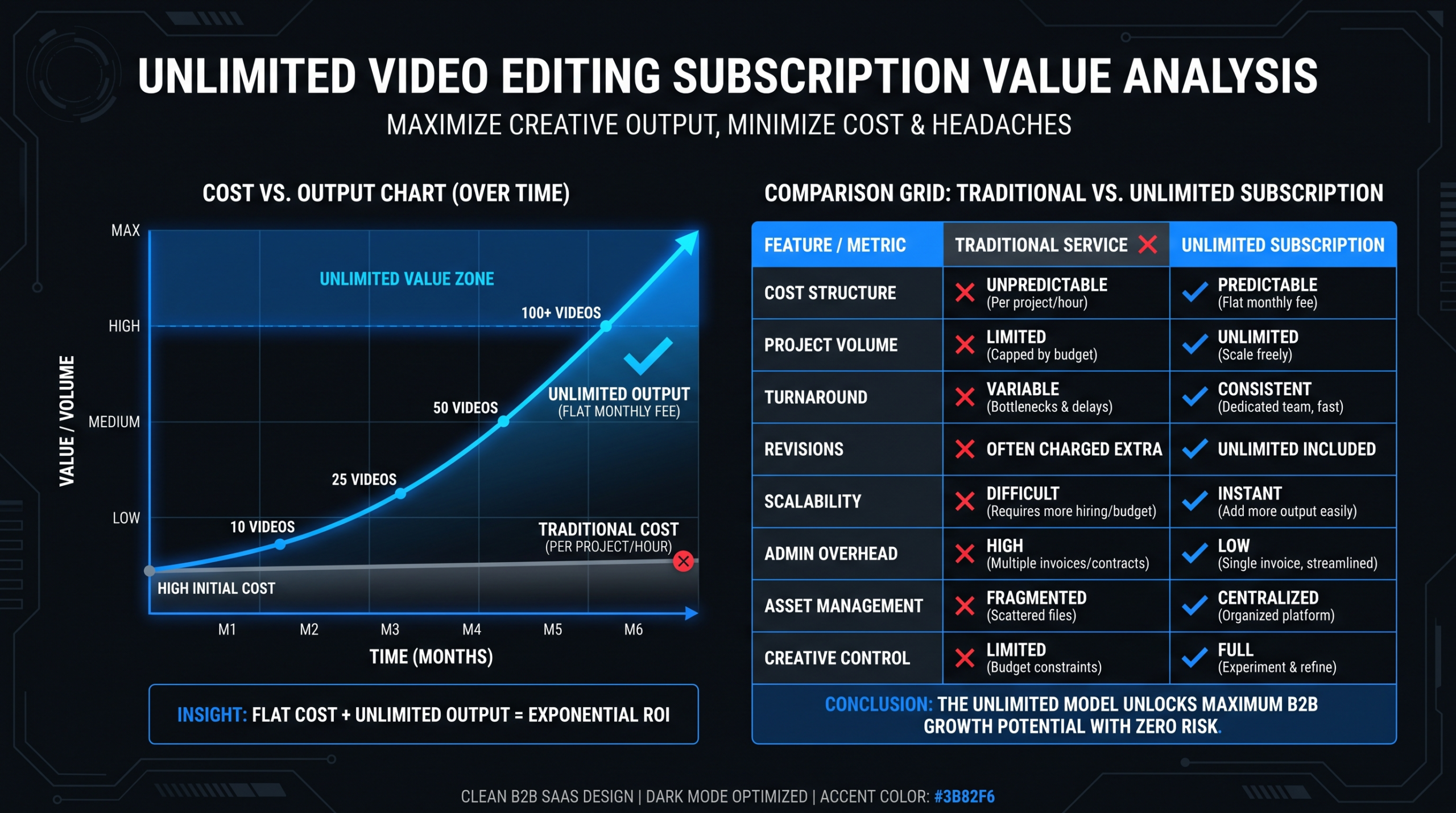
The table makes the trade-off clear: subscriptions win on volume and flexibility; dedicated teams win on quality, consistency, and capability. Neither is universally better — the right answer depends on your content type and how much brand continuity matters to your business outcomes.
To understand which team model is right for your situation, see our guide to outsourcing video editing — it covers the decision criteria in detail, including how to think about in-house vs. external teams.
The Quality Gap Most Buyers Don't Expect
The most common complaint from buyers who try unlimited editing subscriptions isn't the throughput — it's the quality ceiling. Understanding why this ceiling exists helps you set realistic expectations.
Why Editor Rotation Hurts Quality
Subscription services manage their economics by spreading editors across many accounts. An editor working on your account today may be on a completely different client tomorrow. There's no accumulation of brand knowledge, no memory of your preferred cuts, no intuition about which takes you'd select. Every video starts from cold context.
This isn't a failure of the individual editor — it's the inevitable result of the model. Subscription services optimized for throughput cannot simultaneously optimize for deep client knowledge.
Junior-Heavy Teams Are Common
At the price points where subscriptions are competitive ($2,000–$5,000/month), the services that can sustainably deliver often rely heavily on junior editors in lower-cost markets. That works well for simple, repetitive content. It rarely produces the quality needed for a product demo video that will live on your homepage or run as a paid ad.
Feedback Loop Limitations
In a queue-based model, revision rounds eat throughput. If your first draft needs significant changes — which happens regularly when editors don't deeply know your brand — you're consuming production capacity on revision rounds instead of new content. The more revision-heavy your process, the less "unlimited" actually delivers.
For SaaS teams where video quality directly affects pipeline and conversion, this quality gap has real commercial cost. That's why companies like Video Editing Company's dedicated plans — which assign a fixed senior editor and PM to your account from day one — exist as an alternative. The economics look similar to premium subscriptions at scale, but the output quality and brand consistency are structurally different.
How to Evaluate Any Unlimited Plan Before You Buy
Before committing to any subscription, run this checklist. It will surface the deal-breakers that don't appear in marketing copy.
Ask These Questions
- How many active requests does my plan tier allow? One active request is not unlimited in any meaningful sense — it's a sequential queue.
- What is the average turnaround time for a video like mine? Get this in writing, for the specific type of content you produce (not "basic edits").
- Do I get the same editor each time, or does it rotate? Rotating editors = no brand memory. This matters for anything beyond generic social content.
- What's excluded from the plan? Motion graphics, animation, color grading, and sound design are frequently excluded or upcharged.
- What does the revision policy look like? How many revision rounds are included, and at what turnaround time?
- Can I see examples from companies in my industry? Ask for a portfolio of SaaS or B2B content specifically — not just creator-focused showcase reels.
Run a Trial on Your Hardest Content First
Most reputable services offer a trial or a first-video satisfaction guarantee. Don't test with your easiest content. Give them your most complex, brand-sensitive request. If they handle that well, they can handle everything else. If they struggle, you've found your answer before a monthly commitment.
Calculate Your Real Cost per Finished Minute
Divide the monthly subscription cost by the total finished minutes of video you'll realistically get at your content type. This normalizes the comparison against per-project pricing, retainers, and dedicated teams. A "cheap" subscription that delivers 8 videos per month at $3,000 is $375 per video — not cheap if a retainer at the same spend gets you 10 better-quality videos.
For the full cost breakdown across all model types, our video editing services guide walks through what's included in each pricing model and how to compare them accurately.
Research from Wistia's State of Video reports consistently shows that video quality and consistency correlate with engagement and completion rates — so the quality gap has downstream business impact, not just aesthetic implications. Similarly, HubSpot's video marketing data points to strategic video as a key driver of pipeline for B2B companies — which means the right editing model is a strategic decision, not just a cost optimization.
Frequently Asked Questions
Is unlimited video editing actually unlimited?
No — and that's the most important thing to understand before buying. Requests are unlimited, but production capacity is finite. Most plans limit you to one or two active requests at a time, with 24–72 hour turnaround per video. Realistically, this means 8–40 completed videos per month depending on plan tier and content complexity. The word "unlimited" refers to your ability to queue requests, not to simultaneous production.
What types of companies benefit most from unlimited video editing subscriptions?
Content creators, social media teams, and companies with high volumes of short, repetitive content get the most value. YouTube channels, podcasts repurposing clips to social, and e-commerce brands running consistent short-form ads are well-suited. B2B SaaS companies needing polished product demos, customer stories, and brand-consistent content typically find dedicated editing teams more cost-effective at scale.
How does unlimited video editing compare in cost to hiring a full-time editor?
A mid-level full-time video editor in the US costs $55,000–$90,000 per year in salary alone, plus benefits, equipment, software, and management overhead — often totaling $80,000–$130,000 annually. A premium unlimited subscription runs $66,000–$108,000 per year, with similar throughput but no employer overhead. Dedicated agency teams often land in the same range while providing senior talent, a project manager, and no hiring risk. The full-time hire wins at high complexity and 40+ hours/week of editing need; outsourcing wins on everything else.
Can I cancel an unlimited video editing subscription anytime?
Most subscription services are month-to-month with no long-term contracts — this is one of their genuine advantages. Some have 2–4 week notice periods before cancellation takes effect. Dedicated team arrangements typically require 30–90 day notice. Always read the cancellation terms before signing, especially if the service bundles in setup, brand onboarding, or asset library work that may not transfer when you leave.
What should I look for in an unlimited video editing service if I need B2B quality?
Look for dedicated editor assignment (not rotating), a portfolio that includes B2B and SaaS-specific content, explicit coverage of motion graphics in the plan, and a PM or account manager rather than just a ticket queue. If those four things aren't clearly offered, the service is optimized for content creators, not B2B marketing teams. Companies like Video Editing Company build their model around dedicated senior teams specifically for B2B SaaS — which is a different product category than subscription editing, even if the monthly cost overlaps.
Not Sure Which Model Is Right for Your Team?
Talk to our team. We'll show you exactly what a dedicated editing team delivers versus what a subscription service realistically produces — with real examples from B2B SaaS clients at your content volume.
Book a Free Strategy Call See Our Plans