SaaS Video
Video Strategy
Conversions
By the VEC Team — February 2026 — 19 min read
SaaS Video Production: How to Create Videos That Actually Convert
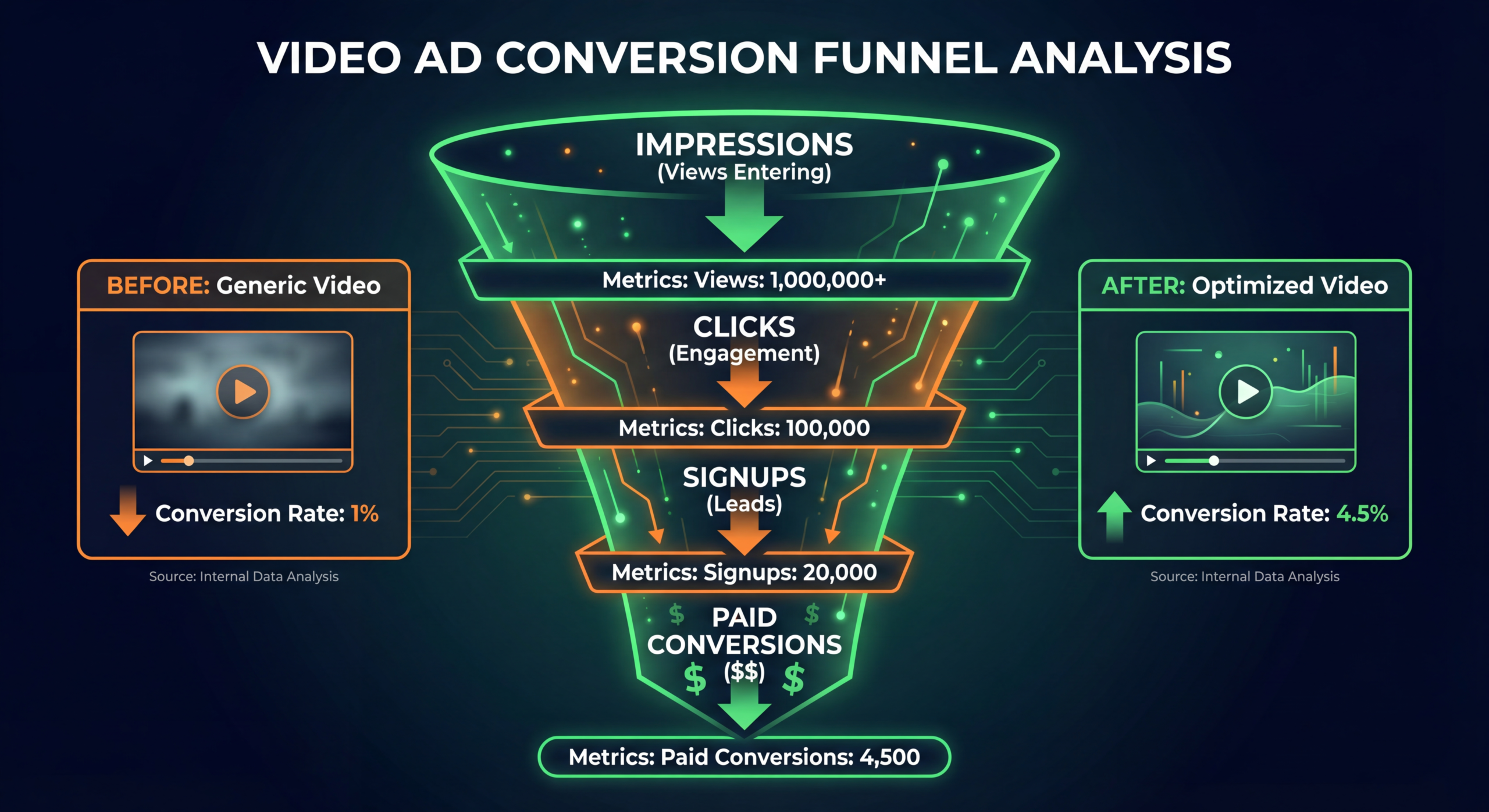
Most SaaS video production is a waste of money. Not because video doesn't work — it does, spectacularly — but because most SaaS companies approach video production without a conversion strategy. They create beautiful videos that get views and even shares, but fail to move the metrics that matter: trial signups, demo requests, paid conversions, and expansion revenue.
This guide is different. We're going to show you exactly how to approach SaaS video production with conversion as the primary objective — from strategy and scripting to production and optimization. Whether you're a startup producing your first product video or an established SaaS company scaling your video program, this framework will help you create video for software companies that actually drives revenue.
Let's start with why most SaaS video strategies fail, then build the right one from the ground up.
Why Most SaaS Video Production Fails to Convert
We've audited video programs for dozens of SaaS companies, and the failure patterns are remarkably consistent. Here are the five most common reasons SaaS video production doesn't convert:
1. No Funnel Alignment
The most common mistake in SaaS video strategy is producing videos without mapping them to specific funnel stages. A beautifully produced explainer video is worthless if it targets the wrong audience at the wrong time. Awareness-stage prospects need different content than evaluation-stage prospects, and your video production should reflect that.
2. Feature Obsession
SaaS companies love their features. And that love bleeds into their videos. Instead of leading with the customer's problem and showing how the product solves it, feature-obsessed videos parade through UI screenshots like a software museum tour. Features don't convert — outcomes do.
3. One-and-Done Production
Many SaaS companies treat video production as a project rather than a program. They invest $20,000 in a single hero video, launch it, and then don't produce another video for six months. Video marketing requires consistency. A single video, no matter how good, cannot sustain a conversion strategy.
4. No Distribution Strategy
Building a great video without a distribution plan is like building a store in the middle of the desert. Where will this video live? How will prospects find it? What landing page does it support? Which ads will drive traffic to it? Distribution should be planned before production begins.
5. Missing Measurement
If you can't measure how video impacts your pipeline, you can't optimize it. Yet most SaaS companies track vanity metrics (views, likes) rather than conversion metrics (trial starts, demo requests, pipeline influenced). Without measurement, you're flying blind.
The SaaS Video Production Conversion Framework
Now let's build the right framework. Effective SaaS video production follows a conversion-first approach that maps every video to a specific business outcome.
Step 1: Map Your Funnel to Video Types
Every stage of your buyer's journey should have at least one dedicated video type. Here's the mapping we use with our SaaS clients at VEC:
Funnel-to-Video Mapping
TOFU
Awareness — "I have a problem"
Brand Explainer
Thought Leadership
Educational Content
Social Clips
Goal: Attract → Email capture, blog subscribe
MOFU
Consideration — "What solutions exist?"
Product Demo
Use Case Videos
Comparison Videos
Webinar Replays
Goal: Educate → Free trial signup, demo request
BOFU
Decision — "Is this the right choice?"
Customer Testimonials
Case Study Videos
ROI Calculators
Personalized Demos
Goal: Convert → Paid subscription, contract sign
POST
Retention — "How do I get more value?"
Onboarding Series
Feature Tutorials
Release Updates
Community Content
Goal: Retain → Reduce churn, drive expansion
Step 2: Define Conversion Goals for Each Video
Before you produce any video, answer these questions:
- Who is the primary viewer? (Persona, role, stage of awareness)
- What should they do after watching? (Specific action — not "learn more")
- Where will they encounter this video? (Landing page, email, social, ad, in-app)
- How will we measure success? (Which metric moves if this video works?)
If you can't answer all four, you're not ready to produce. Go back and clarify your strategy.
Step 3: Script for Conversion, Not for Completeness
SaaS video scripts tend to be feature encyclopedias. A conversion-focused script follows a different structure:
- Hook (0–5 seconds): State the viewer's pain point in their language. No logos, no introductions.
- Agitate (5–15 seconds): Amplify the problem. Show what happens if they don't solve it.
- Solution (15–45 seconds): Introduce your product as the answer. Show the transformation, not the tool.
- Proof (45–75 seconds): Demonstrate with real UI or customer quotes. Make it tangible.
- CTA (75–90 seconds): Tell them exactly what to do next. Make it specific and low-friction.
This isn't the only script structure, but it's the one that consistently converts for SaaS video production.
SaaS Video Production: Pre-Production That Prevents Waste
The most expensive mistake in SaaS video production isn't a bad edit — it's producing the wrong video in the first place. Thorough pre-production prevents this.
Creative Brief Essentials
Every SaaS video should start with a creative brief that includes:
- Business objective: What metric will this video move?
- Target persona: Specific role, company size, and pain points.
- Key message: One sentence the viewer should remember.
- Proof points: 2–3 data points or customer quotes that support the message.
- Competitive context: What competitors are saying and how this video differentiates.
- Distribution plan: Every channel and placement, with format requirements.
- Success metrics: KPIs with targets.
Demo Environment Preparation
This is where many SaaS companies stumble. Before recording product footage:
- Create a dedicated demo account with realistic (but not real) data.
- Populate the demo with scenarios that match your target persona's use case.
- Ensure the UI is on the latest stable version — not a development branch.
- Hide or blur any features that haven't been publicly announced.
- Set up the demo environment on a clean browser profile (no bookmarks bar, personal extensions, or notification badges).
Storyboarding for SaaS
SaaS storyboards don't need to be artistic. They need to be precise. For each scene, document:
- What's on screen (UI view, animation, talking head, or graphic)
- Voiceover line or dialogue
- On-screen text or annotations
- Transition type
- Duration estimate
Production Techniques for High-Converting SaaS Videos
Now let's talk production. The way you capture footage directly impacts your ability to edit for conversions later.
Screen Recording Best Practices
Screen recordings are the backbone of SaaS video production. Here's how to record them right:
- Resolution: Record at 4K (3840—2160) even if you'll deliver at 1080p. The extra resolution allows you to crop and zoom without quality loss.
- Frame rate: 60fps for smooth cursor movements and scrolling. You can always drop to 30fps in post.
- Mouse movements: Practice the demo flow 3–5 times before recording. Deliberate, smooth cursor movements look professional; jerky, uncertain movements look amateur.
- Multiple takes: Record each section 3 times. This gives your editor options and ensures you have a clean take for every moment.
Talking Head Production
Talking heads add a human element to SaaS videos. Whether your CEO is narrating or a product manager is explaining a feature, follow these production standards:
- Lighting: Three-point lighting minimum. A $300 LED panel setup transforms webcam-quality footage into broadcast-quality content.
- Background: Use your office, but curate it. Remove clutter, add branded elements, ensure the background isn't distracting.
- Audio: Lavalier mic ($50+) or shotgun mic ($200+). Never rely on camera or laptop microphones.
- Eye line: Position the camera at eye level and have the speaker look directly into the lens, not at a monitor.
B-Roll and Supplementary Footage
B-roll is the secret weapon of compelling SaaS video production. While screen recordings show what your product does, B-roll shows the human context:
- Team members collaborating (real, not staged)
- Over-the-shoulder shots of the product in use
- Office environment and culture shots
- Customer workplace footage (with permission)
SaaS Video Production: Conversion Benchmarks You Should Target
How do you know if your SaaS videos are performing? Here are the benchmarks we use with our clients, based on aggregate data from hundreds of SaaS video campaigns.
SaaS Video Conversion Benchmarks
Metric
Below Average
Average
Top Performer
View-through rate
< 30%
30–55%
55%+
CTA click rate
< 2%
2–5%
5%+
Landing page lift (with video)
< 20%
20–50%
80%+
Trial signup attribution
< 5%
5–15%
15%+
Demo request conversion
< 3%
3–8%
8%+
Onboarding completion
< 40%
40–65%
65%+
Social engagement rate
< 1%
1–3%
3%+
Based on aggregate data from SaaS video campaigns, 2024—2026
Interpreting the Benchmarks
A few key observations from this data:
- View-through rate is your editing quality signal. If people aren't watching past 50%, the problem is usually pacing, not content. Your editor needs to tighten the first 15 seconds and add more visual variety.
- CTA click rate above 5% is exceptional — and achievable with contextual CTAs (specific offers tied to video content) rather than generic "learn more" buttons.
- Landing page lift of 80%+ is realistic when you match the video content precisely to the landing page's promise. Disconnect between video and page kills conversions.
SaaS Video Production by Funnel Stage: Deep Dive
Top of Funnel: Awareness Videos
Awareness videos are the widest part of your funnel and typically the most challenging to produce because the audience doesn't know they need your product yet. The key to TOFU SaaS video production:
- Lead with the problem, not the product. Your viewer should think "that's exactly my situation" within the first 5 seconds.
- Use category-level messaging. Talk about the problem space, not your specific solution. "Tired of losing track of customer feedback?" not "Introducing FeedbackPro 3.0."
- Optimize for reach. These videos should be designed for shareability — which means emotional hooks, surprising data points, and strong opening frames.
- Soft CTAs only. At this stage, ask for email signups or content downloads, not trial signups.
Production tip: TOFU videos perform best with a combination of animation and real-world footage. Pure animation feels sterile; pure live action feels generic. The blend creates distinctive, memorable content.
Middle of Funnel: Consideration Videos
This is where SaaS video production gets most interesting — and where the biggest conversion opportunities live. Your viewer knows they have a problem and is actively evaluating solutions.
- Show your product in action. No more abstractions. Record real workflows, real data, and real outcomes in your demo environment.
- Address objections proactively. Script and produce sections that directly counter the top 3–5 objections your sales team hears.
- Use comparison framing. Show how your approach differs from alternatives (without being negative about competitors).
- Include specific metrics. "Customers save an average of 12 hours per week" is more compelling than "save time."
Production tip: Product demos at this stage should be 2–4 minutes maximum. Longer demos can work for inbound leads who've requested them, but consideration-stage content should respect the viewer's time.
Bottom of Funnel: Decision Videos
Decision-stage videos are your closers. They need to provide the final push that turns a prospect into a customer:
- Social proof is everything. Customer testimonials, case study videos, and ROI stories do the heavy lifting here.
- Be specific about results. Vague testimonials don't convert. "We increased our conversion rate by 34% in 90 days" converts.
- Match the prospect's context. If possible, show testimonials from companies in the same industry, size, or use case as the prospect.
- Include pricing context. Not necessarily exact pricing, but value framing: "For the cost of one junior hire, you get..."
Post-Sale: Retention Videos
Here's where most SaaS video strategy drops the ball entirely. Once a customer converts, the video production pipeline often goes silent. But retention videos are arguably the highest-ROI content you can produce:
- Onboarding series: A structured video curriculum that guides new users from signup to activation. This directly impacts your activation rate and time-to-value.
- Feature tutorials: Short videos (60–90 seconds) that help existing users discover and adopt features they haven't used yet. This drives expansion revenue.
- Release announcement videos: Show customers what's new each month. This demonstrates ongoing value and reduces "what am I paying for?" churn.
Video for Software Companies: Distribution Strategy
Production without distribution is wasted effort. Here's how to distribute your SaaS videos for maximum conversion impact.
Website Integration
Your website is your highest-converting video distribution channel. Strategic placement includes:
- Homepage hero: A 30–60 second brand explainer that communicates your value proposition faster than text can.
- Product pages: Feature-specific demos embedded alongside feature descriptions.
- Pricing page: A short video explaining your pricing model and value tiers. This reduces pricing page bounce rates by 20–30%.
- Customer stories page: Testimonial videos organized by industry, use case, or company size.
- Blog posts: Embed relevant videos in top-performing blog content. This improves dwell time and SEO signals.
Paid Media
SaaS video ads require specific production considerations:
- LinkedIn: Professional tone, 30–90 seconds, leads with business problem. Vertical or square format. Captions mandatory.
- YouTube: Hook in 5 seconds (before skip button), 15–30 second ads for awareness, 60–120 second ads for consideration.
- Meta (Facebook/Instagram): Scroll-stopping visual in first 2 seconds, sound-off design, 15–30 seconds for best performance.
- Google Display: 15-second bumper ads, auto-play, strong visual branding.
Sales Enablement
Your sales team is one of the most effective distribution channels for SaaS video content:
- Prospecting emails: Short video thumbnails in outbound emails increase reply rates by 2—3—.
- Pre-meeting sends: Share a product overview video before the demo call so the conversation can go deeper faster.
- Follow-up assets: After a demo, send a personalized recap video or relevant case study video.
- Proposal support: Include testimonial and ROI videos in proposal decks.
Email Marketing
Video in email is a proven conversion driver, but implementation requires care:
- Use animated GIF thumbnails with play buttons (most email clients don't support embedded video).
- Link to a landing page with the video, not directly to YouTube.
- Include "Watch the video" as a clear CTA — this can increase click rates by 65%.
- Test video placement: above the fold vs. after introductory copy.
SaaS Video Production Costs: What to Expect
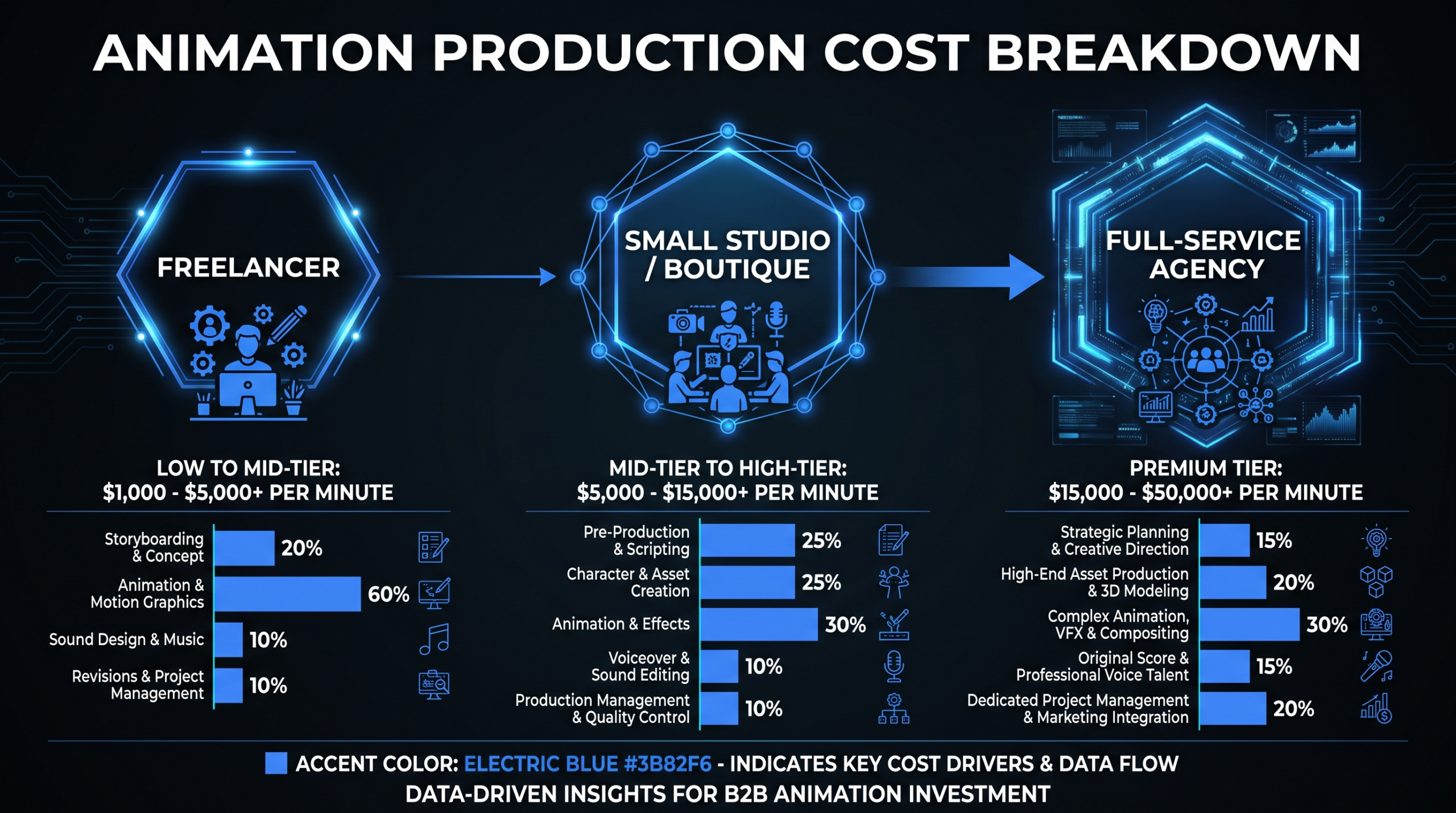
Let's talk money. SaaS video production costs vary dramatically based on complexity, quality, and volume. Here's a realistic breakdown:
Budget Tiers
Starter ($1,000—$3,000 per video)
- Screen recording with professional voiceover
- Basic motion graphics (lower thirds, transitions)
- Stock music and SFX
- 1–2 rounds of revisions
- Single format delivery
Professional ($3,000—$8,000 per video)
- Custom animation and motion graphics
- Professional talking head footage (remote or on-location)
- Custom music selection or composition
- Multi-format delivery (16:9, 1:1, 9:16)
- Branded templates for ongoing use
Premium ($8,000—$25,000+ per video)
- Full production crew (director, DP, sound engineer)
- On-location shoots with professional lighting and staging
- Custom 3D animation or complex motion graphics
- Multiple stakeholder interviews and testimonials
- Comprehensive post-production with color grading
The Smart Approach: Batch Production
The most cost-effective approach to SaaS video production is batch production. Instead of producing one video at a time, plan and produce 4–8 videos in a single production cycle. This reduces per-unit costs by 30–40% through shared setup, equipment, and creative direction.
At VEC, our SaaS video retainers are structured around batch production — allowing our clients to maintain a consistent publishing cadence at a fraction of the cost of one-off production.
Optimizing SaaS Video Production for Search and Discovery
Your videos should work for you 24/7, which means optimizing them for search. Here's how:
YouTube SEO for SaaS
- Keyword-optimized titles: Include your primary keyword in the first 60 characters of your title.
- Descriptions: Write 300+ word descriptions with keywords, timestamps, and links.
- Tags: Include 10–15 relevant tags, mixing broad and specific keywords.
- Thumbnails: Custom thumbnails with large text, high contrast, and a human face increase click-through rates by 30%+.
- Closed captions: Upload accurate captions (don't rely on auto-generated). These are indexed for search.
- Video schema markup: Add VideoObject structured data to every page with an embedded video.
- Transcripts: Publish full transcripts alongside videos. This gives search engines textual content to index.
- Page speed: Use lazy loading for video embeds to prevent them from slowing your page load time.
- Hosting: Use Wistia, Vimeo Pro, or Vidyard for website embeds. YouTube embeds leak traffic to competitors through suggested videos.
Advanced SaaS Video Production Strategies
Personalized Video at Scale
AI-powered video personalization allows you to create thousands of unique video variants from a single template. Insert the prospect's name, company logo, industry-specific messaging, and relevant use cases dynamically. SaaS companies using personalized video in sales outreach report 3— higher response rates.
Interactive Product Tours
Instead of linear video, create interactive tours that let viewers choose which features to explore. These hybrid video-interactive experiences see 4— longer engagement than traditional video and provide valuable intent data for sales teams.
User-Generated Video Content
Encourage your power users to create feature tutorials, workflow videos, and review content. User-generated SaaS videos are perceived as more trustworthy than brand-produced content and cost nothing to produce. Feature the best UGC on your website and social channels.
Video in Product (In-App Video)
Embed contextual video content directly in your product interface. When a user opens a feature for the first time, trigger a 30-second tutorial video. When they haven't logged in for a week, send an email with a "what's new" video. This bridges SaaS video production with product-led growth.
Related Resources
Continue building your SaaS video strategy with these guides:
Frequently Asked Questions
How much does SaaS video production cost?
SaaS video production costs range from $1,000 to $25,000+ per video depending on complexity. A basic screen recording with voiceover and motion graphics starts at $1,000—$3,000. Professional productions with custom animation, on-location filming, and multi-format delivery typically cost $3,000—$8,000. Premium productions with full crews and complex animation can exceed $15,000. Batch production retainers reduce per-unit costs by 30–40%.
What types of videos convert best for SaaS companies?
Customer testimonial videos consistently show the highest conversion rates for bottom-of-funnel SaaS marketing, with an average lift of 34% in demo-to-close rates. Product demo videos drive the most trial signups. Explainer videos are the most effective for top-of-funnel awareness. The key is matching the video type to the funnel stage — not producing one type exclusively.
How long should SaaS marketing videos be?
Optimal length depends on the video type and funnel stage: awareness ads perform best at 15–30 seconds, explainer videos at 60–90 seconds, product demos at 2–4 minutes, and customer testimonials at 2–3 minutes. For organic YouTube content, 5–10 minutes works well for tutorial and educational content. The universal rule: every second must earn its place. Cut anything that doesn't advance the narrative or conversion goal.
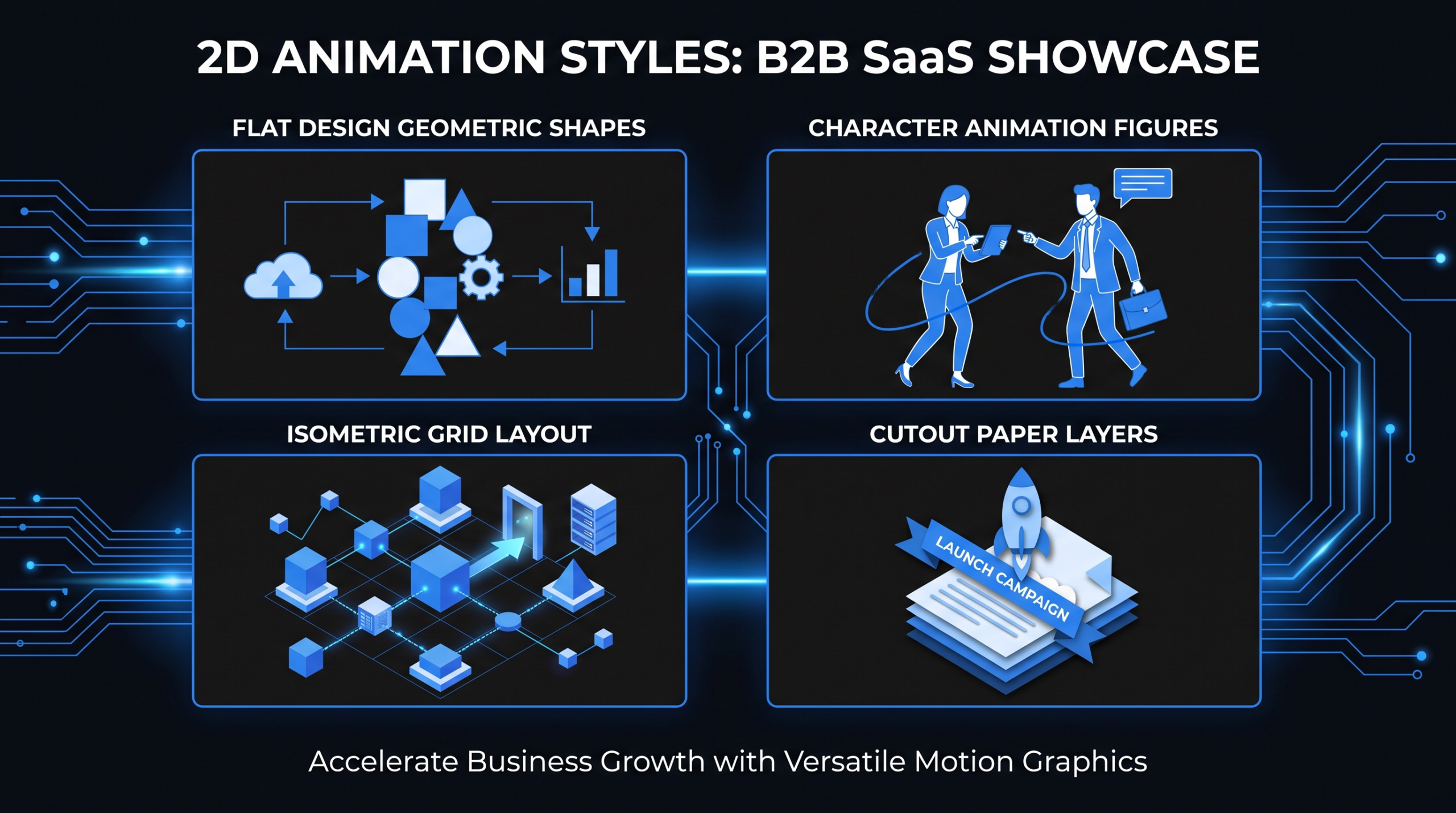
Should we use animation or live action for SaaS videos?
Both have their place. Animation works best for explaining abstract concepts (workflows, data flows, integrations) and offers infinite creative flexibility. Live action (talking heads, office footage, customer interviews) builds trust and emotional connection. The highest-performing SaaS videos typically blend both — using animation for product concepts and live action for social proof and human connection.
How do we measure the ROI of SaaS video production?
Track three layers of metrics: (1) Engagement — view-through rate, average watch time, drop-off points. (2) Conversion — CTA click rate, trial signups attributed to video, demo requests from video landing pages. (3) Revenue — pipeline influenced by video, close rate with video vs. without, customer lifetime value of video-acquired customers. Use UTM parameters, video analytics platforms (Wistia, Vidyard), and CRM attribution to connect video views to revenue.
How often should a SaaS company produce new videos?
We recommend a minimum cadence of 4 hero videos and 8–12 derivative clips per month. This maintains consistent presence across channels and provides your sales team with fresh content. Companies scaling aggressively may produce 8–12 hero videos per month. The key is building a sustainable production pipeline rather than sporadic bursts of activity.
See real examples from recognized SaaS companies: our curated founder-led video examples for SaaS page breaks down five videos from Loom, Superhuman, Notion, HubSpot, and Drift — showing exactly what makes each format work and how to apply the same approach to your own program.
📥 Free: SaaS Video Swipe File
Get our curated collection of 50+ high-converting SaaS video examples, organized by funnel stage, video type, and company size. See exactly what's working in 2026.
Download the Swipe File
See Pricing
Ready to Produce SaaS Videos That Convert?
Our team specializes in SaaS video production that drives measurable business outcomes. From strategy to final delivery, we'll help you build a video program that actually moves your metrics.
Book a Free Strategy Call →