

By VEC Team - February 2026 - 20 min read
Every SaaS company knows video is essential-for product demos, customer onboarding, paid ads, and thought leadership. But when it comes to budgeting for video production services, most SaaS leaders are flying blind. The range of costs is staggering: you might get a quote for $500 and another for $50,000 for what seems like the same type of video.
This guide demystifies SaaS video production cost by breaking down exactly what you should expect to pay for every type of video in a SaaS company's content arsenal. We'll cover video production pricing models, show you how to allocate your video production budget, and explain where to invest for maximum impact at each growth stage.
Whether you're a seed-stage startup creating your first product demo or a Series C company scaling content across channels, this guide gives you the numbers you need. For a personalized assessment, schedule a call with VEC.
SaaS companies have unique video needs that don't map neatly to traditional production pricing. Understanding these differences is essential to building an accurate video production budget.
Unlike physical products that can be filmed on a set, SaaS products exist as interfaces on screens. Demonstrating value requires screen recordings, UI animations, workflow visualizations, and data graphics-all of which require specialized post-production skills rather than traditional camera work.
SaaS products ship updates weekly or monthly. A product demo shot today may be outdated in 90 days. This means SaaS companies need video production workflows that can rapidly update existing content, not just create from scratch. The cost of maintaining and updating a video library is a major line item that most traditional production quotes don't account for.
While a consumer brand might need one hero video and some social ads, SaaS companies need video at every funnel stage: awareness (thought leadership, brand), consideration (product demos, comparisons), decision (testimonials, case studies), and retention (onboarding, training, feature updates). This breadth requires volume, which makes cost-per-video and scalability critical.
A single SaaS video often needs to be repurposed into 5-10 assets: full-length for YouTube, 60-second cut for LinkedIn, 30-second for Instagram, 15-second for TikTok/Shorts, GIF for email, and stills for social. Your video production pricing should account for this multi-format delivery, not just the hero asset.
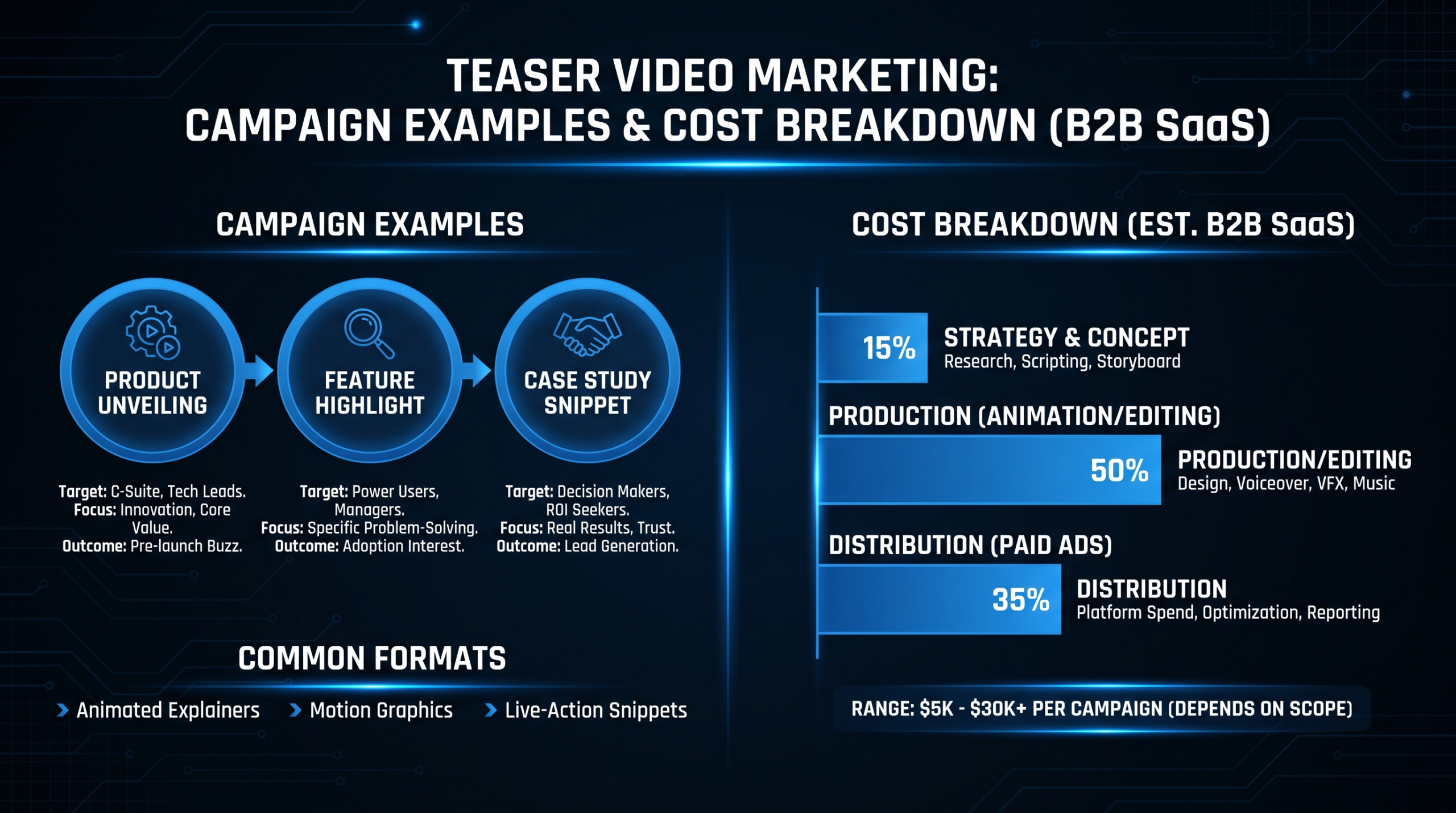
Let's break down SaaS video production cost across every major video type. These ranges reflect total production cost including scripting, shooting/recording, editing, motion graphics, and delivery in 2026.
DIY/Basic = screen recording + simple editing. Mid-Tier = professional editing + motion graphics. Premium = full production with scripting, professional VO, custom animation.
Product demos are the workhorse of SaaS video content. The cost range is enormous because it depends heavily on the approach. A basic screen recording with voiceover and simple editing can be produced for $500-$1,500. A polished demo with scripted narration, UI animations that highlight key features, custom motion graphics, and professional sound design costs $2,000-$5,000. A cinematic-quality demo with live-action B-roll, professional actors, and high-end animation reaches $5,000-$15,000.
For most SaaS companies, the mid-tier approach delivers the best ROI. Your demo needs to look professional and clearly communicate value, but it doesn't need to be a Hollywood production. Focus your budget on clear scripting and smooth UI animations rather than expensive live-action production.
Explainer videos-typically 60-90 seconds-distill your product's value proposition into a compelling narrative. These are among the most expensive per-second video types because they require extensive scripting, storyboarding, and usually animation.
Simple motion graphics explainers (think: animated icons, text, and basic illustrations) run $1,000-$3,000. Character-animated explainers with custom illustrations cost $3,000-$8,000. Premium explainers with bespoke 2D or 3D animation from agencies like Wyzowl or Demo Duck can reach $8,000-$25,000.
The key insight: explainer videos have an extremely long shelf life (often 2-3 years before needing an update), so the annualized cost is lower than it appears. A $5,000 explainer used for 2 years costs just $208/month-often the highest-ROI video investment a SaaS company can make.
Testimonials are the most persuasive video content for SaaS buyer committees. Remote testimonials (filmed by the customer on their own camera or via Zoom, then professionally edited) cost $500-$2,000. On-location testimonials with a professional film crew cost $2,000-$5,000 per customer. Multi-customer testimonial campaigns with full production reach $5,000-$12,000+ per finished video.
The remote-first approach has become the industry standard since 2020. With proper guidance (sending customers a lighting kit, camera settings guide, and interview questions in advance), remote testimonials can look surprisingly professional at a fraction of on-location costs. VEC's production process includes remote interview direction to maximize quality while minimizing cost.
Training and onboarding content is typically the highest-volume video category for SaaS companies. A single product might need 20-50 tutorial videos covering every major workflow and feature. At these volumes, cost per video is critical.
Basic screen recordings with voiceover and simple editing run $300-$1,000 per video. These are functional and get the job done for internal training or knowledge base content. Polished tutorials with UI zoom-ins, annotations, chapter markers, and branded intros/outros cost $1,000-$3,000. Premium tutorials with custom animations showing abstract concepts and professional narration run $3,000-$8,000.
Most SaaS companies should produce the bulk of their tutorial content at the basic-to-mid tier ($300-$1,500 per video) and reserve premium production for their top 5-10 most-viewed tutorials. This tiered approach can cut total tutorial library costs by 50-70% versus producing everything at premium quality.
Paid social video ads are where SaaS companies need the highest volume of creative variants. Effective paid social requires constant testing-new hooks, new formats, new angles-which means you need to produce dozens of ad variants per month to find winners.
At the low end, user-generated-content-style ads (authentic, raw, shot on phone) cost $200-$800 to produce. Polished social ads with motion graphics, text overlays, and professional editing run $800-$2,500. High-production hero ads for platforms like YouTube or connected TV cost $2,500-$10,000.
The trend in 2026 is clear: UGC-style and creator-led ads consistently outperform polished productions on platforms like Meta, TikTok, and LinkedIn. Smart SaaS companies are shifting budget from fewer premium ads to higher volume lower-production-value variants, reducing their effective cost per ad while increasing performance.
Most SaaS companies host 2-4 webinars per month. The raw recordings need editing to remove dead air, add intros/outros, insert slides and graphics, and extract highlight clips for social distribution.
Basic webinar editing (cleanup + basic branding) runs $300-$800. Full post-production with graphics overlays, chapter markers, and social clip extraction costs $800-$2,000. Premium webinar packages with custom animated graphics, multi-speaker editing, and comprehensive repurposing into 10+ social assets reach $2,000-$4,000.
Knowing individual video costs is useful, but the real question is: how should you distribute your total video production budget across categories? The answer depends on your company stage and growth priorities.
Based on VEC analysis of 50+ SaaS company video budgets (Series A-C, $5K-$30K/month video spend)
At the earliest stage, your video production budget should be laser-focused on the videos that directly drive revenue:
At this stage, don't build a content machine. Build the 3-5 essential video assets that accelerate sales conversations and validate your messaging. Work with a cost-effective editing service or dedicated editor rather than a premium agency.
With product-market fit established, it's time to build a consistent content engine:
This is the stage where a video production services partner like VEC delivers the most value. You need consistent volume with fast turnaround, which a dedicated editing team handles far more efficiently than project-by-project freelancer engagements.
At scale, your video operation should be a well-oiled machine producing 20-50+ assets per month:
How you pay for video production services affects both your budget and the quality of output. Here are the four main models SaaS companies use:
You pay a fixed fee per video project. This works for one-off high-value productions (brand videos, explainers, hero demos) where scope can be clearly defined upfront. Expect $1,000-$25,000+ per project depending on complexity.
Pros: Clear cost per deliverable, no ongoing commitment. Cons: Expensive at volume, every project requires new scoping and negotiation, no continuity between projects.
A fixed monthly fee provides access to a dedicated production or editing team. Retainers typically range from $3,000/month (editing only) to $15,000+/month (full production including scripting, filming direction, editing, and distribution). This is the model VEC uses for most SaaS clients.
Pros: Predictable cost, dedicated team learns your brand, fastest turnaround, best per-unit economics at volume. Cons: Requires consistent monthly volume to be cost-effective; minimum 3-6 month commitment is typical.
Hiring a full-time video editor ($60,000-$100,000/year salary + benefits + equipment + software) gives you maximum control but highest fixed cost. A complete in-house team (editor + motion designer + videographer) costs $180,000-$350,000/year all-in. This only makes sense at the Series B+ stage with 25+ videos per month.
Pros: Maximum brand alignment, instant availability, deep product knowledge. Cons: Extremely expensive, limited skill diversity (one editor can't do everything), management overhead, retention risk.
The most effective approach for many SaaS companies is a hybrid: use an in-house video strategist or producer to direct content strategy and manage the brief process, while outsourcing production and editing to a dedicated team like VEC. This gives you strategic control without the full cost burden of an in-house production department.
Understanding the cost drivers helps you make strategic trade-offs in your video production budget:
How does your video spend compare to other SaaS companies? Based on industry data and VEC's experience working with 100+ SaaS brands, here are the benchmarks:
According to Wyzowl's 2025 State of Video Marketing report, 91% of businesses use video as a marketing tool, and companies allocate an average of 20-30% of their total marketing budget to video content (production + distribution). For SaaS specifically, we see 15-25% as the typical range.
SaaS companies that track video attribution report video-assisted leads cost 30-50% less than non-video leads. The median cost-per-lead for video-driven campaigns is $35-$75 on LinkedIn and $15-$40 on Meta, versus $80-$150+ for static content campaigns on the same platforms.
Regardless of your budget size, these strategies help SaaS companies maximize ROI on video production services:
Every long-form video should be systematically repurposed into 5-10 derivative assets. A 10-minute YouTube episode becomes: 3-5 short-form clips for social, a blog post transcript, an audiogram for Twitter, GIFs for email campaigns, and still frames for social posts. This multiplies your content output by 5-10x without multiplying production cost proportionally. At VEC, repurposing packages add just 20-30% to the base edit cost while tripling your content output.
For recurring content types (feature updates, weekly tutorials, social clips), invest upfront in a branded template: intro animation, lower thirds, transition style, color palette, and music bed. The template costs $500-$2,000 to create but reduces every subsequent video's production time by 30-50%. Over 50 videos, a $1,000 template investment saves $15,000-$25,000 in cumulative production costs.
Instead of producing videos one at a time, batch similar content types. Record 4-6 tutorials in one session, film 3 customer testimonials in one week, or script 8 social ads simultaneously. Batching reduces per-unit costs by 15-30% and creates a content buffer that prevents the panic of producing videos on deadline.
The most expensive mistake in video production is starting without a clear plan. For every $1 spent on scripting, storyboarding, and brief development, you save $3-$5 in production and post-production costs by eliminating re-shoots, re-edits, and revision cycles. Budget 10-15% of your total production cost for pre-production planning.
Track which video types, topics, and formats drive the most pipeline value. Most SaaS companies find that 20% of their videos drive 80% of results. Identify your top performers and invest disproportionately in producing more content like them, while scaling back on underperforming categories.
Get a customized video production budget based on your company stage, content goals, and video types. Our calculator shows you exactly where to allocate spend for maximum ROI.
Calculate Your Budget ?VEC specializes in video production services for SaaS companies. Our model is designed specifically for the volume, speed, and variety that SaaS content demands:
See how SaaS companies like yours have optimized their video budgets in our case studies, or book a free consultation to get a custom proposal.
Most SaaS companies allocate 15-25% of their marketing budget to video. In dollar terms, Series A companies typically spend $3,000-$10,000/month on video production services, Series B spends $10,000-$30,000/month, and Series C+ companies invest $25,000-$100,000+/month. The right budget depends on your growth stage, content volume targets, and the complexity of your video needs.
Product demo videos and customer testimonials consistently deliver the highest ROI for SaaS companies. Demos accelerate the sales cycle by letting prospects see your product in action before a live demo call, while testimonials build trust with buying committees. Both can be produced at mid-tier quality ($1,500-$3,000 per video) with excellent results.
For most SaaS companies under 200 employees, outsourcing to a dedicated video production services partner is more cost-effective. A full in-house video team costs $180,000-$350,000/year, while an outsourced dedicated team provides comparable output for $36,000-$96,000/year. The break-even point for in-house typically comes at 30+ videos per month and $250K+ annual video budgets.
SaaS explainer videos range from $1,000-$25,000 depending on animation quality, length, and complexity. Simple motion graphics explainers cost $1,000-$3,000. Character-animated explainers run $3,000-$8,000. Premium custom-animated explainers from specialized agencies cost $8,000-$25,000. For most SaaS companies, the $3,000-$8,000 range delivers the best quality-to-cost ratio.
Hero videos (explainers, brand videos) should be updated every 12-24 months or when there's a major product pivot. Product demos need updating every 3-6 months as the UI evolves. Tutorial/onboarding videos should be reviewed quarterly and updated when workflows change. Social and ad content should be refreshed continuously with new creatives every 2-4 weeks to prevent ad fatigue.
A comprehensive SaaS video retainer typically includes: dedicated editor(s) familiar with your brand, project management, editing of all video types (demos, tutorials, social, testimonials), motion graphics and animation, color correction, sound mixing, multi-format delivery (landscape, square, vertical), revision rounds (often unlimited), and monthly strategy calls. Some retainers also include scripting, storyboarding, and content strategy.
The most effective cost-reduction strategies are: (1) create reusable templates for recurring content types, (2) batch production sessions, (3) provide detailed creative briefs to minimize revisions, (4) use screen recordings instead of live-action for product content, (5) repurpose every long-form video into 5-10 derivative assets, and (6) commit to volume with a monthly retainer for better per-unit pricing. These strategies combined can reduce effective SaaS video production cost by 40-60%.
Book a free strategy call and we’ll help you map the right editing scope, pricing model, and production setup for your team.
Book a Free Strategy Call View Pricing