Virtual Tours vs Product Video for Proptech
TL;DR
- Virtual tours let buyers, renters, and investors self-explore a property or platform at their own pace — strongest for top-of-funnel discovery, remote audiences, and leasing pipelines.
- Product demo videos deliver a guided, edited narrative — strongest for mid-funnel conversion, investor decks, agent onboarding, and feature announcements.
- For most proptech teams, the answer is not either/or: tours handle awareness and self-service exploration; product videos handle the persuasion layer where timing and storytelling matter.
- Budget, production complexity, and update frequency are the three practical tiebreakers when you can only do one.
Table of Contents
Proptech marketing teams face a format question that sounds simple but rarely is: should you invest in a virtual tour or a product demo video? Both promise to show prospects exactly what your platform does. Both require real production effort. And both get deployed across the funnel in ways that have nothing to do with their original intent.
The honest answer depends on which part of the buyer journey you're trying to move — and who, specifically, is sitting on the other side of the screen. A leasing manager evaluating property management software has completely different viewing behavior than an institutional investor underwriting a proptech deal. Getting the format wrong doesn't just waste budget; it misses the moment.
This guide maps both formats against every major proptech audience, gives you honest production economics, and tells you exactly when to run both simultaneously.
What Virtual Tours and Product Videos Actually Are
Before comparing them, it helps to nail down what each format actually does — because the terms get misused constantly in proptech marketing conversations.
Virtual Tours Defined
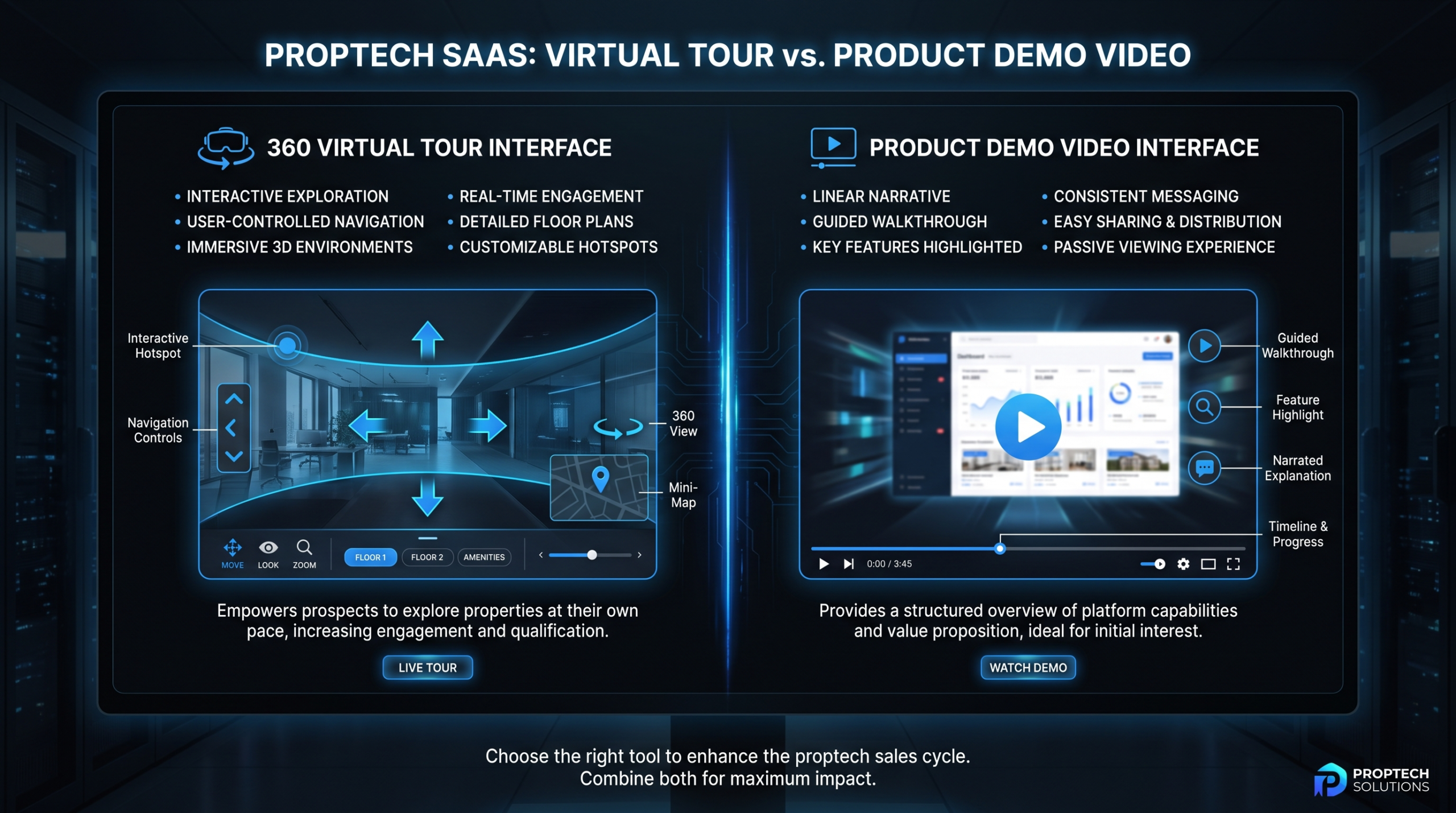
A virtual tour is an interactive, self-navigated experience that lets the viewer explore a space or interface at their own pace. In proptech, this covers two distinct use cases:
- Property virtual tours: 360° photospheres or video walkthroughs of physical spaces — apartments, commercial buildings, construction sites — stitched together so a remote viewer can pan, zoom, and move between rooms. Platforms like Matterport, Zillow 3D Home, and iGUIDE are built specifically for this use case.
- Software virtual tours: Interactive product sandboxes or guided click-through demos embedded on a SaaS platform's website, letting a prospect explore the UI without signing up. Tools like Navattic, Storylane, and Tourial sit in this category.
The defining characteristic of a virtual tour is user control. The viewer decides where to go, what to click, and how long to linger. You don't direct their attention — you create an environment they explore.
Product Demo Videos Defined
A product demo video is a produced, edited, linear piece of content that guides the viewer through your product's value proposition in a specific sequence. The creator controls the narrative arc, the pacing, the emphasis, and the emotional beats. The viewer watches; they don't navigate.
In proptech, demo videos typically serve one of four purposes: explaining what the platform does (explainer-style), showing a specific workflow end-to-end (workflow demo), highlighting a new feature (feature announcement), or building social proof with real-world results (case study video). Each has its own structure and placement in the funnel.
The defining characteristic is editorial control. You decide what the viewer sees, in what order, and with what context. That's both the power and the constraint of the format.
Audience Fit: Who Responds to Each Format
Format effectiveness in proptech isn't universal — it varies sharply by who's watching and what decision they're trying to make. Here's how the split typically looks across the key audiences in a proptech go-to-market motion:
Homebuyers and Renters
This audience wants to self-qualify before committing to a site visit or inquiry. They're browsing multiple listings, often outside business hours, frequently from mobile. A property virtual tour is the clear winner here: it lets them explore a unit on their own timeline, dramatically reduces wasted showing appointments, and gives them a sense of space that static photography can't replicate.
Product demo videos for this audience work when the proptech platform itself is the product — for example, a rent-to-own app explaining how its application process works, or a proptech search tool showing how its AI matching engine surfaces better listings than competing portals.
Leasing Teams and Property Managers
Leasing professionals evaluate property management software differently from homebuyers. They care about workflow efficiency: how many clicks to create a lease, how maintenance requests surface, how reporting pulls together for ownership groups. A product demo video built around these specific workflows — showing the intake form, the automated comms, the dashboard rollup — will outperform a generic platform tour every time.
Virtual tours of the physical properties they manage remain relevant here too, but as a tool they hand to their own prospects, not as content they consume as a software buyer.
Real Estate Agents
Agents face two distinct content needs. First, they need property virtual tour capabilities to serve their buyers and sellers — so proptech platforms targeting agents need to show, quickly, how easy it is to create and share tours. A short product demo video showing the tour creation workflow (shoot, stitch, share in under 30 minutes) is highly persuasive for this audience.
Second, agents themselves can be the audience for a virtual tour of a listing they haven't physically visited yet. Both formats are genuinely relevant here, but for different stages of their workflow.
Investors and Capital Allocators
Institutional investors evaluating proptech platforms or underwriting specific assets move slowly, evaluate deeply, and care intensely about credibility signals. A well-produced product demo video — polished edit, clear ROI narrative, real customer quotes — reads as a credibility signal in a way a self-service tour does not.
For physical asset evaluation (a commercial building, a development site), a professional virtual tour gives remote investors access they'd otherwise need a flight for. In this context, both formats earn their budget.
Product Evaluators and Procurement Teams
SaaS procurement in proptech often involves a committee of stakeholders: IT, finance, operations, and the actual end users. This audience skims. They'll watch a two-minute demo video to understand the product category; they'll interact with a product sandbox tour to answer specific "can it do X?" questions.
Interactive product tours (software-based) shine here because they allow self-directed exploration of the exact features each stakeholder cares about, without scheduling a live demo call.
Strengths and Limits Side by Side
The table below captures the core trade-offs. Neither format wins cleanly — your proptech niche and funnel stage determine which column matters more.
Format Comparison: Virtual Tour vs Product Video
| Dimension | Virtual Tour | Product Demo Video |
|---|---|---|
| User control | High — viewer self-navigates | None — creator controls sequence |
| Narrative clarity | Low — viewer may miss key features | High — you control what they see first |
| Emotional impact | Moderate — sense of space and scale | High — music, pacing, story arc |
| Mobile experience | Variable — 360° can be clunky on mobile | Strong — standard video player works everywhere |
| Update friction | High for physical tours, low for software sandboxes | High — re-edit required for any UI change |
| SEO / discoverability | Limited — interactive content rarely indexed well | Strong — YouTube SEO, schema markup, embeds |
| Share-ability | Good for property links, awkward in decks | Excellent — embeds anywhere, renders everywhere |
| Analytics depth | Rich — heatmaps, room dwell time, click paths | Moderate — play rate, watch time, drop-off |
| Production time | Fast for property capture, slow for software sandboxes | Slower for full edit, faster for screen recordings |
| Cost floor | Low ($200–$1,500+ for property; $5K–$30K for interactive SaaS sandbox) | Low ($300–$2,000 for screen-record demo; $5K–$25K+ for brand-quality production) |
Where Virtual Tours Genuinely Win
Virtual tours outperform product videos in three specific proptech scenarios:
- Remote property evaluation: When the asset being evaluated is physical (a unit, a floor plate, a development site), nothing replaces the ability to explore space without traveling. Property virtual tours remove geography as a friction point entirely.
- Self-service discovery at scale: Portals and marketplaces that need to show hundreds of listings can't produce a demo video per listing. A tour scales horizontally in ways scripted video cannot.
- Interactive SaaS sandboxes for complex platforms: If your proptech platform has 15+ feature modules and prospects have highly varied use cases, a self-guided product sandbox lets each evaluator go deep on the specific workflow that matters to them — a linear video can't deliver that breadth.
Where Product Videos Genuinely Win
Product demo videos outperform virtual tours in equally specific scenarios:
- Investor presentations: A deck or data room with an embedded two-minute product video reads as professional and polished. An embedded interactive tour does not render reliably across email and PDF environments.
- Feature launch communications: New feature announcements need a linear story — what the problem was, what the feature does, what the outcome looks like. A virtual tour gives no narrative context.
- SEO and organic discovery: Properly optimized product videos on YouTube and embedded on your blog drive organic traffic. Interactive tours are largely invisible to search engines.
- Short-cycle conversion: When a prospect has 90 seconds and a specific "can it do X?" question, a tight, well-edited demo video answers it more efficiently than asking them to navigate a sandbox.
Production Cost and Workflow Reality
Proptech marketing teams frequently underestimate the ongoing production cost of either format. Here's an honest breakdown of what the investment actually looks like.
Virtual Tour Production Costs
For property virtual tours, the primary costs are capture hardware and platform fees. Professional 360° cameras like the Matterport Pro3 typically retail in the $5,000–$8,000 range (current pricing on matterport.com). If you're outsourcing capture, third-party photographers commonly charge in the $150–$600+ range per property depending on square footage and market — these are illustrative ranges that vary significantly by region and service tier. Platform hosting fees run separately.
For interactive software product tours (SaaS sandbox tools), platforms like Navattic, Storylane, and Tourial typically price in the $500–$2,500+/month range for team plans, based on their publicly listed pricing. Building a high-quality product sandbox — with conditional logic, tooltips, and branching paths — commonly requires 20–80 hours of initial setup work from a product marketer or front-end developer, plus ongoing maintenance each time the UI changes.
Product Demo Video Production Costs
Screen-recorded SaaS demo videos with basic editing can be produced in-house for the cost of screen recording software and an editor's time. Expect $300–$1,500 per video when handled by a freelance editor with access to motion graphics templates.
Brand-quality proptech demo videos — the kind used in investor materials, on the website homepage, and in paid advertising — require full post-production: professional edit, motion graphics, color grade, licensed music, voice-over or on-camera talent, and multiple revision rounds. Agency rates for this work vary widely, and understanding the full cost structure helps make better outsourcing decisions. For a deeper breakdown, see video editing cost per minute and what goes into professional product demo video production.
The hidden cost most teams miss is update friction. Every time your platform changes its UI — and in early-stage proptech, this happens constantly — both your virtual tour sandbox and your screencap demo videos need updates. Maintaining a library of 10 demo videos across three product tiers is a real operational commitment.
Production Cost Comparison (Illustrative Ranges)
| Format | Entry Level | Mid-Market | Enterprise / Brand Quality | Ongoing Maintenance |
|---|---|---|---|---|
| Property Virtual Tour | $200–$500 (outsourced capture) | $500–$1,500 per property | $2,000–$8,000+ (large assets) | Low (assets don't change) |
| SaaS Product Sandbox Tour | $0 (DIY on freemium plan) | $500–$2,500/mo platform + setup hours | $5K–$30K build + platform | High (UI changes constantly) |
| Screen-Rec Demo Video | $300–$800 per video | $1,000–$3,000 per video | $4,000–$10,000 per video | Medium (re-record on major UI changes) |
| Brand Demo / Explainer Video | $2,000–$5,000 | $5,000–$15,000 | $15,000–$40,000+ | Low (evergreen positioning content) |
Ranges are illustrative benchmarks based on publicly available agency and platform pricing. Actual costs vary by region, vendor, and scope.
Workflow Differences
Virtual tour production for physical properties is operationally intensive on the capture side and lightweight on the post side: someone needs to be on-site with the right equipment, but the resulting deliverable requires minimal editorial work. The workflow bottleneck is logistics.
Product demo video production has the opposite profile: no on-site logistics, but substantial post-production effort — script, recording, edit, motion graphics, music, VO, QA, export. The workflow bottleneck is editorial capacity. For SaaS-focused proptech teams managing a steady volume of feature launches, this is exactly the problem a dedicated editing team solves. VEC works with B2B SaaS companies specifically on this kind of recurring video content — you can review our SaaS video production capabilities and team pricing if that matches your situation.
Repurposing: Which Format Stretches Further
Content teams in early-stage proptech need maximum mileage from every asset. Here's an honest assessment of how far each format can stretch.
How Virtual Tours Repurpose
Property virtual tours are largely purpose-built assets. A Matterport scan of Unit 12B in a multifamily development can be:
- Embedded on the listing page
- Shared as a direct link in agent and leasing communications
- Included in investor marketing materials (with appropriate caveats about the live vs. rendered state)
Beyond those three uses, the format doesn't adapt well. You can't cut a Matterport tour into social clips. You can't run it as a pre-roll ad. It doesn't work in an email body. The asset has a narrow useful life and a narrow distribution surface.
Interactive software product tours have similar limits: they live on your website or in a sales sequence, and that's effectively the end of their distribution surface. They don't translate to social, email, or paid channels without fundamental transformation.
How Product Videos Repurpose
A well-produced, two-to-three-minute product demo video can generate a significant content surface from a single production run:
- Full video: website homepage, product page, YouTube, LinkedIn
- 30-second cut: LinkedIn feed, paid social, email header
- 15-second cut: Instagram Reels, TikTok, pre-roll
- Still frames + captions: organic social posts
- GIF excerpts: sales email sequences, Slack-based sales conversations
- Transcript + quotes: blog content, sales deck copy
This multiplier effect is one of the strongest arguments for investing in professional video production over interactive tour platforms when budget is constrained. A high-quality two-minute video can realistically generate 8–12 distinct content assets that each do real distribution work across different channels.
Understanding how to maximize output from a single production run is a large part of how teams structure an outsourcing relationship. See our guide on how to outsource video editing effectively for the workflow model that supports this kind of multi-cut output.
When to Run Both Formats Together
The most effective proptech content strategies deploy both formats — not as redundancy, but as a deliberate sequencing of two different cognitive modes: exploration and persuasion.
The Exploration-to-Persuasion Arc
The pattern that works consistently in proptech sales cycles looks like this:
- Awareness layer (virtual tour / product sandbox): A prospect finds your platform via organic search, a referral, or a portal listing. They interact with a virtual tour or sandbox that lets them self-qualify. No sales pressure. No commitment required. They understand the product at their own pace.
- Consideration layer (product demo video): When that same prospect enters an email sequence, hits a retargeting ad, or lands in a sales conversation, a polished two-to-three-minute demo video does something the tour can't: it makes an argument. It shows them the customer who looks like them, the problem that maps to their situation, and the outcome that's possible.
- Decision layer (live demo + supporting clips): The sales team reinforces with short, focused demo clips targeting specific objections — integrations, security, implementation timeline.
Running both formats strategically means the virtual tour handles discovery and self-service qualification while the product video handles the persuasion moment. The combination consistently outperforms either format in isolation for complex, multi-stakeholder proptech deals.
Specific Trigger Points for Running Both
Consider running virtual tours and product videos simultaneously when:
- You have a physical product component — a marketplace, a smart building integration, a co-living space — where "see the space" is as important as "see the software."
- Your deal cycle involves multiple stakeholder types — executives need the narrative video; practitioners need the exploratory tour.
- You're running a launch campaign — the product tour goes on the landing page for exploration; the video runs in paid channels for reach.
- Your platform has complex onboarding — the virtual sandbox serves as a persistent self-service training resource; the video serves as the initial introduction that convinces someone to explore the sandbox.
Decision Criteria: A Practical Framework
If you can only do one format in the next quarter, here is the decision logic that actually holds up in proptech practice:
Choose a Virtual Tour when:
- Your product involves physical spaces that prospects need to evaluate remotely
- You're operating a portal or marketplace that needs to show volume at scale (one tour per listing)
- Your platform is complex enough that self-guided exploration beats a scripted intro
- Your primary buyer behavior is high-intent search-and-browse (renters, buyers, agents sourcing properties)
Choose a Product Demo Video when:
- You have a defined value prop that benefits from a narrative arc — problem, solution, outcome
- Your distribution channels are linear (email, paid social, investor decks, YouTube)
- You're launching a feature and need to communicate context, not just capability
- SEO and organic discoverability matter to your growth model
- Your deal cycle is short and high-volume — prospects need to get the point in 90 seconds
Run Both when:
- You're at Series A+ and have content capacity to maintain both asset types
- Your funnel has distinct self-serve and sales-assisted tracks that each need different content
- You're marketing both physical assets and SaaS capabilities simultaneously
- You have a quarterly launch cadence where videos can be cut into a multi-format campaign
"The teams that waste the most budget on proptech video are the ones running elaborate interactive tours for a product that needs a two-minute argument, or cutting polished demo videos for an audience that needs to click around and self-qualify. Matching the format to the cognitive mode of the buyer at that specific moment is the whole game." — Video Editing Company editorial team
For proptech companies specifically building their first video content motion, a single, well-produced product demo video is almost always the higher-leverage starting point. It's distributable across every channel, it's recut-able into multiple formats, and it forces the internal clarity about your value prop that interactive tours let you avoid. Once you have that foundation, layer in virtual tour capabilities where the use case genuinely demands it.
If your team is managing a steady volume of product videos — feature launches, onboarding content, customer testimonials — and finding that production bottlenecks are limiting what you can ship, that's the scaling point where a dedicated editing team makes economic sense. VEC builds dedicated teams for exactly this kind of recurring SaaS video output. See how other B2B SaaS teams have structured this in our case studies.
Frequently Asked Questions
Can a virtual tour replace a product demo video in a proptech sales deck?
Generally no. Investor decks and sales presentations require a linear narrative that you control — context, problem framing, outcome evidence. An interactive virtual tour gives investors a tool to explore, not a story to follow. Most proptech teams use a 90-to-120-second demo video as the deck's core content asset and supplement it with a virtual tour link for any physical asset they're showcasing. The tour supports the video; it doesn't replace it.
How often do virtual tours and product videos need to be updated in fast-moving proptech companies?
Product videos are particularly sensitive to UI changes — any major navigation or workflow change can make a demo video feel outdated or, worse, actively misleading to prospects who then see a different screen in a live demo. Teams commonly build a light refresh cadence into their production calendar: a full re-record for major platform changes, a patch edit (re-record specific segments) for minor UI updates. Property virtual tours are largely evergreen unless the physical space changes. Software product sandbox tours require maintenance in line with your product release cadence.
What's the right length for a proptech product demo video targeting property managers?
Property managers are task-focused, time-constrained buyers. Demo videos targeting this audience typically perform best in the 90-second to three-minute range — enough to show two or three complete workflow scenarios (maintenance intake, lease renewal, reporting) without losing attention. Longer platform overview videos (five to eight minutes) work for onboarding and training use cases once a prospect has converted, but are too long for top-of-funnel consideration content.
Is there a proptech video format that works well for both human buyers and AI search engines?
Product demo videos — when properly structured with a clear title, descriptive transcript or closed captions, schema markup, and answer-first section headers — are indexed and cited by AI search tools like Google AI Overviews and ChatGPT in ways that virtual tours are not. Interactive tour content is largely invisible to AI crawlers. If AI-search discoverability is part of your SEO strategy, product video content (especially when supported by companion blog posts like this one) is the stronger investment. For a broader look at how video and search interact, Wistia's video SEO guide is a practical reference.
What video format works best for proptech companies targeting institutional real estate investors?
Institutional investors respond to credibility signals more than self-service exploration. A polished, professionally produced two-to-three-minute product video — with a clear thesis, customer evidence, and a credible management team presence — reads as serious and investable in a way an interactive sandbox does not. Virtual tours of physical assets remain relevant for underwriting specific properties, but as a platform marketing tool for attracting institutional capital, a well-produced video that articulates your thesis, TAM, and product differentiation is the right format. Pair it with a concise one-page data room summary for best results.
Need a Dedicated Video Team for Your Proptech Platform?
VEC builds dedicated editing teams for B2B SaaS companies managing recurring video content — product demos, feature launches, onboarding, testimonials. Growth plan from $5K/mo. Guarantee: double your video output in 90 days or month 4 is free.
Book a Free Strategy Call See Team Pricing