Video Editing Agency: What They Do and Cost
TL;DR
- A video editing agency provides dedicated post-production teams, project management, and consistent output — not just editing software access.
- Service models range from per-project ($500–$25K/video) to monthly retainers ($3K–$15K/mo) to dedicated teams ($5K–$25K/mo).
- Agencies beat freelancers on consistency and scalability; they beat in-house on speed-to-hire and cost predictability.
- Red flags: vague revision policies, no assigned editor, no PM, "unlimited" claims without throughput clarity.
- VEC specializes in B2B SaaS: dedicated editing teams, flat monthly plans from $5K, and a 90-day output guarantee.
Table of Contents
Most marketing teams hire a video editing agency the wrong way: they Google "best video editing agency," pick the one with the nicest reel, and discover six months later that delivery is inconsistent, costs are unpredictable, and switching means starting from zero again.
The problem isn't the agencies — it's that "video editing agency" covers wildly different business models, service scopes, and pricing structures. A boutique post-production house in New York is structurally nothing like an offshore subscription service charging $2K/month for "unlimited" edits. Evaluating them on the same criteria is like comparing a recruiting firm to a staffing temp agency.
This guide gives you the full picture: what video editing agencies actually do, the four service models you'll encounter, honest cost ranges, how agencies compare to the alternatives, and how to evaluate them before you commit budget.
What a Video Editing Agency Actually Does
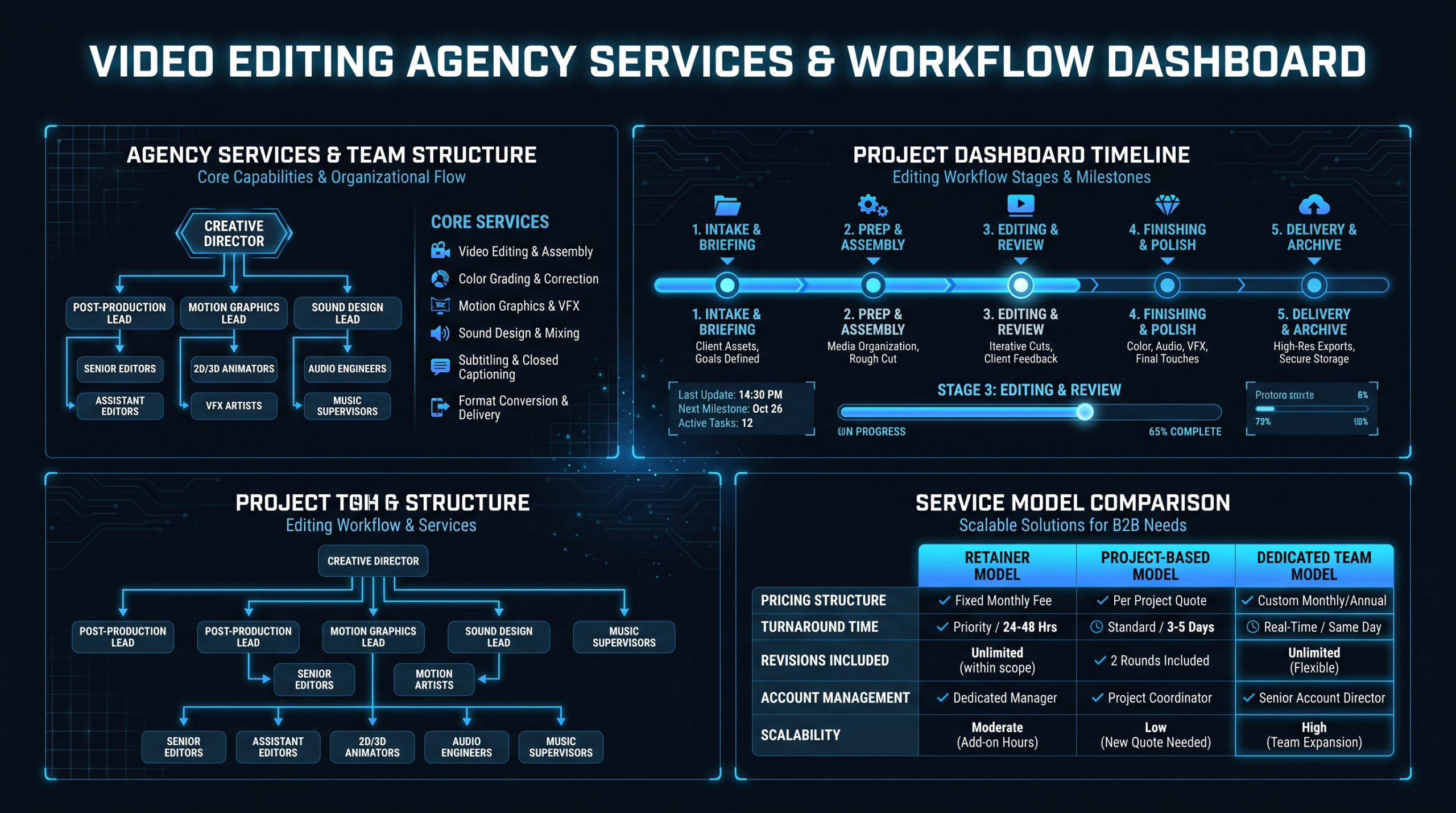
A video editing agency provides post-production services — the work that transforms raw footage into finished video content — at scale, with professional project management and repeatable quality systems. That's the short version. The reality of what that encompasses varies significantly by agency type.
Core Post-Production Services
Every legitimate video editing agency covers the fundamentals:
- Assembly editing: Selecting the best takes, trimming footage, building the narrative arc from raw clips.
- Color grading: Balancing exposure, correcting color temperature, applying a visual look consistent with brand guidelines.
- Audio mixing: Cleaning dialogue, syncing music, balancing levels, adding sound effects, normalizing loudness.
- Motion graphics: Lower-thirds, title cards, animated transitions, kinetic text, and branded intros/outros.
- Multi-format export: Deliverables cut for YouTube (16:9), LinkedIn (1:1 or 4:5), Instagram Reels (9:16), and horizontal long-form.
What You're Actually Buying (Beyond the Edit)
The editing itself is only part of what you're paying for. The rest — and often the part that separates good agencies from great ones — is operational infrastructure:
- Project management: A dedicated PM or account manager who translates your creative brief into actionable edits, coordinates feedback rounds, and holds the timeline.
- Revision systems: Structured feedback tools (Frame.io, Vimeo Review, or custom portals) that capture annotations, track versions, and prevent miscommunication.
- Brand documentation: Agencies that work with you long-term build and maintain a brand style guide covering your color palettes, approved fonts, intro/outro templates, and music preferences.
- Backup and redundancy: Professional agencies maintain asset libraries, project backups, and handoff protocols so you're not locked out if a team member leaves.
- QA processes: Before delivery, finished edits go through an internal review against your technical specs and brand guidelines — not just a spot-check by the editor themselves.
According to Wyzowl's annual State of Video Marketing report, the vast majority of marketers using video say it gives them a good return on investment — which is precisely why the operational infrastructure behind that investment matters. For a breakdown of exactly what's included in agency service packages, our guide on what video editing services include covers each deliverable type in detail.
What Most Agencies Don't Include
It's equally important to know what's typically out of scope — because finding out mid-project costs extra:
- Script writing or creative direction (usually a separate production or strategy service)
- Filming / videography (this is video production, not post-production)
- Stock footage licensing (usually charged at cost plus margin)
- Subtitles and captions in multiple languages
- Animated explainer videos or whiteboard animation (specialized motion graphics)
- Thumbnail design and YouTube channel management
Ask any agency you're evaluating to list explicitly what falls inside and outside the engagement scope. Vague scope language is the primary cause of billing disputes.
The Four Service Models Explained
Understanding which model you're evaluating is the prerequisite to any price comparison. The same agency might offer multiple models; many SaaS companies use different models at different growth stages.
Model 1: Per-Project (Project-Based)
You brief the agency on one specific video, they quote a price, you approve, they deliver. The entire engagement is scoped to a single deliverable.
Best for: Companies producing 1–4 videos per quarter, testing a new agency before committing, one-off campaign needs.
Common pricing: $500–$2,500 for a straightforward YouTube edit; $3,000–$15,000 for a polished SaaS product demo; $10,000–$50,000+ for a brand campaign with multiple deliverables.
Key watch-out: Scope creep is the main cost lever. Define revision rounds (standard is 2–3), format variations, and what constitutes a "change request" vs. a revision before you sign.
Model 2: Monthly Retainer
You commit to a fixed monthly fee for a defined set of deliverables or reserved hours. The agency guarantees capacity; you get a lower per-unit rate and a consistent point of contact.
Best for: Companies producing 6–20 videos/month with a predictable content calendar. Most Series A–B SaaS marketing teams fall here.
Common pricing: $3,000–$5,000/month (starter, 4–6 videos), $6,000–$12,000/month (growth, 8–15 videos), $12,000–$18,000/month (scale, 15–25 videos).
Key watch-out: "Use it or lose it" clauses. If your deliverable count fluctuates, confirm whether unused capacity rolls over or expires.
Model 3: Subscription (Async Queue)
A flat monthly fee for "unlimited" editing requests submitted through a portal. The agency works through your queue sequentially — typically one active request at a time.
Best for: Teams with high volumes of short-form, similar content (social clips, podcast cuts, webinar excerpts) where speed matters more than polish.
Common pricing: $2,000–$3,500/month (basic, ~8–12 videos/month throughput), $4,000–$7,000/month (standard, ~12–20 videos/month), $7,000–$10,000/month (premium, 20–30 videos/month).
Key watch-out: "Unlimited" requests ≠ unlimited output. Throughput is constrained by turnaround time per video. A subscription at $3,000/month with a 72-hour turnaround will realistically produce around 10 videos/month — not 30. Understand the actual throughput before comparing sticker prices.
Model 4: Dedicated Team
An assigned pod — typically a senior editor, junior editor, and project manager — works exclusively (or near-exclusively) on your account. They learn your brand deeply and operate as an embedded extension of your marketing team.
Best for: Companies producing 15+ videos/month, teams that need deep brand consistency, SaaS companies where video is a core content channel.
Common pricing: $5,000–$10,000/month (1 editor + PM), $9,000–$16,000/month (senior + junior + PM), $15,000–$25,000/month (full team with creative direction).
Key watch-out: Underutilization risk. If you don't consistently have enough work to fill the team's hours, you're overpaying. Dedicated teams make financial sense when you'd otherwise be managing 2+ separate vendors or considering a full-time hire.
For a side-by-side breakdown of team model vs. project-based agency, see dedicated video team vs. project agency: how to scale.
How Much a Video Editing Agency Costs
Agency pricing varies by location, experience level, team size, and the complexity of your content. Here's an honest, hedged picture of what you should expect across model types in 2026.
Video Editing Agency Cost Ranges by Model (2026)
| Model | Typical Range | Per-Video Cost (Est.) | Commitment |
|---|---|---|---|
| Per-Project | $500–$25,000+/video | Full price each time | None |
| Monthly Retainer | $3,000–$18,000/mo | $300–$1,200/video | 3–6 months typical |
| Subscription | $2,000–$10,000/mo | $150–$800/video | Month-to-month |
| Dedicated Team | $5,000–$25,000/mo | $250–$700/video at scale | 3–12 months typical |
What Drives Agency Costs Up
- Editor location: US/UK-based senior editors at $100–$150/hr vs. managed offshore teams at $25–$55/hr. Quality differences are real but narrowing at agencies with strong QA systems.
- Content complexity: A talking-head edit takes 3–4 hours of editor time. A polished SaaS product demo with screen recordings, motion graphics, and branded animations takes 10–20 hours.
- Motion graphics intensity: Kinetic text, animated charts, and custom transitions add 30–60% to edit time.
- Turnaround time: Rush delivery (under 48 hours) typically adds a 25–40% premium.
- Number of deliverable formats: The same video in 16:9, 1:1, and 9:16 is three projects, not one.
What Drives Agency Costs Down
- Longer commitments: A 12-month retainer typically costs 10–20% less per month than a 3-month arrangement. Agencies price for revenue predictability.
- Volume: Higher monthly video counts lower the per-unit cost across all models.
- Organized footage: Agencies spend a meaningful portion of edit time on footage organization. Teams that deliver pre-organized assets with clear selects often negotiate lower rates.
- Standardized templates: Repeatable content formats (weekly podcast cuts, consistent social clips) are faster to edit — and most agencies will reflect that in pricing.
For granular cost-per-minute breakdowns, our video editing cost per minute guide maps editor time to finished output across different content types.
The Total Cost of Ownership Calculation
Agency fees are only part of the picture. A full cost comparison needs to include:
- Internal management time (typically 3–6 hours/week for a marketing manager coordinating with an agency)
- Stock footage and music licensing (usually charged at cost, but can add $200–$1,000+/month at scale)
- Revision overages if you exceed the included rounds
- Onboarding period — the first 2–4 weeks of a new engagement typically produce lower volume as the team learns your brand
Agency vs. Freelancer vs. In-House: Real Comparison
The agency vs. freelancer vs. in-house debate is the most common decision SaaS marketing teams face as video becomes a core content channel. Here's how they actually stack up — not in theory, but in the scenarios that matter.
Agency vs. Freelancer vs. In-House: Head-to-Head
| Factor | Agency | Freelancer | In-House Editor |
|---|---|---|---|
| Monthly cost (10 videos/mo) | $6,000–$12,000 | $3,500–$8,000 | $8,500–$14,000 (fully loaded) |
| Scale up/down quickly | Yes (retainer scope) | Yes, but availability varies | No (headcount decision) |
| Brand consistency | High (with dedicated team) | Medium (depends on freelancer) | Highest |
| Coverage during illness/vacation | Yes (built-in) | No | No |
| Breadth of skills (color, motion, audio) | High (team covers all) | Limited to one editor's skills | Limited to one hire |
| Time to first video | 1–2 weeks (onboarding) | 3–5 days | 4–8 weeks (hire + onboard) |
| Risk of losing institutional knowledge | Low (agency retains) | High (freelancer leaves) | High (employee leaves) |
| Strategic video input | Medium (some agencies) | Low | High (embedded in team) |
When Freelancers Win
A freelancer is the right call when you need a one-off edit, when you're under $2,000/month budget, or when you're testing a new content format before committing to ongoing production. Platforms like Upwork and Fiverr have raised the talent floor considerably — you can find competent editors at $30–$75/hour without going through an agency's overhead markup.
The freelancer ceiling: single point of failure. When your editor gets sick, has a competing project, or decides to raise their rate, you have no fallback. For ongoing programs producing 6+ videos/month, this operational fragility becomes a real business risk.
When In-House Wins
In-house makes sense when your editing volume is high enough to fill 40 hours/week, your content requires extreme brand immersion (daily Slack conversations, quick reactive edits), or video is genuinely a core competency you need to own. Most SaaS teams reach this threshold at 25–40+ videos/month or when video production is central to the product experience itself.
The in-house ceiling: fully-loaded annual cost for a mid-level US-based video editor typically lands between $100,000–$160,000 when you include salary, benefits, equipment, software licenses, and recruiting costs. That's $8,500–$13,000/month before the editor produces their first frame.
HubSpot's video marketing research consistently shows that video content drives higher engagement across B2B channels than static alternatives — which raises the stakes for operational reliability. Our detailed guide on how to outsource video editing covers the full decision framework with cost modeling for each path.
When Agency Wins
Agencies are the strongest option for companies producing 8–30 videos/month that need consistent output, professional-grade quality, and operational reliability — without taking on the overhead and risk of a full-time hire. The sweet spot for a dedicated video editing agency is exactly where most scaling SaaS marketing teams live: past the "occasional project" threshold and before the "we need a full internal team" threshold.
How to Choose the Right Video Editing Agency
Choosing a video editing agency is easier to get right when you evaluate them on concrete criteria rather than vibes and reel quality. Here's a structured approach.
Step 1: Define Your Volume and Complexity First
Before you look at a single agency, document: how many videos you need per month, what types they are, and what complexity level (talking head, screen recording, motion graphics, animated explainer). This drives which model makes sense and which agencies are actually equipped to serve you.
Step 2: Match Agency Type to Your Model Needs
- 1–5 videos/month: Freelancer or per-project agency. You don't need the infrastructure overhead of a retainer.
- 5–15 videos/month: Retainer or subscription model. Look for agencies with proven capacity at your volume and content type.
- 15+ videos/month: Dedicated team model. Evaluate how they structure their pods, whether you get a named PM, and what the onboarding process looks like.
Step 3: Evaluate the Trial or Test Project
Most reputable agencies offer a paid trial project or a short initial engagement before a full retainer. Use it to evaluate:
- Turnaround time against their stated SLA
- Accuracy of the edit to your brief (how well they listened, not just executed)
- Quality of the PM's communication — responsiveness, clarity, proactive problem-flagging
- Quality of the revision process — did they incorporate feedback correctly the first time?
Step 4: Ask the Operational Questions
Beyond "do you like their reel," these are the questions that determine whether the engagement actually works:
- Who specifically will be editing my content? Will I have the same editors throughout?
- What is your process when my assigned editor is unavailable?
- How do you handle sudden volume increases — a campaign launch, product announcement, or event coverage?
- What does your revision process look like? What qualifies as a revision vs. a new request?
- What file organization do you need from me, and in what format do you deliver?
- How do you handle brand style guide changes?
Evaluation Scorecard: Key Criteria
| Criterion | What to Look For | Weight |
|---|---|---|
| Portfolio relevance | Work in your industry/format, not just impressive reels in other categories | High |
| Dedicated PM | Named point of contact, not a rotating support queue | High |
| Revision clarity | Defined rounds, clear process, no ambiguity on overages | High |
| SaaS experience | Screen recordings, product demos, SaaS brand voice — not just event/narrative video | High (for SaaS) |
| Turnaround SLA | Written guarantee, not a verbal "usually 48 hours" | Medium |
| Team stability | Low editor turnover, agency tenured 3+ years, references available | Medium |
| Pricing transparency | Clear breakdown of what's included, what's extra | Medium |
| Scalability ceiling | Can they handle 2× your current volume if you need to scale? | Medium |
7 Red Flags Before You Sign
These are the signals that reliably predict a frustrating agency relationship. Seeing one is a reason to probe deeper; seeing two or more is a reason to walk away.
- "Unlimited revisions" with no throughput clarity. No edit takes zero time. "Unlimited revisions" without a defined process creates scope chaos. Ask: what's the actual turnaround per revision round, and how many concurrent active requests can you handle?
- No named editor or PM assigned to your account. If you can't get a straight answer on who specifically will be editing your content, you're buying from a staffing pool, not a team. Quality and brand consistency suffer.
- Portfolio without SaaS or B2B examples. A reel full of cinematic brand films and event coverage doesn't predict performance on screen-recorded product demos and motion-graphics-heavy SaaS content. They're different skills.
- Vague contract language on scope. Watch for phrases like "reasonable edits," "standard revisions," or "normal turnaround." Get specifics in writing before you sign anything.
- No case studies or reference clients. Any agency charging $5,000+/month should be able to connect you with 1–2 current or recent clients willing to speak to their experience. If they can't or won't, that's telling.
- Reluctance to discuss their team's structure. "We have a large team" without specifics about who manages accounts, how editors are assigned, and what backup processes exist signals an agency that's reselling or over-leveraging capacity.
- Guaranteed results on SEO or views. A video editing agency controls the quality of the edit, not the distribution outcome. Any agency promising view counts or organic traffic from their editing work is either confused about what they sell or misleading you.
When an Agency Is the Right Call
Video editing agencies aren't the right fit for everyone. Here's an honest breakdown of when it makes clear sense and when it doesn't.
Agency Is the Right Call When:
- You're producing 8–30 videos/month and need consistent output without a full-time hire
- Brand consistency across every video matters — same intro/outro, same color treatment, same audio quality
- You've outgrown freelancers due to reliability or single-editor limitations
- You need backup coverage: someone is always available even during holidays or turnover
- You want operational reliability: missed deadlines and quality inconsistency have real downstream costs
- Your team doesn't have time to manage 3+ freelancers — a single PM is the right management overhead
Agency Is NOT the Right Call When:
- You need fewer than 4 videos per quarter — per-project or freelancer is more cost-efficient
- Your content requires daily editorial judgment and creative direction that needs to live inside your team
- You're pre-PMF and experimenting with video formats — commit to an agency after you know what works, not before
- Budget is under $2,000/month — most quality agencies aren't viable at that price point; freelancers or subscriptions are more appropriate
How VEC Fits Into This
VEC (Video Editing Company) is a dedicated video editing agency built specifically for B2B SaaS companies. The core model is a dedicated team arrangement — your own assigned editing team (senior editor + junior editor + project manager) operating on a flat monthly retainer. This structure is designed for the Series A–C SaaS marketing team that produces consistent content and needs professional-grade output without hiring in-house.
Three things that differentiate VEC from generalist agencies:
- SaaS-native expertise. The team understands screen recordings, product demo pacing, SaaS brand voice, and the specific formats that perform for B2B audiences: LinkedIn video, product walkthroughs, customer testimonials, explainer animations.
- Flat-rate plans without scope ambiguity. Growth at $5K/month, Core at $9.5K/month, and Scale at $16K/month — what's included is defined. No per-revision billing, no format-variation fees for standard deliverables. See the full pricing breakdown.
- The 90-day output guarantee. VEC guarantees double your current video output in the first 90 days, or month four is free. This is a business accountability mechanism, not a marketing claim — it's in the contract.
The process is straightforward to evaluate: book a strategy call, VEC assesses your current content operation and target output, and proposes the plan that fits. See how it works and case studies from SaaS companies that have run the engagement.
Frequently Asked Questions
What is a video editing agency and how is it different from a production company?
A video editing agency focuses on post-production: taking your existing footage and transforming it into finished videos. A video production company typically handles both production (filming) and post-production. If you already have footage — screen recordings, talking-head interviews, customer testimonials — a video editing agency is usually the more cost-effective choice. You're paying for editing expertise, not camera crews or studio time.
How long does it take a video editing agency to deliver a finished video?
Standard turnaround at most agencies is 48–72 hours for short-form content (under 5 minutes) and 5–7 business days for longer-form, motion-graphics-heavy work. Dedicated team arrangements tend to be faster than per-project work because the team already knows your brand and doesn't need a ramp-up. Subscription models work through a queue sequentially, so actual wait time depends on how many active requests are ahead of yours.
What's the minimum monthly budget to work with a quality video editing agency?
Realistically, $3,000–$4,000/month is where quality retainer-based agencies start. Below that, you're in freelancer or subscription territory. Dedicated team arrangements typically start around $5,000/month. The cheapest video editing agency isn't necessarily the best value — what matters is cost per finished video relative to the quality and operational reliability you actually need.
Do video editing agencies work with footage I send, or do they film too?
Most video editing agencies are post-production specialists — they work exclusively with footage you provide. Some larger agencies or full-service shops also offer production services (filming, animation, voiceover casting), but those are typically separate engagements with separate pricing. If you need both production and editing, clarify up front whether the agency handles both or if you'll need separate vendors.
How do I know if an agency is actually right for a SaaS company?
Ask for portfolio examples specifically in B2B SaaS: product demos, onboarding videos, feature release announcements, customer testimonials. Screen recording is a skill in itself — SaaS videos require clean cursor movements, product UI framing, and pacing that matches the software's workflow. An agency with a strong narrative film reel but no SaaS examples may struggle with the format. Also ask who on their team has experience with tools like Loom, Camtasia, or screen-capture workflows.
Ready to Stop Patching Together Video Production?
VEC gives B2B SaaS companies a dedicated editing team, flat monthly pricing, and a 90-day output guarantee. Book a free strategy call to see if the model fits your content operation.
Book a Free Strategy Call View Pricing Plans