Dedicated Video Team vs Project Agency: Scaling
TL;DR — Key Takeaways
- Project agencies reset context with every brief — your brand knowledge walks out the door when the project ends.
- Dedicated video teams accumulate brand intelligence over time, compressing revision cycles and accelerating output as months pass.
- The re-briefing tax commonly adds two to four weeks of lead time per project and 15–25% in wasted revision cycles.
- At eight or more videos per month, dedicated teams typically outperform project agencies on both cost-per-video and turnaround time.
- Transition is straightforward — the critical step is producing a thorough brand bible before onboarding your pod.
Table of Contents
The question isn't whether to outsource video. Most Series A–C SaaS marketing teams have already settled that. The real question — the one that determines whether your video program scales or perpetually stalls — is which outsourcing model you choose.
Project agencies sell you flexibility. Dedicated video teams sell you leverage. Both claims are true, and both hide real costs that most buyers discover six months too late. This guide breaks down the strategic, operational, and financial differences between the two models — without the sales pitch from either side.
If you're currently using a project agency and wondering why each video campaign still feels like starting from scratch, you're experiencing a structural problem, not an execution one. If you're evaluating a dedicated team and worried about lock-in, that concern is valid — and there are specific signals that tell you whether the commitment is the right call right now.
The Core Structural Difference
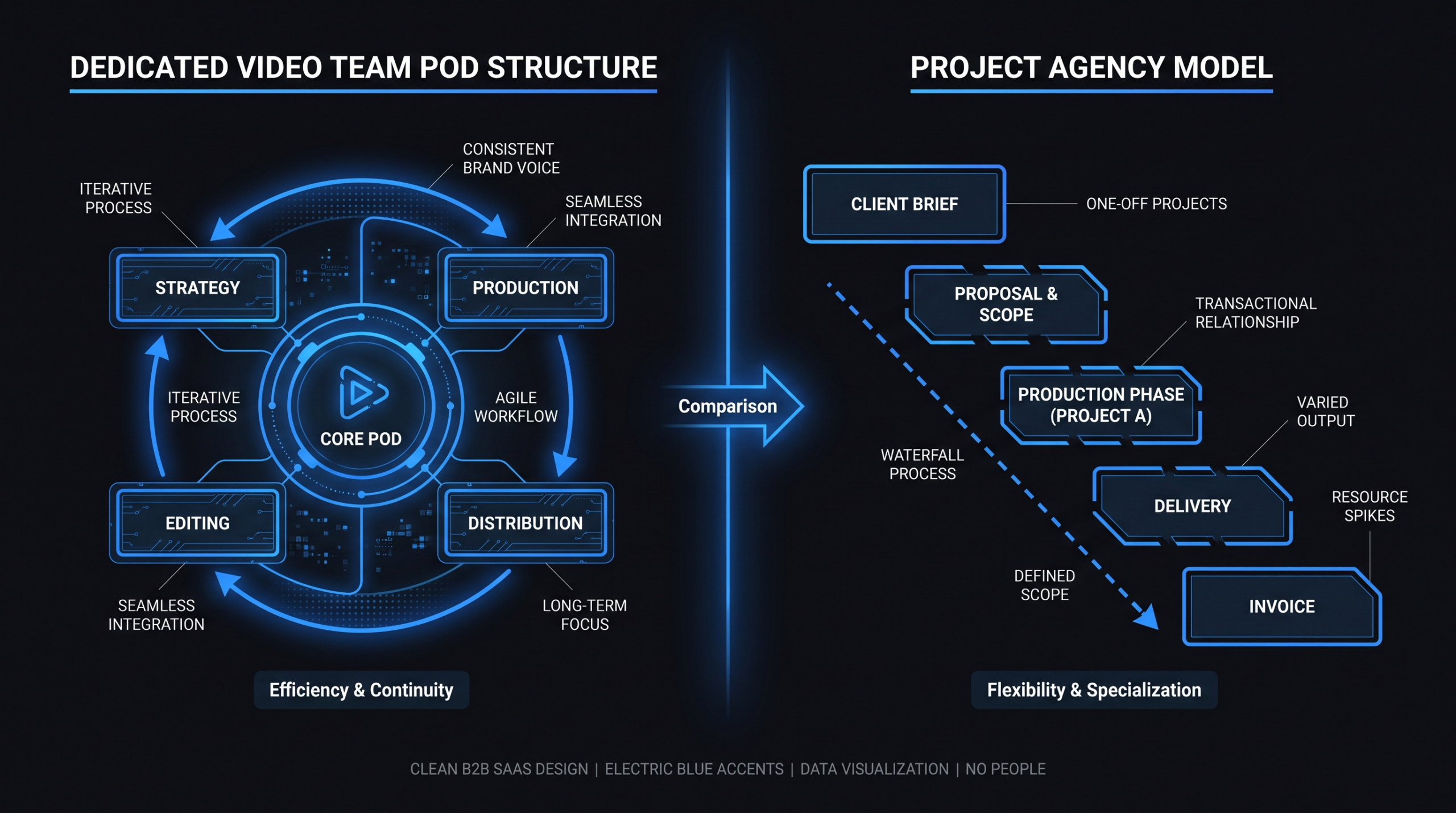
A project agency is a transaction machine. You bring a brief; they produce a video; the engagement ends. Their business model is optimized for new-client acquisition and project throughput — your account is one of dozens they're managing simultaneously, each at a different stage of the production pipeline.
A dedicated video team is a relationship structure. You retain a pod — typically a senior editor, a junior editor, and a project manager at minimum — who work exclusively or primarily on your account. Their business model depends on retaining you, not on winning the next RFP.
This structural difference has downstream effects on everything: turnaround time, brand consistency, revision cycles, institutional knowledge, and ultimately your effective cost per finished minute of video.
It also shapes how each model handles growth. When you go from six videos per month to sixteen, a project agency responds by scaling up your project volume — each new project requires the same briefing overhead as the last. A dedicated team absorbs the volume increase within their existing brand context, often without proportional increases in coordination time.
Dedicated Team vs. Project Agency: Structural Comparison
| Factor | Project Agency | Dedicated Video Team |
|---|---|---|
| Brand knowledge | Reset with each project | Compounds over months |
| Who works on your account | Whoever is available | Assigned, consistent pod |
| Briefing overhead | High — every project | Low — after initial onboarding |
| Revision cycle length | Typically 2–3 weeks | Typically 3–7 days (after ramp) |
| Volume flexibility | High — scale up or down per project | Moderate — within team capacity |
| Cost predictability | Low — varies per project | High — fixed monthly |
| Creative consistency | Variable — different editors | High — same team, learned style |
| Minimum commitment | None — per project | Typically 3–6 months |
The Hidden Cost of Constant Re-Briefing
Re-briefing isn't just annoying. It's expensive in ways that don't show up on invoices — and it compounds with every video you produce.
What a Full Re-Briefing Cycle Actually Looks Like
With a new project agency, a typical cycle runs like this: discovery call, brand document review, style guide walkthrough, sample video reference gathering, script or storyboard approval, first cut delivery that misses your tone, revision notes that re-explain brand fundamentals you thought were in the brief, second cut that's closer but still off on pacing, final approval with three remaining minor tweaks. From signed contract to approved first video, this commonly takes three to five weeks.
With a dedicated video team that has been on your account for four months, the same cycle typically compresses to three to five business days. They already know what you mean when you say "clean B2B, not corporate." They've internalized your color grading preferences, your acceptable music energy levels, your CEO's comfort on camera. They know which footage angles your audience responds to because they've watched your analytics notes.
The Re-Briefing Tax in Hard Numbers
Consider a team producing twelve videos per month with a project agency model. Each video requires an average of two rounds of substantive revision before approval — not because the agency is bad, but because they're working from a written brief rather than accumulated institutional knowledge. Teams commonly report that revision rounds decrease by 40–60% after the first three months with a dedicated pod, simply because the team stops guessing and starts knowing.
If each revision round takes three to four days and you're running twelve projects per month, the revision overhead alone can account for 20–30% of your total production calendar. That's work that simply evaporates once a dedicated team has internalized your preferences.
There's also the internal cost. Someone on your team manages each agency relationship — writing briefs, answering questions, giving feedback, chasing timelines. With project agencies, this overhead tends to scale linearly with video volume. With a dedicated team, it plateaus after the first sixty days as the team becomes self-directing within your brand guidelines.
The Security and Quality Consistency Problem
Project agencies also introduce a less-discussed operational risk: your unreleased product footage, customer testimonials, and brand assets pass through a different team on every project. Each handoff is a new trust relationship to establish, a new NDA to execute, a new set of access credentials to manage. With a dedicated team, you establish that trust once and maintain it across a long-term relationship.
Quality consistency follows the same logic. A 90-second product demo edited by a senior editor at your dedicated pod — someone who has cut forty videos for you and knows how to showcase your UI — will look fundamentally different from the same brief executed by a competent but brand-naive editor at a project agency. The dedicated editor knows which feature reveals land, which pacing keeps attention, which background music your audience doesn't skip past. That institutional knowledge isn't transferable through a brief, no matter how detailed.
The question isn't whether your brand guide is thorough enough to brief a new agency. It's whether any written document can replace six months of your dedicated editor watching what actually converts.
When a Project Agency Makes Sense
Project agencies aren't the wrong choice — they're the right choice for a specific set of situations. Being clear-eyed about when they win helps you avoid over-committing to a dedicated team before you're ready.
Low-Volume or Infrequent Video Needs
If you produce fewer than four videos per quarter, the overhead of a dedicated team — monthly retainer, onboarding investment, minimum commitment — isn't justified by the volume. A project agency gives you professional production when you need it without paying for capacity you won't use.
One-Off Campaign or Event Videos
Annual conference videos, product launch films, investor demo reels — these have specific production requirements that often differ substantially from your ongoing content. A specialist agency with a specific creative portfolio may serve these better than a team optimized for your recurring content.
Testing a New Video Format
Before committing to animated explainers, interactive video, or documentary-style case studies as recurring formats, using a project agency to produce one or two test pieces is sensible budget management. You're not asking your dedicated team to develop new specializations speculatively — you validate the format first.
Early-Stage Companies Without Defined Brand Voice
Dedicated teams learn your brand — but if your brand isn't stable yet, that learning is wasted. Pre-Series A companies still finding their market positioning may find project agencies more appropriate until their messaging solidifies.
For a deeper analysis of different video agency models and their cost structures, see our guide to video production agency pricing models.
When a Dedicated Video Team Wins
The dedicated team model earns its premium when several conditions align. Most Series B and Series C SaaS marketing teams hit all of them.
Volume Exceeds Eight Videos Per Month
At this volume, the re-briefing tax from project agencies typically outweighs the flexibility premium they charge. Your content calendar has enough consistent work to justify reserved capacity, and the per-video cost arithmetic shifts decisively in the dedicated team's favor. If you're unsure about your video volume trajectory, read our overview of SaaS video production to benchmark against comparable companies.
Brand Consistency Is a Non-Negotiable
When your video content spans product demos, customer testimonials, LinkedIn clips, sales enablement assets, and conference presentations — all carrying your brand — consistency becomes the difference between a coherent video strategy and a fragmented one. A dedicated team applies the same eye, the same color sensibility, and the same understanding of your pacing standards across every format.
You're Building for Compound Returns
Video content that performs compounds. A high-quality product demo from month one continues generating pipeline in month eighteen. When your dedicated team learns what makes your videos convert — which hooks, which feature reveals, which call-to-action placements — they apply those learnings to every video they produce. That institutional intelligence is an asset that belongs to your program, not to any individual project.
You'd Otherwise Consider Hiring Full-Time
A senior video editor plus a junior editor plus a project manager is a meaningful internal hire — with salary, benefits, equipment, software licenses, PTO coverage, and the recruitment cost when someone leaves. Dedicated outsourced teams eliminate all of that overhead while delivering comparable or superior output. If you've been on the edge of opening headcount for video, a dedicated team is often the better structural answer. You can learn more about what to expect from video editing services before committing.
The Scaling Math: Side-by-Side Cost Analysis
Let's make the financial comparison concrete. The numbers below reflect ranges commonly reported in vendor pricing pages and buyer conversations — not precise quotes, since your mileage will vary based on video complexity and provider.
Monthly Cost Comparison by Video Volume
| Volume | Project Agency (est.) | Dedicated Team (est.) | Savings with Dedicated |
|---|---|---|---|
| 4 videos/month | $6,000–10,000 | $5,000–8,000 | ~0–20% |
| 8 videos/month | $12,000–20,000 | $7,000–10,000 | ~40–50% |
| 12 videos/month | $18,000–30,000 | $9,500–14,000 | ~45–55% |
| 20 videos/month | $30,000–50,000 | $14,000–20,000 | ~50–60% |
Note: Project agency costs assume a typical B2B SaaS mix — product demos, YouTube edits, social clips, and occasional explainers. Dedicated team costs reflect a senior editor + junior editor + PM pod structure. Actual costs vary by provider, video complexity, and revision volume.
The crossover point — where dedicated teams become clearly more cost-effective — typically lands around six to eight videos per month for comparable quality. Below that threshold, the monthly retainer for a dedicated team may cost more than the project-by-project alternative. Above it, the math moves decisively toward the dedicated model.
The Factors Most Cost Comparisons Ignore
Raw monthly spend is only part of the picture. These factors amplify the dedicated team advantage at scale:
- Internal management hours. Brief-writing, feedback, timeline chasing — commonly 4–8 hours per video with a new agency, dropping to 1–2 hours per video with an established dedicated team.
- Revision round volume. An extra revision round on a $3,000 video adds real cost (typically $300–600 per round at project agencies). Dedicated teams commonly need fewer revision rounds after month two.
- Rush premium. Project agencies routinely charge 25–50% premiums for expedited delivery. Dedicated teams prioritize your work within their schedule without rush surcharges.
- Format variation costs. Repurposing one video into four social formats is a standard daily task for your dedicated pod — with a project agency, each variation is typically a new scoped deliverable.
For a detailed breakdown of how different cost structures affect your effective cost per minute of video, see our analysis of how to outsource video editing effectively.
Provider Comparison: Top Dedicated Video Teams for B2B SaaS
Not all dedicated video team providers are built the same. Here's an honest assessment of the leading options for Series A–C SaaS companies, evaluated on pod structure, pricing transparency, SaaS experience, and turnaround commitment.
Top Dedicated Video Team Providers for SaaS (2026)
| Provider | Pod Structure | Starting Price | SaaS Focus | Standout Feature |
|---|---|---|---|---|
| Video Editing Company | Sr. Editor + Jr. Editor + PM | $5,000/mo (Growth) | SaaS-dedicated | 90-day double-output guarantee; transparent tiered pricing |
| Increditors | Sr. Editor + Jr. Editor + PM + CD | ~$2,500–12,000+/mo (custom quote) | SaaS, YouTube, finance, education | Full-service pod with Creative Director; known for compounding YouTube channel performance |
| Vidpros | Editor + PM | ~$1,500–3,500/mo | General | Fast turnaround subscription model; suited for social clip volume |
| Raindrop | Varies by project | Project-based | General / brand | High-production brand films; not optimized for recurring content |
| Tasty Edits | Editor + PM | ~$2,000–4,000/mo | YouTube creators | Creator-focused; lighter B2B SaaS expertise |
#1: Video Editing Company
Video Editing Company is built specifically for B2B SaaS teams that need consistent, high-volume video output without building an in-house team. The model offers three tiered plans — Growth ($5K/mo), Core ($9.5K/mo), and Scale ($16K/mo) — each with a dedicated pod structure and a defined output commitment. The 90-day guarantee ("double your video output in 90 days or month four is free") is one of the few performance-backed commitments in the dedicated team space. Pod structure includes a senior editor, junior editor, and project manager at minimum, with the higher tiers adding motion design capacity. See full pricing details here.
Best for: Series A–C SaaS teams with consistent video volume needs across product demos, customer stories, LinkedIn content, and sales enablement.
Cons: Minimum 3-month commitment; may be over-resourced for teams under six videos per month.
#2: Increditors
Increditors operates a full-service dedicated pod model — senior editor, junior editor, project manager, and creative director — making them one of the more senior-heavy structures in the market. Their positioning spans YouTube creators, SaaS companies, finance, and education, with particular traction among clients looking to compound channel performance over time. Custom retainers reportedly range from approximately $2,500 to $12,000+ per month depending on scope, with no instant self-serve pricing tiers. Contact: [email protected].
Best for: Teams that want a Creative Director involved in content strategy, not just execution. Strong fit for companies with complex video types (explainers, case studies, thought leadership series).
Cons: Not exclusively SaaS-focused; custom pricing requires a conversation before you know what you'll pay. Less transparent on upfront tiers than some alternatives.
What to Look for Beyond Price
When evaluating any dedicated team provider, the questions that matter most aren't in the pricing page. Ask: who specifically will be on my pod, and can I speak with them before signing? What's the SLA for first-cut delivery? How do you handle team member turnover? What does the onboarding process look like, and what does week one output realistically look like versus month three output? According to research from Wistia's video production research, the biggest driver of long-term video program success is consistency of production — which depends more on team stability than on any individual creative decision.
How to Transition from Project Agency to Dedicated Team
The transition from project agency to dedicated team is straightforward operationally, but it requires one investment that most teams underestimate: building a thorough brand bible before the pod onboards.
The Pre-Transition Checklist
- Brand bible. Compile all visual guidelines, approved color grades, font usage, logo variants, and any brand video examples your team considers reference-quality. This document is what your pod will internalize in week one.
- Style reference library. Gather 8–12 examples of videos your team considers "on-brand" — including videos from other companies whose style you admire. Add short notes on what you like about each.
- Audio DNA. Document your approved music genres, energy levels, and tempo ranges. Include examples of background music that has worked and music that has been rejected.
- Feedback vocabulary. Make a list of the feedback phrases you use most often ("tighten the pacing," "more breathing room in the intro," "reduce the lower third size") so your pod learns your language immediately.
- Workflow integration. Decide how your pod will receive footage (typically a shared cloud folder), how they'll deliver cuts (Frame.io, Vimeo review, or your preference), and who on your team has final approval authority.
What to Expect in Months One Through Three
Month one output will be 60–80% of what you'll get at steady state — the team is still building your brand internalization even with a strong brief. Revision rounds in month one tend to be longer than steady state. By month two, most teams report that revision rounds drop significantly. By month three, the dedicated pod is typically producing faster, with fewer revision cycles, and with noticeably better first-cut quality than a project agency with the same brief.
For a detailed guide to the mechanics of outsourcing video editing effectively — including what to include in your brand bible, how to structure review cycles, and how to measure output quality — see our full guide on how to outsource video editing.
Running a Parallel Month
If you're concerned about output continuity during the transition, running one overlap month — where you assign a simple, defined project to your new dedicated team while wrapping up existing projects with your current agency — gives you a low-stakes environment to calibrate the relationship before going all-in. Use that month to refine your feedback vocabulary and brand bible based on what the pod actually asks about, not what you assumed they would need.
According to Wyzowl's annual video marketing report, companies that maintain consistent video output over twelve or more months report substantially higher conversion attribution from video than those with intermittent production — which reinforces the case for any model that reduces the friction of consistent output, whether that's a well-managed retainer or a dedicated team.
Frequently Asked Questions
At what video volume does a dedicated team become more cost-effective than a project agency?
The crossover point typically lands around six to eight videos per month for comparable quality and complexity. Below that volume, the monthly retainer for a dedicated team may exceed what you'd pay project-by-project. Above it, dedicated teams are consistently more economical — and the per-video advantage grows as volume increases. At fifteen or more videos per month, dedicated teams typically cost 40–60% less on a per-video basis than equivalent project agency work.
How long does it take for a dedicated video team to learn my brand?
Most teams report meaningful brand familiarity by week three and strong internalization by the end of month two. The quality of your onboarding brief is the primary variable — a thorough brand bible with visual references, audio preferences, and annotated video examples can compress that timeline substantially. Month three is typically when first-cut quality starts exceeding what a project agency delivers even with a detailed written brief.
What happens if I'm not happy with the dedicated team's work?
This depends heavily on the provider's SLA and contract terms. Reputable dedicated team providers offer revision rounds within their retainer structure, with defined escalation paths if output quality consistently misses the mark. Before signing, ask specifically: how many revision rounds are included per video, what's the process if first-cut quality is consistently below expectations, and what's the exit clause if the relationship doesn't work out within the first sixty days. Month-one guarantees or satisfaction-backed onboarding periods are a sign of a provider confident in their team quality.
Can a dedicated video team handle multiple video formats — demos, social clips, explainers — simultaneously?
Yes, and this multi-format flexibility is one of the dedicated team model's underappreciated advantages. Because the pod works across your full video portfolio, they understand how a long-form product demo connects to the short-form social clips derived from it, and how both connect to your explainer series. That cross-format coherence is very difficult to achieve when different video types go to different project agencies. The key is ensuring the pod structure includes the right skill mix — motion design capability is often needed for explainers but may not be included in basic editor + PM pods.
What's the difference between a dedicated video team and a video editing subscription service?
The core difference is throughput model and team assignment. Subscription services (think "unlimited" editing plans) operate on a sequential queue — one active request at a time, worked through by whichever editor is available. Dedicated teams work in parallel on multiple deliverables, with assigned editors who stay on your account long-term. Subscriptions can work well for high-volume, simple edits (social clips, podcast cuts). They typically struggle with complex, multi-format production, and their "unlimited" framing is constrained by real throughput limits — usually eight to twelve videos per month on standard plans. A dedicated team structure, like what Video Editing Company offers across its Growth, Core, and Scale plans, gives you committed capacity and consistent team members across the full complexity range of B2B SaaS video.
Ready to Stop Re-Briefing and Start Scaling?
Video Editing Company builds dedicated video pods for B2B SaaS teams — assigned editors who learn your brand once and compound that knowledge into every video they produce. Growth starts at $5K/month, with a guarantee: double your video output in 90 days or month four is free.
Book a Free Strategy Call View Pricing Plans