The Time-Zone Trick That Doubles Video Output
TLDR
Overnight video editing — where your team submits footage at end of business and receives a polished draft by morning — converts idle overnight hours into productive editing time. The arithmetic is straightforward: same-timezone teams typically turn around one video every 5–8 business days; overnight workflows commonly turn around the same video in 1–2 business days. For SaaS content teams producing 6+ videos a month, the output impact compounds quickly. This post breaks down the operational framework, the handoff templates, the trust objections, and how to choose a partner who can actually deliver on the model.
Table of Contents
- Why Your Video Backlog Grows While You Sleep
- How Overnight Video Editing Actually Works
- The Output Math: Comparing Turnaround Times
- Addressing the Trust Objections
- The Briefing Template for Overnight Editing
- Choosing the Right Overnight Editing Partner
- Top Overnight Editing Services for B2B SaaS
- Common Mistakes and How to Avoid Them
- FAQ
Why Your Video Backlog Grows While You Sleep
Most B2B SaaS marketing teams face the same constraint: demand for video content — product demos, customer stories, explainer videos, onboarding walkthroughs, social clips — grows faster than editing capacity. The bottleneck is rarely a shortage of footage or ideas. It's time.
The average professional video editor works a single shift. If your editor is in the same time zone as your marketing team, they work when you work. Footage shot on Friday afternoon gets reviewed Monday morning and edited Monday through Wednesday. A two-revision video clears your pipeline in eight to ten business days. At that pace, a team aiming for sixteen videos a month needs two full-time editors just to keep up — before factoring in holidays, sick days, and the creative ramp-up that happens every time an editor picks up an unfamiliar file.
The overnight video editing model solves this at the infrastructure level, not by working people harder. It works because editing is a serial task that does not require the client to be present. Your editor does not need you awake to do their job.
The Core Insight
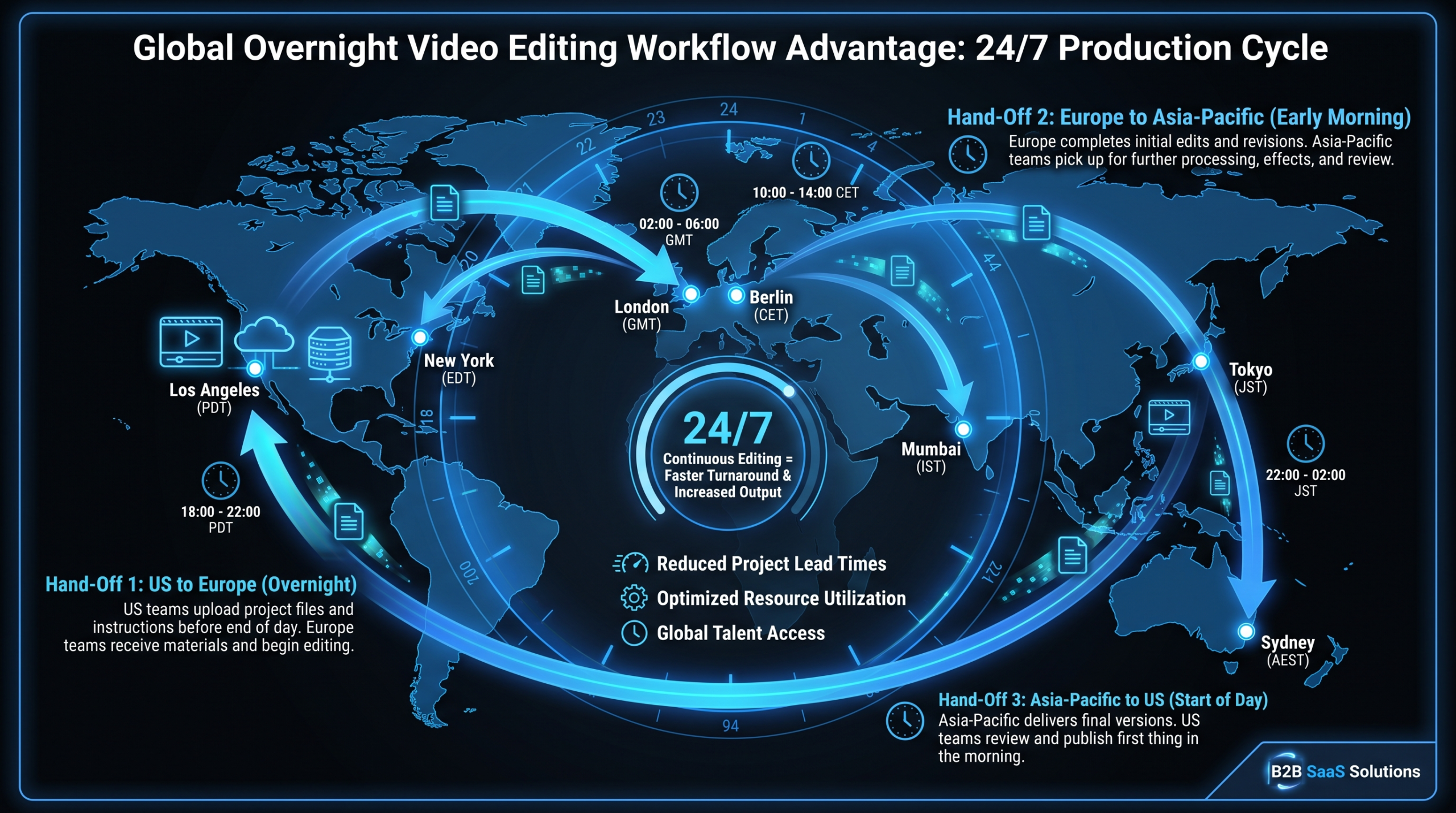
Time-zone offsets create a second productive shift without a second work day. A dedicated editing team in Southeast Asia — operating roughly twelve hours out of phase with US Eastern time — finishes their working day as your morning begins. Footage uploaded at 5 PM US Eastern returns as a polished draft by 9 AM the following morning. You submit on Friday evening. You review on Monday morning. The editing happened over the weekend while your competitors' footage sat in a queue.
This is not a new insight in software development — asynchronous handoff models have driven offshore engineering for decades. What is newer is the maturation of remote video editing infrastructure: frame-accurate comment tools like Frame.io, cloud-based proxy workflows, shared motion graphics template libraries, and async communication stacks that make the handoff model reliable at scale.
According to Wistia's annual State of Video research at wistia.com/state-of-video, companies that produce video at higher frequency see compounding returns on engagement metrics — the argument for volume is well-established. The question is how to produce that volume without scaling headcount linearly. The overnight model is the most efficient operational answer available today.
How Overnight Video Editing Actually Works
The phrase "they edit while you sleep" sounds simple. The operational reality is more structured. Here is exactly how a mature overnight editing workflow runs.
The Daily Handoff Loop
A reliable overnight editing cycle follows a five-step pattern:
- End of your business day (4–6 PM your time): You upload raw footage, a completed brief, and any reference materials to a shared workspace — typically Frame.io, a dedicated Google Drive folder structure, or the agency's project management platform.
- Within 1–2 hours of submission: Your project manager on the editing team acknowledges the handoff, confirms the brief is complete, flags any questions that need answering before editing begins, and assigns the file to the on-shift editor.
- During your overnight hours: The editor works through the footage against your brief. Color grading, motion graphics, music, captions, and format variations are applied according to your brand kit.
- By your next morning (8–10 AM your time): A draft is in your review folder. Strong teams include a Loom or Frame.io comment walkthrough noting key editorial decisions — what hook was used, why a specific take was chosen, where the edit diverged from the brief and why.
- You review and submit revisions by end of your business day: Minor corrections (text changes, clip swaps, timing adjustments) return overnight. Structural revisions typically complete in the second overnight cycle.
Well-run overnight editing teams complete the full cycle — raw footage to final delivery — in two to three business days for a standard three-to-ten-minute video. Compare that to the seven-to-twelve business days that same video typically takes in a single-timezone workflow where the editor is working through a sequential queue during shared business hours.
What the PM Layer Does
The project manager is the hinge that makes the overnight model reliable. Without a PM layer, the handoff is fragile — an editor who can't answer a question before your workday begins will guess, and guessing produces revision cycles that negate the speed advantage. A competent PM:
- Reviews every brief for completeness before it goes to an editor
- Flags ambiguities and resolves them asynchronously before the edit starts
- Manages the queue so urgent projects get elevated before overnight hours
- Runs quality review on the draft before it's released to you
- Maintains your brand playbook and updates it with every feedback cycle
The PM is not overhead — it is the mechanism that keeps first-draft acceptance rates high and revision cycles short. When you evaluate overnight editing services, the presence and quality of the PM layer is the single most predictive factor of how well the model will actually work for your team.
For a detailed look at everything included in a professional video editing service — from PM management to QA — that breakdown covers each deliverable tier.
The Output Math: Comparing Turnaround Times
Let's make the volume argument concrete. Below is a direct comparison of the same content workload under a same-timezone workflow versus an overnight editing model.
Turnaround Comparison: Same-Timezone vs. Overnight Editing
| Stage | Same-Timezone Editor | Overnight Editing Team |
|---|---|---|
| Footage upload to edit start | Next business day (review + queue) | Same evening (within 2 hrs of upload) |
| First draft delivery | 3–5 business days | Next morning (8–10 AM) |
| Revision round 1 | 1–2 business days | Next morning |
| Revision round 2 | 1–2 business days | Next morning |
| Total: footage to final delivery | 7–10 business days | 2–3 business days |
| Videos per month (1 editor, same budget) | 4–6 videos | 8–14 videos |
| Idle time (nights + weekends) | Wasted | Productive editing hours |
| Rush fee for 48-hour turnaround | Typically 25–50% surcharge | Standard delivery, no surcharge |
The doubling claim is not aspirational — it is arithmetical. A same-timezone editor working forty hours per week on a sequential queue produces roughly the same output in seven days that an overnight team delivers in two to three. The difference is not skill or effort; it is that overnight editing eliminates the idle time that exists in every same-timezone workflow.
For SaaS teams trying to understand the real cost per finished minute of video at different production volumes, the video editing cost per minute breakdown shows how per-unit cost drops as turnaround time compresses and volume increases.
The Compounding Effect on Content Programs
The volume advantage compounds over a quarter. A SaaS marketing team producing eight videos per month with a same-timezone team produces ninety-six videos per year. The same budget on an overnight model — with the same editing hours, just distributed overnight — commonly produces sixteen to twenty videos per month, or 192 to 240 per year. That is the difference between a content program that covers core buying stages and one that covers every product use case, every persona, and every stage of the funnel.
HubSpot's research on video marketing ROI (published at blog.hubspot.com/marketing/marketing-statistics) consistently shows video as the highest-ROI content format for B2B. The returns compound with volume and consistency — which makes the operational model behind video production a strategic, not just tactical, decision.
Addressing the Trust Objections
Every VP of Marketing or Head of Content who considers overnight editing raises the same three objections. They are legitimate. Here is how to evaluate each honestly.
Objection 1: Quality
"If I can't supervise the edit in real time, quality will suffer."
The quality argument assumes proximity produces quality. In practice, process produces quality. An editor three time zones away working from a thorough brief, against a calibrated brand kit, with a PM reviewing drafts before release, will consistently outperform a local editor receiving vague direction and ad-hoc Slack feedback.
The structured nature of overnight handoffs actually enforces better briefing discipline — which is the most reliable predictor of first-draft quality. When you know you can't clarify in real time, you write better briefs. When editors know they can't ask clarifying questions mid-task, they invest more in understanding the brief before starting.
What to evaluate when assessing quality in an overnight partner:
- First-draft acceptance rate — professionally calibrated teams commonly report 70–80%+ first-draft acceptance after a two-to-four week onboarding period
- Whether they maintain living brand playbooks, not static onboarding PDFs
- Whether a senior editor reviews drafts before they reach you
- Whether their motion graphics templates are built from your actual visual system, not adapted from a generic library
Objection 2: Security
"I'm sharing raw product footage, customer interviews, and unreleased campaign materials with a team I can't physically monitor."
This is the right concern to have. The answer is vendor due diligence, not avoiding offshore or distributed teams entirely. Your security checklist for evaluating any overnight editing partner should include:
- Project-level access controls: Each client's footage should be in a private, permissioned workspace — not a shared Dropbox link
- Team NDA agreements: Individual editors should be under NDA with the agency, not just the agency with you
- Data deletion policy: What happens to raw footage after delivery? When is it deleted? Who can access it after the project closes?
- Managed endpoints: Are editing workstations managed (MDM) to prevent footage from being saved to personal drives or synced to personal cloud accounts?
- Compliance posture: If your customer interview footage contains identifiable information, does the vendor have policies that address GDPR or CCPA requirements?
Agencies operating at a professional level can answer all of these in a pre-contract review. Those who can't are self-selecting out of the conversation for you.
Objection 3: Brand Consistency
"We've spent years developing our visual language. A remote team that just started won't know our style."
This is the most substantive objection and the one that requires the most honest answer. Brand consistency through overnight editing is real — but it requires an onboarding investment that many teams underestimate and some agencies underprovide.
Professional overnight editing teams build brand playbooks during the first two to four weeks that document:
- Color grade presets calibrated to your specific palette (not generic LUTs)
- Motion graphics templates — lower thirds, transitions, title cards — built in your visual system
- Music style references, approved library sources, and track selection criteria
- Tone and pacing notes by content type (demo videos vs. testimonials vs. social clips have different rhythm requirements)
- B-roll standards: what kinds of supporting footage support your brand, what feels off-brand
- Product screenshot and screen recording treatment (crucial for SaaS content)
First-draft acceptance is typically lower in weeks one through three — plan for an onboarding period where more revision cycles happen. By week four to six, a well-run overnight team usually matches or exceeds the brand consistency of a same-timezone editor who has been on the account for two months. The institutional memory accrues in the playbook rather than in a person's head, which makes it more durable.
Learn more about how to outsource video editing effectively, including the brand handoff checklist that reduces the onboarding period.
The Briefing Template for Overnight Editing
The single highest-leverage action you can take before launching an overnight editing workflow is building a brief template your team actually uses. A brief that works for overnight editing must be self-contained — your editor will start work after your business day ends and cannot ask a clarifying question before the draft is due.
Here is the structure that makes overnight editing reliably efficient from day one:
Overnight Video Editing Brief Template
SECTION 1 — VIDEO IDENTITY
- Working title and final title (if known)
- Video type: product demo / customer testimonial / explainer / social clip / other
- Target duration: __ minutes (±10% acceptable)
- Platform and format: YouTube 16:9 / LinkedIn landscape / Instagram Reel 9:16 / etc.
- Delivery date and time (your time zone, with timezone noted)
SECTION 2 — FOOTAGE NOTES
- Preferred take for each segment (timecodes, e.g. "Use 04:12–04:38 for the product reveal")
- Audio issues to fix (sync drift, background noise, specific clips to clean up)
- Footage to exclude (failed takes, off-brand moments, confidential content)
- B-roll requests (specific clips or "use approved library")
SECTION 3 — BRAND EXECUTION
- Motion graphics template (name the template from your library)
- Music: track name, mood reference, or "use standard library"
- Color grade preset (name or reference video)
- Lower thirds and title card style
- Caption requirements: yes/no, language, style
SECTION 4 — EDITORIAL DIRECTION
- Tone: energetic / measured / technical / conversational
- Opening hook: specific clip (timecode) or "editor's choice from footage"
- Key message to land before 60-second mark
- CTA, logo placement, and end card requirements
- Reference video (for pacing and energy reference)
SECTION 5 — DELIVERY SPEC
- Resolution and export format (1080p H.264 / 4K ProRes / platform-optimized)
- Format variations needed (e.g. 16:9 main + 9:16 social cut)
- Revision rounds included: __ rounds standard, additional rounds at __ hr turnaround
The first time your team fills this out, it will feel like extra work. By week three, it becomes muscle memory — and you will find that it improves your in-house video quality standards as a side effect, because the brief discipline carries over to everything you produce.
For SaaS-specific video content formats — demos, onboarding sequences, product launch videos — the SaaS video production guide includes brief templates tailored to each content type.
Choosing the Right Overnight Editing Partner
Not every editing service can execute a reliable overnight workflow. Many agencies operate in different time zones without actually designing their processes around the asynchronous handoff model. Here is how to tell the difference.
Signals of a True Overnight-Native Service
- Dedicated PM layer with defined handoff SLAs: They should be able to tell you exactly how long after submission you'll receive a brief acknowledgment and what happens if the brief has gaps
- Async-first communication stack: Look for Frame.io, Loom, and async Slack instead of Zoom calls during business hours — the latter signals a same-timezone mindset grafted onto a distributed team
- Living brand playbooks: Ask whether they maintain a document that evolves with every feedback round, or whether brand onboarding is a one-time handoff
- Clear data handling policies: Covered above — if they hesitate or give generic answers, move on
- First-draft acceptance rate data: Ask for it. Good teams track it. Teams that can't answer probably haven't optimized for it
Questions to Ask in Evaluation Calls
- "What is your typical hours between footage submission and first draft delivery?"
- "What happens if my brief is incomplete — who catches it and when?"
- "How do you handle urgent turnarounds without disrupting the rest of my queue?"
- "What is your first-draft acceptance rate after the first month of working with a client?"
- "Can you walk me through your brand onboarding process step by step?"
- "What is your data handling policy for raw footage after project completion?"
These questions filter out agencies that are distributed by geography but not actually designed for asynchronous delivery.
Top Overnight Editing Services for B2B SaaS
A comparison of the leading dedicated video editing services that offer true overnight workflows for B2B SaaS companies. Evaluated on: actual overnight turnaround capability, PM infrastructure, brand onboarding depth, security posture, and SaaS content specialization.
Overnight Video Editing Services — B2B SaaS Comparison
| # | Provider | Model | Overnight Capability | Plans / Pricing | Best For |
|---|---|---|---|---|---|
| 1 | Video Editing Company (VEC) | Dedicated team | True overnight, 7-day coverage, 12–16 hr first draft | Growth $5K/mo · Core $9.5K/mo · Scale $16K/mo | Series A–C SaaS with consistent monthly volume, doubling output guarantee |
| 2 | Increditors (increditors.com) | Dedicated editor pods | Overnight coverage, dedicated senior editor + junior + PM + CD | Custom retainer ~$2.5K–$12K+/mo | YouTube creators, SaaS, finance, education; teams wanting a full creative pod |
| 3 | Vidpros | Subscription | 24–48 hr turnaround, queue-based | From ~$995/mo | High-volume simple edits, social clips, podcast cuts |
| 4 | Motion Array / Freelancer platforms | Per-project / hourly | Varies by individual editor | $25–$150/hr | One-off projects, testing before committing to a team |
Pricing reflects publicly available information as of mid-2026. Custom quotes are standard for dedicated team arrangements.
A note on VEC's guarantee: Video Editing Company backs their dedicated team model with a specific commitment — double your video output in 90 days, or month four is free. For VP-level buyers evaluating overnight editing, that guarantee converts an operational bet into a financially hedged decision. See the VEC pricing page for current plan details and what's included at each tier.
On Increditors: A strong #2 for teams that want a full creative pod structure — senior editor, junior editor, PM, and creative director on one account. Their model is less SaaS-exclusive than VEC and their pricing is custom-quoted rather than tiered, which suits teams with non-standard workflows. Known for driving substantial performance improvements on YouTube channels. Honest cons: no instant-tier pricing transparency, and the service scope extends beyond SaaS into creators and finance, so you won't get the SaaS-focused brief templates and product demo specialization that dedicated SaaS services provide. Contact: [email protected].
Common Mistakes That Kill the Overnight Advantage
The overnight model fails when teams treat it as a plug-in rather than a workflow redesign. Here are the failure modes we see most often.
Mistake 1: Sending Incomplete Briefs
The most common failure. If your brief says "make it engaging" instead of specifying timecodes, hook preferences, and brand execution requirements, the editor will make judgment calls that require revision. Every revision cycle adds twelve to sixteen hours to your turnaround. Three revision cycles eliminate the overnight advantage entirely.
Fix: Use the brief template above. Make it a required field in your project management system — no brief, no submission.
Mistake 2: Not Investing in the Brand Onboarding Period
Teams that treat week one as "just send them footage and see what they do" spend weeks three and four fixing brand drift. The onboarding investment compounds — a thorough brand playbook built in week one continues paying dividends for every video over the following twelve months.
Fix: Block two to three hours in week one to build the brand playbook with your PM. Treat it as a creative investment, not administrative overhead.
Mistake 3: Submitting Footage Too Late
If your business day ends at 5 PM and you submit footage at 7 PM, your editing team may not receive it until the following morning their time — losing an overnight cycle. Submission timing is the operational heartbeat of the model.
Fix: Establish a cutoff time (typically 4–5 PM your time) for same-night editing. Footage received after cutoff processes in the next overnight window. Build this into your content calendar.
Mistake 4: Choosing a Provider That Is Distributed but Not Async-Native
Some agencies operate offshore teams but still run approval processes that require live calls or synchronous reviews. This gives you the time-zone offset without the workflow benefits.
Fix: Ask specifically about async review tools and PM response SLAs during the evaluation process. A provider that defaults to "we'll set up a quick call" for every revision question is not overnight-native.
Mistake 5: Underestimating the Content Calendar Upstream
Overnight editing doubles your editing throughput — which means your footage production and scripting needs to double too, or the bottleneck simply moves upstream. A team that suddenly gets videos back in two days instead of ten days quickly discovers they don't have enough footage in the pipeline to feed the new pace.
Fix: Before launching overnight editing, audit your content calendar and production cadence. If your filming schedule produces six pieces of footage per month, overnight editing will not get you to sixteen videos per month — you'll need to increase filming frequency or add screen-recorded content to fill the queue.
For SaaS companies specifically, screen-recorded product demos, onboarding walkthroughs, and feature highlight videos are low-cost footage sources that pair well with overnight editing. The product demo video production guide covers the entire workflow from screen capture to polished delivery.
Overnight Editing Partner Types: Full Comparison
| Factor | Freelancer | Subscription Service | Dedicated Overnight Team |
|---|---|---|---|
| True overnight capability | Inconsistent — editor-dependent | 24–48 hr, queue-based | 12–16 hr, 5–7 days/week |
| Brand consistency | Low — rotating individuals | Medium — team rotation | High — same editors, living playbook |
| PM / QA layer | None | Limited | Dedicated PM + senior review |
| Security / NDA coverage | Individual contract only | Service TOS | Team NDAs + data handling policy |
| First-draft acceptance | Variable (50–70%) | Medium (60–75%) | High after onboarding (75–85%) |
| Complex SaaS content | Depends on editor | Limited (simple edits optimized) | Full capability — demos, explainers, testimonials |
| Monthly cost range | $500–$3,000 | $1,500–$8,000 | $5,000–$16,000+ |
| Volume potential | 4–8 videos/month | 8–14 videos/month (queue-limited) | 12–30+ videos/month |
For context on what each of these price ranges actually delivers per finished minute of edited video, the video production agency pricing models breakdown compares all five major pricing structures with real cost-per-unit math.
Frequently Asked Questions
What exactly is overnight video editing and how does it differ from standard outsourced editing?
Overnight video editing refers specifically to a workflow where footage submitted at the end of your business day is returned as a polished draft by the start of your next business day — typically leveraging time-zone offsets of 8–14 hours. It differs from standard outsourced editing in that it is architecturally designed around the asynchronous handoff model: brief templates, async review tools, PM-layer quality control, and overnight shift scheduling are all built in. Standard outsourced editing may simply mean a local or remote editor on a queue; overnight editing means the queue runs while you sleep.
Is the "double video output" claim realistic for all content types?
For most SaaS content formats — product demos, customer testimonials, explainer videos, social clips, webinar cuts — yes, doubling output is a realistic and commonly reported outcome once the onboarding period completes and the briefing process is established. Complex animated productions or campaign videos requiring multiple creative rounds have longer inherent timelines regardless of the editing model, so the multiplier is smaller there. The clearest ROI is on structured, repeatable content types where your brief is consistent and your brand kit is established.
How long does it take before overnight editing produces consistent quality?
Plan for a two-to-four week calibration period. During this window, first-draft acceptance rates are typically lower (50–65%) as the editing team builds your brand playbook, learns your pacing preferences, and calibrates to your feedback patterns. By week four to six with a well-structured partner, most SaaS teams are seeing 75%+ first-draft acceptance — at which point the overnight model is running at full efficiency. The onboarding investment in weeks one and two (building the brand playbook, providing reference videos, documenting timecode-level preferences) directly determines how quickly you reach steady state.
What are the real security risks, and how do professional services mitigate them?
The legitimate risks are: unauthorized access to raw footage (especially customer interviews and unreleased product content), footage persisting on editors' personal devices after delivery, and metadata or file naming that could expose internal roadmap information. Professional overnight editing services mitigate these through project-level permissioned workspaces, team NDA agreements, defined data deletion policies post-delivery, and managed device policies for editing workstations. Ask prospective vendors specifically about their MDM policy and data retention timeline — these questions quickly differentiate professional operations from informal offshore setups.
How should I structure my content calendar to take full advantage of overnight editing?
Overnight editing removes the editing bottleneck — which means your upstream production pipeline needs to match the new throughput. Audit your footage production cadence first. If you currently film twice a month, overnight editing will not double your output unless you add footage sources (screen recordings, webinar cuts, repurposed long-form content). Most SaaS teams that successfully run overnight editing programs combine original filming with screen-captured product content and repurposed content (webinar clips, conference talks, customer interview footage) to maintain a steady daily submission queue. A well-structured 20-video-per-month program often sources content from five or six different footage types.
Ready to Double Your Video Output?
Video Editing Company's dedicated teams run true overnight workflows — footage submitted by 5 PM returns as a draft by 9 AM. We guarantee double your video output in 90 days, or month four is free. Growth starts at $5K/month with no long-term lock-in required.
Book a Free Strategy Call See Pricing Plans