8 Proptech Video Examples That Convert
TL;DR
- Proptech buyers are skeptical: they've seen dozens of platforms promise transformation. Video closes the trust gap faster than any other format.
- Eight archetypes drive the majority of proptech video conversions - each targets a different stage of the funnel and a different audience persona.
- The best-converting proptech videos share three traits: they lead with the problem, they make the tech invisible, and they anchor trust with a specific outcome.
- Archetype framing lets you build a repeatable video production system rather than one-off creative efforts.
- Most proptech teams underinvest in agent-facing and investor-facing video - the two highest-leverage archetypes for enterprise deals.
Table of Contents
- Why Proptech Video Converts Differently
- Archetype 1: Platform Explainer Videos
- Archetype 2: Virtual Tour Integration Videos
- Archetype 3: Agent-Facing Tutorial Videos
- Archetype 4: Investor Pitch Companion Videos
- Archetype 5: Homebuyer Education Videos
- Archetype 6: Market Data & Neighborhood Intelligence Videos
- Archetype 7: Customer Success Story Videos
- Archetype 8: Traditional vs. Digital Comparison Videos
- All 8 Archetypes at a Glance
- Sequencing These Videos in Your Funnel
- FAQ
Proptech video is not marketing - it's sales infrastructure. When a platform needs to convince a skeptical VP of Acquisitions to replace a process their team has used for a decade, a feature list on a landing page isn't going to do it. A well-crafted two-minute video that shows the before and after, with a believable outcome, is what moves people.
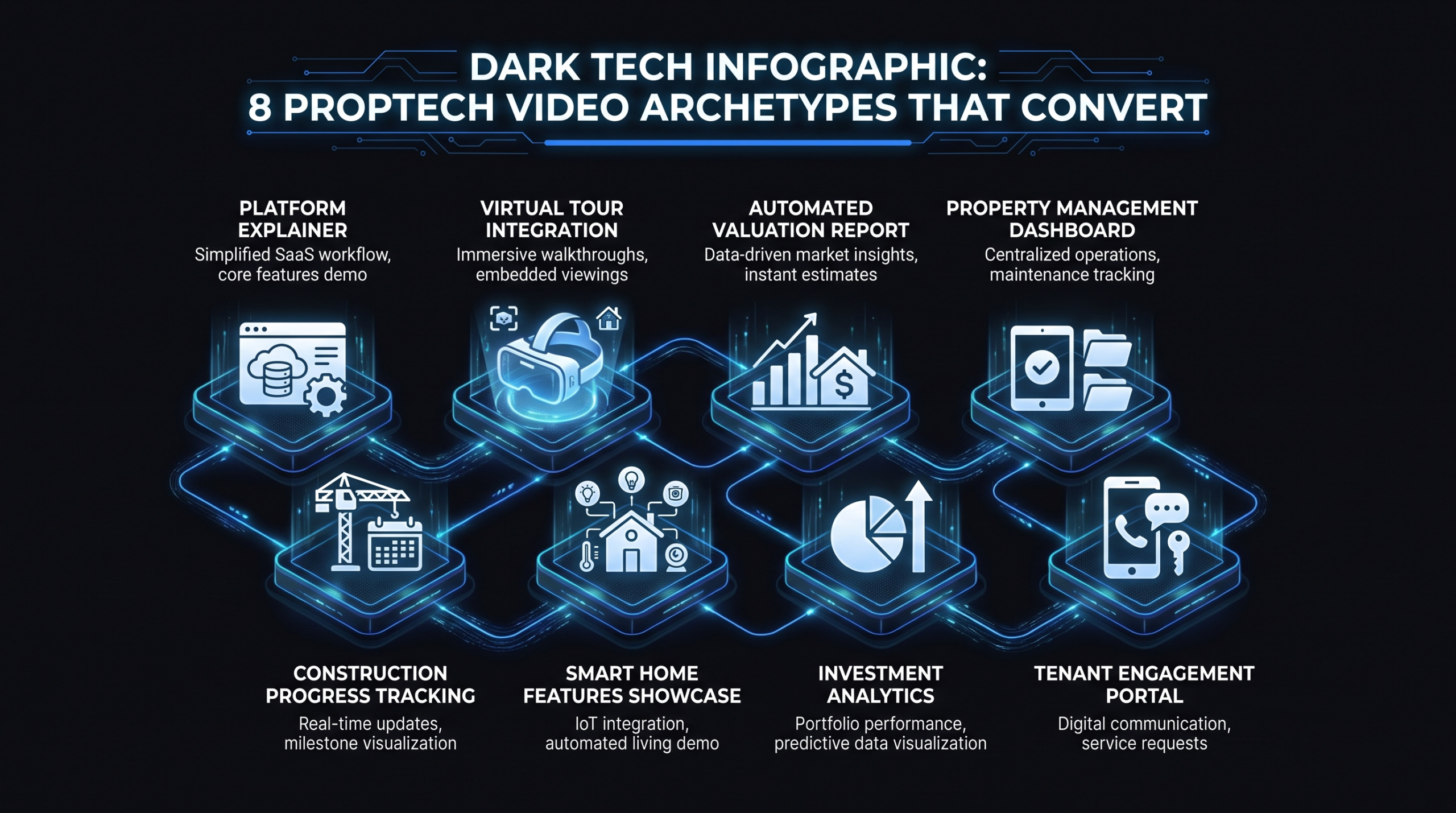
The challenge for most proptech marketing teams is that video feels expensive, slow, and hard to systematize. It doesn't have to be. The most effective proptech video programs we've seen aren't built on creative inspiration - they're built on archetypes. Eight specific formats, each mapped to a distinct buyer concern, audience persona, and funnel stage.
This guide breaks down each one. For every archetype, you'll get the conversion mechanic, the structural elements to replicate, and the production signals that separate high-converting from low-converting executions. Our full proptech video production guide covers the broader strategy; this piece is focused on the formats themselves.
Why Proptech Video Converts Differently
The Trust Problem in Property Technology
Property technology operates in one of the highest-stakes industries for software adoption. Real estate agents have seen "game-changing" platforms come and go. Developers and investors are making decisions with seven-figure consequences. Homebuyers are navigating the most complex transaction of their lives. The common thread: trust is the bottleneck, not awareness.
Most proptech platforms are already known to their target buyers - the problem is that those buyers have no compelling reason to change what's working today. Video's structural advantage is that it shows rather than claims. A platform that claims to "reduce listing time by weeks" is marketing. A video that shows a listing coordinator walking through a workflow in real time, demonstrating exactly where the time is saved, is evidence.
The Complexity Gap Video Closes
Proptech products carry inherent complexity: MLS integrations, compliance guardrails, AI valuation models, digital transaction workflows. Buyers need to understand not just what the platform does, but how it fits into their existing stack and processes. Text and screenshots can describe this; video can demonstrate it in 90 seconds.
This is why proptech video conversion rates tend to correlate more closely with video specificity than with production quality. A screen recording that genuinely shows the workflow converting a paper-based process to a digital one outperforms a polished brand film that stays abstract. The formats that follow are organized around this principle: specificity first, polish second.
Research from Wyzowl's annual video marketing report consistently finds that buyers in complex B2B categories are more likely to prefer video over text when evaluating software - a trend particularly pronounced for products where workflow visualization matters. Proptech sits squarely in that category.
Archetype 1: Platform Explainer Videos
The platform explainer is the foundation of every proptech video library. Its job is to answer the question "what does this actually do?" in a way that resonates with a specific persona, not a general audience.
What Makes It Convert
The highest-converting platform explainers in proptech share a counterintuitive structure: they spend the first 20 seconds on the problem, not the product. The viewer needs to recognize themselves in the pain before they'll care about the solution. A platform for property managers that opens with "manage 50 units across 5 buildings without losing a maintenance request" converts better than one that opens with a product logo animation.
The second conversion lever is persona specificity. A single platform explainer trying to speak to property managers, listing agents, and institutional investors simultaneously will resonate with none of them. The platforms that produce persona-specific explainers - one for the brokerage operations team, one for the individual agent - see meaningfully higher engagement from each segment.
Elements to Replicate
- Open with the cost of inaction: 15-20 seconds on the problem state, ideally with a visual representation (cluttered spreadsheet, missed notification, manual paper process).
- Show the platform in use: at minimum 30 seconds of actual screen recording with narration explaining why specific UI elements matter.
- Name the outcome, not the feature: "Listings go live 48 hours faster" not "automated listing syndication."
- One clear CTA: "Book a demo" or "See pricing" - never both on the same video.
- Keep it under 2 minutes: platform explainers targeting VP-level buyers see drop-off above 90 seconds; agent-facing explainers can run slightly longer.
For a deeper look at producing platform demo content that converts, see our guide to product demo video production. HubSpot's analysis of video marketing effectiveness also notes that demo videos are consistently ranked among the formats most likely to influence a B2B purchase decision.
Archetype 2: Virtual Tour Integration Videos
Virtual tour integration videos address one of proptech's most common buyer objections: "will this actually work with how we list properties?" These videos show the integration between the platform and real-world listing workflows, typically featuring how 3D tours, floor plans, or interactive media are embedded and managed within the platform.
What Makes It Convert
These videos convert because they eliminate the "I'll have to figure that out later" mental blocker. Buyers evaluating a platform that promises seamless virtual tour management need to see the actual workflow - how footage is uploaded, how tours are linked to listings, how agents access and share them with clients - before they'll move to a trial or demo request.
The conversion moment in these videos is almost always the "before" moment: the clip that shows what the listing coordinator used to do (manual upload to three different platforms, copy-paste embed codes, email the link to six people) versus the integrated workflow. That contrast is the conversion mechanism.
Elements to Replicate
- Start with the friction point: show the manual, multi-step process the buyer currently lives with before introducing your solution.
- Use real interface footage: screen-recorded walkthroughs with cursor movement that shows actual button clicks, not polished motion graphics of the UI.
- Show the agent's view and the back-end view: buyers in brokerage operations need to see both - what the agent experiences and what the coordinator manages.
- Address the objection explicitly: if integration with the MLS is a common concern, show that workflow in the video rather than leaving it for the sales call.
- Keep it under 3 minutes: this archetype works well in an email follow-up to demo requests, so length tolerance is slightly higher than a top-of-funnel explainer.
Archetype 3: Agent-Facing Tutorial Videos
Agent adoption is the make-or-break implementation risk for most proptech platforms. The brokerage leadership signs the contract; the agents decide whether the platform lives or dies. Tutorial videos targeted at agents are among the highest-leverage videos a proptech marketing team can produce - they drive adoption, reduce churn, and generate the internal champions who expand the account.
What Makes It Convert
Agent-facing tutorials convert (in the sense of driving adoption and positive NPS) when they respect the agent's time and existing skill level. Agents are not software power users. Videos that assume familiarity with concepts like "API integration" or "workflow automation" will be ignored. Videos that start with "here's how to add a new listing in four clicks" will be watched repeatedly.
The production quality bar for this archetype is different from marketing-facing content. Agents respond to authenticity - a well-lit screen recording with a clear voiceover from someone who obviously knows the platform converts better than an over-produced training video with unnecessary b-roll. What matters is that every step is shown, every action is narrated, and every video ends with the agent knowing exactly what to do next.
Elements to Replicate
- One task per video: "How to create a listing" is one video. "How to share a listing with a buyer" is a different video. Never combine two workflows.
- Title videos by the task, not the feature: "Adding a New Client" converts better than "CRM Contact Creation Workflow."
- Show the most common error: agents stop watching when they hit an unexpected screen. Anticipate the two or three most common stumble points and address them explicitly.
- Keep it under 90 seconds per task: agents will watch a 90-second video three times; they will not watch a 10-minute onboarding video once.
- Build a playlist structure: individual short videos organized into a "Getting Started" playlist create a completion loop that drives full onboarding.
Archetype 4: Investor Pitch Companion Videos
Institutional property investors - family offices, REITs, private equity real estate funds - evaluate proptech platforms differently from brokerages. Their primary concern is data integrity, return attribution, and portfolio-level visibility. An investor pitch companion video is a 2-4 minute video sent alongside a proposal or following a demo call that speaks directly to these concerns.
What Makes It Convert
Investor-facing proptech videos convert because they make the "how does this affect my returns?" question answerable without a follow-up call. The buyer has seen the demo; they understand what the platform does. What they need now is a succinct summary of the value proposition mapped to their specific use case - illustrated with the kind of portfolio-level data visualization that makes the business case self-evident.
The conversion mechanism here is not persuasion - it's clarity. Investors who move deals forward quickly are the ones who can articulate the value to their investment committee in simple terms. A good investor pitch companion video gives them that language. It's essentially a leave-behind that explains the platform through the investor's own lens.
Elements to Replicate
- Lead with the portfolio-level view: show aggregate dashboards, portfolio-wide analytics, and cross-asset comparison tools first - not individual property workflows.
- Use data visualization extensively: charts, maps, and performance timelines are more persuasive to investors than testimonials or narrative.
- Address risk explicitly: data security, audit trails, compliance with fiduciary obligations. Investors who don't see these addressed will not move forward regardless of ROI claims.
- Include a narrated walkthrough of the reporting output: show the actual report the investment committee would receive, not just the dashboard that generates it.
- Keep it under 4 minutes: this video is sent as a sales asset, not consumed in a passive browsing context. It needs to be watchable in a single sitting by a busy partner-level buyer.
Archetype 5: Homebuyer Education Videos
Homebuyer education videos are a consumer-facing archetype primarily used by proptech platforms whose end users include buyers directly (buyer platforms, mortgage tech, homeowner apps) or by real estate agents who use them as a marketing and trust-building tool with prospective clients.
What Makes It Convert
Homebuyer education videos convert for a different reason than B2B proptech content: they convert because they reduce anxiety. Buying a home is the most financially significant decision most people will ever make. Platforms and agents that address the fear and complexity of the process - in a genuine, accessible way - build the trust that drives the next action, whether that's creating an account, filling out a lead form, or booking a first consultation.
The highest-converting homebuyer education videos avoid jargon entirely. They meet buyers at their actual level of knowledge ("what happens at closing?", "what does pre-approval actually mean?") rather than the level the platform assumes they're at. Every technical term that appears on screen should be defined in plain language within the same video.
Elements to Replicate
- Title videos as questions buyers actually search: "What happens at closing?", "How long does pre-approval take?", "What is earnest money?"
- Use animation for process visualization: mortgage approval flows, escrow timelines, and contract processes are hard to show via screen recording - simple animated diagrams work better.
- Maintain a single narrator voice throughout the series: buyer trust compounds across videos; an inconsistent voice breaks continuity.
- End every video with a next-step action: "See how our platform tracks your home search" or "Connect with a buyer specialist."
- Optimize for mobile viewing: homebuyers research primarily on mobile. Subtitles, large text on screen, and square/vertical formats for social distribution significantly increase completion rates.
Archetype 6: Market Data & Neighborhood Intelligence Videos
Market data and neighborhood intelligence videos showcase a proptech platform's most differentiated asset: its data. These videos take market analytics - price trends, inventory levels, days-on-market patterns, neighborhood-level demand signals - and present them in a way that demonstrates the platform's intelligence advantage over public data sources.
What Makes It Convert
These videos convert because they give something of genuine value before asking for anything. A proptech platform that produces a monthly market update video for a specific metro area or asset class is demonstrating its data capability in real time - and giving buyers a reason to return month after month. When those buyers are finally in the market for a platform decision, the brand with the consistent data content has a trust advantage that a cold email campaign cannot replicate.
For investor-facing platforms, market data videos serve a second conversion function: they demonstrate the quality and depth of the platform's underlying data. A fund that sees a competitor platform publishing quarterly market intelligence reports - visually clear, methodologically credible - is implicitly evaluating that platform's data quality at the same time.
Elements to Replicate
- Use animated chart transitions: static screenshots of dashboards are not compelling; animating the data as it's narrated dramatically increases engagement and perceived credibility.
- Name the data sources: "Based on MLS transaction data from Q1-Q2 2026" is a trust signal that "according to our platform" is not.
- Produce on a consistent cadence: monthly or quarterly cadence matters more than production quality for this archetype. Consistency builds the habit of return.
- Keep it hyper-specific: "Multifamily cap rate trends in Phoenix, Q2 2026" converts better than "Commercial real estate trends, 2026." Specificity signals real expertise.
- Gate selectively: top-of-funnel market recaps should be freely accessible; deeper intelligence reports can be gated behind email capture or account creation.
Archetype 7: Customer Success Story Videos
Customer success story videos are the proptech equivalent of case studies - but with the trust amplification that comes from a real person speaking on camera about a specific outcome they experienced. Done right, these are the most persuasive assets in a proptech video library.
What Makes It Convert
Success story videos convert at the decision stage because they eliminate the buyer's remaining risk by transferring it to someone who has already taken it. The buyer sees someone who was in their exact position - same company size, same problem, same skepticism - and made the switch. The specific outcome matters more than the delivery; "we reduced our listing coordination time from 3 days to 4 hours" is more persuasive than a five-star endorsement delivered with enthusiasm but without a quantified result.
The proptech-specific nuance: buyer personas in this industry are highly credential-conscious. A testimonial from a "VP of Operations at a regional brokerage with 400 agents" will outperform one from an anonymous "real estate professional" even if the actual content is identical. Specificity about the speaker's context validates the relevance of their experience to the evaluating buyer.
Elements to Replicate
- Structure as before/during/after: what was the problem, what was the transition like, what is the measurable outcome?
- Get a specific outcome on camera: coach your interview subjects to give a number. If they're uncomfortable with exact figures, hedged ranges ("somewhere between 30 and 50 percent less time") still outperform qualitative praise.
- Name the speaker's context explicitly: title, company size, years using the platform, team structure. Buyers self-qualify based on relevance.
- Keep the interview raw, the production polished: authentic interview footage with a clean background, good lighting, and professional audio converts better than over-scripted, over-produced testimonials.
- Create persona-specific cuts: a 3-minute full testimonial video plus a 60-second cut for the brokerage audience and a separate 60-second cut for the investor audience from the same interview session - maximizing the ROI of a single day of filming.
Archetype 8: Traditional vs. Digital Comparison Videos
The traditional vs. digital comparison video is the category creation format for proptech. Its job is not to sell the platform - it's to sell the category shift. These videos make the case that the way the buyer currently does something (manual, paper-based, spreadsheet-driven, relationship-dependent) is categorically inferior to a digital-first approach, before the platform is ever mentioned.
What Makes It Convert
These videos convert by manufacturing what researchers call "category urgency" - the recognition that a buyer is behind, not just uninformed. When a brokerage VP watches a comparison video that maps their current 14-step listing coordination process against a 3-click digital workflow, the conversion that happens is not "I want this platform" - it's "I can't keep doing things the way we've been doing them." That mindset shift is the precondition for every downstream conversion.
The format is especially effective for proptech platforms targeting institutional buyers who are resistant to change precisely because they've built operational processes around the old way. For this audience, the comparison video serves as an organizational alignment tool - it gives the internal champion something to share with skeptical stakeholders that makes the case for change without requiring them to become an advocate in person.
Elements to Replicate
- Show the process cost, not just the feature: "Manual listing coordination takes 14 steps and an average of 3 days" is more compelling than "our platform has automated coordination features."
- Use side-by-side visual formatting: split-screen or alternating scenes that show the old process and the new process in direct visual parallel make the comparison visceral and immediate.
- Avoid competitive comparisons: the traditional vs. digital comparison targets the incumbent process, not a competing platform. Naming competitors shifts the frame from "should we modernize" to "which platform should we choose" - which is a different, later-stage conversation.
- End with an honest transition acknowledgment: buyers are more willing to change when the video acknowledges that the transition takes time and the vendor has a plan for it.
- Distribute it at the top of the funnel: this format belongs in cold email outreach, paid social, and the homepage - not behind a registration gate where buyers have already made some commitment.
All 8 Proptech Video Archetypes at a Glance
Proptech Video Archetypes - Funnel Position, Audience & Primary Conversion Goal
| Archetype | Funnel Stage | Primary Audience | Conversion Goal | Ideal Length |
|---|---|---|---|---|
| Platform Explainer | TOFU | Marketing & Ops leaders | Demo request | 60-90 sec |
| Virtual Tour Integration | MOFU | Brokerage ops, coordinators | Trial activation | 2-3 min |
| Agent Tutorial | MOFU/BOFU | Individual agents | Adoption & retention | 60-90 sec/task |
| Investor Pitch Companion | BOFU | Institutional investors, funds | Deal progression | 2-4 min |
| Homebuyer Education | TOFU | Consumer homebuyers | Lead capture / account creation | 90 sec-3 min |
| Market Data Intelligence | TOFU/MOFU | Investors, agents, developers | Return visit / brand recall | 2-5 min |
| Customer Success Story | BOFU | Decision-stage evaluators | Final conversion | 2-3 min |
| Traditional vs. Digital | TOFU/MOFU | Change-resistant enterprises | Category urgency / champion enablement | 90 sec-2 min |
Production Resources by Archetype
Production Complexity, Team Requirements & Cadence by Archetype
| Archetype | Production Complexity | Minimum Team | Recommended Cadence | Evergreen? |
|---|---|---|---|---|
| Platform Explainer | Medium | Editor + voiceover + motion | Per major product release | Refresh every 12-18 months |
| Virtual Tour Integration | Low-Medium | Screen recorder + editor | Per major integration change | Yes, until UI changes |
| Agent Tutorial | Low | Screen recorder + editor | Per feature release | Yes, until feature changes |
| Investor Pitch Companion | High | Editor + motion + narrator | Per enterprise pitch cycle | Partially (refresh data annually) |
| Homebuyer Education | Medium | Editor + animation + voiceover | Series build-out, then quarterly refresh | High (process rarely changes) |
| Market Data Intelligence | Medium | Editor + motion + data viz | Monthly or quarterly | No - time-sensitive |
| Customer Success Story | High | Camera crew + editor + sound | 2-4 per year per persona | Yes, 2-3 years |
| Traditional vs. Digital | Medium-High | Editor + animation + voiceover | One hero version + persona cuts | 3-5 years |
How to Sequence These Video Types in Your Funnel
Most proptech teams produce videos in the order they think of them rather than the order buyers need them. The result is a library that's heavy on platform explainers and light on the decision-stage assets that actually close deals.
A more effective sequencing approach starts with funnel position and works outward. The minimum viable proptech video library for a B2B platform looks like this:
Phase 1: Close the Awareness Gap (TOFU)
Start with one persona-specific platform explainer and one traditional vs. digital comparison video. These two assets create the category and establish the value proposition. Distributing them via LinkedIn, paid social, and cold email sequence will tell you which personas are responding before you invest in deeper-funnel content.
Phase 2: Accelerate the Evaluation (MOFU)
Once you have demo volume, the next bottleneck is the evaluation period - the time between demo and decision. Virtual tour integration videos and an agent tutorial series address the most common "but how does it actually work?" objections that stall deals at this stage. A proptech team that can answer implementation questions with a video link rather than scheduling another demo call will significantly compress its sales cycle.
Phase 3: Enable the Decision (BOFU)
Customer success stories and investor pitch companion videos belong in this phase. These are assets for buyers who have already decided that change is necessary - they just need permission to choose your platform. A testimonial video from a buyer who matches their profile and a crisp pitch companion for their investment committee review are the two assets most commonly missing from proptech video libraries.
The most common proptech video mistake: building a TOFU library and wondering why deal velocity isn't improving. Top-of-funnel video creates leads; BOFU video closes them. You need both.
At VEC, we work with B2B SaaS and proptech teams specifically to build these multi-format libraries on a predictable production cadence. If your team is producing more than 6 videos per quarter, a dedicated editing team typically delivers better quality and lower per-video cost than project-by-project production. See our pricing page for the plans that fit proptech programs at different scales, and our SaaS video production guide for broader strategy context.
Repurposing Across Archetypes
One production investment can serve multiple archetypes. A customer success story interview session typically yields: a 2-minute BOFU testimonial, a 60-second social proof clip for paid LinkedIn, a quote pull for the product page, and a voiceover track that can anchor a case study blog post. Proptech teams that plan for repurposing at the brief stage - not after the video is delivered - see materially higher ROI from their video budgets. For more on this, see how to outsource video editing to a team that manages the full repurposing workflow.
Frequently Asked Questions
What makes a proptech video "convert" vs. one that just gets views?
Conversion-optimized proptech video has three traits that view-optimized video often lacks: a specific audience persona (not "anyone in real estate"), a single call to action tied to a measurable next step, and a problem statement that appears before the product does. Videos optimized for views tend to prioritize broad appeal and production quality; videos optimized for conversion prioritize specificity and clarity about who the video is for and what it's asking them to do next.
How many videos does a proptech platform need to cover the full funnel?
A minimum viable proptech video library covers each major funnel stage with at least one asset per core persona. For a B2B platform with two primary buyer personas (brokerage operators and institutional investors), that typically means 8-12 videos: 2-3 platform explainers, 2 virtual tour or integration demos, 4-6 agent tutorials, 2 customer success stories, and 1 investor pitch companion. Most teams can build this library over 6-9 months on a consistent production cadence rather than trying to produce everything at once.
Should proptech videos be gated or freely accessible?
Gating strategy should match funnel position. Top-of-funnel content (platform explainers, comparison videos, market data recaps) converts more leads when freely accessible - requiring email capture before a prospect understands your value proposition creates unnecessary friction. Middle-of-funnel content (integration demos, deeper market intelligence) can be lightly gated. Decision-stage content (investor pitch companions, full customer success story series) is typically shared directly by sales rather than gated on the website.
How often should proptech videos be refreshed?
Cadence depends on archetype. Platform explainers and agent tutorials should be refreshed whenever a major UI or workflow change occurs - typically every 12-18 months for stable platforms. Market data intelligence videos are time-sensitive and need monthly or quarterly production. Customer success stories and traditional vs. digital comparison videos are the most durable: a well-produced testimonial from a credible customer commonly remains effective for 2-3 years without updates. Investing in production quality for these evergreen archetypes has a higher long-term ROI than refreshing them frequently.
What's the biggest production mistake proptech teams make with video?
The most common production mistake is treating all videos as if they have the same production requirements. An investor pitch companion video benefits from high production values - professional lighting, motion graphics, careful script - because it's being evaluated by institutional buyers making high-stakes decisions. An agent tutorial video will actually convert better with minimal production: a clean screen recording, a clear voiceover, and nothing that makes it feel more formal than a Loom from a colleague. Misallocating production budget to high-polish agent tutorials and low-polish pitch companions is a common and expensive mistake.
Ready to Build Your Proptech Video Library?
VEC works with B2B SaaS and proptech marketing teams to produce consistent, conversion-optimized video on a predictable monthly cadence. Dedicated editing teams, SaaS-specific experience, and a 90-day output guarantee.
Book a Free Strategy Call View Plans & Pricing