
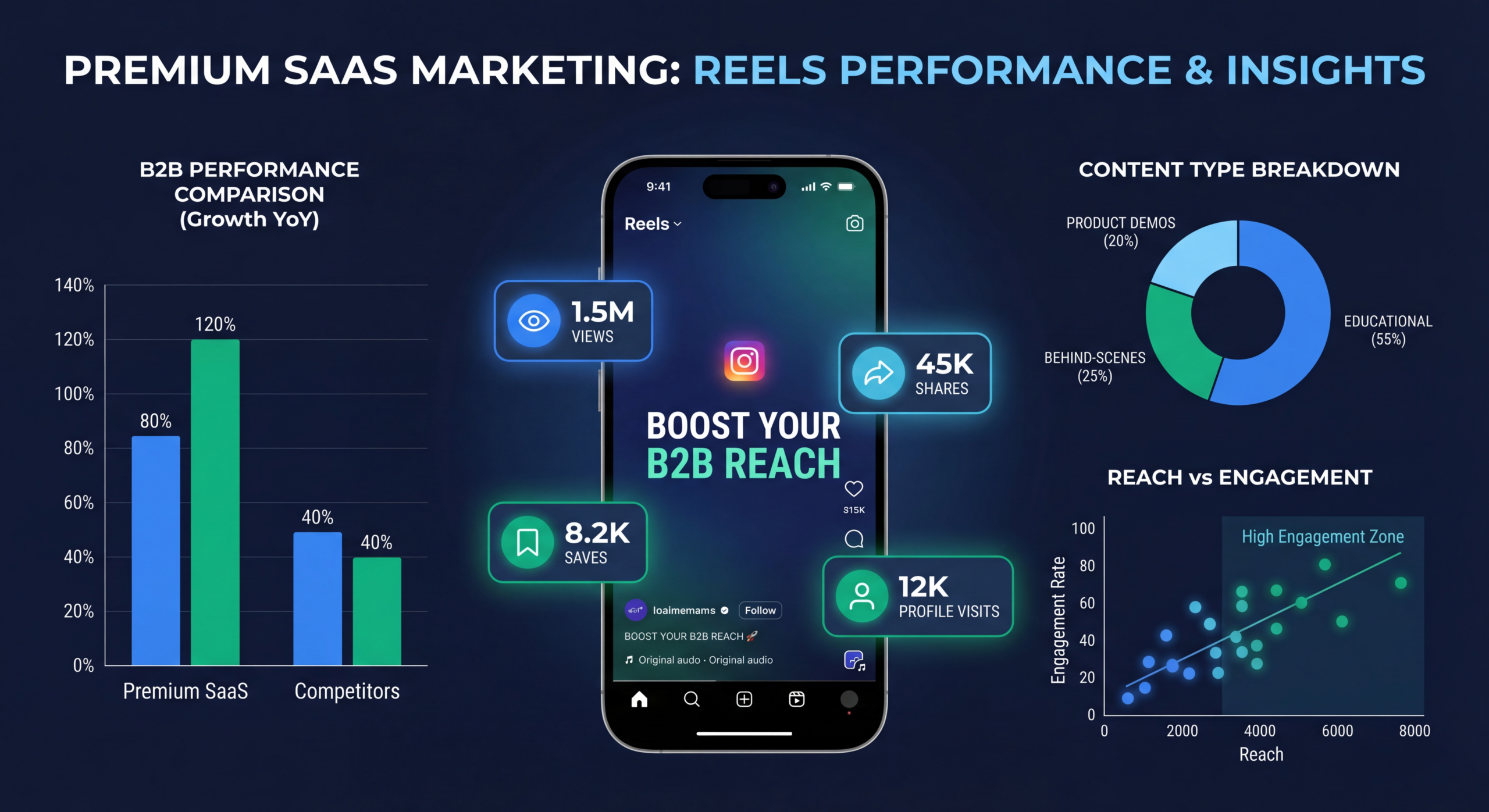
Instagram Reels for B2B SaaS: Does It Work?
Table of Contents
The Case for B2B Reels
The instinctive reaction from most B2B SaaS marketers to Instagram Reels is skepticism: "Our buyers aren't on Instagram." But the data tells a more nuanced story. 71% of B2B decision-makers under 45 use Instagram regularly (Morning Consult, 2025). They're not there for product research - they're there for professional inspiration, industry trends, and the people behind the companies they interact with.
Instagram Reels won't replace LinkedIn as your primary B2B distribution channel. But it can serve a specific role in your content ecosystem: humanizing your brand, reaching decision-makers in a less competitive environment, and repurposing content that already exists in your video library.
The key insight is that B2B Reels don't look like B2C Reels. You're not doing dance trends or unboxing videos. You're creating 30-90 second educational content, behind-the-scenes glimpses, and quick-hit insights that build brand affinity with people who might also see your LinkedIn post, your YouTube tutorial, or your webinar invitation.
When Reels makes sense for B2B SaaS
- You already create video content: Reels work best as a repurposing channel, not a primary production channel. If you're making YouTube videos, webinars, or social clips for LinkedIn, creating Reel versions is incremental effort.
- Your ICP is under 45: VP-level decision-makers in their 30s and 40s are active Instagram users. C-suite executives over 50 are less likely to see your Reels.
- You're building a personal brand: Founder-led SaaS companies benefit most from Reels because the format rewards personality and authenticity - exactly what builds personal brands.
- You want long-term brand building: Reels won't generate demo requests next week. They build the brand awareness that makes every other channel more effective over 6-12 months.
What Actually Works for B2B on Reels
Educational quick-hits
The most successful B2B Reels format: one insight, one framework, or one actionable tip delivered in 30-60 seconds. "Here's the biggest mistake I see SaaS companies make with their product demo videos" ? explain the mistake ? give the fix. This format works because it provides immediate value and positions you as an expert.
Behind-the-scenes process
Show how the sausage is made. A time-lapse of editing a client video, a before/after comparison, or a walkthrough of your creative process. This demystifies your service and builds trust by showing competence in action.
Hot takes and contrarian opinions
"Unpopular opinion: most SaaS explainer videos are a waste of money. Here's why..." Contrarian content drives engagement because people either agree passionately or disagree and comment. Both outcomes boost reach.
Mini case studies
30-second versions of customer success stories. "This SaaS company was getting 12% demo completion rates. We changed three things in their video. Now they're at 34%." Quick hook, quick proof, quick CTA.
Trend commentary
React to industry trends, product launches, or viral content through a B2B lens. "Everyone's talking about [trending topic]. Here's what it means for SaaS video marketing." This ties your expertise to what's already getting attention.
| CONTENT TYPE | BEST LENGTH | POSTING FREQUENCY | EXPECTED ENGAGEMENT |
|---|---|---|---|
| Educational quick-hit | 30-60 sec | 3-4x/week | 3-8% engagement rate |
| Behind-the-scenes | 15-45 sec | 1-2x/week | 4-10% engagement rate |
| Hot take/opinion | 15-30 sec | 1-2x/week | 5-15% engagement rate |
| Mini case study | 30-45 sec | 1x/week | 2-5% engagement rate |
| Trend commentary | 15-45 sec | As relevant | 5-12% engagement rate |
Content Frameworks
The "one thing" framework
Hook: "The one thing most [role] get wrong about [topic]..." ? Explain the common mistake (10 sec) ? Give the fix (10 sec) ? End with "Save this for later." This format consistently performs because it's specific, actionable, and creates a knowledge gap in the first second.
The "before/after" framework
Show a split screen or sequential before/after. "This is what most SaaS demo videos look like [show bland example]. This is what converts at 3x [show polished example]." Visual contrast is immediately engaging and works even on mute.
The "here's how" framework
"Here's how we [achieved specific result] in [timeframe]:" ? Step 1 (5 sec) ? Step 2 (5 sec) ? Step 3 (5 sec) ? Result (5 sec). Process-oriented content performs well because it gives viewers a template they can apply immediately.
The "myth vs reality" framework
"Myth: You need a $50K budget for SaaS video. Reality: [shows actual budget breakdown]." Myth-busting content drives saves and shares because people want to reference it later or send it to colleagues who hold the myth.
Production Workflow
Repurposing existing content (80% of your Reels)
Most B2B Reels should come from content you've already created:
- YouTube videos ? Reels: Take the most quotable 30-60 seconds from a 10-minute YouTube video. Add captions, crop to 9:16, done. Use our video repurposing matrix to systematize this.
- Webinar highlights ? Reels: Extract the single best insight from a 45-minute webinar. The "aha moment" clip.
- Blog posts ? Reels: Turn a blog post's key takeaway into a face-to-camera 30-second Reel. "I just wrote about [topic]. Here's the one thing you need to know..."
- Client work ? Reels: Behind-the-scenes of production process, before/after comparisons (with client permission).
Native Reel production (20% of your Reels)
Some Reels should be created specifically for the format:
- Film vertically (9:16) - don't crop horizontal video
- Use trending audio when it fits naturally (don't force it)
- Face-to-camera delivery with energy - Instagram rewards personality more than polish
- Add text overlays for the hook (first 2 seconds) and key points - most viewing is sound-off
- Keep it under 60 seconds (Instagram's algorithm favors completions, and shorter = more completions)
Batching workflow
Produce Reels in batches to minimize production overhead:
- Monday: Plan 5-7 Reels for the week (15 min)
- Tuesday: Film all face-to-camera Reels in one session (30-45 min)
- Wednesday: Edit and add captions/text (1-2 hours)
- Schedule for daily posting through the week
Total weekly time investment: 2-3 hours for 5-7 Reels. This is manageable even for lean teams.
Metrics & Benchmarks
| METRIC | B2B BENCHMARK | WHAT IT TELLS YOU |
|---|---|---|
| Reach | 3-10x follower count | Algorithmic distribution effectiveness |
| Plays | 500-5,000 per Reel | Content discovery (varies by account size) |
| Engagement rate | 3-8% (likes + comments / reach) | Content resonance |
| Saves | 50-200 per high-performing Reel | Content value (saves = future reference) |
| Shares | 20-100 per high-performing Reel | Advocacy (people sharing with colleagues) |
| Profile visits | Track weekly trend | Brand curiosity driven by Reels |
| Website clicks | Track via link in bio UTM | Conversion from Instagram to website |
B2B SaaS Companies Doing Reels Well
Gong
Gong's Instagram mixes data-driven sales insights (from their own platform data) with team culture content. Their Reels consistently get 10K+ views with B2B-relevant content because they lead with insights, not product pitches.
Notion
Notion uses Reels to show quick productivity hacks and template walkthroughs. Their content works because it's directly useful - viewers can implement the tip immediately. They average 50K+ views on educational Reels.
HubSpot
HubSpot blends educational marketing tips with relatable workplace humor. Their most successful Reels are the ones that make marketers say "that's so true" - relatable content builds community engagement in a way that pure education can't.
Common Mistakes
- Treating Reels like LinkedIn: Instagram is a visual-first, entertainment-leaning platform. The tone should be more casual, more personality-driven, and less formal than LinkedIn. Nobody wants to read a corporate case study on Instagram.
- Posting product promos: "Check out our latest feature update" Reels get zero engagement. Lead with value or entertainment, not product marketing.
- Ignoring captions: 85% of Instagram video is watched without sound. If your Reel relies on audio to make sense, you'll lose most of your audience. Add text captions and visual hooks.
- Inconsistent posting: The Instagram algorithm rewards consistency. Posting 5 Reels one week then nothing for 3 weeks hurts your reach. Better to post 2-3x/week consistently than to burst and ghost.
- Expecting immediate pipeline impact: Reels build brand awareness over 6-12 months. If you're measuring success by demo requests from Instagram, you'll be disappointed and quit too early.
Ready to Level Up Your Video Strategy?
Talk to our team about your video production needs. No commitment required.
Book a Free Strategy Call See PricingReady to get started? Explore our case studies.
Frequently Asked Questions
Is Instagram Reels worth it for B2B SaaS?
If you already create video content for other channels, yes - the incremental effort is low and the brand awareness benefit is real. If you'd need to create Reels from scratch with no existing video library, start with LinkedIn and YouTube first and add Instagram later.
How often should a B2B company post Reels?
3-5 times per week for growth, 2-3 times per week for maintenance. Consistency matters more than frequency. Start with 3x/week and increase only if you can maintain quality.
Should I use trending audio on B2B Reels?
Only if it fits naturally. Forced trend participation looks awkward for professional brands. Use trending audio for lighter content (team culture, behind-the-scenes) and original audio or voiceover for educational content.
Can Reels actually generate B2B leads?
Directly, rarely. Indirectly, yes. Reels build brand recognition so that when prospects encounter your brand on LinkedIn, in search, or via email, they already have positive associations. Track brand search volume and direct traffic as leading indicators.
What hashtags should B2B companies use on Reels?
Use 5-10 relevant hashtags mixing broad (#saas #b2bmarketing) with niche (#saasvideomarketing #b2bvideo). Avoid hashtags with 100M+ posts (too competitive) and use hashtags in the 10K-500K range for discoverability.
Video Repurposing Matrix
Turn one video into 20+ assets across Instagram, LinkedIn, YouTube and more with our systematic repurposing framework.
Download Free
